The Tesla Model X has always been the outlier of the luxury electric SUV segment—a tri-row family hauler with falcon-wing doors, supercar acceleration, and a price tag to match. For 2026, the Model X continues largely unchanged from its 2023-refreshed interior, meaning buyers are getting a mature platform with proven long-range capability but a design that's entering its second decade. If you've been searching for a deep look at the Tesla X inside and out, this review covers every number that matters: real-world range, charging curves, cargo dimensions, tax-credit eligibility, and whether it still beats the Rivian R1S, BMW iX, and Mercedes EQS SUV in daily ownership.
2026 Tesla Model X Quick Spec Sheet
| Spec | Long Range (Dual Motor) | Plaid (Tri-Motor) |
|---|---|---|
| EPA Range | 335 miles | 326 miles |
| Battery (usable) | ~100 kWh, NMC | ~100 kWh, NMC |
| Drivetrain | Dual Motor AWD | Tri-Motor AWD |
| Horsepower | 670 hp | 1,020 hp |
| 0-60 mph | 3.8 seconds | 2.5 seconds |
| Top Speed | 155 mph | 163 mph |
| Max DC Charge Rate | 250 kW | 250 kW |
| 10-80% DC Time | ~31 minutes | ~31 minutes |
| Level 2 Rate | 11.5 kW (~44 mi/hr) | 11.5 kW (~44 mi/hr) |
| EPA Efficiency | 101 MPGe / 33 kWh/100mi | 98 MPGe / 34 kWh/100mi |
| Towing Capacity | 5,000 lbs | 5,000 lbs |
| Base MSRP | $79,990 | $94,990 |
| Federal Tax Credit (§30D) | Not eligible (MSRP cap) | Not eligible (MSRP cap) |
| Battery Warranty | 8 yr / 150,000 mi | 8 yr / 150,000 mi |
Real-World Range: What the EPA Number Doesn't Tell You
Real-World Expectation: ~270-290 miles highway (70-80 mph); ~235-260 miles in freezing temperatures
The Model X Long Range's 335-mile EPA estimate remains one of the highest of any production three-row EV, but as with every EV, that number assumes a mix of city and highway driving at moderate temperatures. In our experience and consistent with fueleconomy.gov data, sustained highway driving at 75 mph drops usable range to roughly 270-290 miles. The Model X's large frontal area and boxy profile penalize it at speed more than a sedan like the Model S.
Cold weather compounds this. In sub-32°F conditions, expect a 15-25% reduction depending on whether you precondition the cabin and battery. The Model X includes a heat pump (standard since the 2022 refresh), which significantly reduces the efficiency penalty of cabin heating compared to older resistive systems. Still, a 335-mile SUV becomes a ~250-mile SUV on a 20°F January morning if you're running the heater hard and haven't preconditioned while plugged in.
For context on daily usability: most owners charging at home overnight will rarely think about range. A 40-mile daily commute uses roughly 13-14 kWh, easily replenished by a Level 2 home charger in under two hours.
Charging Speed: DC Fast, Home Level 2, and the Supercharger Advantage
| Charging Level | Power / Voltage | Speed | Miles Added |
|---|---|---|---|
| Level 1 (120V household) | ~1.4 kW | Very slow | ~4-5 mi/hr |
| Level 2 (240V, 48A) | 11.5 kW | Overnight fill | ~44 mi/hr |
| DC Fast (Tesla Supercharger V3) | 250 kW peak | 10-80% in ~31 min | ~175 mi in 15 min |
| DC Fast (CCS adapter, non-Tesla) | Up to 150-175 kW typical | Varies by station | Varies |
The Model X charges at up to 250 kW on Tesla's V3 Superchargers using its native NACS connector. The charge curve peaks around 250 kW at low state-of-charge and tapers progressively—by 60% SoC you're typically seeing ~120 kW, and by 80% it drops to roughly 50-60 kW. That taper is why the 10-80% time is ~31 minutes rather than the theoretical minimum a flat 250 kW curve would suggest.
Tesla's included CCS adapter (standard since 2024) opens up Electrify America, EVgo, and other non-Tesla networks, though real-world speeds on those networks typically peak at 150-175 kW for the Model X due to handshake and thermal negotiation differences. Plan for 35-45 minutes for a 10-80% session on a 150 kW CCS station.
Home charging on a 240V/48A Level 2 circuit (like the Tesla Wall Connector) delivers 11.5 kW, adding roughly 44 miles of range per hour. A full overnight session (10 hours) replenishes ~440 miles—more than enough to refill the entire battery from near-empty. Installation costs for a Level 2 circuit typically range from $500 to $2,000 depending on panel proximity and whether a service upgrade is needed.
Inside the Model X: Cabin, Cargo, and the Falcon Wing Reality
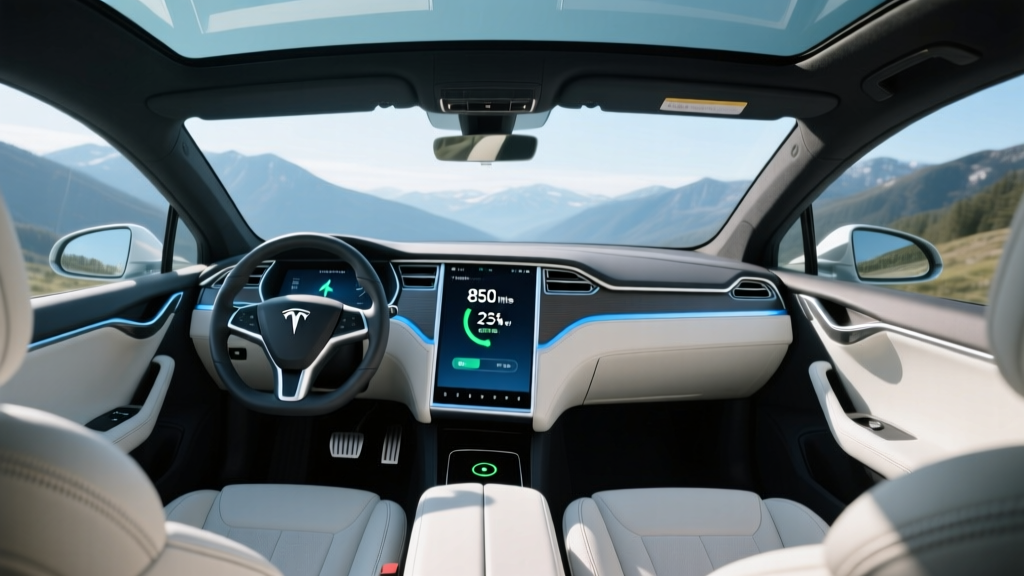
The Model X interior was comprehensively refreshed for the 2023 model year and carries over into 2026. The yoke steering wheel remains standard (a conventional round wheel is available as a no-cost option), and the 17-inch center touchscreen with 22-speaker audio system anchors the dashboard. A second-row 8-inch touchscreen gives rear passengers climate and media control.
Passenger and cargo dimensions:
- Seating: 5, 6, or 7 passengers (6-seat with second-row captains chairs is the most popular configuration)
- Front headroom: 40.5 inches
- Second-row legroom: 40.9 inches
- Third-row legroom: 32.7 inches (best for children or short trips)
- Cargo behind 3rd row: ~15.3 cu ft
- Cargo behind 2nd row (3rd row folded): ~41.1 cu ft
- Max cargo (all rear seats folded): ~77.5 cu ft
- Front trunk (frunk): ~6.5 cu ft
The falcon-wing rear doors are the Model X's signature feature. They articulate upward on double hinges, creating a massive opening that makes loading car seats and accessing the third row genuinely easier than any conventional SUV door. However, they require roughly 12 inches of lateral clearance and full overhead clearance—low-ceiling garages and tight parking structures can trigger the ultrasonic sensors to limit opening arc, which occasionally leads to awkward partial-open positions.
Build quality on 2025-2026 Model X units has improved noticeably from early-production complaints, though panel-gap consistency still trails what you'll find on a BMW iX or Mercedes EQS SUV at this price point.
Performance: 670 HP Standard, 1,020 HP If You Want Plaid
The dual-motor Long Range Model X produces 670 horsepower and hits 0-60 mph in 3.8 seconds—a number that still astonishes for a 5,185-pound three-row SUV. The tri-motor Plaid variant (1,020 hp, 2.5 seconds to 60 mph) exists in a category of its own, outrunning most supercars while carrying seven people and their luggage.
Both variants use Tesla's adaptive air suspension, which adjusts ride height based on speed and terrain. The system provides up to 8.2 inches of ground clearance in its highest setting, adequate for light trail use and snow. The Model X is rated to tow 5,000 pounds, making it viable for a small boat or utility trailer, though towing at capacity will cut range roughly in half—plan for ~160-170 miles between charges when pulling a loaded trailer.
Regenerative braking is strong and predictable. Tesla's one-pedal driving mode (when set to "Hold") brings the vehicle to a complete stop without touching the brake pedal, reducing brake wear significantly in daily driving.
Pricing, Trims, and Federal Tax Credit Eligibility
| Trim | Base MSRP | Destination | Typical As-Tested | §30D Credit Eligible? |
|---|---|---|---|---|
| Long Range (Dual Motor) | $79,990 | $1,995 | $82,000-$92,000 | No — exceeds MSRP cap |
| Plaid (Tri-Motor) | $94,990 | $1,995 | $97,000-$110,000 | No — exceeds MSRP cap |
Under current IRS §30D rules, the new clean vehicle credit has an MSRP cap of $80,000 for SUVs, vans, and pickup trucks. The Model X Long Range's base MSRP of $79,990 sits tantalizingly close to that threshold, but once destination charges and any options are added, the vehicle's total MSRP exceeds the cap, making it ineligible for the $7,500 federal credit. The Plaid, at $94,990 base, is well above the limit.
Additionally, §30D imposes buyer income caps ($300,000 MFJ / $150,000 single) and battery critical-mineral and component sourcing requirements that shift annually. Even if the MSRP math worked, the Model X's battery sourcing has historically not met the escalating thresholds. Buyers should consult a tax professional for their specific situation rather than assuming credit eligibility.
State incentives may apply. Several states (California, Colorado, Massachusetts, and others) offer their own EV rebates or tax credits with different MSRP and income rules. Check your state's energy office or DMV for current programs.
Autopilot, FSD Supervised, and Safety Technology
Every 2026 Model X ships with Tesla's Basic Autopilot, which includes Traffic-Aware Cruise Control and Autosteer (lane centering). The optional Full Self-Driving (Supervised) package, currently priced at $8,000 upfront or $99/month, adds automatic lane changes, Navigate on Autopilot (highway on/off-ramp routing), Autopark, and Smart Summon.
FSD (Supervised) has improved substantially in its v12.x neural-network-driven architecture, handling complex urban intersections and unprotected left turns with increasing competence. However, it still requires active monitoring, can misinterpret construction zones, and occasionally makes conservative decisions that frustrate other drivers. It is a driver-assist system, not a replacement for an attentive human.
The Model X earned a 5-star overall rating from NHTSA and has historically performed well in IIHS testing. Standard active safety includes automatic emergency braking, blind-spot monitoring, lane departure warning, and the cabin-facing driver-attention camera.
Pros, Cons, and Who Should Buy the Model X
- Class-leading 335-mile EPA range for a 3-row EV
- Access to the Tesla Supercharger network (20,000+ stalls in North America)
- Falcon-wing doors ease car-seat and 3rd-row access
- 5,000-lb towing capacity with integrated trailer brake controller option
- Continuous OTA software updates add features post-purchase
- Proven powertrain with 8yr/150,000mi battery warranty
- No federal tax credit due to MSRP cap
- Base price nearing $82K with destination
- Third row is tight for adults on long trips
- Panel gaps and interior material quality trail German rivals at this price
- Falcon wings can struggle in tight garages and low ceilings
- Plaid trim is expensive and range drops to 326 mi
Best for: Families who need three rows, value maximum range, road-trip frequently (Supercharger access is a genuine advantage on cross-country drives), and want the option to tow. The Model X is also one of the few luxury EVs that can carry 6-7 passengers and still deliver over 300 miles per charge.
Consider alternatives if: You prioritize interior material quality (BMW iX, Mercedes EQS SUV), need a genuinely adult-friendly third row (Rivian R1S, Kia EV9), or want to maximize federal and state incentives (which the Model X does not qualify for at the federal level).
Frequently Asked Questions
What is the real-world range of the Tesla Model X?
The EPA rates the Long Range at 335 miles and the Plaid at 326 miles. In real-world highway driving at 70-80 mph, expect 270-290 miles. In cold weather (below 32°F), range can drop to 235-260 miles unless you precondition the battery while plugged in. For mixed city/highway commuting in moderate temperatures, 300+ miles is achievable.
How fast does the Model X charge at home and on the road?
On a 240V Level 2 home charger (48A), the Model X adds ~44 miles of range per hour, fully recharging overnight in about 9-10 hours. On a Tesla V3 Supercharger (250 kW peak), a 10-80% session takes approximately 31 minutes. Charging slows significantly above 80% to protect battery health, so plan to unplug at 80% on road trips unless you need the full capacity.
Does the Tesla Model X qualify for the federal EV tax credit?
No. Under current IRS §30D rules, new EV SUVs must have an MSRP at or below $80,000 to qualify. The Model X Long Range starts at $79,990 before the $1,995 destination charge, pushing it over the cap. The Plaid at $94,990 is well above it. Additionally, battery sourcing requirements further complicate eligibility. State-level incentives may still apply depending on where you live.
Is the Model X worth buying over the Rivian R1S or BMW iX?
It depends on your priorities. The Model X wins on range (335 mi vs. R1S's ~352 mi with Max Pack but at a higher price, and BMW iX's ~324 mi), Supercharger network access, and falcon-wing convenience. The Rivian R1S offers a more rugged design, better off-road capability, and a more adult-friendly third row. The BMW iX delivers a notably more luxurious interior with higher-quality materials. If Supercharger reliability on road trips is your top concern, the Model X retains an edge.
How much does it cost to charge a Model X at home?
At the US average residential electricity rate of ~$0.16/kWh, fully charging the ~100 kWh battery from empty costs roughly $16. For a typical 40-mile daily commute consuming ~13 kWh, daily home charging costs about $2.08—roughly 80% less than an equivalent gasoline SUV getting 20 MPG at $3.50/gallon.
What is the battery warranty on the Model X?
Tesla covers the Model X battery and drive units for 8 years or 150,000 miles, whichever comes first, with a guaranteed minimum 70% capacity retention over that period. Tesla's NMC batteries have demonstrated strong longevity in fleet data, with most vehicles retaining 85-90% capacity at 100,000 miles when following recommended charging practices (daily charge to 80-90%, occasional 100% for trips).