The GVWR Question That Changes Everything for Model X Buyers
If you've been researching the Tesla Model X and stumbled across searches about its Gross Vehicle Weight Rating (GVWR), you're not alone. The phrase "Tesla Model X GVWR 6000 pounds" has become a hot search query among EV shoppers — and for good reason. Under IRS §30D rules, the GVWR of an electric vehicle determines which MSRP cap applies for federal tax credit eligibility. Vehicles rated above 6,000 lbs fall under the $80,000 MSRP cap for SUVs, pickup trucks, and vans, rather than the $55,000 cap for sedans. The Tesla Model X, with a GVWR that sits at or just above that critical threshold, benefits from this classification.
But the tax credit question is only one piece of the puzzle. The 2026 Tesla Model X remains one of the most capable — and most expensive — three-row electric SUVs on the market. Let's walk through every number that matters: range, charging, performance, space, and the real cost of ownership after incentives.
2026 Tesla Model X: Core Specifications at a Glance
| Specification | Model X Long Range | Model X Plaid |
|---|---|---|
| EPA Range | 335 miles | 326 miles |
| Battery (usable) | ~100 kWh (NMC) | ~100 kWh (NMC) |
| Drivetrain | Dual-Motor AWD | Tri-Motor AWD |
| Horsepower | 670 hp | 1,020 hp |
| 0-60 mph | 3.8 sec | 2.5 sec |
| Max DC Fast Charge | 250 kW | 250 kW |
| 10-80% DC Charge | ~30 min | ~30 min |
| Level 2 Charge Rate | 11.5 kW (~34 mi/hr) | 11.5 kW (~34 mi/hr) |
| MPGe (combined) | 102 MPGe | 98 MPGe |
| Efficiency | 33 kWh/100 mi | 34 kWh/100 mi |
| GVWR | ~6,100 lbs | ~6,200 lbs |
| Towing Capacity | 5,000 lbs | 5,000 lbs |
| Cargo (behind 3rd row) | 37.1 cu ft | 37.1 cu ft |
| Cargo (max, seats folded) | 85.1 cu ft | 85.1 cu ft |
| Base MSRP | $79,990 | $94,990 |
| Battery Warranty | 8 yr / 150,000 mi | 8 yr / 150,000 mi |
Source: fueleconomy.gov and Tesla's official specifications page. Pricing reflects 2026 model year MSRP before destination fees.
Real-World Range: What the EPA Sticker Doesn't Tell You
The Long Range Model X carries an EPA-estimated 335 miles of range, while the Plaid drops slightly to 326 miles. In real-world driving, expect:
- Mixed city/suburban: 300-320 miles — regenerative braking helps recover energy in stop-and-go traffic
- Highway (70-80 mph sustained): 260-285 miles — aerodynamic drag dominates at speed, and the Model X's large frontal area hurts efficiency
- Cold weather (below 32°F): 220-260 miles — NMC chemistry loses 20-30% in freezing temps, even with Tesla's heat pump and battery preconditioning
On a 300-mile road trip at 75 mph in 40°F weather, plan for at least one charging stop. The onboard navigation's range estimator is generally accurate within 5-8%, but always budget a 10% buffer for headwinds, elevation, and HVAC use.
The ~100 kWh NMC (nickel manganese cobalt) battery pack provides substantial energy density but is more susceptible to cold-weather losses than LFP chemistry. Tesla's thermal management system with a heat pump mitigates this to some degree, but physics wins in sub-freezing conditions. Preconditioning the battery before a DC fast-charge stop is essential — skip it and your peak charge rate may drop from 250 kW to under 100 kW.
Charging Speed: DC Fast, Level 2, and the Curve Reality
Charging a 100 kWh battery isn't instantaneous, and understanding the charge curve is critical for trip planning.
| Charging Level | Power (kW) | Speed (miles/hr) | Notes |
|---|---|---|---|
| Level 1 (120V) | 1.4 kW | ~4 mi/hr | Emergency/trickle only; full charge takes ~70+ hours |
| Level 2 (240V, 48A) | 11.5 kW | ~34 mi/hr | Full charge in ~9 hours; ideal overnight home charging |
| DC Fast (V3 Supercharger) | Peak 250 kW | Up to 175 mi/hr at peak | 10-80% in ~30 min; tapers significantly above 80% |
| DC Fast (V4 Supercharger) | Peak 250 kW* | Similar to V3 | *Model X limited to 250 kW; does not reach V4's higher architecture |
The critical detail many spec sheets omit: peak kW is not sustained kW. The Model X hits 250 kW only briefly between roughly 15-35% state of charge. From 35-60%, it typically sustains 150-180 kW. From 60-80%, expect 80-120 kW. Above 80%, charging slows dramatically to protect battery health — a 80-100% top-off can add another 25-35 minutes.
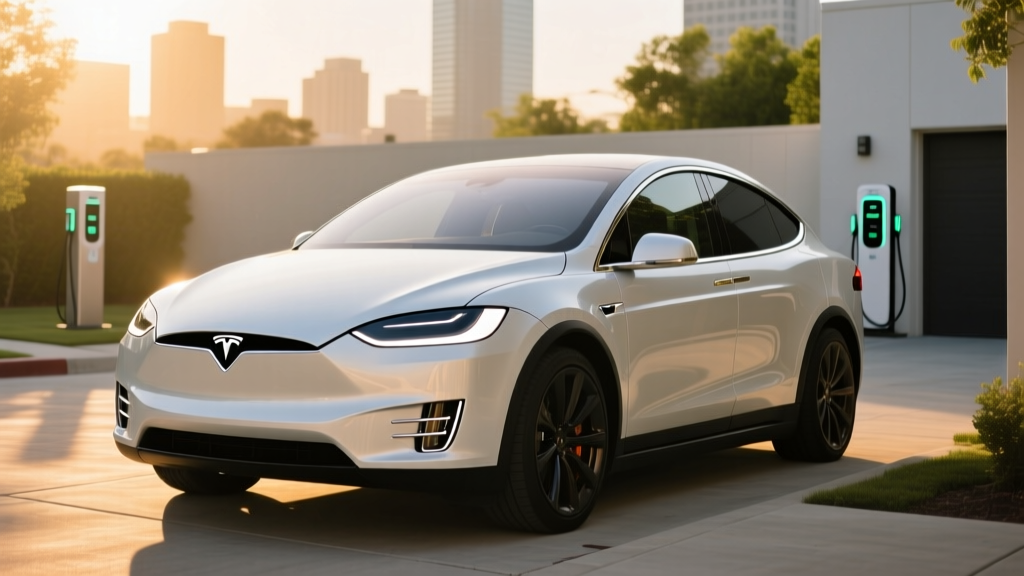
For home charging, Tesla's Wall Connector at 48 amps on a 60-amp circuit delivers 11.5 kW, adding about 34 miles of range per hour. A full charge from 10% takes roughly 9 hours. Most owners who charge nightly at home rarely visit a public charger except on road trips. Installation of a 240V/60A circuit typically costs $800-$2,500 depending on panel proximity and local permit requirements — budget for a potential panel upgrade if your home has a 100-amp service.
Performance, Tech, and the Falcon Wing Reality
The Model X Long Range delivers 670 horsepower through a dual-motor AWD system, reaching 0-60 mph in 3.8 seconds — remarkable for a three-row SUV weighing over 5,000 pounds. The Plaid variant's tri-motor setup produces 1,020 hp and a 2.5-second 0-60 time, making it one of the quickest production SUVs ever built.
Ride quality benefits from standard adaptive air suspension, which adjusts ride height automatically based on speed and GPS-remembered locations. The cabin is dominated by a 17-inch center touchscreen running Tesla's latest software, with a rear-seat entertainment display and an available yoke-style steering wheel.
Driver Assistance (SAE Level 2): Tesla's Autopilot comes standard and includes adaptive cruise control, lane centering, and automatic emergency braking. Full Self-Driving (Supervised) — currently a $8,000 add-on or $99/month subscription — adds automated lane changes, traffic light recognition, and city street navigation. Despite the name, FSD is SAE Level 2, meaning the driver must remain fully attentive with hands on the wheel at all times. It is not autonomous driving.
Tesla's Full Self-Driving is a Level 2 driver-assist system. The driver is legally responsible for all vehicle operation. FSD can make errors at construction zones, unmapped intersections, and in heavy rain or snow. Never treat it as a substitute for an engaged driver.
The signature Falcon Wing rear doors are the Model X's most polarizing feature. They provide outstanding access to the second and third rows in tight parking spaces (they need only ~12 inches of side clearance), but the hydraulic mechanisms add weight, complexity, and occasional reliability concerns. Owners report occasional sensor calibration issues and slower open/close times compared to conventional doors.
Pricing, Tax Credits, and the GVWR Advantage Explained
Here's where the "Tesla Model X GVWR 6000 pounds" search query pays off. Under IRS §30D rules, the federal tax credit has different MSRP caps depending on vehicle classification:
- Sedans: MSRP cap of $55,000
- SUVs, pickups, vans (GVWR above 6,000 lbs): MSRP cap of $80,000
The Model X, with a GVWR of approximately 6,100-6,200 lbs (depending on trim and configuration), classifies as an SUV under the §30D framework. This means the Long Range at $79,990 MSRP falls under the $80,000 cap and is potentially eligible for the full $7,500 federal tax credit — assuming the buyer meets income requirements and the vehicle's battery sourcing complies with critical-mineral and component rules.
| Trim | Base MSRP | Est. Destination | Max §30D Credit | Est. Net Price* |
|---|---|---|---|---|
| Long Range | $79,990 | $1,990 | $7,500 | ~$74,480 |
| Plaid | $94,990 | $1,990 | $0 (exceeds $80K cap) | ~$96,980 |
*Net price assumes full credit eligibility. Actual credit depends on battery sourcing compliance and buyer income. The Plaid's MSRP exceeds the $80,000 SUV cap and does not qualify for §30D.
- Vehicle MSRP ≤ $80,000 (SUV classification, GVWR > 6,000 lbs) — Long Range qualifies; Plaid does not
- Buyer MAGI ≤ $300,000 (joint) / $225,000 (head of household) / $150,000 (single)
- Battery components must meet North American manufacturing thresholds (increasing yearly)
- Critical minerals must meet sourcing thresholds from FTA countries (increasing yearly)
- Credit can be transferred to the dealer at point of sale as a purchase-price reduction
- Vehicle must be new, purchased for personal use, and primarily used in the U.S.
Rules are subject to change. Consult a tax professional and verify current sourcing compliance at irs.gov before purchasing.
Who Should Buy the Model X — and Who Should Look Elsewhere
The Model X occupies a narrow niche: buyers who need three rows, want electric, value Supercharger access, and can spend $75,000-$100,000+. Here's a decision framework:
- You need three-row seating with genuine adult-size third-row space and easy Falcon Wing access
- You tow up to 5,000 lbs and want a capable electric tow vehicle
- Supercharger network reliability is a priority for frequent road trips
- You want 335 miles of range with AWD and 670+ hp in a family SUV
- You only need two rows — the Model Y, Rivian R1S, or Hyundai Ioniq 9 offer better value
- Budget is under $65,000 — consider the Kia EV9 or a used Model X
- You want the latest interior design — the Model X cabin dates to its 2021 refresh
- Charging speed is paramount — newer 800V architectures (Hyundai/Kia, Lucid) charge faster
Pros and Cons: The Honest Assessment
- Class-leading 335-mile EPA range for a three-row electric SUV
- Supercharger network access — the most reliable DC fast-charging ecosystem in North America
- Falcon Wing doors provide unmatched third-row access in tight spaces
- 5,000-lb towing capacity with integrated trailer brake controller option
- Long Range trim qualifies for $7,500 §30D credit (subject to sourcing/income rules)
- 8-year/150,000-mile battery warranty with 70% minimum retention guarantee
- Over-the-air updates continuously add features and improvements
- Plaid trim exceeds $80K MSRP cap — no federal tax credit
- 250 kW peak charge rate trails 800V competitors (Hyundai Ioniq 9 peaks ~350 kW)
- Falcon Wing doors add complexity, weight, and potential maintenance cost
- Interior design and materials feel dated vs. newer luxury EV SUVs
- Yoke steering wheel is polarizing and not ideal for low-speed maneuvering
- High insurance premiums — expect $2,500-$4,000/year depending on state and driving record
- Highway real-world range drops to ~260-285 miles — plan road trips accordingly
Frequently Asked Questions
What is the real-world range of the Tesla Model X?
The EPA estimates 335 miles for the Long Range and 326 miles for the Plaid. Real-world mixed driving typically yields 300-320 miles. Sustained highway driving at 75+ mph drops range to 260-285 miles. In freezing temperatures, expect 220-260 miles due to NMC battery chemistry losses and cabin heating demands.
How fast does the Model X charge at home and on DC fast chargers?
On a Level 2 home charger (240V, 48A), the Model X charges at 11.5 kW, adding about 34 miles per hour — a full charge takes roughly 9 hours. On a Tesla V3 Supercharger, it peaks at 250 kW and charges from 10-80% in approximately 30 minutes, though the charge curve tapers significantly above 60% SoC.
Does the Tesla Model X qualify for the federal EV tax credit?
The Long Range trim at $79,990 MSRP qualifies under the $80,000 SUV cap (enabled by its GVWR above 6,000 lbs), assuming the buyer's income is within §30D limits and the vehicle's battery meets critical-mineral and component sourcing thresholds for 2026. The Plaid at $94,990 exceeds the MSRP cap and does not qualify. Always verify current eligibility at irs.gov.
Is the Model X worth buying vs. the Kia EV9 or Rivian R1S?
The Model X wins on range (335 mi vs. EV9's ~304 mi), Supercharger access, and performance. The Kia EV9 starts ~$20,000 lower and offers 800V fast charging. The Rivian R1S offers superior off-road capability, a more modern interior, and a lower starting price. If Supercharger reliability and maximum range are your top priorities, the Model X holds an edge. If value or interior freshness matters more, test-drive the EV9 and R1S.
What is the battery warranty on the Model X?
Tesla covers the Model X battery and drive unit for 8 years or 150,000 miles, whichever comes first, with a guaranteed minimum 70% capacity retention. This is one of the more generous battery warranties in the industry and reflects the durability of Tesla's NMC pack design with active thermal management.
Can the Model X tow, and does towing affect range?
Yes, the Model X is rated to tow up to 5,000 lbs. However, towing a loaded trailer can reduce range by 30-50% depending on trailer weight, aerodynamics, and terrain. Plan for significantly more frequent charging stops when towing, and use Tesla's trip planner with the trailer profile enabled.