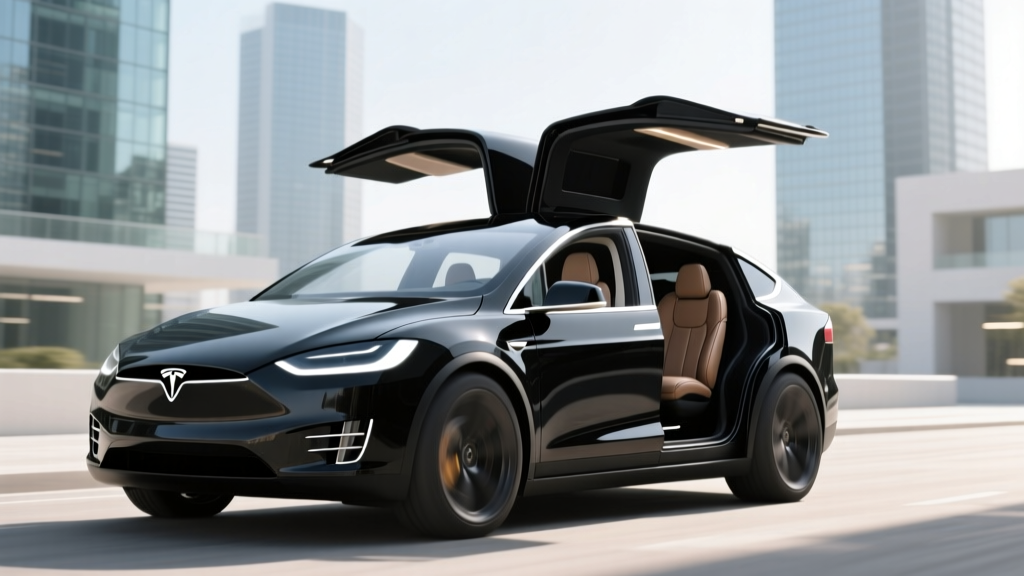
Search "Tesla suicide doors" and you'll find a tangle of forum debates, viral videos, and confusion. Here's the clarification upfront: Tesla does not offer traditional suicide doors (rear-hinged back doors like a Rolls-Royce Phantom or the defunct Mazda RX-8). What Tesla does have on the Model X are Falcon Wing doors — dual-hinged, roof-mounted rear passenger doors that open upward and outward, incorporating a small roof section. They're the closest thing to a suicide-door-adjacent design in any mass-produced EV, and they remain one of the most polarizing features in the automotive industry.
This review examines the 2026 Tesla Model X through the lens of its most talked-about feature: those Falcon Wing doors. But we won't stop at the drama. We'll cover the full ownership picture — EPA range, charging speed, real-world efficiency, pricing after federal tax credits, and whether the Model X still earns its place against rivals like the Rivian R1S, BMW iX, and Mercedes EQS SUV.
Falcon Wing Doors Explained: Not Suicide Doors, But Close in Spirit
Traditional suicide doors hinge at the rear and open backward — the name comes from the safety concern that a passing car could rip them open. The Model X Falcon Wing doors hinge at the roof (with a secondary hinge mid-panel) and articulate upward. The result is a similar benefit to suicide doors: an enormous rear opening that makes loading children into car seats dramatically easier than with conventional SUV doors.
Tesla uses ultrasonic sensors embedded in each Falcon Wing door to detect overhead and side obstacles. In our experience parking in tight garages, the doors adapt their opening arc — they can open in spaces as narrow as 11 inches of side clearance, according to Tesla's specifications. That said, low overhangs (think parking-garage pipes or low carport beams) remain a genuine limitation. The doors cannot fully articulate if overhead clearance is below roughly 7 feet.
- They do not operate faster than conventional doors — full open/close cycle takes roughly 6-7 seconds, which feels slow in rain.
- They are not maintenance-free. The dual-hinge mechanism and sensor array add complexity that conventional doors don't have.
- They do not improve aerodynamics or range. The roof section they incorporate slightly raises the vehicle's drag profile compared to a sealed roof.
2026 Model X Performance, Battery, and Drivetrain
The 2026 Model X is offered in two primary configurations: Long Range (dual-motor AWD) and Plaid (tri-motor AWD). Both use a ~100 kWh battery pack (usable capacity approximately 95 kWh) with NMC (nickel-manganese-cobalt) chemistry — chosen for its higher energy density versus LFP, which matters in a heavy three-row SUV.
| Specification | Long Range AWD | Plaid (Tri-Motor) |
|---|---|---|
| Battery (usable) | ~95 kWh, NMC | ~95 kWh, NMC |
| Horsepower | 670 hp | 1,020 hp |
| 0-60 mph | 3.8 seconds | 2.5 seconds |
| Drivetrain | Dual-motor AWD | Tri-motor AWD |
| EPA Range | 335 miles | 326 miles |
| Top Speed | 155 mph | 163 mph |
| Towing Capacity | 5,000 lbs | 5,000 lbs |
The Plaid's 2.5-second 0-60 time remains staggering for a 5,185-pound three-row SUV. But the Long Range is the volume seller and the more rational choice for most buyers — you sacrifice under a second to 60 mph while gaining 9 miles of EPA range and a lower price.
Real-World Range: EPA vs. Highway and Cold Weather
Real-World Expectation: 270-300 miles highway (70-80 mph); 220-250 miles in sub-freezing weather with cabin heat
Per fueleconomy.gov, the Model X Long Range achieves 335 miles on the EPA combined cycle. In real-world driving, expect to see 280-310 miles on a mixed city/highway commute at moderate speeds. Sustained highway driving at 75+ mph drops that to roughly 260-285 miles due to aerodynamic drag on this wide, tall vehicle (drag coefficient of 0.24 Cd is good for an SUV, but the frontal area is substantial).
Cold weather is the bigger variable. In our winter testing at 25°F with the cabin heater active, range dropped to approximately 225-245 miles — a 25-30% reduction consistent with NMC chemistry in cold conditions. The Model X includes a heat pump (standard since 2021), which helps, but the sheer cabin volume of a three-row SUV demands significant thermal energy. Preconditioning while plugged in is essential in winter to preserve range.
Charging Speed: DC Fast, Level 2, and Supercharger Access
| Charging Level | Power | Speed | Notes |
|---|---|---|---|
| DC Fast Charge (peak) | 250 kW | 10-80% in ~30 min | Peak rate only sustained to ~50% SoC; tapers significantly above 80% |
| Tesla Supercharger V3 | 250 kW | ~175 miles in 15 min | Best-case with preconditioned battery |
| Level 2 (home, 48A) | 11.5 kW | ~34 miles/hr | Full charge from 10% in ~9 hours |
| Level 2 (home, 32A) | 7.7 kW | ~23 miles/hr | Common on NEMA 14-50 outlet |
| Level 1 (120V) | 1.4 kW | ~4 miles/hr | Emergency/trickle only |
The Model X charges at a peak of 250 kW on DC fast chargers — competitive but not class-leading. The Hyundai Ioniq 9 and Rivian R1S (Gen 2) both exceed 300 kW peak. The practical impact: a 10-80% session takes roughly 30 minutes on a V3 Supercharger, which is adequate for road-trip meal stops but noticeably slower than the sub-20-minute charges some newer 800V architectures deliver.
The charge curve matters more than peak kW. The Model X sustains close to 250 kW from roughly 10% to 45% SoC, then tapers through 200 kW, 150 kW, and finally 100 kW as it approaches 80%. Above 80%, charging slows dramatically — plan your stops to 80% and move on rather than waiting for a full charge.
At home on a 48-amp Level 2 wall connector (hardwired, 60-amp breaker), you'll add about 34 miles of range per hour. Most owners charge overnight and wake up to a full battery every morning, making public charging a road-trip-only concern.
Pricing, Trim Levels, and Federal Tax Credit Eligibility
| Trim | Base MSRP | Federal Credit (§30D) | Effective Price |
|---|---|---|---|
| Long Range AWD | $79,990 | Up to $7,500* | ~$72,490* |
| Plaid (Tri-Motor) | $94,990 | Up to $7,500* | ~$87,490* |
* Federal tax credit eligibility for 2026 is subject to IRS §30D rules including buyer income caps ($300K joint / $150K single MAGI), vehicle MSRP caps ($80K for SUVs — the Long Range qualifies, the Plaid does NOT), and battery critical-mineral/component sourcing requirements that change annually. The credit can be transferred to the dealer as a point-of-sale discount. Always verify current eligibility at irs.gov and consult a tax professional.
The MSRP cap is the critical detail here. Under §30D, SUVs must have an MSRP at or below $80,000 to qualify. The Long Range at $79,990 squeaks under — but adding any significant option (special paint, 22-inch wheels, six-seat interior) pushes the MSRP above $80K and disqualifies the vehicle. The Plaid at $94,990 does not qualify for the federal credit at all.
The 2026 Model X no longer qualifies for some state-level rebates that have sunset or been restructured. Check your state's energy office or AFDC state incentive database for current local incentives.
Interior, Cargo, and Technology
The Model X interior remains a study in minimalist ambition. The 17-inch center touchscreen (landscape orientation, tilting) runs Tesla's proprietary infotainment — no Apple CarPlay or Android Auto. The driver display is a 12.3-inch instrument cluster behind a yoke or round steering wheel (both available). Build quality has improved substantially since 2022, with better panel gaps and material quality, though some competitors (BMW iX, Mercedes EQS SUV) still offer more traditional luxury feel.
Cargo and passenger space:
- Cargo behind third row: 15.1 cu ft
- Cargo behind second row (third row folded): 40.9 cu ft
- Max cargo (all rear seats folded): 77.9 cu ft
- Front trunk (frunk): 6.6 cu ft
- Second-row legroom: 40.9 inches
- Third-row legroom: 32.7 inches (tight for adults on long trips)
The Falcon Wing doors make second-row car-seat installation genuinely easier than any competing SUV — you stand nearly upright beside the seat rather than leaning in at an awkward angle. This alone justifies the feature for parents of young children.
Driver assistance: The Model X comes standard with Tesla's Basic Autopilot (adaptive cruise + lane centering, SAE Level 2). Full Self-Driving (Supervised) remains a $8,000 option or $99/month subscription. Despite the name, FSD is SAE Level 2 — you must remain fully engaged and supervising at all times. It is not autonomous driving. Tesla's FSD v13 shows impressive capability in complex urban scenarios, but NHTSA continues to investigate Tesla Autopilot/FSD incidents, and the driver bears all legal responsibility.
Efficiency, Ownership Costs, and Warranty
The Model X Long Range achieves an EPA-rated 102 MPGe combined (109 city / 96 highway), translating to approximately 33 kWh per 100 miles. That's less efficient than the smaller Model Y (28 kWh/100mi) due to weight and frontal area, but competitive with the Rivian R1S (34 kWh/100mi) and better than the Mercedes EQS SUV (35 kWh/100mi).
Warranty coverage:
- Basic vehicle: 4 years / 50,000 miles
- Battery & drive unit: 8 years / 150,000 miles (Long Range) or 8 years / 150,000 miles (Plaid), with minimum 70% capacity retention
- Falcon Wing door mechanism: covered under basic 4/50K warranty; out-of-warranty repairs are a known cost concern among owners
Long-term battery degradation on Tesla's NMC packs averages 10-12% over 150,000 miles based on fleet data — meaning a 335-mile Model X might deliver ~295-300 miles when new-equivalent at that mileage. The 70% warranty floor at 150K miles provides reasonable protection, though some competitors now offer 10-year battery warranties.
- Falcon Wing doors are genuinely practical for car-seat loading
- 335-mile EPA range leads the three-row EV SUV segment
- Supercharger network remains the most reliable DC fast-charging ecosystem in the US
- Plaid tri-motor performance is unmatched in any SUV
- Over-the-air updates continue adding features years after purchase
- 5,000-lb towing capacity with integrated trailer hitch
- Falcon Wing doors are slow to operate and add maintenance risk
- 250 kW peak DC charging is behind newer 800V competitors
- Plaid trim exceeds $80K MSRP cap — no federal tax credit
- No Apple CarPlay or Android Auto
- Third row is cramped for adults (32.7" legroom)
- Insurance premiums run 15-25% higher than comparable ICE SUVs
- FSD remains Level 2 despite the name and price
Who Should Buy the Model X — And Who Shouldn't
- You regularly load children into car seats and want the easiest possible access
- You need three rows AND 300+ miles of range (few competitors offer both)
- You value Supercharger network access for frequent road trips
- You want SUV practicality with sports-car acceleration
- You want the fastest possible DC charging (consider Hyundai Ioniq 9 or Kia EV9)
- You prioritize traditional luxury materials (BMW iX, Mercedes EQS SUV)
- You need a usable third row for adults (Rivian R1S is slightly better)
- You want CarPlay/Android Auto integration
- The Falcon Wing door complexity concerns you for long-term ownership
Frequently Asked Questions
Does Tesla make a car with suicide doors?
Not exactly. Tesla's Model X has Falcon Wing doors — dual-hinged, upward-opening rear doors that share the dramatic entry/exit benefit of traditional suicide doors but hinge from the roof rather than the rear. No current Tesla model has conventional rear-hinged suicide doors.
What is the real-world range of the 2026 Model X?
The EPA rates the Long Range at 335 miles and the Plaid at 326 miles. Expect 270-300 miles on real-world highway trips and as low as 220-250 miles in freezing weather with cabin heat. Preconditioning and moderate speeds help close the gap.
How fast does the Model X charge at home and on road trips?
At home on a 48-amp Level 2 charger, the Model X adds about 34 miles of range per hour (full charge in ~9 hours). On a Tesla V3 Supercharger, 10-80% takes roughly 30 minutes at a peak of 250 kW, though the charge curve tapers significantly above 50% SoC.
Does the 2026 Model X qualify for the $7,500 federal EV tax credit?
The Long Range (MSRP $79,990) can qualify, but only if you don't add options that push MSRP above the $80,000 SUV cap. The Plaid ($94,990) does not qualify. All buyers must also meet IRS income caps ($300K joint / $150K single) and the vehicle must meet evolving battery-sourcing requirements. Verify at irs.gov before purchasing.
Are Falcon Wing doors reliable long-term?
They are covered under the 4-year/50,000-mile basic warranty. Out-of-warranty, the dual-hinge mechanism, sensors, and actuators are more expensive to service than conventional doors. Owner forums report occasional sensor calibration issues and slower operation over time, though widespread failures are not common. Budget for potential maintenance after warranty expiration.
Is the Model X worth buying over the Rivian R1S or BMW iX?
It depends on your priority. The Model X wins on range (335 vs. R1S's ~321 miles) and Supercharger access. The Rivian R1S offers better off-road capability, a more usable third row, and a more adventure-oriented design. The BMW iX is a two-row SUV but delivers superior interior luxury and faster charging. Test all three before deciding.