The Tesla Model X remains one of the most polarizing electric SUVs on the market, and much of that conversation centers on a single feature: its doors. The rear Falcon Wing doors — double-hinged, sensor-laden, and undeniably theatrical — have defined the Model X since its 2015 debut. For the 2026 model year, Tesla continues to refine the platform with updated battery chemistry, faster charging, and revised pricing. But do the Falcon Wing doors hold up in daily ownership, and does the rest of the package justify a six-figure MSRP? This review breaks down every spec that matters.
Spec Table: 2026 Tesla Model X at a Glance
| Spec | Model X Long Range | Model X Plaid |
|---|---|---|
| EPA Range | 348 miles | 320 miles |
| Battery (usable) | ~100 kWh (NMC) | ~100 kWh (NMC) |
| Drivetrain | Dual-Motor AWD | Tri-Motor AWD |
| Horsepower | 670 hp | 1,020 hp |
| 0-60 mph | 3.8 seconds | 2.5 seconds |
| Peak DC Fast Charge | 250 kW | 250 kW |
| 10-80% DCFC Time | ~28 minutes | ~28 minutes |
| Level 2 Home Charge | 11.5 kW (~34 mi/hr) | 11.5 kW (~34 mi/hr) |
| MPGe (combined) | 109 MPGe | 101 MPGe |
| Efficiency | 31 kWh/100 mi | 33 kWh/100 mi |
| Seating | 5, 6, or 7 passengers | 5 or 6 passengers |
| Cargo (behind 3rd row) | 15.0 cu ft | 15.0 cu ft |
| Cargo (max, seats folded) | 85.1 cu ft | 85.1 cu ft |
| Base MSRP | $81,630 | $96,630 |
| Battery/Drive Warranty | 8 yr / 150,000 mi | 8 yr / 150,000 mi |
Sources: fueleconomy.gov, Tesla.com specifications (2026 model year). Prices reflect destination charge; excludes options.
The Falcon Wing Doors: Engineering, Practicality, and Known Issues
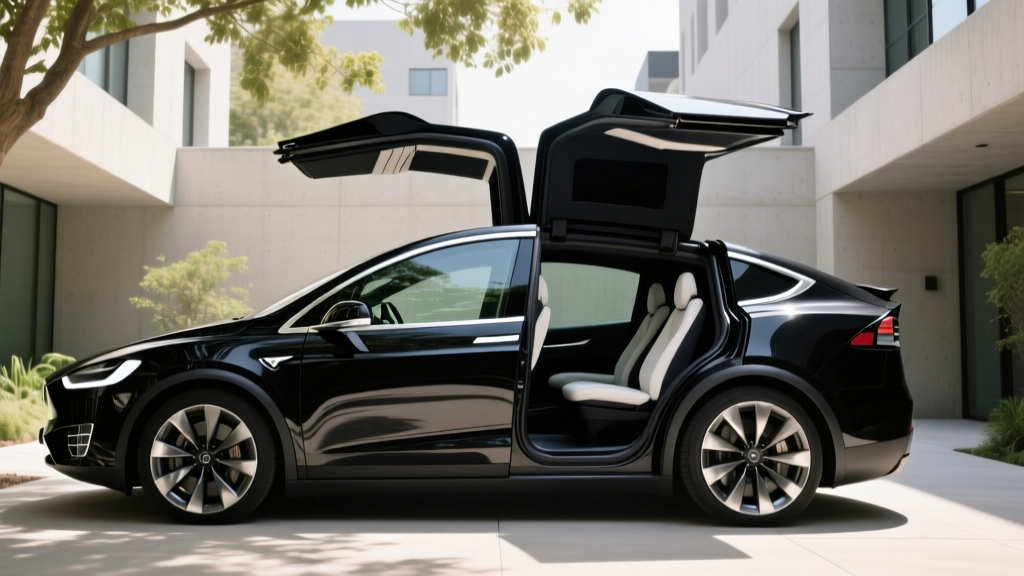
Let's address the keyword topic directly. The Tesla Model X doors are unlike anything else in production. The front doors are conventional power units with auto-present handles, but the rear Falcon Wing doors are the headline act. They are double-hinged — bending at a midpoint joint — and use ultrasonic sensors to detect overhead and side obstacles before articulating upward and outward.
What the Falcon Wing Doors Do Well
- Parking-lot access: In tight spaces where a sliding minivan door isn't available, the Falcon Wing doors open vertically, requiring only about 12 inches of lateral clearance on each side. Parents loading children into car seats consistently cite this as the single best feature of the Model X.
- Headroom on entry: Because the door sweeps upward, adults can stand nearly upright while reaching into the second or third row — a genuine ergonomic advantage over conventional SUVs.
- Weather protection: The upward sweep provides partial overhead shelter during rain when loading passengers.
Where the Model X Doors Fall Short
- Low-clearance garages: The Falcon Wing doors require approximately 72 inches of vertical clearance to open fully. In older garages with low ceilings or hanging storage racks, the doors will partially open or refuse to open. Tesla's sensors detect the obstruction, but the workaround is a slower, partial-open cycle.
- Snow and ice accumulation: In winter climates, ice can form along the upper hinge and seal. Tesla has improved the seal heating elements since the 2022 refresh, but owners in sub-freezing regions still report occasional frozen hinges that require manual de-icing.
- Speed of operation: A full open-close cycle takes roughly 6-8 seconds. That's slower than a conventional door, and in a drive-through or quick-stop scenario, it can feel deliberate.
- Repair cost: Out-of-warranty Falcon Wing door actuator replacement runs approximately $1,500–$2,500 per side. Sensor calibration adds to the bill. The 8-year/150,000-mile battery and drive unit warranty does not cover door actuators — those fall under the 4-year/50,000-mile basic vehicle warranty.
- Noise: At highway speeds, some owners report wind noise around the upper hinge seal. Tesla has issued multiple service bulletins addressing seal alignment, and 2026 models show improved sealing consistency.
Real-World Range: Beyond the EPA Sticker
EPA Estimated Range: 348 miles (Long Range) / 320 miles (Plaid)
Real-World Expectation: In mixed suburban-highway driving at 70°F, expect 290–320 miles in the Long Range and 270–295 miles in the Plaid. At sustained highway speeds above 75 mph, range drops to roughly 250–275 miles (Long Range). In cold weather (below 32°F), reduce these figures by 15–25% due to cabin heating demands and increased battery internal resistance. The Model X's heat pump — standard since the 2022 refresh — mitigates some cold-weather loss compared to older resistive-heating EVs, but the large cabin volume still requires significant energy to warm.
The Model X Long Range achieves 109 MPGe combined, translating to 31 kWh per 100 miles, according to EPA data. The Plaid's tri-motor powertrain and stickier tire compound reduce efficiency to 101 MPGe (33 kWh/100 mi). For a 5,300+ lb vehicle, these figures are competitive — but they trail the more aerodynamic Tesla Model S and the lighter BMW iX.
Charging Speed: DC Fast Charge and Home Level 2
| Charging Level | Power | Speed | Notes |
|---|---|---|---|
| Level 1 (120V) | ~1.4 kW | ~4 miles/hour | Emergency/trickle only; not practical for daily use on a 100 kWh battery |
| Level 2 (240V, 48A) | 11.5 kW | ~34 miles/hour | Requires NACS Wall Connector or J1772 adapter; full charge in ~10 hours |
| DC Fast Charge | Peak 250 kW | 10-80% in ~28 min | Peak rate sustained to ~50% SoC, then tapers; adds ~175 miles in 15 min under ideal conditions |
| Tesla Supercharger V4 | Up to 250 kW | Same as above | Native NACS connector; no adapter needed at Tesla stations |
A critical detail on the charge curve: the Model X peaks at 250 kW only when the battery is preconditioned (via navigation to a Supercharger) and the state of charge is below 50%. Above 60%, the rate tapers significantly — expect 80-120 kW between 60-80%, and below 50 kW above 90%. This means the published 10-80% time of ~28 minutes is achievable, but a 10-95% session will take closer to 50 minutes. Plan road-trip stops accordingly: charge to 80%, then move on.
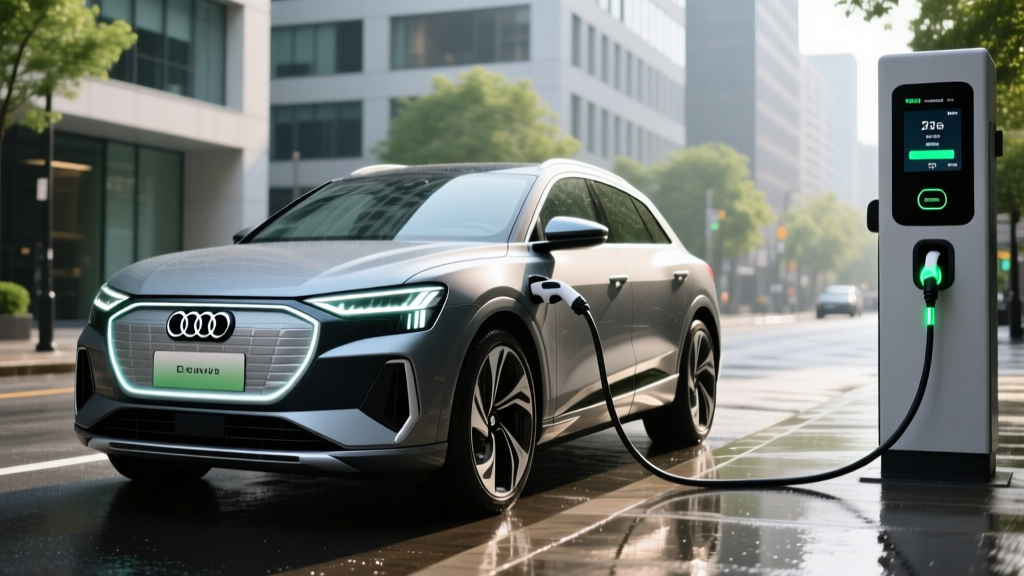
For home charging, Tesla's Gen 2 Wall Connector delivers up to 11.5 kW (48 amps) on a 60-amp circuit. That adds roughly 34 miles of range per hour — sufficient to fully replenish the battery overnight. Installation typically requires a 240V/60A dedicated circuit; budget $500–$2,000 for electrician labor depending on panel proximity, with a panel upgrade to 200A potentially adding $1,500–$3,000 if your home's service is insufficient.
Performance, Drivetrain, and the Plaid Question
The Model X Long Range uses a dual-motor all-wheel-drive layout producing 670 combined horsepower, achieving a 0-60 mph time of 3.8 seconds. That is genuinely quick for a three-row SUV weighing over 5,100 pounds.
The Plaid variant adds a third rear motor for 1,020 horsepower and a 2.5-second 0-60 mph time — making it one of the fastest production SUVs ever built. The Plaid's torque-vectoring rear axle also improves cornering response, though the vehicle's mass is always perceptible in transitions. Both trims feature adaptive air suspension with adjustable ride height, which aids highway efficiency (lower stance) and rough-road clearance (raise up to 2.2 inches above standard).
Towing capacity is rated at 5,000 pounds when properly equipped — adequate for a small trailer or a pair of personal watercraft, but not for large boat or camper trailers. Note that towing will reduce real-world range by 30-50% depending on trailer weight and aerodynamics.
Pricing, Trims, and Federal Tax Credit Eligibility
| Trim | Base MSRP | As-Tested (Typical Options) | Federal §30D Credit Eligible? |
|---|---|---|---|
| Model X Long Range | $81,630 | $88,000–$94,000 | No — exceeds MSRP cap |
| Model X Plaid | $96,630 | $102,000–$110,000 | No — exceeds MSRP cap |
Under current IRS §30D rules, the federal EV tax credit is capped at $80,000 MSRP for SUVs. Both Model X trims exceed this threshold, making them ineligible for the up-to-$7,500 federal credit regardless of buyer income or battery sourcing. Additionally, the §30D credit imposes buyer income caps ($300,000 joint / $150,000 single modified AGI) and critical-mineral/battery-component sourcing requirements — but the MSRP cap alone disqualifies the Model X.
Buyers may still benefit from state-level incentives (which vary by jurisdiction — check your state's energy office), utility company rebates for home charger installation, and potential employer or local municipality programs. Consult a tax professional for personalized guidance.
Popular options that push as-tested prices higher include: six-seat interior ($6,500), Full Self-Driving (Supervised) capability ($8,000), 22-inch turbine wheels ($5,500), and premium paint colors ($2,000–$3,000). A well-equipped Long Range can easily reach $95,000 before taxes.
Interior, Cargo, and Technology
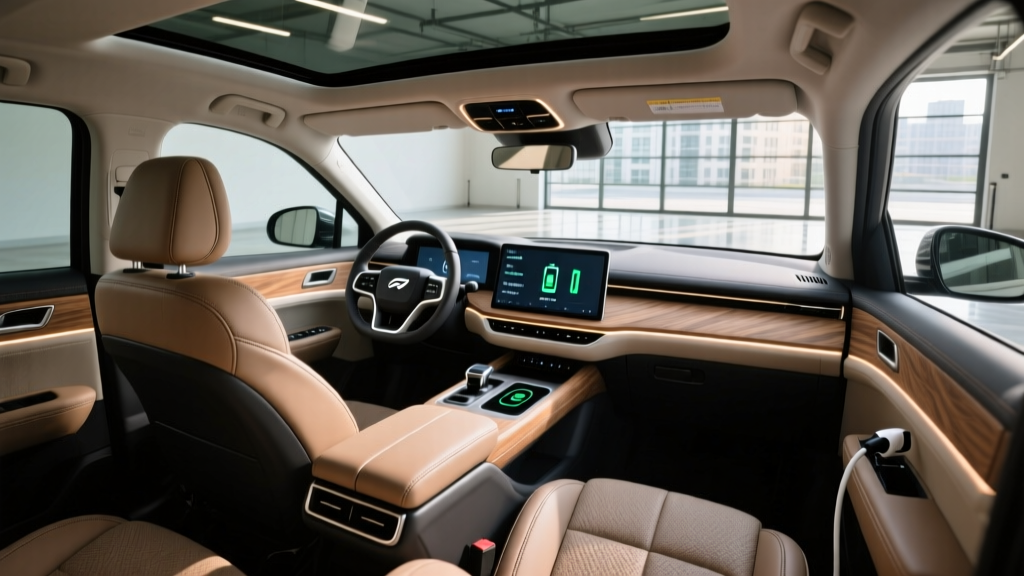
The Model X interior centers on a 17-inch landscape touchscreen running Tesla's latest software. The yoke steering wheel remains standard (a conventional round wheel is available as a no-cost option). Rear passengers get a dedicated 8-inch touchscreen for climate and entertainment controls — a meaningful upgrade for families on long trips.
Passenger space: The Model X offers 41.2 inches of front legroom, 41.0 inches in the second row, and 32.7 inches in the third row. The third row is best suited for children on longer journeys; adults will find it tolerable for short trips. The six-seat configuration (two captain's chairs in the second row) is the most practical for car-seat families, as it provides a walk-through to the third row without folding.
Cargo: Behind the third row, you get 15.0 cubic feet — enough for a few grocery bags or a stroller. Fold the third row and you unlock 42.5 cubic feet; fold both rear rows for a maximum of 85.1 cubic feet. The front trunk (frunk) adds 6.6 cubic feet, useful for charging cables and a small bag.
Driver assistance: Tesla's Autopilot (basic adaptive cruise and lane centering) is standard. The Full Self-Driving (Supervised) package adds automated lane changes, traffic light recognition, and city-street navigation — but remains a SAE Level 2 system. The driver must remain fully engaged, hands on the wheel (or yoke), and eyes on the road at all times. This is not autonomous driving; it is advanced driver assistance.
⚠ FSD (Supervised) Limitation: Tesla's Full Self-Driving is a Level 2 driver-assist system per SAE classification. It does not make the Model X self-driving. You are legally and operationally responsible for the vehicle at all times. Do not use FSD as a substitute for attentive driving.
Pros and Cons
Pros
- Falcon Wing doors provide unmatched car-seat and third-row loading access
- 348-mile EPA range (Long Range) is best-in-class for a three-row electric SUV
- Supercharger network access with native NACS — the most reliable public charging ecosystem in the US
- Plaid performance is staggering: 1,020 hp, 2.5s 0-60 in a 7-seat vehicle
- Over-the-air updates continue to add features years after purchase
- Air suspension provides adjustable ride height for varied terrain
Cons
- No federal tax credit — MSRP exceeds the §30D $80,000 SUV cap
- Falcon Wing doors: slow operation, low-garage limitations, ice sensitivity, and expensive out-of-warranty repairs
- Build quality inconsistencies still reported (panel gaps, interior trim alignment)
- Third-row legroom (32.7 in) is tight for adults on long trips
- High insurance premiums — expect $2,500–$4,000/year depending on region and driving record
- No Apple CarPlay or Android Auto — Tesla's proprietary infotainment only
- Plaid range penalty (320 mi) is significant for the performance trade-off
Who Should Buy the Tesla Model X?
The Model X occupies a narrow but defensible niche. It is best suited for:
- Families who need three rows and car-seat access: The Falcon Wing doors genuinely simplify loading rear-facing car seats — no other SUV matches this convenience.
- Tesla ecosystem loyalists: If you rely on the Supercharger network and Tesla's software integration, no competitor offers the same charging infrastructure seamlessness.
- Performance-minded buyers who need utility: The Plaid is the only three-row SUV that hits 60 mph in 2.5 seconds.
It is not ideal for:
- Budget-conscious buyers: At $81K+ with no federal credit, the Model X faces stiff competition from the BMW iX xDrive50 ($87K, similar range, more refined interior), the Rivian R1S ($79K+ with available tri-motor and genuine off-road capability), and the Kia EV9 ($60K–$75K, three rows, available for the federal credit).
- Low-garage homeowners: If your garage ceiling is below 7 feet, the Falcon Wing doors will be a persistent frustration.
- Towing-heavy users: The 5,000-lb limit and severe range reduction under load make dedicated tow vehicles or the Rivian R1S (7,700-lb capacity) more practical.
Warranty and Long-Term Ownership
Tesla covers the Model X battery and drive unit for 8 years or 150,000 miles, whichever comes first, with a guaranteed minimum 70% capacity retention over that period. The basic vehicle warranty is 4 years or 50,000 miles. These terms are competitive with the industry standard, though some competitors (Hyundai/Kia at 10 years/100,000 miles) offer longer battery coverage.
Battery degradation data from fleet analyses suggests Tesla's NMC packs retain approximately 90-92% capacity at 50,000 miles and 85-88% at 100,000 miles under normal use. The 100 kWh pack in the Model X has proven durable, but replacement cost out of warranty is estimated at $15,000–$22,000 — a figure to keep in mind for long-term ownership planning beyond the warranty window.
Frequently Asked Questions
What is the real-world range of the Tesla Model X?
The EPA rates the Long Range at 348 miles and the Plaid at 320 miles. In real-world mixed driving at moderate temperatures, expect 290–320 miles (Long Range) and 270–295 miles (Plaid). Sustained highway driving above 75 mph and cold weather below freezing will reduce these figures by 15–30%.
How fast does the Model X charge?
At a DC fast charger (250 kW peak), the Model X charges from 10-80% in approximately 28 minutes under ideal conditions. At home on a Level 2 (240V/48A) Tesla Wall Connector, it adds about 34 miles of range per hour, fully charging overnight in roughly 10 hours.
Does the Tesla Model X qualify for the federal EV tax credit?
No. Under current IRS §30D rules, SUVs must have an MSRP at or below $80,000 to qualify. Both Model X trims exceed this cap. State and utility incentives may still apply — check local programs.
Are the Falcon Wing doors reliable long-term?
Reliability has improved significantly since the 2016–2019 production years, which saw widespread actuator and sensor failures. The 2022+ refresh brought redesigned hinges and improved sensors. However, out-of-warranty repairs remain expensive ($1,500–$2,500 per actuator). The basic warranty covers door components for 4 years/50,000 miles.
Is the Model X worth buying over the Rivian R1S or BMW iX?
Choose the Model X if Falcon Wing door access, Supercharger network reliability, and tri-motor Plaid performance are top priorities. Choose the Rivian R1S if you need more towing capacity (7,700 lbs), off-road capability, and a lower starting price. Choose the BMW iX if interior refinement and build quality matter more than third-row seating (the iX is a two-row SUV). Each serves a different buyer profile.
How much does it cost to charge a Model X at home?
At the US average residential electricity rate of ~$0.16/kWh, fully charging the 100 kWh battery costs approximately $16. That provides roughly 300 real-world miles — equivalent to about $0.053 per mile. A comparable gas SUV at 22 MPG and $3.50/gallon costs $0.159 per mile — about three times more per mile driven.
Does the Model X have Apple CarPlay or Android Auto?
No. Tesla uses its proprietary infotainment system exclusively. It includes built-in navigation, Spotify, Netflix/YouTube (while parked), and a web browser, but does not support smartphone mirroring. This is a dealbreaker for some buyers accustomed to CarPlay integration.