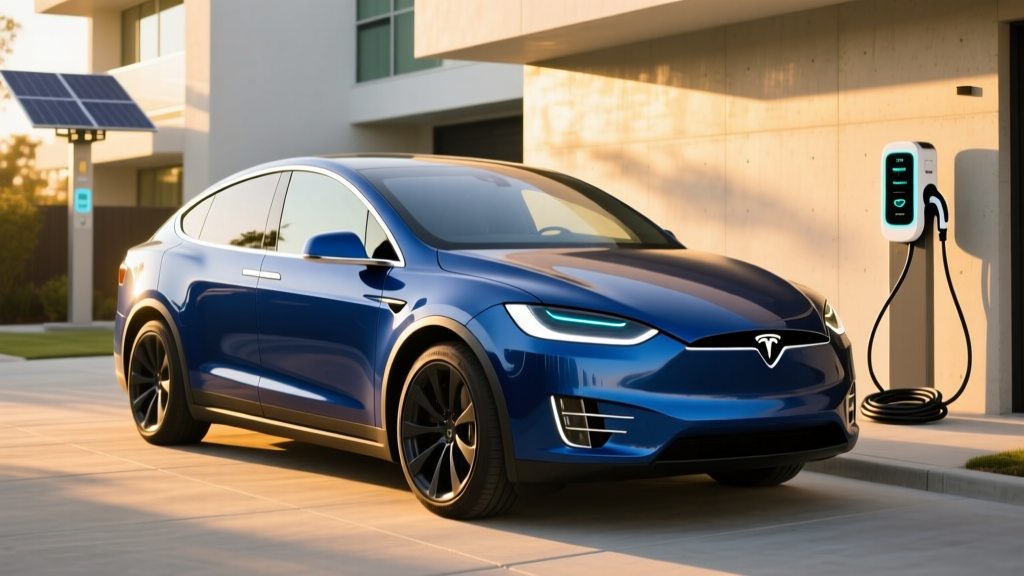
The Tesla Model X has occupied a singular niche since its debut: a three-row electric SUV with falcon-wing rear doors, supercar-rivaling acceleration, and a footprint that threads the needle between full-size utility and midsize garage-ability. For 2026, the Model X continues with dual-motor and tri-motor (Plaid) powertrains, an estimated 100 kWh battery pack, and a starting MSRP that positions it firmly in the luxury tier. But beyond the headline performance numbers, buyers evaluating this SUV need hard data on interior volume, cargo capacity, and real-world usability. This review breaks down every critical Model X dimension, pairs EPA range estimates with real-world expectations, and evaluates whether Tesla's flagship SUV earns its premium price tag.
2026 Tesla Model X Dimensions and Exterior Footprint
The Model X is classified as a midsize-to-large luxury SUV, but its proportions skew toward the spacious end of that spectrum. Here are the key exterior measurements that determine garage fit, parking ease, and road presence:
| Dimension | Measurement |
|---|---|
| Overall Length | 199.1 inches |
| Overall Width (mirrors folded) | 81.5 inches |
| Overall Width (mirrors out) | 88.0 inches |
| Overall Height | 66.9 inches |
| Wheelbase | 116.7 inches |
| Ground Clearance | 6.5 inches (adjustable via air suspension) |
| Curb Weight (Long Range AWD) | 5,185 lbs |
| Curb Weight (Plaid) | 5,390 lbs |
At just under 200 inches long, the Model X fits comfortably in a standard two-car garage (typically 20–22 feet deep). The 116.7-inch wheelbase — longer than a BMW X5's — translates directly into cabin length, which is where the Model X differentiates itself from competitors like the Mercedes EQS SUV or the Rivian R1S. The adjustable air suspension can raise ground clearance to approximately 8.0 inches for rough driveways or lower it for highway efficiency.
Interior Space: Passenger Volume and Cargo Capacity
The Model X is available in five-, six-, and seven-seat configurations, and the Model X dimensions inside the cabin dictate which layout works best for your household.
Passenger Dimensions
| Measurement | Front Row | Second Row | Third Row (if equipped) |
|---|---|---|---|
| Headroom | 41.7 in | 40.9 in | 37.1 in |
| Legroom | 41.2 in | 41.0 in | 32.7 in |
| Shoulder Room | 60.7 in | 60.0 in | 53.3 in |
| Hip Room | 55.6 in | 59.0 in | 38.5 in |
The second row offers genuine adult comfort — 41 inches of legroom rivals many midsize sedans. The third row, however, is best suited for children or short trips; at 32.7 inches of legroom, adults will feel cramped beyond 30 minutes. Six-seat configurations with captain's chairs provide a center aisle and slightly more second-row adjustability, but sacrifice one seating position.
Cargo Volume
Cargo flexibility is where the Model X's hatchback design and front trunk (frunk) pay dividends:
- Behind third row: 15.0 cu ft (enough for a couple of carry-on bags or a week of groceries for five)
- Behind second row (third row folded): 42.5 cu ft
- Behind front row (all rear rows folded): 81.5 cu ft
- Frunk (front trunk): 6.6 cu ft — useful for charging cables, a gym bag, or a small cooler
Compared to the Rivian R1S (which offers roughly 104 cu ft max with all seats folded), the Model X gives up some ultimate volume, but the frunk and the low, flat load floor make everyday usability excellent. The falcon-wing doors require approximately 12 inches of lateral clearance to open — worth noting if you park tightly beside another vehicle.
| Spec | Long Range AWD | Plaid (Tri-Motor AWD) |
|---|---|---|
| EPA Range | 335 miles | 326 miles |
| Battery (usable est.) | ~100 kWh (NMC) | ~100 kWh (NMC) |
| Drivetrain | Dual-Motor AWD | Tri-Motor AWD |
| Horsepower | 670 hp | 1,020 hp |
| 0–60 mph | 3.8 seconds | 2.5 seconds |
| Top Speed | 155 mph | 163 mph |
| Max DC Fast Charge | 250 kW | 250 kW |
| 10–80% DC Charge | ~31 minutes | ~31 minutes |
| Level 2 Home Charge | 11.5 kW (~34 mi/hr) | 11.5 kW (~34 mi/hr) |
| Efficiency (MPGe) | 102 MPGe combined | 98 MPGe combined |
| Efficiency (kWh/100 mi) | 33 kWh/100 mi | 34 kWh/100 mi |
| Towing Capacity | 5,000 lbs | 5,000 lbs |
| Base MSRP | $81,630 | $96,630 |
Range and Efficiency: EPA Estimates vs. Real-World Driving
The 2026 Model X Long Range carries an EPA-estimated 335 miles of range, while the Plaid drops slightly to 326 miles. These figures assume the 20-inch wheels; upgrading to 22-inch wheels reduces range by approximately 5–8%. Per fueleconomy.gov, the Long Range achieves 102 MPGe combined.
Real-World Range Expectations
EPA sticker: 335 miles (Long Range AWD)
Expect in practice:
- Highway (70–80 mph, moderate weather): ~270–290 miles — the Model X's tall, wide profile creates more aerodynamic drag at speed than a sedan like the Model S
- City/suburban mixed driving: ~310–330 miles — regenerative braking recovers energy in stop-and-go conditions
- Cold weather (below 32°F): ~235–265 miles — battery chemistry (NMC) is sensitive to cold; preconditioning via the Tesla app mitigates some loss but cannot eliminate it
- Towing (5,000 lb trailer): ~170–200 miles — towing roughly halves effective range
The ~100 kWh NMC (nickel manganese cobalt) battery provides strong energy density, but NMC chemistry degrades slightly faster than LFP over many charge cycles. Tesla recommends daily charging to 80–90% for NMC packs and reserving 100% charges for road trips.
Charging Speed: DC Fast Charging and Home Level 2
Charging speed remains one of the Model X's strongest competitive advantages, thanks to Tesla's Supercharger network and the vehicle's 250 kW peak DC charge rate.
| Charge Level | Power / Rate | Time or Miles Added |
|---|---|---|
| Level 1 (120V household) | ~1.4 kW | ~4 miles per hour |
| Level 2 (240V home Wall Connector) | 11.5 kW | ~34 miles per hour; full charge in ~9 hours |
| DC Fast Charge (Supercharger V3/V4) | Peak 250 kW | 10–80% in ~31 minutes; ~175 miles in 15 min |
| DC Fast Charge (CCS adapter at third-party stations) | Up to 250 kW (station dependent) | Varies; Electrify America 350 kW stalls will still cap at the car's 250 kW limit |
Charging curve reality: The 250 kW peak is achieved between roughly 10–30% state of charge. Above 50%, the rate tapers to approximately 150 kW, and above 80%, it drops below 60 kW. This is standard behavior for NMC lithium-ion packs — the battery management system slows charging to protect cell longevity. On a road trip, plan stops around the 10–80% window for the fastest throughput.
At home, Tesla's Gen 3 Wall Connector on a 60-amp circuit delivers 11.5 kW (48 amps continuous), adding roughly 34 miles of range per hour. A full overnight charge from 20% to 90% takes approximately 6–7 hours. Installation typically requires a 60-amp breaker and 6-gauge wire; budget $500–$2,000 for professional installation depending on panel proximity, per a licensed electrician's assessment.
Performance and Driving Dynamics
The Model X Long Range's dual-motor all-wheel-drive powertrain produces 670 horsepower and achieves a 3.8-second 0–60 mph time — quicker than most sports cars from a decade ago. The Plaid's tri-motor setup (one front, two rear) generates 1,020 hp and reaches 60 mph in 2.5 seconds, making it one of the fastest production SUVs ever built.
Both trims feature adaptive air suspension, torque-vectoring AWD, and Tesla's low center of gravity (battery pack mounted under the floor). The result is flat cornering for a 5,200+ lb vehicle, though the steering feel is notably light and offers limited feedback compared to a Porsche Cayenne or BMW X5 M. The brake-by-wire regen system enables one-pedal driving in most conditions, and the blended braking transition is among the smoothest in the EV segment.
For towing, the Model X is rated at 5,000 lbs — adequate for a small boat, a pair of jet skis, or a lightweight travel trailer. Tesla offers a tow hitch as a factory or dealer-installed accessory, and the onboard software includes a trailer mode that adjusts stability control and range estimation.
Pricing, Trims, and Federal Tax Credit Eligibility
The 2026 Model X is offered in two trims:
| Trim | Base MSRP | Destination | As-Tested (typical options) | §30D Federal Credit Eligible? |
|---|---|---|---|---|
| Long Range AWD | $81,630 | $1,995 | ~$87,000–$92,000 | No — exceeds MSRP cap |
| Plaid (Tri-Motor AWD) | $96,630 | $1,995 | ~$102,000–$108,000 | No — exceeds MSRP cap |
Federal tax credit reality: Under IRS §30D rules, the Model X does not qualify for the $7,500 new clean vehicle credit. The credit imposes an MSRP cap of $80,000 for SUVs, and both Model X trims exceed this threshold before destination charges. Additionally, the buyer must have a modified adjusted gross income below $300,000 (married filing jointly) or $150,000 (single), and the battery must meet critical-mineral and battery-component sourcing requirements. The Model X fails on MSRP alone. For full eligibility rules, see IRS.gov §30D.
Some buyers may offset cost through state-level rebates (check your state's energy office), employer EV incentives, or utility company charging rebates. Tesla also periodically offers referral credits or free Supercharging promotions that reduce ownership costs.
Technology, Driver Assistance, and Standout Features
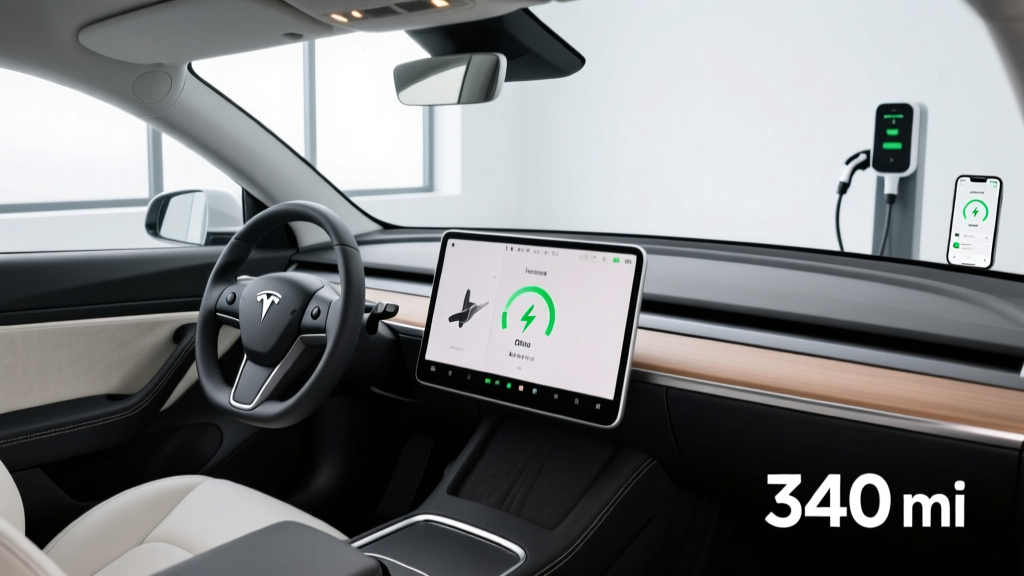
The Model X's interior is dominated by a 17-inch center touchscreen running Tesla's proprietary infotainment OS. Key tech features include:
- Autopilot (standard): Adaptive cruise control, lane-keeping assist, and automatic emergency braking. This is an SAE Level 2 system — the driver must remain fully engaged at all times.
- Full Self-Driving (Supervised) — $8,000 option: Adds automatic lane changes, traffic-light recognition, and navigate-on-Autopilot. Still SAE Level 2; despite the name, the driver is legally and practically responsible for all driving decisions.
- Falcon-wing rear doors: Double-hinged with ultrasonic obstacle sensors; open in tight spaces with as little as 12 inches of side clearance. Includes a powered liftgate.
- HEPA air filtration (Bioweapon Defense Mode): Hospital-grade cabin filtration, a genuine differentiator in wildfire-smoke or high-allergy regions.
- Over-the-air updates: Tesla routinely pushes software improvements that add features, refine efficiency, or update the UI — no dealer visit required.
- 1,400-watt 22-speaker audio system with immersive sound processing.
- Yoke or round steering wheel (buyer's choice at order time).
Driver Assistance Limitations
Neither Autopilot nor FSD (Supervised) makes the Model X a self-driving vehicle. These are SAE Level 2 driver-assist systems. You must keep your hands on the wheel (or demonstrate attention via the cabin camera), monitor traffic, and be prepared to take over instantly. FSD does not handle construction zones, unmapped roads, or severe weather reliably. Only Level 4 services like Waymo operate without a human driver — and those are geofenced to specific cities.
Notable Drawbacks
- Panel-gap inconsistency: Tesla's build quality has improved, but the Model X's complex falcon-wing doors and large liftgate still show occasional fitment variance.
- No Apple CarPlay or Android Auto: Tesla's proprietary system is capable, but if you prefer phone-mirroring, it's not available.
- Visibility: The sloping roofline and thick rear pillars create blind spots; rely on the backup camera and blind-spot monitoring.
- Falcon-wing door sensors: Occasionally over-detect obstacles in heavy rain or car washes, requiring manual override.
- Insurance costs: The Model X carries higher-than-average insurance premiums due to repair costs and performance classification. Expect quotes 20–40% above a comparable BMW X5.
Battery Longevity and Warranty Coverage
Tesla warranties the Model X battery and drive units for 8 years or 150,000 miles (whichever comes first), with a minimum 70% capacity retention threshold over that period. This is one of the more generous warranties in the luxury EV segment and reflects confidence in the NMC pack's thermal management system.
Based on fleet data from high-mileage Model S and X vehicles, NMC batteries typically retain approximately 85–90% capacity after 100,000 miles when charged primarily to 80–90%. Degradation is non-linear: expect a steeper initial drop of 2–3% in the first year, followed by a slow, linear decline. Battery replacement out of warranty is estimated at $15,000–$22,000, though full replacements are rare; Tesla often replaces individual modules at lower cost.
The vehicle's basic limited warranty covers 4 years or 50,000 miles. Tesla does not offer a complimentary maintenance schedule (there are no oil changes, but cabin air filters, brake fluid, wiper blades, and tire rotations are owner responsibilities).
Who the Model X Is For — and Who Should Look Elsewhere
Choose the Model X if:
- You need three rows and genuine cargo flexibility in an EV, and falcon-wing doors ease car-seat loading in tight parking spaces.
- You value access to the Tesla Supercharger network for frequent road trips (over 6,000 stations and 65,000+ chargers in North America).
- You want supercar-level acceleration in a family vehicle (Plaid specifically).
- Home charging is available, and your daily commute falls within 200–250 miles round trip.
Look elsewhere if:
- Your budget tops out around $70,000 — consider the Tesla Model Y, Kia EV9, or Rivian R1S Dual-Motor Standard.
- You need a third row for full-size adults regularly — the Kia EV9 and Rivian R1S offer more usable third-row space.
- You require Apple CarPlay or prefer a traditional dealer service network — BMW iX or Mercedes EQS SUV may be better fits.
- You live in a region with limited Supercharger coverage and no home charging access.
Pros
- Class-leading acceleration (2.5s 0–60 in Plaid)
- Supercharger network access for reliable road-trip charging
- Spacious second row with 41 inches of legroom
- Falcon-wing doors ease child-seat access
- Excellent HEPA cabin air filtration
- Over-the-air software updates continuously improve the vehicle
- 5,000-lb towing capacity
Cons
- No federal tax credit (exceeds $80K MSRP cap)
- Third row is tight for adults (32.7 in legroom)
- High insurance premiums
- No Apple CarPlay / Android Auto
- Falcon-wing doors can be slow and occasionally sensor-glitchy
- Build-quality variance still surfaces on some units
- Price premium over rivals like the Kia EV9
Frequently Asked Questions
What is the real-world range of the 2026 Tesla Model X?
The EPA rates the Long Range at 335 miles, but real-world highway driving at 75 mph yields approximately 270–290 miles. In cold weather (below freezing), expect 235–265 miles. City driving with regenerative braking can approach the EPA figure.
How fast does the Model X charge at home and on the road?
At home on a Level 2 Tesla Wall Connector (11.5 kW), the Model X adds approximately 34 miles of range per hour, with a full overnight charge taking about 9 hours. On a V3 or V4 Supercharger at 250 kW peak, a 10–80% charge takes approximately 31 minutes. Expect roughly 175 miles of range added in the first 15 minutes.
Does the 2026 Model X qualify for the $7,500 federal EV tax credit?
No. Under IRS §30D, the new-vehicle credit has an $80,000 MSRP cap for SUVs, and both Model X trims exceed this limit. Income caps and battery-sourcing requirements also apply. Check IRS.gov for current rules and any legislative updates.
How do the Model X dimensions compare to the Kia EV9?
The Model X is 199.1 inches long vs. the EV9's 197.4 inches, but the Model X has a longer wheelbase (116.7 vs. 122.0 inches for the EV9). The EV9 offers a more usable third row (35.1 in legroom) and a lower starting price (~$55,000), while the Model X offers more cargo space behind the second row and significantly more power.
Is the Model X worth buying over the Rivian R1S?
It depends on priorities. The R1S offers more third-row space, a quad-motor option, better off-road capability, and a lower starting price. The Model X counters with faster charging, Supercharger network access, a more refined on-road ride, and the falcon-wing door advantage for child-seat loading. If road-trip charging reliability is paramount, the Model X has the edge; if off-pavement capability and third-row comfort matter more, the R1S wins.
What is the biggest drawback of the Model X?
Price is the primary barrier — starting above $83,000 with destination, and no federal tax credit to offset it. Secondary concerns include the tight third row for adults, high insurance costs, and the lack of Apple CarPlay. For the price, some competitors offer more polished interior materials and dealer-based service networks.
How long will the Model X battery last?
Tesla warranties the battery for 8 years / 150,000 miles at 70% minimum capacity. Real-world fleet data suggests NMC packs retain 85–90% after 100,000 miles with proper charging habits (daily 80–90%, avoiding prolonged 100% states). Out-of-warranty replacement is estimated at $15,000–$22,000, though full replacements are uncommon.