The Tesla Model X occupies a rare space in the EV market: a three-row electric SUV with supercar-baiting acceleration and access to the most reliable DC fast-charging network in North America. But with a starting price near $80,000, buyers need to know exactly what they're paying for — and whether the math works after incentives, charging costs, and depreciation.
This review breaks down every number that matters for the 2026 Tesla Model X: EPA range, real-world efficiency, DC fast-charge speeds, home charging requirements, and the total cost picture including federal tax credit eligibility under IRS §30D rules.
2026 Tesla Model X: Quick Specs at a Glance
| Spec | Long Range (Dual Motor) | Plaid (Tri-Motor) |
|---|---|---|
| Base MSRP | $79,990 | $94,990 |
| EPA Range | 348 mi (20" wheels) | 325 mi (20" wheels) |
| Battery (usable) | ~95 kWh, NMC | ~95 kWh, NMC |
| Drivetrain | Dual-Motor AWD | Tri-Motor AWD |
| Horsepower | 670 hp | 1,020 hp |
| 0–60 mph | 3.8 sec | 2.5 sec |
| Max DC Fast Charge | 250 kW | 250 kW |
| 10–80% DC Time | ~32 min | ~32 min |
| Level 2 Rate (48A) | 11.5 kW (~34 mi/hr) | 11.5 kW (~34 mi/hr) |
| MPGe (combined) | 102 MPGe | 98 MPGe |
| Efficiency | 33 kWh/100 mi | 34 kWh/100 mi |
| Cargo (behind 3rd row) | 42.5 cu ft | 42.5 cu ft |
| Cargo (max, folded) | 92.3 cu ft | 92.3 cu ft |
| Seating | 5, 6, or 7 passengers | 5, 6, or 7 passengers |
| Towing Capacity | 5,000 lbs | 5,000 lbs |
| Battery Warranty | 8 yr / 150,000 mi | 8 yr / 150,000 mi |
Source: fueleconomy.gov and Tesla's official specifications page. Prices exclude $1,390 destination fee.
Real-World Range: What the EPA Sticker Doesn't Tell You
Real-World Highway (70 mph, moderate temps): ~280–310 miles
Cold Weather (below 32°F, mixed driving): ~220–260 miles
Best-Case City/Suburban (55 mph, 65°F): ~330–345 miles
The Model X Long Range carries a 348-mile EPA rating with 20-inch wheels, dropping to roughly 325 miles if you opt for the 22-inch turbine wheels. The Plaid variant sits at 325 miles on 20s. These are respectable numbers for a 5,100+ pound, three-row SUV.
But real-world range tells a more nuanced story. The Model X's large frontal area and boxy SUV profile generate substantial aerodynamic drag at highway speeds. In sustained 70–75 mph driving on flat terrain at moderate temperatures, expect roughly 280–310 miles from a full charge — approximately a 10–20% reduction from the EPA combined figure. This is typical for large electric SUVs; the Rivian R1S and BMW iX show similar highway penalties.
Cold weather compounds the loss. Lithium-ion NMC chemistry loses efficiency below freezing, and the Model X must divert energy to cabin heating and battery thermal management. In sub-32°F conditions, plan for 220–260 miles of usable range. Tesla's heat pump (standard on current models) mitigates this compared to older resistive-heating EVs, but the physics of cold-weather battery operation remain unavoidable.
For context: a 300-mile road trip in a Long Range Model X is comfortable in summer but requires a brief Supercharger stop in winter. Plan accordingly.
Charging Speed: Supercharger Access and Home Setup
| Charging Level | Power | Speed (miles/hr) | Use Case |
|---|---|---|---|
| Level 1 (120V household) | ~1.4 kW | ~3–4 mi/hr | Emergency/trickle only |
| Level 2 (240V, 48A Wall Connector) | 11.5 kW | ~34 mi/hr | Daily home charging (full in ~9 hrs) |
| Level 2 (240V, 32A Mobile Connector) | 7.7 kW | ~23 mi/hr | Budget home setup (full in ~13 hrs) |
| DC Fast (Tesla Supercharger V3/V4) | Peak 250 kW | ~750+ mi/hr at peak | Road trips, 10–80% in ~32 min |
| DC Fast (CCS adapter at third-party) | Up to 150–250 kW | Varies by station | Non-Tesla networks (EA, EVgo) |
The Model X charges at a peak rate of 250 kW on Tesla's V3 and V4 Superchargers. In practice, the charging curve follows a familiar pattern: the battery accepts close to peak power between 10–40% State of Charge (SoC), then progressively tapers. From 10–80%, expect roughly 32 minutes at a V3 Supercharger. The final 80–100% stretch adds another 25–35 minutes as the battery management system protects cell longevity — avoid charging above 80% on road trips unless absolutely necessary.
At home, the Tesla Wall Connector on a 60-amp circuit delivers up to 48 amps (11.5 kW), adding roughly 34 miles of range per hour. A full charge from 10% takes about 9 hours — overnight is sufficient. Installation costs for a dedicated 60A circuit typically run $800–$2,500 depending on panel proximity and local permitting, with potential panel-upgrade costs of $1,500–$3,000 if your home's electrical service is limited to 100 amps.
The NACS (North American Charging Standard) connector is native on the Model X, giving it seamless access to Tesla's Supercharger network — now over 6,000 V3/V4 stalls in North America. A CCS adapter (sold separately by Tesla for ~$175) unlocks Electrify America, EVgo, and other third-party networks, though reliability on non-Tesla networks remains inconsistent in many regions.
Performance: From Family Hauler to Supercar Killer
The Model X Long Range delivers 670 horsepower through its dual-motor all-wheel-drive system, reaching 60 mph in 3.8 seconds. That's quicker than a Porsche Cayenne Turbo GT — in a seven-seat electric SUV. The single-speed transmission means acceleration is linear and immediate, with no gear-shift hesitation.
The Plaid variant adds a third rear motor for 1,020 horsepower and a 2.5-second 0–60 time, making it one of the fastest production SUVs ever built. However, the Plaid's performance advantage comes at a $15,000 premium and a 23-mile range penalty. Unless you're tracking the vehicle or simply want the excess, the Long Range is the rational choice for daily driving and road trips.
Ride quality has improved on recent model years with adaptive air suspension standard across both trims. The system adjusts damping and ride height based on speed and terrain, dropping the body at highway speeds for better aerodynamic efficiency. Steering is precise but somewhat numb — typical of Tesla's electric rack tuning. The 5,100-pound curb weight is noticeable in tight corners, though the low center of gravity (battery pack under the floor) keeps body roll surprisingly controlled.
Tesla Model X Cost: Pricing, Trims, and Tax Credit Reality
| Trim | Base MSRP | Destination | Total Before Options | Federal §30D Credit | Effective Price |
|---|---|---|---|---|---|
| Long Range (Dual Motor) | $79,990 | $1,390 | $81,380 | $0 (MSRP cap) | $81,380 |
| Plaid (Tri-Motor) | $94,990 | $1,390 | $96,380 | $0 (MSRP cap) | $96,380 |
Here's the critical cost detail many buyers miss: the Tesla Model X does not qualify for the $7,500 federal EV tax credit under IRS §30D. The reason is the MSRP cap. Current §30D rules limit eligibility to SUVs with a manufacturer's suggested retail price at or below $80,000. The Model X Long Range starts at $79,990, but once the mandatory $1,390 destination fee is included, the total exceeds the cap. The Plaid, at $94,990, is well above it.
This is confirmed by the IRS's list of eligible vehicles at irs.gov, where the Model X is not listed for the new-vehicle credit. Even if the base MSRP were exactly at the cap, the income limits ($300,000 joint / $150,000 single modified AGI) and battery critical-mineral sourcing requirements would further restrict eligibility.
- ✗ MSRP cap for SUVs: ≤ $80,000 — Model X exceeds this with destination
- ✗ Income cap: $300K joint / $150K single — many Model X buyers exceed this
- △ Battery sourcing: critical minerals and component requirements apply
- ✓ Used EV credit (§25E): If buying a qualifying used Model X under $25,000, up to $4,000 credit may apply (income caps: $150K joint / $75K single)
Common options that push the price higher include the six-seat interior configuration ($6,500), seven-seat layout ($4,000), Full Self-Driving (Supervised) capability ($8,000), and premium paint colors ($1,500–$2,500). A well-equipped Long Range with six seats and FSD can easily reach $95,000–$100,000 before taxes and registration.
Interior, Cargo, and Technology
The Model X offers three seating configurations: five-seat (standard bench second row), six-seat (two captain's chairs with a center pass-through), and seven-seat (bench second row plus a compact third row). The six-seat layout is the most practical for adults, offering comfortable captain's chairs with individual armrests and easy third-row access through the center aisle.
Cargo volume is generous: 42.5 cubic feet behind the third row, expanding to 92.3 cubic feet with both rear rows folded. The front trunk (frunk) adds additional storage, though it's smaller than the Model S frunk due to the SUV's HVAC and mechanical packaging. Second-row legroom measures approximately 40.2 inches; the third row is best suited for children or short trips, with around 32.7 inches of legroom.
The 17-inch center touchscreen runs Tesla's latest software with a responsive interface, integrated navigation with real-time Supercharger routing, and over-the-air updates that periodically add features. The 12.3-inch driver display and optional rear-seat entertainment screen round out the package. Tesla's app integration (preconditioning, remote charging monitoring, Sentry Mode cameras) remains best-in-class.
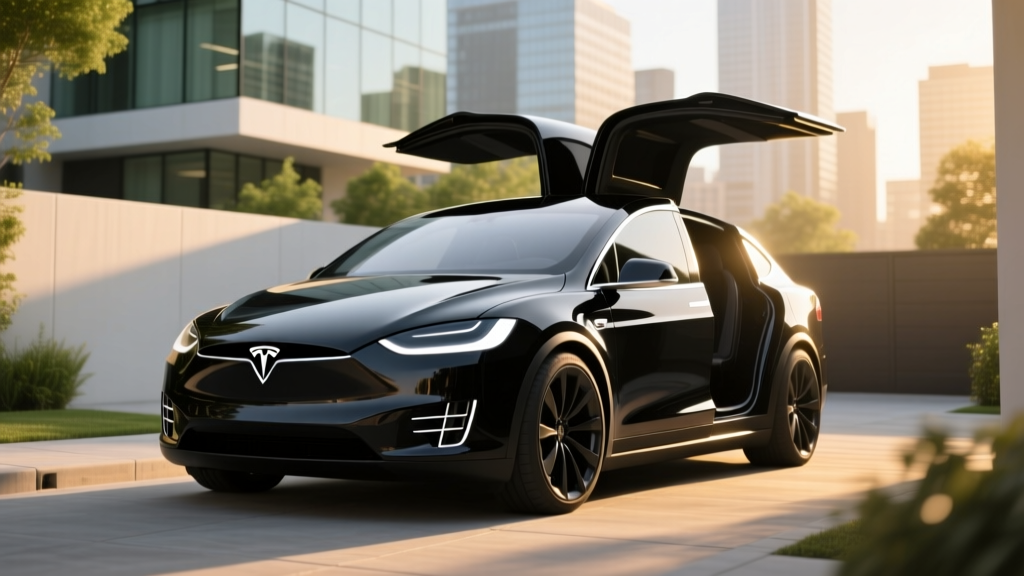
The signature Falcon Wing rear doors are a polarizing feature. They open vertically, providing excellent headroom access to the second and third rows — particularly useful when loading children into car seats in tight parking spaces. However, they are slower to open than conventional doors, can be problematic in low-clearance garages (ultrasonic sensors adjust the hinge point, but it's not foolproof), and add mechanical complexity that has historically been a maintenance concern.
Driver Assistance: Autopilot and FSD (Supervised)
Tesla Autopilot and Full Self-Driving (Supervised) are driver-assistance systems, not autonomous driving. The driver must remain fully engaged, hands on the wheel, eyes on the road at all times. Tesla's "FSD" branding is misleading — the system cannot drive without human supervision and does not meet SAE Level 3 or above.
Standard Autopilot includes Traffic-Aware Cruise Control and Autosteer (lane-centering on highways). The $8,000 FSD (Supervised) upgrade adds automatic lane changes, Navigate on Autopilot (highway on-ramp to off-ramp), traffic light and stop sign recognition, and Autopark. In practice, FSD handles well-marked highways competently but struggles with construction zones, faded lane markings, and complex urban intersections. The driver must be prepared to intervene at any moment.
Tesla's vision-only approach (no LiDAR or radar on current models) means the system relies entirely on cameras and neural network processing. Performance has improved significantly through software updates, but it remains a Level 2 system that demands constant attention — not a replacement for an alert driver. NHTSA continues to monitor Tesla's Autopilot/FSD through its Standing General Order crash-reporting requirements.
Ownership Costs: 5-Year Outlook
| Cost Category | Model X Long Range (5 yr) | Notes |
|---|---|---|
| Purchase Price (base + dest.) | $81,380 | No federal credit available |
| Estimated Electricity (50K mi) | $3,800–$5,500 | $0.13–$0.19/kWh avg; varies by utility & Supercharger use |
| Maintenance | $1,200–$2,000 | Cabin filter, wipers, tire rotation, brake fluid check |
| Tires (1 set replacement) | $1,800–$2,800 | 20" or 22" EV-rated tires wear faster on heavy SUVs |
| Insurance (avg) | $14,000–$20,000 | $2,800–$4,000/yr; Model X premiums are above average |
| Estimated Depreciation | $28,000–$35,000 | ~40–45% over 5 years; luxury EVs depreciate steeply |
| Approx. 5-Year Total | $130,000–$147,000 | Before any state/local incentives |
Electricity costs depend heavily on your charging mix. Home charging at the national average of ~$0.15/kWh yields roughly $0.05 per mile for the Model X (at 33 kWh/100 mi). Supercharger rates vary from $0.25–$0.50/kWh depending on location and time of day, pushing road-trip fuel costs to $0.08–$0.17 per mile. A driver who charges 80% at home and 20% on Superchargers will average approximately $4,500 in electricity over 50,000 miles — roughly $4,000–$6,000 less than an equivalent gas SUV at 18 MPG and $3.50/gallon.
Insurance is the hidden cost. The Model X's high repair costs (aluminum body, integrated battery structure, sensor replacement) push premiums well above average for its class. Expect $2,800–$4,000 annually depending on your state, driving record, and coverage level. Always get insurance quotes before purchasing.
Depreciation is the largest single cost. Luxury EVs, particularly those priced above $80,000, tend to lose 40–50% of their value over five years. The Model X is no exception, though Tesla's brand recognition and Supercharger network provide some residual-value support compared to less-established luxury EV brands.
Pros and Cons
✓ Pros
- Supercharger network access — most reliable DC fast-charging in North America
- Genuine three-row seating with Falcon Wing door accessibility
- 348-mile EPA range (Long Range) is excellent for the class
- Over-the-air updates continuously improve the vehicle
- 5,000-lb towing capacity for boat/car trailer duty
- Class-leading infotainment and app integration
- Adaptive air suspension standard
✗ Cons
- No federal tax credit (exceeds $80K MSRP cap)
- Insurance premiums significantly above class average
- Falcon Wing doors add complexity and potential maintenance cost
- Third row is tight for adults (32.7" legroom)
- Heavy curb weight (~5,100 lbs) accelerates tire wear
- FSD (Supervised) is $8,000 for a Level 2 system — not self-driving
- DC fast-charge speed (250 kW peak) trails newer 800V competitors like the Hyundai Ioniq 9 and Porsche Cayenne EV
Who Should Buy the Tesla Model X?
- Need three-row EV seating and refuse to compromise on Supercharger access for road trips
- Value performance — 670–1,020 hp in a family SUV has no direct rival at this price
- Have home Level 2 charging and can absorb the $80K+ purchase without the federal credit
- Tow occasionally (5,000-lb capacity handles a small boat or utility trailer)
- Want the Tesla software/app ecosystem and over-the-air feature improvements
- Need the $7,500 federal credit — consider the Rivian R1S (qualifying trims), Kia EV9, or Hyundai Ioniq 9
- Prioritize third-row adult comfort — the Rivian R1S and Kia EV9 offer more usable space
- Want the fastest DC charging available — newer 800V-architecture SUVs charge faster at compatible stations
- Have a tight insurance budget — premiums are steep
Frequently Asked Questions
What is the real-world range of the Tesla Model X?
The EPA rates the Model X Long Range at 348 miles and the Plaid at 325 miles. In real-world highway driving at 70 mph, expect 280–310 miles. In cold weather below freezing, plan for 220–260 miles. City driving at moderate speeds and temperatures can approach the EPA figure.
How fast does the Model X charge at home and on the road?
At home on a 48-amp Level 2 Tesla Wall Connector, the Model X charges at 11.5 kW, adding about 34 miles of range per hour (full charge in ~9 hours). On a V3 Supercharger, it peaks at 250 kW and charges from 10–80% in approximately 32 minutes, though the charge curve tapers significantly above 80% SoC.
Does the Tesla Model X qualify for the federal EV tax credit?
No. Under current IRS §30D rules, the Model X exceeds the $80,000 MSRP cap for SUVs once the destination fee is included. Income limits and battery-sourcing requirements would further restrict most buyers. Check the IRS eligible vehicle list for the most current information.
Is the Model X worth buying versus competitors like the Rivian R1S or BMW iX?
It depends on your priorities. The Model X wins on Supercharger network access, software integration, and raw performance (especially Plaid). The Rivian R1S offers a more usable third row, off-road capability, available federal tax credit, and a more adventurous design. The BMW iX provides a more luxurious interior and quieter ride but only seats five. If three-row seating and Supercharger reliability are non-negotiable, the Model X has no direct substitute.
What are the biggest ongoing costs of owning a Model X?
Depreciation ($28,000–$35,000 over five years), insurance ($14,000–$20,000 over five years), and tire replacement ($1,800–$2,800 per set) are the largest ownership expenses beyond the purchase price. Electricity costs are modest at roughly $3,800–$5,500 over 50,000 miles depending on your home/Supercharger mix.
What battery warranty does the Model X carry?
Tesla provides an 8-year/150,000-mile battery and drive unit warranty, whichever comes first. The warranty covers defects and excessive capacity loss (Tesla defines this as retaining below 70% of original capacity). NMC chemistry in the Model X has shown typical degradation of 5–10% over the first 100,000 miles based on fleet data, well within the warranty threshold.