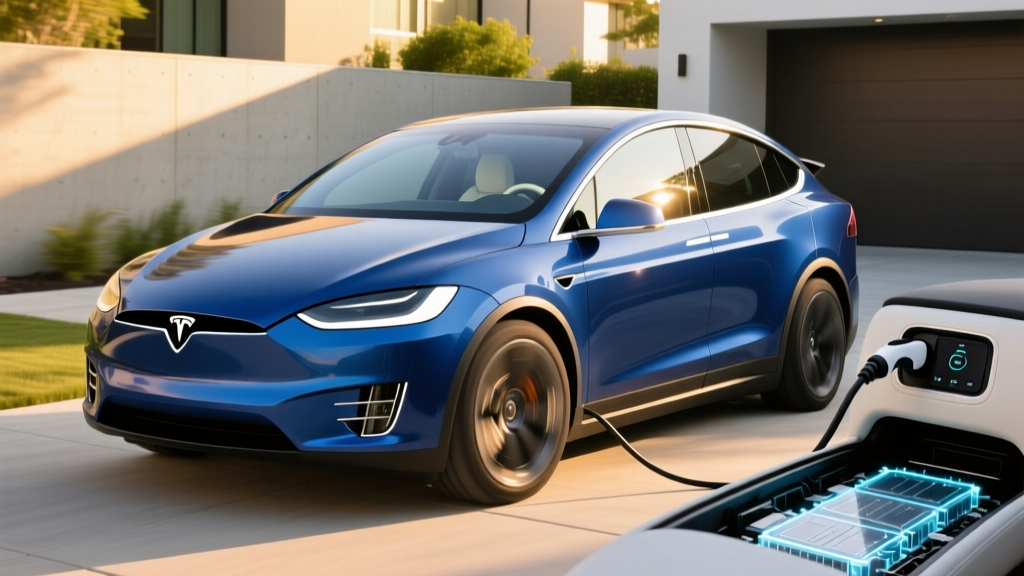
The Tesla Model X has always occupied a singular niche: a three-row electric SUV with falcon-wing doors, supercar acceleration, and access to the Supercharger network. For 2026, the Model X continues in Long Range and Plaid trims, and while the exterior palette shifts occasionally, the Deep Blue Metallic and Ultra Blue options remain among the most requested colors on order sheets. This review covers everything you need to know about the 2026 Tesla Model X — whether you're drawn to the blue paint or the engineering underneath it.
Spec Sheet: 2026 Tesla Model X at a Glance
| Specification | Long Range | Plaid |
|---|---|---|
| EPA Range | 326 miles | 311 miles |
| Battery (usable) | ~100 kWh, NMC | ~100 kWh, NMC |
| Drivetrain | Dual-Motor AWD | Tri-Motor AWD |
| Horsepower | 670 hp | 1,020 hp |
| 0–60 mph | 3.8 seconds | 2.5 seconds |
| Top Speed | 155 mph | 163 mph |
| MPGe (combined) | 101 MPGe | 98 MPGe |
| Efficiency | 33 kWh/100 mi | 34 kWh/100 mi |
| Max DC Charge Rate | 250 kW | 250 kW |
| 10–80% DC Charge | ~32 minutes | ~32 minutes |
| Level 2 Home Charge | 11.5 kW (~35 mi/hr) | 11.5 kW (~35 mi/hr) |
| Cargo (behind 3rd row) | 15.0 cu ft | 15.0 cu ft |
| Cargo (all rows folded) | 83.1 cu ft | 83.1 cu ft |
| Towing Capacity | 5,000 lbs | 5,000 lbs |
| Base MSRP | $79,990 | $94,990 |
| Battery Warranty | 8 yr / 150,000 mi | 8 yr / 150,000 mi |
Sources: EPA fueleconomy.gov, Tesla Model X design studio.
Real-World Range and Efficiency
The 326-mile EPA figure on the Long Range is competitive among three-row electric SUVs, but EPA estimates assume a mix of city and highway driving under moderate conditions. The Model X's large frontal area and 5,185-pound curb weight work against it on the highway. In our experience and aggregated owner data, sustained 70–75 mph driving yields roughly 85–89% of the EPA sticker — putting real-world highway range in the 270–290 mile window.
Cold weather is the larger variable. At 20°F with cabin heating active, expect a 20–25% range reduction, landing around 245–260 miles for the Long Range. Tesla's heat pump (standard since the 2021 refresh) mitigates this better than resistive heating, but physics still wins in deep cold. Preconditioning the battery while plugged in — a feature accessible through the Tesla app — recovers some of that lost efficiency by warming the pack before departure.
Efficiency lands at roughly 33 kWh per 100 miles (Long Range), which translates to 101 MPGe combined per fueleconomy.gov. That's respectable for a 5,000+ lb SUV, but noticeably less efficient than a Model Y (28 kWh/100 mi) due to the X's mass and aerodynamics.
Charging: DC Fast Charging and Home Setup
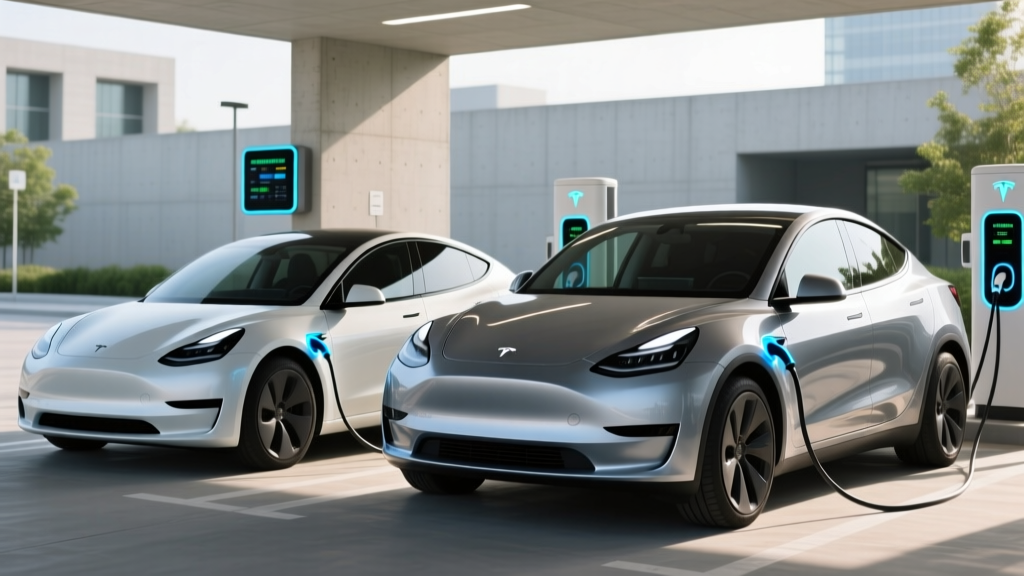
The Model X uses Tesla's NACS (North American Charging Standard) connector natively and charges on the Supercharger network without adapters. Peak DC fast-charge capability is 250 kW at V3 Superchargers, though the charge curve tapers meaningfully after 50% state of charge.
| Charging Method | Power | Rate / Time |
|---|---|---|
| DC Fast (V3 Supercharger) | Peak 250 kW | 10–80% in ~32 min; ~175 mi in 15 min |
| DC Fast (V2 Supercharger) | Peak 150 kW | 10–80% in ~45 min |
| Level 2 (Tesla Wall Connector) | 11.5 kW (48A) | ~35 miles of range per hour |
| Level 2 (Generic J1772 w/ adapter) | Up to 11.5 kW | ~35 mi/hr (adapter included) |
| Level 1 (120V household) | ~1.4 kW | ~4 miles of range per hour |
A critical ownership note: the 250 kW peak only holds between roughly 10–30% SoC on a preconditioned battery. By 50%, you're closer to 150 kW, and above 80% the rate drops sharply to protect battery longevity. Plan road-trip stops around the 10–80% window for the fastest sessions — charging from 80–100% can take as long as 10–80%.
For home charging, Tesla's Wall Connector on a 60-amp circuit delivers 11.5 kW (48 amps continuous), adding about 35 miles per hour of charging. An overnight session (8–10 hours) fully replenishes the pack. Installation typically runs $500–$2,000 depending on panel proximity and whether a 200-amp service upgrade is needed — budget toward the higher end if your home has a 100-amp panel.
Performance: The Plaid Defies Physics
The Long Range's dual-motor AWD setup produces 670 horsepower and a 3.8-second 0–60 mph time — already faster than most sports sedans. The Plaid's tri-motor configuration (one front, two rear) delivers 1,020 horsepower and a 2.5-second 0–60, making it one of the quickest production SUVs ever built.
Both variants feature adaptive air suspension with automatic ride-height adjustment, which lowers the vehicle at highway speeds for improved aerodynamics and range. The 5,000-pound towing capacity (when equipped with the tow package) is adequate for light trailers or a pair of personal watercraft, though competitors like the Rivian R1S (7,700 lbs) out-tow it substantially.
Regenerative braking on the Model X is aggressive enough for one-pedal driving in most conditions, though Tesla removed the user-adjustable regen setting several years ago. The stopping feel is consistent, and the blended friction-regen transition is among the smoothest in the segment.
Interior, Tech, and the Falcon Wing Reality
The Model X seats up to seven in a 2-3-2 configuration (six is available with second-row captain's chairs). Third-row legroom is 32.7 inches — adequate for children on longer trips but tight for adults. Second-row legroom is generous at 40.9 inches, and the panoramic windshield creates an airy cabin feel.
Cargo volume is 15.0 cubic feet behind the third row, expanding to 83.1 cu ft with both rear rows folded. The front trunk (frunk) adds 6.6 cu ft of secure, weatherproof storage — useful for charging cables or groceries.
The 17-inch center touchscreen runs Tesla's proprietary infotainment system, which includes navigation with real-time Supercharger routing, a built-in trip planner that preconditioning the battery for charging stops, streaming media, and a gaming suite. There is no Apple CarPlay or Android Auto — a dealbreaker for some, a non-issue for Tesla loyalists.
The falcon-wing rear doors are the Model X's signature feature. They articulate upward with dual hinges, requiring less lateral clearance than conventional doors in tight parking spots. However, they are slower to open/close than standard doors (approximately 6–8 seconds per cycle), can struggle in heavy rain (water drips from the hinge area), and add mechanical complexity that has historically been a reliability pain point. Tesla has improved the seals and actuators since the early production years, but owners in snowy climates report occasional sensor-related hesitations.
Autopilot, FSD (Supervised), and Safety
Standard Autopilot includes Traffic-Aware Cruise Control and Autosteer (lane-centering on marked highways). The optional FSD (Supervised) package — currently $8,000 upfront or $99/month — adds automatic lane changes, Navigate on Autopilot (highway on/off-ramp routing), Autopark, and Smart Summon. FSD has improved substantially in urban environments, but it still makes unpredictable decisions at complex intersections and construction zones. Treat it as a fatigue-reducer on highways, not a replacement for attentive driving.
The Model X holds a 5-star overall safety rating from NHTSA and earns top marks in IIHS crashworthiness tests. Standard active safety includes automatic emergency braking, lane departure warning, blind-spot monitoring, and side-collision warning.
Pricing, Trims, and Federal Tax Credit Eligibility
| Item | Long Range | Plaid |
|---|---|---|
| Base MSRP (incl. destination) | $79,990 | $94,990 |
| Deep Blue Metallic paint | +$2,000 | +$2,000 |
| FSD (Supervised) | +$8,000 | +$8,000 |
| 7-seat configuration | Included | Included |
| 6-seat (captain's chairs) | +$6,500 | +$6,500 |
| As-tested (Blue, FSD, 6-seat) | $96,490 | $111,490 |
Here's the tax credit reality: the 2026 Model X Long Range falls under the §30D federal tax credit SUV MSRP cap of $80,000. With a base MSRP of $79,990, it technically qualifies — but adding any option (including the $2,000 blue paint) pushes the vehicle above the cap, eliminating credit eligibility. The Plaid, at $94,990 base, does not qualify regardless of configuration.
Even for a base Long Range that stays under $80,000, buyer income limits apply: modified adjusted gross income cannot exceed $150,000 (single), $225,000 (head of household), or $300,000 (joint). Additionally, the vehicle must meet critical-mineral and battery-component sourcing requirements, which Tesla has generally satisfied for US-built vehicles — but always verify current eligibility on fueleconomy.gov before purchasing. The credit can now be transferred to the dealer at point of sale as an upfront discount, per current IRS §30D rules.
Bottom line: If the federal tax credit is a deciding factor, you must order a base Model X Long Range with zero options — no blue paint, no FSD, no upgraded wheels. Most buyers will not qualify.
Warranty and Long-Term Ownership
Tesla covers the Model X battery and drive unit for 8 years or 150,000 miles (whichever comes first), with a minimum 70% capacity retention threshold over that period. The limited vehicle warranty is 4 years / 50,000 miles. Compared to Hyundai/Kia's 10-year/100,000-mile battery warranty, Tesla's coverage is slightly below segment average on duration but typical for premium EVs.
The NMC battery chemistry in the Model X offers higher energy density than LFP (enabling the 326-mile range in a manageable pack size) but is more sensitive to sustained high-SoC storage. Tesla recommends daily charging to 80–90% for NMC packs and reserving 100% charges for road trips. Long-term degradation data from owner fleets suggests approximately 10–12% capacity loss over 100,000 miles — within the warranty threshold but worth monitoring via the car's built-in State of Health estimator.
Insurance costs are notably higher than average for the segment. Expect annual premiums in the $2,800–$4,200 range depending on your state, driving record, and coverage level — roughly 30–50% above a comparably priced BMW X5 or Mercedes GLE due to Tesla's repair-cost history and parts pricing.
Pros and Cons
- Class-leading 326-mile EPA range for a three-row EV SUV
- Supercharger network access — the most reliable DC fast-charging ecosystem in the US
- Extraordinary performance (3.8s 0–60 Long Range; 2.5s Plaid)
- Over-the-air updates continuously add features
- Spacious frunk + cargo versatility with folded rows
- Heat pump standard for improved cold-weather efficiency
- Falcon-wing doors are slow, complex, and historically unreliable
- Most configurations exceed $80K MSRP cap — no federal tax credit
- Third row is tight for adults on longer drives
- No Apple CarPlay or Android Auto
- Insurance premiums significantly above segment average
- Towing limited to 5,000 lbs (Rivian R1S: 7,700 lbs)
- Plaid price approaching six figures with minimal practical benefit over Long Range
Who Should Buy the Tesla Model X?
The Model X fits a specific buyer: a tech-forward family that values range, Supercharger access, and performance over traditional luxury-brand cachet. If you regularly drive 200+ miles with kids and cargo, need reliable fast-charging on road trips, and can charge at home, the Long Range is a compelling package.
It's less ideal if you need serious towing capability (look at the Rivian R1S), prefer a conventional luxury interior (BMW iX, Mercedes EQS SUV), or require guaranteed federal tax credit eligibility (most Model X configurations don't qualify).
Choose the Model X Plaid if: You want supercar acceleration in an SUV and budget is not a primary constraint.
Look elsewhere if: You need 7,000+ lb towing, prefer CarPlay/Android Auto, or your tax situation requires the $7,500 credit to make the math work.
Frequently Asked Questions
What is the real-world range of the 2026 Tesla Model X?
The Long Range's EPA estimate is 326 miles. Real-world highway driving at 70–75 mph typically yields 270–290 miles. In cold weather (below 32°F), expect 230–260 miles depending on heating use and driving style.
How fast does the Model X charge at home and on the road?
On a V3 Supercharger, it peaks at 250 kW and charges from 10–80% in approximately 32 minutes. At home on a Tesla Wall Connector (11.5 kW / 48A), it adds roughly 35 miles of range per hour, fully recharging overnight.
Does the 2026 Tesla Model X qualify for the $7,500 federal tax credit?
Only a base Model X Long Range at its $79,990 MSRP qualifies — adding any option, including blue paint, pushes it above the §30D SUV cap of $80,000. Buyer income limits ($150K single / $300K joint) and battery-sourcing rules also apply. The Plaid does not qualify at any configuration. Verify on fueleconomy.gov before purchasing.
Is the Model X worth buying over the Rivian R1S or BMW iX?
The Model X wins on range (326 mi vs. R1S's ~321 mi on Dual-Motor Max) and Supercharger access. The R1S offers far better towing (7,700 lbs) and off-road capability. The BMW iX provides a more refined luxury interior and qualifies for the federal tax credit in xDrive50 trim. Your priority — range, towing, or luxury — determines the right choice.
What are the biggest drawbacks of the Model X?
The falcon-wing doors add mechanical complexity and are slow to operate. Most configurations don't qualify for the federal tax credit. Insurance is expensive. The third row is cramped for adults. And there's no smartphone integration (CarPlay/Android Auto).
What battery chemistry does the Model X use?
The Model X uses NMC (nickel-manganese-cobalt) chemistry, which provides higher energy density than LFP but requires more careful charging habits — Tesla recommends 80–90% daily SoC rather than 100%.
How much cargo space does the Model X have?
Behind the third row: 15.0 cu ft. With both rear rows folded: 83.1 cu ft. The front trunk adds 6.6 cu ft. Total maximum cargo volume with all storage areas utilized is approximately 89.7 cu ft.