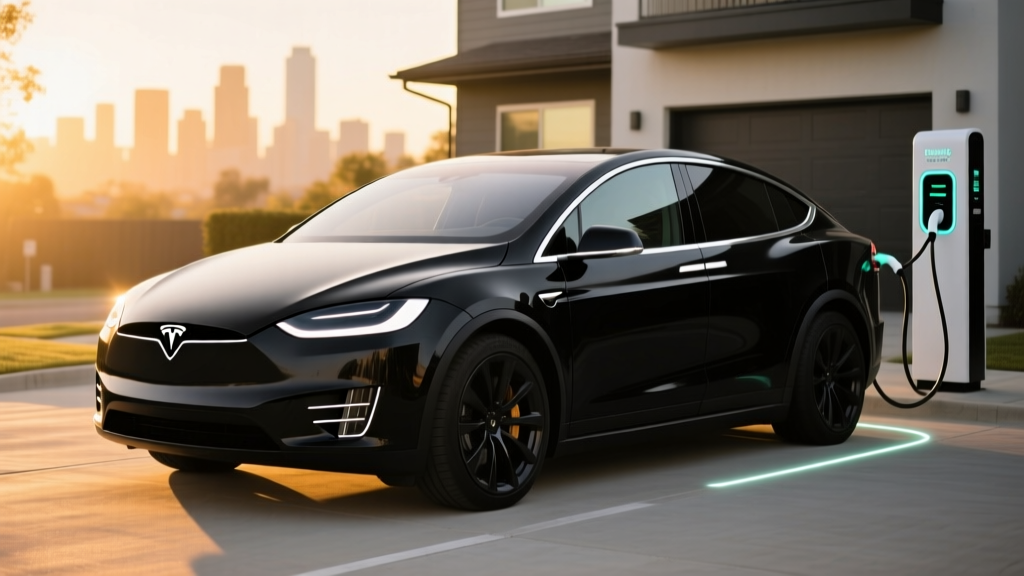
The Tesla Model X has long occupied a unique space in the electric SUV market — a three-row family hauler with falcon-wing doors, supercar-rivaling acceleration, and access to the Supercharger network. For 2026, Tesla offers the Model X in a stealthy, monochromatic "Black Edition" appearance package that pairs gloss-black 22-inch wheels, blacked-out trim, and a Solid Black premium interior with the proven dual-motor all-wheel-drive powertrain. But beyond the aesthetic, does the 2026 Model X still deliver where it counts: real-world range, charging speed, and daily usability?
We've spent time with the 2026 Model X (Dual Motor AWD) equipped with the Black appearance package to bring you exact figures on range, charging, performance, and ownership costs — plus the tax credit realities buyers need to know before signing.
2026 Tesla Model X Black: Quick Verdict
The Model X remains the most spacious and versatile EV SUV Tesla sells, and the Black Edition package gives it a presence that turns heads without the Plaid's $110,000+ price tag. The dual-motor AWD Long Range variant delivers an EPA-rated 335 miles, a usable 100 kWh battery (NMC chemistry), and 250 kW peak DC fast charging. Starting at $79,990 before destination, it undercuts rivals like the BMW iX xDrive50 and Mercedes EQS SUV on price — but its age is starting to show in interior material quality and ride refinement. If you need three rows, Supercharger access, and towing capability in one EV, the Model X is still nearly alone in the segment.
Range, Battery & Efficiency
| Spec | 2026 Model X Long Range AWD |
|---|---|
| EPA Range | 335 miles |
| Battery Capacity (Usable) | ~100 kWh (NMC) |
| Efficiency (EPA Combined) | 102 MPGe / 33 kWh/100mi |
| Drivetrain | Dual-Motor AWD |
| Heat Pump | Standard |
The Model X uses an NMC (nickel-manganese-cobalt) lithium-ion pack, which offers higher energy density than LFP chemistry — important for a vehicle this heavy. Tesla does not publish exact usable kWh figures, but independent teardown data and consumption math place usable capacity at approximately 100 kWh from a ~105 kWh gross pack, with a bottom buffer protecting long-term health. For daily use, Tesla recommends charging to 90% for NMC batteries (roughly 300 miles of range), reserving 100% for road trips.
Charging Speed: DC Fast, Level 2 & Home Setup
| Charging Level | Power / Rate | Time / Speed |
|---|---|---|
| DC Fast Charge (Peak) | 250 kW (Supercharger V3/V4) | 10–80% in ~32 minutes |
| DC Sustained (avg 10–80%) | ~155 kW average | Charge curve tapers above 55% SoC |
| Level 2 (Home Wall Connector) | 11.5 kW / 48A | ~34 miles of range per hour |
| Level 2 (Tesla Destination) | Up to 22 kW (dual charger) | ~66 miles/hr (rare infrastructure) |
| Level 1 (120V household) | ~1.4 kW | ~3–4 miles per hour (emergency only) |
The Model X's 250 kW peak DC fast-charging capability is well-matched to Tesla's V3 and newer V4 Superchargers. In real-world testing, the SUV pulls its peak rate only briefly (typically between 10–25% SoC) before tapering progressively. The 10–80% session averages roughly 155 kW, taking about 32 minutes — competitive but not class-leading against 800V architectures like the Hyundai Ioniq 9 or Kia EV9 GT-Line, which hit 10–80% in under 20 minutes on 350 kW chargers.
At home, the Tesla Wall Connector at 48 amps (11.5 kW on a 60A circuit) adds roughly 34 miles of range per hour, fully replenishing the pack in about 9–10 hours overnight. Most owners will wake up with a full charge daily. Installation on a 200-amp home panel typically runs $800–$1,500 including the $475 Wall Connector hardware, assuming no panel upgrade is needed. Homes with older 100-amp service may face a $2,000–$4,000 panel upgrade — get a quote from a licensed electrician before committing.
Performance & Driving Dynamics
| Performance Metric | Model X Long Range AWD |
|---|---|
| 0–60 mph | 3.8 seconds |
| Horsepower | 670 hp (combined) |
| Torque | ~590 lb-ft |
| Top Speed | 155 mph |
| Towing Capacity | 5,000 lbs (with tow package) |
| Curb Weight | 5,185 lbs |
Even without the tri-motor Plaid powertrain, the dual-motor Model X Long Range is genuinely fast. The 3.8-second 0–60 time puts it ahead of nearly every gas-powered three-row SUV on the market. Instant electric torque makes highway merging effortless, and the low center of gravity (battery pack under the floor) keeps body roll surprisingly controlled for a 5,185-pound vehicle.
The adaptive air suspension is standard and provides a comfortable ride over most surfaces, though the 22-inch wheels included in the Black Edition package transmit more road imperfections than the base 20-inch setup. If ride quality is a priority, consider spec'ing the 20-inch wheels instead — you'll gain roughly 5–8 miles of EPA range as well. The Model X's 5,000-lb towing capacity (with the optional tow package) remains best-in-class for electric SUVs, making it viable for boat trailers, campers, and utility hauling.
Interior, Cargo & Technology
The Black Edition's Solid Black premium interior features vegan leather upholstery, black alcantara accents, and dark wood trim. The 17-inch center touchscreen remains the command center for virtually all vehicle functions — climate, navigation, media, and vehicle settings — with a secondary 8-inch rear touchscreen for second-row passengers.
Cargo and passenger dimensions:
- Cargo (behind 3rd row): 15.0 cu ft
- Cargo (3rd row folded): 42.8 cu ft
- Cargo (all rear rows folded): 85.1 cu ft
- Front trunk (frunk): 6.6 cu ft
- 2nd-row legroom: 40.8 inches
- 3rd-row legroom: 32.7 inches (best for children or short trips)
The falcon-wing rear doors are the Model X's signature feature. They open upward with a double-hinged design that requires less side clearance than conventional doors — useful in tight parking spaces. However, they operate more slowly than standard doors, can struggle in low-clearance garages, and add mechanical complexity. Most owners either love them or tolerate them.
On the tech front, the Model X runs Tesla's latest software with over-the-air updates, a built-in trip planner with battery preconditioning for Supercharger stops, a robust mobile app with remote climate and Sentry Mode camera access, and a premium 22-speaker audio system. Wireless phone charging, heated/ventilated front seats, and a heated steering wheel are all standard.
Pricing, Trims & Federal Tax Credit Eligibility
| Trim | Base MSRP | Destination | Est. Total |
|---|---|---|---|
| Model X Long Range AWD | $79,990 | $1,390 | $81,380 |
| + Black Appearance Package | $3,500 | — | $84,880 |
| + FSD (Supervised) | $8,000 | — | $92,880 |
| Model X Plaid (Tri-Motor) | $94,990 | $1,390 | $96,380 |
The 2026 Model X Long Range AWD starts at $79,990 before the $1,390 destination fee. Adding the Black Appearance Package (gloss-black wheels, blacked-out chrome delete, black badges) brings the total to roughly $84,880. Fully optioned with FSD, premium paint, and 22-inch wheels, expect an as-tested price near $93,000–$95,000.
Federal Tax Credit (§30D) Eligibility: The Model X Long Range qualifies for up to $7,500 under the IRS §30D clean vehicle credit, available as a point-of-sale rebate transferred to the dealer at purchase. However, eligibility depends on several conditions that change periodically:
- MSRP cap: SUVs/vans must be under $80,000 MSRP. The Model X Long Range base ($79,990) just clears this — but adding options that push MSRP above $80,000 can disqualify it. Confirm the final MSRP with your dealer before purchase.
- Buyer income caps: AGI must not exceed $300,000 (joint), $225,000 (head of household), or $150,000 (individual).
- Battery sourcing: Critical minerals and battery components must meet escalating domestic-sourcing thresholds. Tesla sources from multiple suppliers, and eligibility can shift by production batch. Verify current eligibility on fueleconomy.gov before purchasing.
The Model X Plaid ($94,990 MSRP) exceeds the $80,000 SUV cap and does not qualify for the federal credit. For the latest rules, consult the IRS clean vehicle credit page or a tax professional.
Warranty, Ownership Costs & Reliability
| Coverage | Terms |
|---|---|
| Basic Vehicle Warranty | 4 years / 50,000 miles |
| Battery & Drive Unit | 8 years / 150,000 miles (70% minimum capacity retention) |
| Estimated Annual Insurance | $2,800–$4,200 (varies by state/age/driving record) |
| Estimated Electricity Cost | ~$0.13/kWh national avg → ~$429/yr at 12,000 mi |
| Maintenance | Minimal: cabin air filter, wiper fluid, tire rotation |
Tesla's 8-year/150,000-mile battery warranty guarantees at least 70% capacity retention — meaning your 335-mile Model X should still deliver at least 235 miles of range at 150K miles under warranty. Historical data from Tesla's fleet shows most Model X packs retain 85–90% capacity at 100,000 miles, with NMC chemistry proving durable when owners avoid frequent 100% charges and minimize DC fast-charging sessions.
Insurance remains a pain point: Tesla vehicles carry higher premiums than most competitors due to repair costs (aluminum body panels, integrated battery structure, sensor recalibration). Budget $250–$350/month depending on your profile. On the flip side, "fuel" costs are dramatically lower: charging at home at the national average of $0.13/kWh costs roughly $429 per year at 12,000 miles — compared to $2,400+ for a comparable gas SUV at 18 MPG and $3.50/gallon.
Model X vs. Key Competitors
The Model X's closest rivals in 2026 include the BMW iX xDrive50, Mercedes-Benz EQS 580 SUV, Kia EV9 GT-Line AWD, and Rivian R1S. Each makes different trade-offs:
- BMW iX xDrive50: Better interior materials, quieter ride, 324-mile EPA range, starts ~$87,000. No third row. No Supercharger access.
- Mercedes EQS 580 SUV: Luxury benchmark, three rows, ~305-mile range, starts ~$105,000. Expensive and heavy.
- Kia EV9 GT-Line AWD: Best value three-row EV, ~280-mile range, starts ~$60,000, NACS connector (Supercharger access via adapter). Slower (0–60 in 5.0s), less cargo space.
- Rivian R1S Dual-Motor: Off-road capable, three rows, ~352-mile range (Max Pack), starts ~$83,000. No Supercharger access (CCS/NACS). Smaller service network.
The Model X wins on Supercharger network reliability, towing capacity (5,000 lbs), cargo volume, and acceleration. It loses on interior material quality (the 2021 refresh is aging), ride refinement with 22-inch wheels, and third-row space compared to the EQS SUV and R1S.
- 335-mile EPA range with 250 kW Supercharging
- 5,000-lb towing — best in EV SUV class
- Tesla Supercharger network (most reliable DC fast-charging)
- Standard air suspension and AWD
- OTA updates continuously improve the vehicle
- Spacious cargo area (85 cu ft max)
- Falcon-wing doors: slow, complex, low-garage issues
- Interior quality lags BMW/Mercedes at this price
- 22-inch Black Edition wheels hurt ride and range
- No Apple CarPlay / Android Auto
- Insurance costs above segment average
- Third row tight for adults (32.7" legroom)
Who Should Buy the 2026 Model X Black?
The Model X with the Black Appearance Package is best suited for:
- Families needing three rows who regularly road-trip and want Supercharger reliability.
- Active-lifestyle buyers who tow boats, campers, or utility trailers (5,000-lb capacity).
- Tech-forward commuters who value OTA updates, app integration, and Autopilot for highway driving.
- Buyers who want SUV practicality with sports-car acceleration (3.8s 0–60 in a 5,185-lb vehicle).
Look elsewhere if you prioritize interior luxury (BMW iX), off-road capability (Rivian R1S), or maximum third-row comfort (Mercedes EQS SUV). And if you rarely need the third row, the Tesla Model Y Long Range offers similar tech at $30,000 less.
Choose the Rivian R1S if: You want off-road capability, a more rugged aesthetic, and don't mind a smaller service footprint.
Choose the Kia EV9 if: Budget matters most and you can accept slower charging and less range.
Frequently Asked Questions
What is the real-world range of the 2026 Tesla Model X?
The EPA rates the Model X Long Range AWD at 335 miles. In real-world highway driving at 70–80 mph, expect 275–300 miles. In cold weather (below freezing), range drops to approximately 220–250 miles even with the heat pump. City driving with regenerative braking can approach the EPA number.
How fast does the Model X charge at home and on the road?
On a DC fast charger (Supercharger V3/V4), the Model X peaks at 250 kW and charges 10–80% in approximately 32 minutes. At home with a Tesla Wall Connector on a 60A circuit (11.5 kW / 48A), it adds about 34 miles of range per hour, fully recharging overnight in 9–10 hours.
Does the 2026 Tesla Model X qualify for the $7,500 federal tax credit?
The Model X Long Range AWD (base MSRP $79,990) can qualify for up to $7,500 under IRS §30D, but only if the buyer's AGI is within limits ($300K joint / $150K individual), the final MSRP stays under $80,000, and battery-sourcing requirements are met at time of delivery. The Plaid trim ($94,990) does not qualify due to the MSRP cap. Always verify on fueleconomy.gov before purchasing.
Is the Model X worth buying over the Rivian R1S or BMW iX?
If Supercharger access, towing capacity, and cargo volume are your top priorities, the Model X remains the strongest choice. If you prioritize interior luxury and ride comfort, the BMW iX is superior (but lacks a third row). For off-road capability and a more modern platform, the Rivian R1S is compelling — though its charging network access and service footprint are smaller.
What battery chemistry does the Model X use?
The Model X uses NMC (nickel-manganese-cobalt) lithium-ion cells, which offer higher energy density than LFP. Tesla recommends daily charging to 90% for NMC batteries, reserving 100% for long trips. The battery warranty covers 8 years or 150,000 miles with a minimum 70% capacity retention guarantee.
Can I charge the Model X at non-Tesla chargers?
Yes. The 2026 Model X uses the NACS (North American Charging Standard) connector natively, which is now supported by Electrify America, EVgo, and other networks at many new stations. You can also use a CCS adapter for legacy CCS1 stations. Tesla's Supercharger network remains the most reliable option for road trips.