Tesla Model X Bio-Weapon Defense Mode: Gimmick or Genuine Protection?
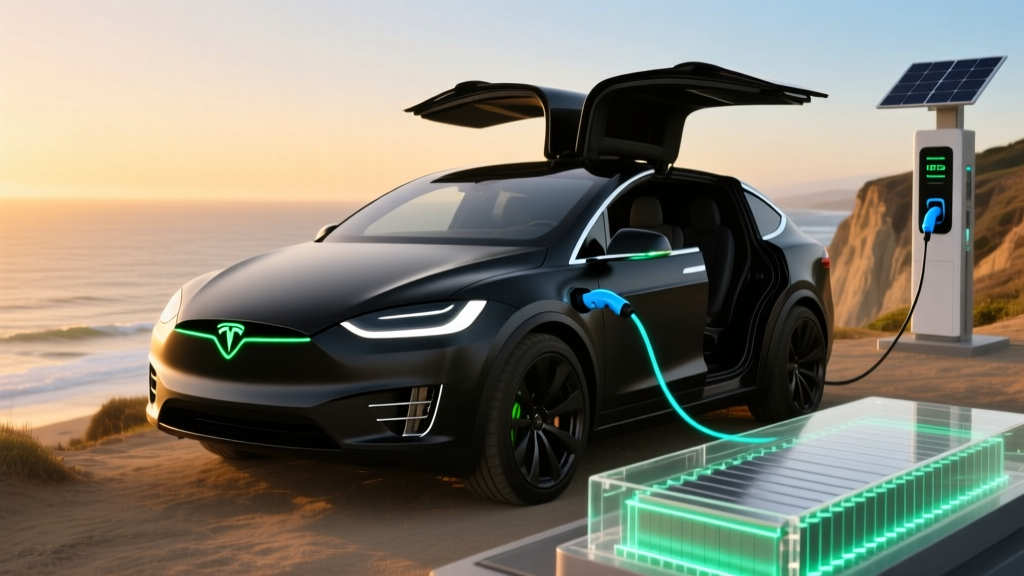
When Tesla introduced Bio-Weapon Defense Mode in the Model X, the name drew laughter and skepticism in equal measure. But behind the marketing theater sits a hospital-grade HEPA filtration system that genuinely outperforms every other cabin air filter on the market. For the 2026 model year, the Tesla Model X remains the only mainstream EV offering this level of cabin air purification — and it pairs that feature with 335 miles of EPA-estimated range, up to 1,020 horsepower, and access to the largest fast-charging network in North America.
This review covers everything a prospective buyer needs: real-world range expectations, DC fast-charging speeds, battery chemistry, pricing after federal tax credits, and whether the Model X still makes sense against rising competition from the Rivian R1S, BMW iX, and Mercedes EQS SUV.
Spec Table: 2026 Tesla Model X at a Glance
| Specification | Long Range (Dual Motor) | Plaid (Tri-Motor) |
|---|---|---|
| EPA Range | 335 miles | 326 miles |
| Battery (usable) | ~100 kWh, NMC | ~100 kWh, NMC |
| Drivetrain | Dual-Motor AWD | Tri-Motor AWD |
| Horsepower | 670 hp | 1,020 hp |
| 0–60 mph | 3.8 sec | 2.5 sec |
| Top Speed | 155 mph | 163 mph |
| Max DC Fast Charge | 250 kW | 250 kW |
| 10–80% DC Time | ~32 min | ~32 min |
| Level 2 Home Charging | 11.5 kW (~34 mi/hr) | 11.5 kW (~34 mi/hr) |
| Efficiency | 100 MPGe / 34 kWh/100mi | 98 MPGe / 35 kWh/100mi |
| Cargo (behind 2nd row) | 42.1 cu ft | 42.1 cu ft |
| Cargo (max, seats folded) | 85.1 cu ft | 85.1 cu ft |
| Seating | 5, 6, or 7 passengers | 5 or 6 passengers |
| Base MSRP | $79,990 | $94,990 |
| Battery Warranty | 8 yr / 150,000 mi | 8 yr / 150,000 mi |
Real-World Range: What the EPA Number Doesn't Tell You
EPA Estimate: 335 miles (Long Range) / 326 miles (Plaid)
Real-World Expectation: Expect 270–295 miles on mixed highway driving at 70–75 mph. In cold weather (below 30°F), plan for 220–260 miles due to battery heating demands and cabin HVAC load. City driving with regenerative braking can return results close to the EPA sticker, sometimes exceeding 310 miles.
The Model X's ~100 kWh NMC (nickel manganese cobalt) battery pack is one of the largest in any consumer EV. Tesla's thermal management system is among the best in the industry, actively preconditioning the pack for both efficiency and charging speed. However, the Model X's brick-like aerodynamics (Cd ~0.25, worse than the Model Y or sedan siblings) and 5,100+ lb curb weight mean highway efficiency suffers noticeably.
On a 75°F day with mixed driving, owners consistently report 280–300 miles before needing to charge. In winter conditions — particularly in northern states where temperatures hover below freezing — the range penalty is real and measurable. Tesla's heat pump (standard since the 2021 refresh) mitigates some cabin heating losses, but battery chemistry still demands energy for thermal conditioning. Preconditioning while plugged in at home is essential for preserving range in cold climates.
Charging Speed: 250 kW Peak, But Read the Curve
| Charging Level | Power / Rate | Miles Added | Notes |
|---|---|---|---|
| Level 1 (120V) | ~1.4 kW | ~3 mi/hr | Emergency/trickle only |
| Level 2 (240V, 48A) | 11.5 kW | ~34 mi/hr | Full charge in ~9 hours |
| DC Fast (Supercharger V3) | Peak 250 kW | ~200 mi in 15 min | 10–80% in ~32 min |
| DC Fast (CCS adapter, EA/others) | Peak ~150–250 kW | Varies by station | Adapter included with new vehicles |
The Model X charges at a peak of 250 kW on Tesla Supercharger V3 stalls. However — and this is critical for road-trip planning — that peak rate is only sustained between roughly 10% and 30% State of Charge (SoC). Above 50%, the charge curve tapers significantly. By 80%, you're pulling closer to 60–80 kW. This is why the 10–80% time is approximately 32 minutes, not the ~15 minutes that simple math on 250 kW might suggest.
For home charging, a Tesla Wall Connector on a 60-amp circuit delivers 11.5 kW (48 amps continuous), adding about 34 miles of range per hour. A full overnight charge from 20% to 90% takes roughly 8–9 hours. Tesla's NACS connector is native, and the included CCS adapter allows access to Electrify America and other non-Tesla networks — though Supercharger reliability remains a significant ownership advantage.
One ownership reality: the Model X's large battery means home charging from near-empty is a multi-hour affair. Most owners who charge nightly from 50–80% will see the car fully topped up by morning without issue. If your utility offers time-of-use rates, scheduling charging for off-peak hours can cut your electricity cost to the equivalent of $1.00–$1.50 per gallon of gasoline.
What Is Bio-Weapon Defense Mode — and Does It Work?
Bio-Weapon Defense Mode is Tesla's branding for a HEPA-grade cabin air filtration system that uses a filter approximately 10 times larger than a standard automotive cabin filter. When activated, the system pressurizes the cabin to create positive air pressure, forcing all incoming air through the HEPA filter and preventing unfiltered air from entering through gaps in door seals or the ventilation system.
The filtration is rated to capture particles down to 0.3 microns at 99.97% efficiency — the same standard used in hospital operating rooms and cleanrooms. In practical terms, this means:
- Wildfire smoke: Dramatically reduces PM2.5 particulates inside the cabin. Owners in California and the Pacific Northwest report this is the single most valuable feature during fire season.
- Allergens and pollution: Filters pollen, dust, and urban smog effectively. Noticeably cleaner cabin air within minutes of activation.
- Odor blocking: Reduces but doesn't entirely eliminate strong chemical odors (some VOCs pass through HEPA, which captures particulates, not gases).
- Biological agents: The name implies military-grade protection. While Tesla's 2016 testing showed the system clearing cabin pollutants rapidly, independent verification of protection against actual biological weapons is not publicly available. Treat it as exceptional particulate filtration — which it is — rather than certified biodefense.
The system adds a secondary activated-carbon filter layer for some gas-phase filtration, but HEPA's core strength is particulate. For wildfire smoke, dust storms, and heavy urban pollution, Bio-Weapon Defense Mode is legitimately best-in-class. No competitor — not Rivian, not BMW, not Mercedes — offers a comparable system.
One practical note: the large HEPA filter requires replacement roughly every 2–3 years (depending on environment), at a cost of approximately $150–$250 at a Tesla Service Center. Owners in high-pollution or wildfire-prone areas may need annual replacement.
Performance, Interior, and Technology
The Model X Long Range delivers 670 hp and a 3.8-second 0–60 mph time — already supercar territory for a 5,100-pound SUV. The Plaid variant's tri-motor setup produces 1,020 hp and hits 60 mph in 2.5 seconds, making it one of the quickest production SUVs ever built. Both variants feature adaptive air suspension with automatic ride-height adjustment and a towing capacity of up to 5,000 lbs (Long Range) when properly equipped.
Inside, the 17-inch center touchscreen (landscape orientation since the 2021 refresh) runs Tesla's infotainment OS with Netflix, YouTube, and gaming capability while parked. The yoke steering wheel remains polarizing — excellent forward visibility, awkward for low-speed maneuvers and three-point turns. A conventional round steering wheel is available as a no-cost option.
The second row offers three individual captain's chairs (in 6-seat config) or a bench (5-seat), with a power-folding third row available for 7-seat layouts. Rear legroom measures 40.9 inches (second row) and 32.7 inches (third row — tight for adults). Cargo space behind the second row is 42.1 cu ft, expanding to 85.1 cu ft with both rear rows folded. The front trunk (frunk) adds 6.5 cu ft for charging cables and groceries.
On the driver-assistance front, Tesla's Autopilot comes standard and includes adaptive cruise control and lane-keeping. Full Self-Driving (Supervised) is a $8,000 add-on (or $99/month subscription) that adds automated lane changes, traffic light recognition, and city-street navigation. Importantly, FSD is an SAE Level 2 system — the driver must remain fully engaged, hands on wheel, eyes on road at all times. It is not autonomous driving.
Pricing, Tax Credits, and Total Cost
| Trim | Base MSRP | Destination | Federal §30D Credit | Est. Net Price |
|---|---|---|---|---|
| Long Range | $79,990 | $1,995 | Up to $7,500* | ~$74,485 |
| Plaid | $94,990 | $1,995 | Up to $7,500* | ~$89,485 |
*Federal §30D tax credit eligibility for 2026 depends on multiple factors. Per the IRS, the buyer must meet income caps ($300,000 joint / $150,000 single MAGI), the vehicle MSRP must not exceed $80,000 for SUVs/vans/pickups (the Long Range qualifies; the Plaid at $94,990 base MSRP exceeds the cap and does not qualify), and battery components and critical minerals must meet phased-in sourcing thresholds. The credit can now be transferred to the dealer as a point-of-sale discount. Consult a tax professional to confirm your eligibility.
The MSRP cap is the critical detail here. The Model X Long Range at $79,990 squeaks under the $80,000 SUV cap and may qualify for the full $7,500 credit — provided battery sourcing requirements are met for the specific build. The Plaid at $94,990 exceeds the cap and is ineligible for the federal credit regardless of buyer income. This makes the Long Range the value play by a wide margin when the credit applies.
For total cost of ownership, the Model X benefits from minimal maintenance (no oil changes, brake pad life extended by regen braking, no transmission fluid), but insurance premiums run 20–40% higher than comparable gas SUVs due to repair cost data. Expect annual insurance of $2,800–$4,200 depending on your state and driving record, per industry data.
Pros and Cons
Pros
- Best-in-class HEPA cabin filtration (Bio-Weapon Defense Mode)
- 335-mile EPA range; Supercharger network reliability
- 670–1,020 hp; 2.5-sec 0–60 (Plaid) in a 7-seat SUV
- Falcon-wing doors improve rear-seat access in tight spaces
- Over-the-air updates continuously add features
- 5,000-lb towing capacity (Long Range)
Cons
- Plaid exceeds $80K MSRP cap — no federal tax credit
- Real-world highway range drops to ~270–295 mi; worse in cold
- 250 kW peak charge rate trails Hyundai/Kia 800V architectures
- Third row is cramped for adults (32.7" legroom)
- Falcon-wing doors can be slow and have sensor quirks
- Insurance costs significantly above segment average
Model X vs. the Competition: Is It Worth It?
The Model X occupies a unique space. No competitor offers the HEPA filtration system, and few match its combination of range, performance, and Supercharger access. But the competitive landscape has matured:
- Rivian R1S: More off-road capable, competitive range (~340 mi with Max Pack), quad-motor performance, and qualifies for the §30D credit on certain trims. Lacks Bio-Weapon Defense Mode. Better third row.
- BMW iX xDrive50: Superior interior materials, ~324 mi EPA range, more refined ride. No HEPA-level filtration. Less cargo space.
- Mercedes EQS 450+ SUV: 305 mi range, luxurious cabin, excellent DC charging speeds. Significantly more expensive and no biodefense filtration.
- Kia EV9: Far more affordable (~$55K–$74K), 3-row seating, 800V architecture for faster charging, qualifies for credits. Lower range (~270 mi) and far less performance.
If Bio-Weapon Defense Mode is a priority — whether for wildfire-prone regions, severe allergies, or urban pollution — the Model X has no substitute. If you need the best-driving luxury electric SUV with the longest proven range and the most reliable public charging network, it still holds its ground. If budget or third-row comfort is paramount, the Rivian R1S or Kia EV9 deserve serious consideration.
Frequently Asked Questions
Does Tesla Bio-Weapon Defense Mode really protect against biological threats?
The HEPA filter captures 99.97% of particles at 0.3 microns, which includes most bacteria, mold spores, and wildfire particulates. However, "bio-weapon defense" is marketing language — the system isn't independently certified against military-grade biological agents. For real-world particulate protection (smoke, allergens, smog), it is genuinely exceptional and the best available in any production vehicle.
What is the real-world range of the Tesla Model X?
The EPA rates the Long Range at 335 miles and the Plaid at 326 miles. In real-world highway driving at 70–75 mph, expect 270–295 miles. In cold weather (below 30°F), range can drop to 220–260 miles. Preconditioning the battery while plugged in helps mitigate cold-weather losses.
Does the 2026 Tesla Model X qualify for the $7,500 federal EV tax credit?
The Long Range trim at $79,990 MSRP is under the $80,000 SUV cap and may qualify, subject to buyer income limits ($300K joint / $150K single) and battery sourcing requirements. The Plaid at $94,990 exceeds the MSRP cap and does not qualify. Always verify current rules on IRS.gov and consult a tax professional.
How fast does the Model X charge at home and on the road?
At home on a Level 2 Tesla Wall Connector (11.5 kW / 48A), the Model X adds ~34 miles of range per hour, fully charging overnight in ~9 hours. On a V3 Supercharger, it peaks at 250 kW and charges from 10–80% in approximately 32 minutes, though the rate tapers significantly above 50% SoC.
How often does the HEPA filter need replacement?
Tesla recommends cabin filter replacement every 2–3 years under normal conditions. In areas with heavy wildfire smoke, dust, or pollution, annual replacement may be necessary. Expect to pay $150–$250 for the filter and service.
Is the Model X a good family vehicle?
For families of 4–5, it's excellent — generous cargo space, top safety ratings from NHTSA, and the HEPA system is invaluable for children with allergies. The third row works for small children but is tight for teenagers or adults on longer trips. If you regularly carry 6–7 passengers, the Rivian R1S offers a more usable third row.