The Tesla Model X and the Bike-Rack Question
Search for "Tesla Model X bike rack" and you'll find a lot of forum debates and very little clarity. The Model X is one of the few electric SUVs with genuine towing capability, but pairing it with a hitch-mounted bike rack involves trade-offs that most marketing materials gloss over. This guide covers which racks work, how a loaded rack impacts real-world range, and provides a complete 2026 Model X spec profile so you know exactly what you're buying before you bolt a hitch to the back.
For 2026, Tesla continues to sell the Model X in Long Range and Plaid trims, both built on the refreshed architecture introduced in 2021 with ongoing software and battery-management updates. It remains the only electric SUV in its price class that offers a factory tow hitch, falcon-wing rear doors, and a three-row seating option — a combination that makes it uniquely suited for active families who need to haul bikes, kayaks, or a small trailer.
2026 Tesla Model X: Full Specifications at a Glance
| Specification | Value |
|---|---|
| EPA Range | 320 miles (Long Range) / 311 miles (Plaid) |
| Battery Capacity | ~100 kWh usable (NMC chemistry) |
| Drivetrain | Dual-Motor AWD (Long Range) / Tri-Motor AWD (Plaid) |
| Horsepower | 670 hp (LR) / 1,020 hp (Plaid) |
| 0–60 mph | 3.8 sec (LR) / 2.5 sec (Plaid) |
| Max DC Fast Charge | 250 kW (peak) |
| 10–80% DC Charge Time | ~30 minutes |
| Level 2 Home Charging | 11.5 kW / ~34 mi/hr (48A Wall Connector) |
| Efficiency | 100 MPGe combined / 34 kWh/100 mi |
| Towing Capacity | 5,000 lbs (with factory tow package) |
| Cargo Volume | 88.1 cu ft (behind 1st row, 5-seat) / 26.6 cu ft (behind 3rd row) |
| Seating | 5, 6, or 7 passengers |
| Base MSRP | $79,990 (LR) / $94,990 (Plaid) |
| Battery Warranty | 8 years / 150,000 miles (min 70% retention) |
| Basic Warranty | 4 years / 50,000 miles |
Real-World Range: What the EPA Sticker Doesn't Tell You
The Model X uses an NMC (nickel manganese cobalt) battery pack, which offers higher energy density than LFP but is more sensitive to extreme temperatures. Tesla's thermal management system is among the best in the industry — the battery is preconditioned automatically when you navigate to a Supercharger — but physics still governs cold-weather losses. If your weekend ride starts in Denver in January, a 320-mile EPA rating translates to roughly 210–230 miles of practical range before you need to stop.
The aerodynamic penalty of a bike rack is significant and often underestimated. A hitch rack with four bikes increases the vehicle's frontal drag area by an estimated 15–20%, which at highway speeds translates directly to higher energy consumption. On the Model X, which averages around 34 kWh/100 mi unladen, expect that to climb to 40–44 kWh/100 mi with a loaded rack. Source: fueleconomy.gov.
Which Bike Racks Actually Work With the Model X?
The Model X's falcon-wing rear doors are the primary complication. These doors open upward and outward using ultrasonic sensors to avoid obstacles. Any bike rack that interferes with the door arc — or triggers the proximity sensors — will cause malfunctions. Here's what works:
Factory Tow Hitch + Hitch-Mounted Rack (Recommended)
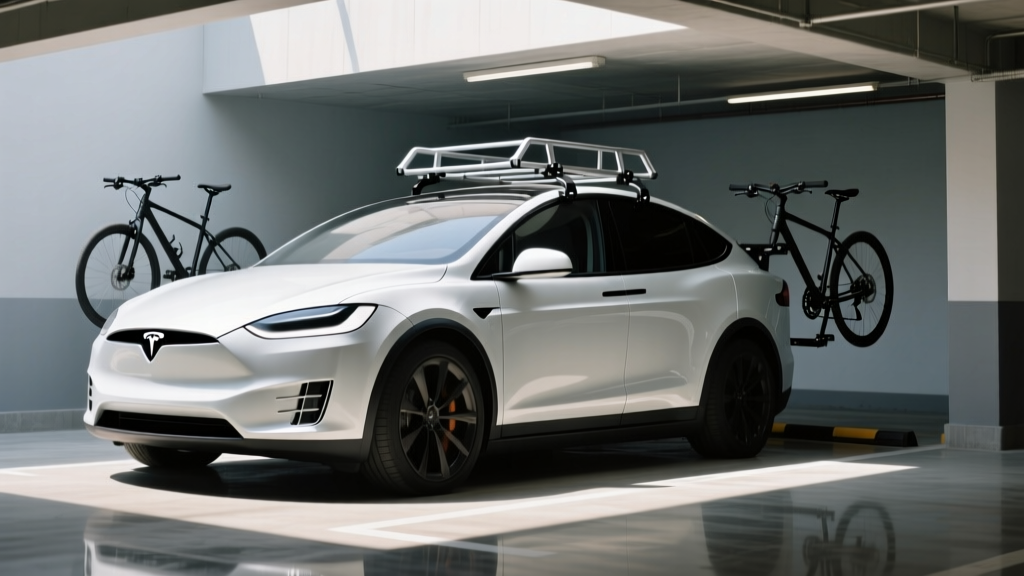
Tesla offers a factory-installed tow hitch with a 2-inch receiver, rated for 5,000 lbs towing and 500 lbs tongue weight. This is the cleanest solution because it positions the rack below the falcon-wing door arc. Compatible racks include:
- 1Up USA Equip-D — premium tray-style, 4-bike capacity, ~$750
- Kuat NV 2.0 — tray-style with integrated cable lock, 4-bike, ~$1,200
- Thule T2 Pro XTR — heavy-duty tray, 4-bike, ~$900
- Yakima OnRamp — e-bike compatible (higher weight capacity per tray), 2-bike, ~$700
Keep total rack-plus-bike weight under 500 lbs (the tongue-weight limit). Four road bikes at ~20 lbs each plus a 60-lb rack puts you around 140 lbs — well within spec. Four e-bikes at 55 lbs each plus a 70-lb rack pushes ~290 lbs — still safe, but approaching the upper range.
Roof-Mounted Racks
The Model X has factory roof rails and available crossbars. Roof racks (e.g., Thule ProRide, Yakima HighRoad) avoid the falcon-wing issue entirely. The trade-off: roof-mounted bikes raise the center of gravity, increase wind noise, and reduce range by a similar 10–15% margin. Lifting bikes onto a 6-foot-tall roof is also impractical for many owners.
Trunk/Hatch-Mounted Racks (Not Recommended)
Traditional strap-on trunk racks are incompatible with the Model X. The falcon-wing doors, glass hatch, and active spoiler provide no secure mounting surface, and strap pressure can damage body panels. Avoid these entirely.
Charging Speed: Supercharger Network and Home Setup
| Charging Level | Power | Speed / Time |
|---|---|---|
| Level 1 (120V household) | ~1.4 kW | ~4 mi/hr — emergency only |
| Level 2 (240V Wall Connector, 48A) | 11.5 kW | ~34 mi/hr / full charge in ~9 hrs |
| DC Fast Charge (Supercharger V3) | 250 kW peak | 10–80% in ~30 min |
| DC Fast Charge (Supercharger V4) | Up to 325 kW peak* | 10–80% in ~25 min* |
*V4 Supercharger speeds depend on station deployment and battery preconditioning; sustained rates taper significantly above 60% state of charge.
The Model X's charge curve is typical for a 100 kWh NMC pack: it holds near peak 250 kW from roughly 10–35% SoC, then progressively tapers. By 60% SoC, you're seeing ~150 kW; by 80%, roughly 70–80 kW. This is why the 10–80% metric matters more than peak kW — the 30-minute figure reflects the entire session, not the best 60 seconds.
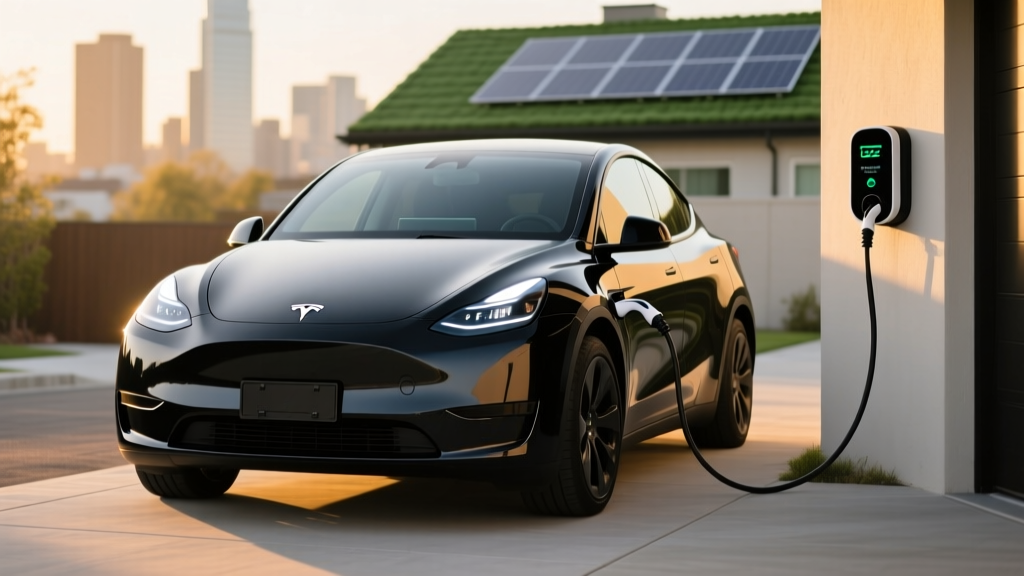
For home charging, Tesla's Wall Connector on a 60-amp circuit delivers 48 amps (11.5 kW), adding roughly 34 miles per hour of charging. A full overnight session easily replenishes the pack. Installation typically runs $800–$2,000 depending on panel proximity and whether your electrical service needs a 200-amp upgrade. Always hire a licensed electrician and pull permits — the Model X's continuous 48A draw requires a circuit rated for 60A.
Pricing, Trims, and Federal Tax Credit Eligibility
| Trim | Base MSRP | As-Tested (typical options) |
|---|---|---|
| Long Range AWD | $79,990 | $85,000–$90,000 |
| Plaid (Tri-Motor) | $94,990 | $100,000–$108,000 |
Federal tax credit status: The 2026 Model X does not qualify for the $7,500 IRS §30D new EV tax credit. Under current rules, the credit is limited to SUVs with an MSRP at or below $80,000. While the Long Range base price of $79,990 technically squeaks under that cap, the addition of any factory option (tow hitch, premium paint, 22-inch wheels, six-seat interior) pushes the vehicle above the threshold. Additionally, the buyer must meet income limits ($300,000 joint / $150,000 single modified AGI) and the vehicle's battery must satisfy critical-mineral and battery-component sourcing requirements under the Inflation Reduction Act. See the IRS §30D guidelines for full eligibility details.
For buyers who do qualify and can spec a base Long Range with zero options, the point-of-sale credit transfer is theoretically possible — but in practice, virtually no Model X leaves the factory at bare MSRP. Budget accordingly.
Performance, Tech, and Daily Ownership
Even at 5,100+ lbs, the Model X Long Range hits 60 mph in 3.8 seconds — quicker than most sports sedans. The Plaid's 2.5-second sprint is absurd for a seven-seat SUV but comes at a $15,000 premium and a slight range penalty. Both trims include adaptive air suspension, which lowers the vehicle at highway speeds to reduce drag and can raise for rough driveways or light off-pavement use.
The 17-inch center touchscreen runs Tesla's latest infotainment software, including navigation with automatic Supercharger routing and preconditioning. The second row gets its own 8-inch display for climate and entertainment. Apple Music, Spotify, and Netflix (while parked) are integrated. Over-the-air updates continue to add features — in 2025, Tesla added improved adaptive cruise smoothing and enhanced Sentry Mode recording.
Autopilot and FSD: Every Model X includes basic Autopilot (traffic-aware cruise control and lane centering). Tesla's Full Self-Driving (Supervised) package is a $8,000 add-on or $99/month subscription.
Notable Drawbacks
- Falcon-wing doors are slow to open (~6 seconds) and can struggle in tight parking garages or heavy rain (water drips from the hinge seams).
- Panel gaps and interior material quality remain inconsistent compared to similarly priced luxury SUVs from BMW, Mercedes, and Rivian.
- No Apple CarPlay or Android Auto — Tesla's proprietary system is capable but locks you into their ecosystem.
- Insurance costs run 20–35% higher than comparable gas SUVs due to repair complexity and parts pricing.
- Third-row space is tight for adults — best suited for children on short trips. Cargo behind the third row is just 26.6 cu ft.
Pros and Cons: The Honest Scorecard
Pros
- Best-in-class 320-mile EPA range for a 3-row electric SUV
- Factory tow hitch supports bike racks and up to 5,000-lb towing
- Supercharger network access — the most reliable DC fast-charging ecosystem
- Tri-motor Plaid offers supercar acceleration in a family hauler
- OTA updates keep the vehicle current years after purchase
- Frunk + rear cargo offer versatile storage for gear and bikes
Cons
- Base price near $80K; realistically $85–$100K+ after options
- Effectively ineligible for the $7,500 federal tax credit
- Falcon-wing doors add complexity and can malfunction in freezing rain
- Bike rack + highway driving cuts real-world range to ~230–250 miles
- Insurance premiums significantly above segment average
- Third row is cramped; competitors like the Rivian R1S offer more space
How It Stacks Up Against Key Competitors
The Model X doesn't exist in a vacuum. Here's how it compares to the other electric SUVs that active families actually cross-shop:
| Vehicle | EPA Range | Tow Capacity | Base MSRP | Bike Rack Solution |
|---|---|---|---|---|
| Tesla Model X LR | 320 mi | 5,000 lbs | $79,990 | Factory 2" hitch + tray rack |
| Rivian R1S (Dual-Motor) | 352 mi | 7,700 lbs | $79,900 | Factory 2" hitch + integrated gear tunnel |
| Kia EV9 (GT-Line AWD) | 270 mi | 5,000 lbs | $63,900 | Dealer-installed hitch; limited rack options |
| BMW iX xDrive50 | 324 mi | 3,500 lbs | $87,250 | Factory hitch available; roof rails standard |
The Rivian R1S is the Model X's closest rival for the "active family with bikes" use case. It offers more cargo space, a standard 2-inch hitch, a gear tunnel (on some trims), and competitive range. The Model X counters with Supercharger access (though Rivian now has NACS adapters and Supercharger access as of 2025), a more refined ride, and Tesla's software ecosystem. The Kia EV9 is the value pick but sacrifices ~50 miles of range and has less proven charging infrastructure. The BMW iX is a luxury cruiser but its 3,500-lb tow rating limits rack and trailer options.
Who Should Buy the 2026 Model X?
Choose the Model X if: You need a three-row electric SUV with a proven tow hitch for bike racks or light trailers, you value Supercharger access for road trips, and you're comfortable with Tesla's proprietary software ecosystem and service model.
Look elsewhere if: You need maximum third-row space (Rivian R1S), you want a sub-$65K price point (Kia EV9), you need the longest possible range for towing (R1S Max Pack at 410 mi), or you prefer traditional luxury build quality (BMW iX).
Frequently Asked Questions
Can I install a hitch on the Model X after delivery?
Yes, Tesla offers a retrofit tow hitch through service centers for approximately $1,500–$2,000 installed. Third-party hitches (e.g., EcoHitch) are also available for ~$600–$800 plus installation. Ensure any aftermarket hitch does not interfere with the rear diffuser or ultrasonic sensors.
How much range do I lose with a bike rack on the Model X?
Expect a 15–25% range reduction at highway speeds with a loaded hitch-mounted rack carrying four bikes. That translates to roughly 50–75 fewer miles from the 320-mile EPA estimate. Roof-mounted racks produce a similar penalty. Preconditioning and moderate speeds (65 mph vs. 75 mph) can recover some of that loss.
Does the Model X qualify for any federal or state EV incentives?
Under current 2026 IRS §30D rules, the Model X is effectively ineligible for the $7,500 federal credit because any option pushes it above the $80,000 MSRP cap for SUVs. Some states offer additional rebates (e.g., California's CVRP, though income-limited) — check your state's energy office. Tesla does not offer a point-of-sale discount in lieu of the credit.
Can I charge the Model X at non-Tesla DC fast chargers?
The 2026 Model X uses Tesla's NACS connector natively. With the included CCS adapter (or a third-party A2Z adapter), you can charge at Electrify America, EVgo, and other CCS-equipped networks. Tesla has also opened its Supercharger network to other brands, so Supercharger stalls are increasingly shared — but Tesla vehicles still get priority pricing and seamless plug-and-charge authentication.
What's the best bike rack for the Tesla Model X?
For a factory-hitch-equipped Model X, the Kuat NV 2.0 (4-bike, tray-style) and 1Up USA Equip-D are the top choices. Both clear the falcon-wing door arc, support up to 60 lbs per tray (e-bike compatible), and include integrated locking. Avoid any rack that extends above the hitch receiver height enough to enter the door sensor zone.
How long does the Model X battery last?
Tesla warranties the battery for 8 years or 150,000 miles (whichever comes first) with a minimum 70% capacity retention. Real-world data from high-mileage Model X owners suggests NMC packs degrade approximately 10–12% over the first 100,000 miles, then slow considerably. Many 2016–2018 Model X vehicles still retain 82–88% of original capacity at 120,000+ miles. Battery replacement, if needed out of warranty, runs $15,000–$22,000 at current pricing.