Quick Verdict: The Model X in 2026
The Tesla Model X remains one of the few three-row electric SUVs that can credibly claim supercar acceleration while hauling a family of six. For 2026, it carries over with the same 100 kWh battery architecture, refreshed interior, and the polarizing yoke steering option. But beyond the headline performance numbers, a growing segment of owners is looking for practical ways to customize the cabin — specifically, Tesla Model X adhesive-based mounts alternatives that avoid the residue, paint damage, and heat-related failures that plague sticky dashboard and windshield solutions. This review covers the full ownership picture: real-world range, charging speeds, tax credit math, and the best non-adhesive mounting strategies for accessories like dashcams, toll transponders, and phone holders.
| Spec | Long Range AWD | Plaid |
|---|---|---|
| EPA Range | 335 mi | 311 mi |
| Battery (usable) | ~100 kWh (NMC) | ~100 kWh (NMC) |
| Drivetrain | Dual-Motor AWD | Tri-Motor AWD |
| Horsepower | 670 hp | 1,020 hp |
| 0–60 mph | 3.8 sec | 2.5 sec |
| Peak DC Fast Charge | 250 kW | 250 kW |
| 10–80% DCFC Time | ~31 min | ~31 min |
| Level 2 Charge Rate | 11.5 kW (~34 mi/hr) | 11.5 kW (~34 mi/hr) |
| MPGe (combined) | 98 MPGe | 98 MPGe |
| Efficiency | 34 kWh/100 mi | 34 kWh/100 mi |
| Base MSRP | $79,990 | $94,990 |
| Federal Tax Credit (§30D) | Up to $7,500* | Up to $7,500* |
| Battery Warranty | 8 yr / 150,000 mi | 8 yr / 150,000 mi |
*Subject to IRS §30D income caps, MSRP caps (SUVs: $80,000), battery sourcing requirements, and point-of-sale transfer. Verify current eligibility at irs.gov.
Range & Efficiency: EPA vs. the Real World
EPA Sticker: 335 miles (Long Range) / 311 miles (Plaid)
Real-World Expectation: ~280–305 mi highway (Long Range); ~255–280 mi (Plaid). In cold weather (below 32°F), expect a 15–25% reduction, dropping effective range to ~220–260 mi depending on cabin heating demand and terrain.
The Model X's ~100 kWh NMC (nickel manganese cobalt) battery pack gives it substantial energy reserves, but the vehicle's 5,185-pound curb weight and large frontal area work against highway efficiency. In mixed suburban driving at moderate temperatures, hitting the EPA 335-mile figure in the Long Range is realistic. Sustained 75–80 mph highway travel, however, typically yields 280–305 miles before the battery buffer engages.
The Plaid's tri-motor setup adds weight and parasitic drag from the third motor, explaining its 24-mile EPA deficit. Cold-weather range loss is a physics reality for all EVs — the Model X's heat pump helps mitigate cabin heating energy draw, but battery chemistry itself becomes less efficient below freezing. Owners in northern climates should plan for ~220–260 miles of usable winter range on a full charge, and preconditioning the battery before DC fast charging becomes essential to achieve advertised charge speeds.
At 34 kWh/100 miles (Long Range), efficiency is competitive for a three-row electric SUV but trails smaller crossovers like the Hyundai Ioniq 5 or Tesla Model Y. For context, the EPA's fueleconomy.gov lists combined MPGe at 98.
Charging Speed: DC Fast, Level 2, and the Curve Reality
| Level | Power | Speed (mi/hr) | Notes |
|---|---|---|---|
| Level 1 (120V) | ~1.4 kW | ~3 mi/hr | Emergency/top-up only |
| Level 2 (240V, 48A) | 11.5 kW | ~34 mi/hr | Full charge in ~10 hr |
| DC Fast (V3 Supercharger) | Peak 250 kW | ~200 mi in 15 min | 10–80% in ~31 min |
| DC Fast (V4 Supercharger) | Up to 250 kW | Similar to V3 | CCS adapter not needed (native NACS) |
The Model X charges at a peak rate of 250 kW on Tesla's V3 and V4 Supercharger network using the native NACS (North American Charging Standard) connector. That peak rate is only sustained between roughly 10% and 30% state of charge. From 30–60%, the rate tapers to approximately 150–170 kW, and above 80%, it drops sharply to protect battery longevity — often below 50 kW. This is the charge curve taper every EV owner should understand: the advertised 250 kW is a peak, not an average.
For home charging, the onboard charger accepts up to 11.5 kW (48 amps on a 60-amp circuit). A full 0–100% charge takes roughly 10 hours — practical for overnight replenishment. Home Level 2 installation typically costs $800–$2,000 depending on panel proximity and whether a 200-amp service upgrade is needed. Tesla's Wall Connector retails around $475 and is hardwired for maximum throughput.
Preconditioning matters: navigating to a Supercharger in the Tesla app or in-car navigation warms the battery to optimal temperature, enabling the full 250 kW peak. Without preconditioning — especially in cold weather — you may see peak rates limited to 100–150 kW until the pack warms up, adding 10–15 minutes to your stop.
Performance & Drivetrain
The Long Range dual-motor AWD delivers 670 horsepower and a 3.8-second 0–60 mph time — numbers that would have defined a supercar a decade ago. The Plaid's tri-motor setup (one front, two rear) produces 1,020 horsepower and hits 60 mph in 2.5 seconds, making it one of the quickest production SUVs ever built. Both variants feature Tesla's adaptive air suspension, which adjusts ride height for highway efficiency or rough-road clearance.
Regenerative braking is strong and effectively enables one-pedal driving in most conditions, though Tesla removed the adjustable regen setting years ago — it's fixed at maximum. Towing capacity reaches 5,000 pounds when properly equipped, adequate for light trailers or a pair of jet skis but not heavy boat hauling.
Interior, Cargo & Accessory Mounting: Adhesive-Free Alternatives
The Model X cabin seats five standard, with optional six- or seven-passenger configurations. The panoramic windshield creates an airy feel but introduces a practical challenge: where do you mount accessories without marring the glass or dashboard?
| Measurement | Dimension |
|---|---|
| Cargo (behind 3rd row) | ~15 cu ft |
| Cargo (3rd row folded) | ~44 cu ft |
| Cargo (all rear rows folded) | ~81 cu ft |
| Front trunk (frunk) | ~7 cu ft |
| 2nd-row legroom | 38.4 in |
| 3rd-row legroom | 32.7 in |
Many owners default to adhesive-based mounts for dashcams, toll transponders (E-ZPass, FasTrak), phone holders, and radar detectors. The problem: Tesla's interior materials — soft-touch plastics, Alcantara-like headliners, and the laminated windshield — don't tolerate adhesive removal well. Heat from cabin sun exposure degrades adhesive bonds, and residue cleanup risks damaging the dashboard surface. Here are the best Tesla Model X adhesive-based mounts alternatives by accessory type:
Dashcam Mounts
- Friction-mount dash pods: Weighted, non-slip bases (e.g., Garmin or Vantrue suction/friction hybrids) sit on the dashboard shelf without adhesive. The Model X's wide dash shelf accommodates most 3–4 inch bases securely.
- Windshield suction cups with silicone grip: High-quality silicone suction cups (not cheap PVC) hold reliably on the Model X windshield when applied to the upper passenger-side zone, avoiding the tinted band. Brands like RAM Mounts offer removable suction arms rated for 5+ pounds.
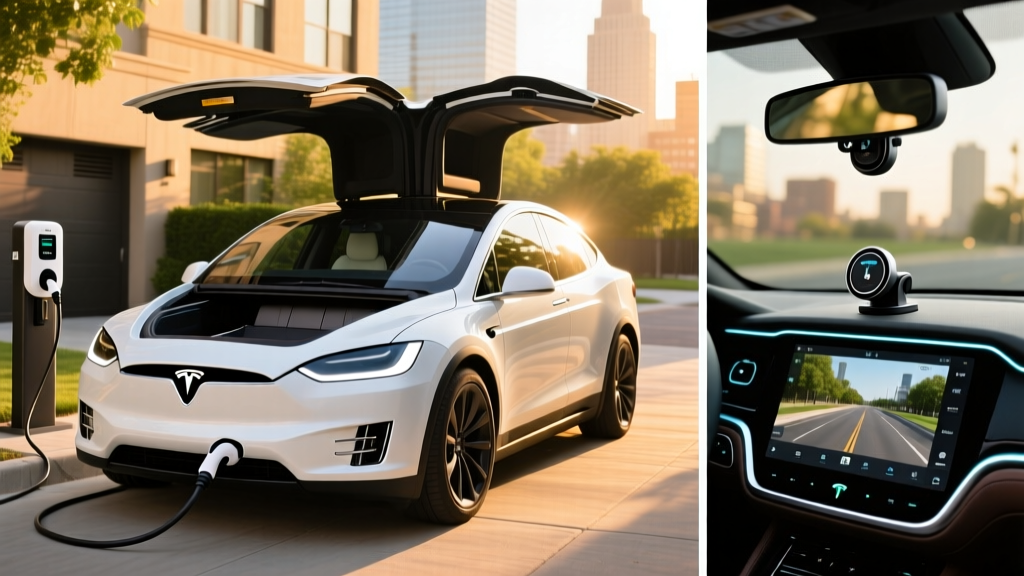
- Rearview mirror clamp mounts: Third-party clamp brackets attach to the mirror stalk, positioning a dashcam behind the mirror housing — completely adhesive-free and nearly invisible from outside.
Toll Transponder & Phone Mounts
- Magnetic vent clips: The Model X's horizontal vents accept magnetic phone mounts (e.g., iOttie, Scosche). For toll transponders, a static-cling windshield mount in the upper-right corner avoids adhesive entirely.
- CD-slot or console friction mounts: Though the Model X lacks a CD slot, console-edge friction clips from brands like TOPGO wedge into the center console trim gap without adhesive or tools.
- Static-cling vinyl pads: Apply a reusable static-cling vinyl sheet to the windshield, then attach a suction mount to the vinyl. This double-layer approach eliminates adhesive contact with glass and is fully removable.
Radar Detectors & Accessories
- Suction-cup windshield mounts (dual-cup): Dual-cup suction systems distribute weight and resist heat-related detachment far better than single cups. Escort and Valentine One include these as standard.
- Visor clips: Lightweight accessories like toll passes or parking permits clip directly to the sun visor fabric using spring-loaded clips — zero adhesive, zero damage.
Pricing, Tax Credits & Total Cost
| Trim | Base MSRP | As-Tested (typical options) | Est. Price After §30D Credit* |
|---|---|---|---|
| Long Range AWD | $79,990 | $85,000–$90,000 | $72,490–$82,500 |
| Plaid | $94,990 | $100,000–$108,000 | $87,490–$100,500 |
*§30D credit eligibility requires: buyer AGI ≤ $300K (MFJ) / $150K (single); SUV MSRP ≤ $80,000 (Long Range base qualifies, Plaid does not); battery meets critical-mineral and component sourcing thresholds. Credit can be transferred to dealer at point of sale. Verify at irs.gov before purchase. Note: Long Range with options exceeding $80,000 MSRP may lose eligibility.
The MSRP cap is the critical gotcha: the IRS classifies the Model X as an SUV, which carries an $80,000 cap (vs. $55,000 for sedans). The Long Range base price of $79,990 squeaks under, but adding FSD ($8,000), premium paint, or 22-inch wheels pushes the MSRP above the threshold. The Plaid, at $94,990 base, does not qualify regardless of options. Buyers targeting the credit should configure carefully and confirm the final MSRP before signing.
Insurance for the Model X runs $2,800–$4,200 annually depending on state, age, and driving record — significantly above the EV average due to repair costs and performance classification. Tesla's own insurance product is available in many states and uses real-time driving data to adjust premiums.
Tech, Driver Assistance & Safety
The Model X runs Tesla's current infotainment stack on a 17-inch center touchscreen with a secondary 8-inch rear passenger display. Wireless Apple CarPlay is not supported — Tesla's native interface handles navigation, media, and vehicle controls exclusively. The 22-speaker audio system is among the best in any SUV at any price point.
SAE Automation Level: Level 2. Tesla's Autopilot and Full Self-Driving (Supervised) are driver-assistance systems, not autonomous driving. The driver must remain engaged, hands on the wheel (or torque-applied with the yoke), and eyes on the road at all times. FSD (Supervised) can navigate highway on-ramps, change lanes, and handle some city intersections, but it requires constant supervision and is not a Level 3 or Level 4 system.
What Autopilot/FSD Does NOT Do: It does not drive autonomously. It does not eliminate driver liability. It does not guarantee safe passage through construction zones, unmapped roads, or adverse weather. NHTSA continues to investigate Tesla's driver-monitoring adequacy — check nhtsa.gov for current recalls and investigations before purchase.
Safety ratings from NHTSA award the Model X five stars overall. The IIHS has not recently tested the current-generation Model X, so buyers relying on IIHS Top Safety Pick data should note this gap. Standard active safety includes automatic emergency braking, lane departure warning, blind-spot monitoring, and 360-degree cameras.
Competitors & Decision Framework
Choose the Tesla Model X if:
- You need three rows and want the fastest acceleration available in an electric SUV
- Supercharger network access and native NACS charging are priorities for road trips
- You value OTA software updates and a mature EV ecosystem
- Three-row seating with falcon-wing rear doors appeals for tight parking access
Look at competitors if:
- Kia EV9: You want three rows under $60K with a conventional SUV layout and the full $7,500 credit
- Rivian R1S: You need serious off-road capability, 5,000+ lb towing, and a more rugged build
- BMW iX: You prefer traditional luxury build quality, quieter cabin, and don't need a third row
- Mercedes EQS SUV: You prioritize ride comfort and interior material quality over acceleration
Pros
- Tri-motor Plaid performance (2.5s 0–60) is unmatched in the segment
- Supercharger network reliability remains the gold standard for DC fast charging
- Falcon-wing doors provide exceptional rear-seat access in tight spaces
- 150,000-mile battery warranty exceeds most competitors
- Strong over-the-air update cadence keeps software current
Cons
- Plaid trim exceeds the $80K §30D MSRP cap — no federal credit
- Build quality inconsistency (panel gaps, interior trim) still reported by owners
- No Apple CarPlay or Android Auto integration
- 250 kW peak DCFC is outpaced by 800V competitors charging at 300–350 kW
- Adhesive accessory mounts risk interior damage — requires aftermarket solutions
- Insurance costs 30–50% above comparable ICE luxury SUVs
Ownership, Warranty & Long-Term Outlook
Tesla covers the Model X battery and drive unit for 8 years or 150,000 miles, whichever comes first, with a minimum 70% capacity retention threshold. The limited vehicle warranty is 4 years / 50,000 miles. Battery degradation data from fleet aggregators suggests the Model X's NMC pack retains approximately 88–92% capacity at 100,000 miles under normal use — consistent with NMC chemistry expectations.
Maintenance costs are low compared to ICE luxury SUVs: no oil changes, no transmission fluid, brake pad life extends well beyond 100,000 miles thanks to regenerative braking. The primary maintenance items are cabin air filter replacement (~$150 every 2 years), tire rotation, and wiper fluid. Tesla recommends a brake fluid check every 2 years and an A/C desiccant bag replacement every 6 years.
The Model X suits large families who road-trip frequently and value acceleration as a daily joy rather than a track-day novelty. Commuters with home Level 2 charging will find the 335-mile range more than adequate for weekly driving between charges. Those who tow regularly should note the 5,000-pound limit and plan for ~40% range reduction when towing at capacity.
Frequently Asked Questions
What is the real-world range of the Tesla Model X?
The EPA rates the Long Range at 335 miles and the Plaid at 311 miles. In real-world highway driving at 75 mph, expect 280–305 miles (Long Range) or 255–280 miles (Plaid). Cold weather (below 32°F) reduces range by 15–25%, yielding roughly 220–260 miles in winter conditions.
How fast does the Model X charge at home and on the road?
At home on a Level 2 (240V, 48A) charger, the Model X adds approximately 34 miles of range per hour, with a full charge taking about 10 hours. On a Tesla V3 or V4 Supercharger, it peaks at 250 kW, achieving a 10–80% charge in roughly 31 minutes. The charge rate tapers significantly above 80% to protect battery health.
Does the Tesla Model X qualify for the federal EV tax credit?
The Long Range base model ($79,990 MSRP) can qualify for up to $7,500 under IRS §30D, provided the buyer meets income caps ($300K MFJ / $150K single) and the vehicle meets battery sourcing requirements. The Plaid ($94,990 base) exceeds the $80,000 SUV MSRP cap and does not qualify. Adding options that push the Long Range above $80,000 MSRP also disqualifies it. Always verify current rules at irs.gov.
What are the best adhesive-free mount alternatives for the Model X?
For dashcams, use mirror-clamp brackets or weighted friction-mount dash pods. For toll transponders, static-cling windshield pads or visor clips work without residue. For phones, magnetic vent clips or console friction mounts avoid adhesive entirely. Dual-cup silicone suction mounts are the most reliable adhesive-free option for radar detectors on the windshield.
Is the Model X worth buying vs. the Kia EV9 or Rivian R1S?
If acceleration, Supercharger access, and falcon-wing doors are priorities, the Model X is unique. If budget and tax credit certainty matter more, the Kia EV9 starts under $55K and qualifies for the full credit. If off-road capability and adventure use cases dominate, the Rivian R1S offers superior ground clearance and build ruggedness. The Model X wins on performance and charging network; competitors win on value and build consistency.
How long will the Model X battery last?
Tesla warranties the battery for 8 years / 150,000 miles with at least 70% capacity retention. Real-world fleet data suggests NMC packs in the Model X retain 88–92% at 100,000 miles under normal charging habits. Avoiding frequent 100% charges (daily limit to 80–90%) and minimizing DC fast charging in extreme heat or cold will extend longevity. Full battery replacement, if needed outside warranty, currently costs $18,000–$25,000 including labor.