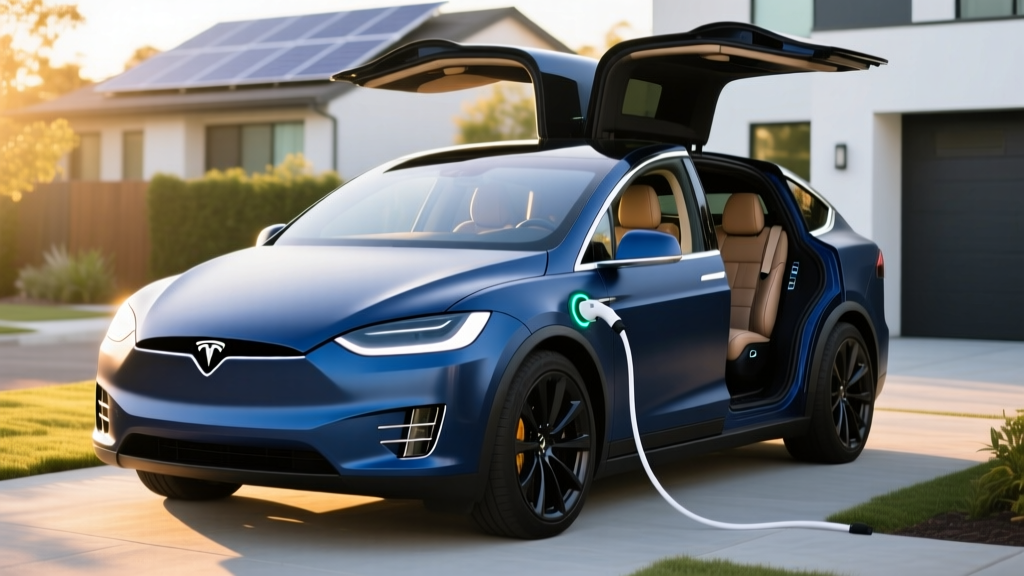
The Tesla Model X remains one of the few premium electric SUVs offering a genuine third row, making the Tesla SUV 7 seater configuration a frequent search for families weighing electrification. For 2026, the Model X continues in Long Range and Plaid trims with incremental software and efficiency updates, but the core value proposition is unchanged: falcon-wing rear doors, Supercharger network access, and up to 335 miles of EPA-estimated range in a three-row package. This review breaks down every spec that matters to real buyers — range reality, charging speed, third-row usability, and whether the federal tax credit actually applies.
2026 Tesla Model X Quick Specs
| Spec | Long Range AWD | Plaid (Tri-Motor AWD) |
|---|---|---|
| Base MSRP | $79,990 | $94,990 |
| EPA Range | 335 mi (20" wheels) | 326 mi (20" wheels) |
| Battery (usable) | ~100 kWh, NMC | ~100 kWh, NMC |
| Peak DC Fast Charge | 250 kW | 250 kW |
| 10–80% DC Time | ~30 min | ~30 min |
| Level 2 Home Charge | 11.5 kW (~34 mi/hr) | 11.5 kW (~34 mi/hr) |
| 0–60 mph | 3.8 sec | 2.5 sec |
| Horsepower | 670 hp | 1,020 hp |
| Drivetrain | Dual-Motor AWD | Tri-Motor AWD |
| MPGe (combined) | 102 MPGe | 98 MPGe |
| Efficiency | 33 kWh/100 mi | 34 kWh/100 mi |
| Seating | 5, 6, or 7 | 5, 6, or 7 |
| Cargo (behind 3rd row) | 13.0 cu ft | 13.0 cu ft |
| Cargo (all rows folded) | 74.4 cu ft | 74.4 cu ft |
| Towing Capacity | 5,000 lbs | 5,000 lbs |
| Battery/Drive Warranty | 8 yr / 150,000 mi | 8 yr / 150,000 mi |
Range and Efficiency: EPA vs. the Real World
Real-World Expectation: 270–300 mi on highway road trips at 70–75 mph; 230–260 mi in sub-freezing winter conditions; up to 320+ mi in mixed city/suburban driving with regen braking.
The Model X Long Range's 335-mile EPA estimate is competitive for a 5,200-lb three-row SUV, but physics sets hard limits. At sustained highway speeds above 70 mph, aerodynamic drag pushes consumption to roughly 37–40 kWh/100 mi, trimming effective range to around 270 miles. In cold weather (below 32°F), expect an additional 15–25% reduction due to battery heating demands and cabin climate load — even with Tesla's heat pump standard on 2026 models.
City and suburban driving is where the Model X shines efficiency-wise. Aggressive regenerative braking recovers energy that heavier SUVs like the Rivian R1S or BMW iX waste as brake heat. According to fueleconomy.gov, the Long Range achieves 102 MPGe combined, which translates to 33 kWh per 100 miles — roughly $0.10–$0.14 per mile at average US residential electricity rates.
Opting for 22" Turbine wheels reduces EPA range to approximately 311 miles due to higher rolling resistance and unsprung weight. If range is a priority, stick with the standard 20" setup.
Charging Speed: DC Fast, Home, and Supercharger Access
| Charging Level | Power / Rate | Miles Added per Hour | Notes |
|---|---|---|---|
| Level 1 (120V outlet) | ~1.4 kW | ~3–4 mi/hr | Emergency/trickle only |
| Level 2 (240V, 48A Wall Connector) | 11.5 kW | ~34 mi/hr | Full charge in ~10 hours |
| Level 2 (240V, 32A Mobile Connector) | 7.7 kW | ~23 mi/hr | Slower; NEMA 14-50 outlet |
| DC Fast (V3 Supercharger) | 250 kW peak | ~175 mi in 15 min | 10–80% in ~30 min |
| DC Fast (CCS via adapter) | Up to 250 kW | Varies by station | Non-Tesla networks |
The Model X peaks at 250 kW on V3 Superchargers, but that peak only holds between roughly 10% and 30% state of charge. The charging curve tapers progressively: by 60% SoC you're typically seeing 120–140 kW, and above 80% it drops below 50 kW. This is standard NMC lithium-ion behavior — charging speed is never a flat line. A realistic 10–80% session takes about 30 minutes at a V3 stall, which is adequate for road-trip meal or restroom stops but trails the 800V architectures in the Hyundai Ioniq 9 or Kia EV9 (both hitting 10–80% in ~18 minutes).
At home, Tesla's Gen 3 Wall Connector on a 60-amp circuit delivers 11.5 kW (48 amps continuous), adding roughly 34 miles of range per hour. Most owners charging overnight from 20% to 80% will wake to a full daily buffer. Installation typically requires a 60-amp breaker and 6-gauge wire — budget $500–$1,500 for a licensed electrician depending on panel proximity, per industry estimates. Always consult a licensed electrician for final specs.
Tesla's NACS (North American Charging Standard) connector is native, meaning seamless Supercharger plug-and-charge. For Electrify America, EVgo, or other CCS networks, Tesla sells a CCS adapter (~$250) that enables access — though charge rates may be limited by the adapter's thermal ceiling on sustained sessions.
Performance and Drivetrain
Even the "base" Long Range Model X is seriously quick: 670 horsepower from its dual-motor AWD setup launches this 5,185-lb SUV to 60 mph in 3.8 seconds. That's sports-car territory from a decade ago, delivered with instant electric torque and no gear shifts.
The Plaid trim adds a third rear motor for 1,020 hp and a 2.5-second 0–60 time, making it one of the fastest production SUVs ever built. However, the Plaid's performance advantage comes with a modest range penalty (326 vs. 335 mi EPA) and a $15,000 price premium. For most families, the Long Range's acceleration is more than sufficient — the Plaid is a statement purchase.
Both trims feature adaptive air suspension with automatic ride-height adjustment, which lowers at highway speeds for aerodynamic efficiency and raises for rough roads or loading. The 5,000-lb towing capacity is adequate for a small boat or light utility trailer, though heavy towing will cut range by 30–40%.
Interior, Third Row, and Cargo Space
The 7-seat configuration uses a 2-3-2 layout: two front captain-style seats, a three-passenger second-row bench, and a two-passenger third row. The 6-seat option replaces the second-row bench with two individual captain's chairs and a center walkway to the third row — this is the more practical family configuration, as it eliminates the need to fold and tumble the second row for rear access.
Key dimensions:
- Front headroom: 41.7 in | Legroom: 41.2 in
- Second-row headroom: 40.9 in | Legroom: 41.2 in
- Third-row headroom: 38.4 in | Legroom: 32.7 in
- Cargo behind 3rd row: 13.0 cu ft
- Cargo behind 2nd row (3rd folded): 37.1 cu ft
- Cargo with all rear rows folded: 74.4 cu ft
- Front trunk (frunk): 6.6 cu ft
The third row is best suited for children or short-trip adult passengers. At 32.7 inches of legroom, it's tighter than the Rivian R1S third row (34.5 in) and far less accommodating than the Kia EV9's (32.0 in but with a more upright seatback). Cargo space behind the third row is modest at 13.0 cu ft — enough for a couple of carry-on bags or grocery runs, but a full family road trip requires roof cargo or folded-row compromise.
The signature falcon-wing rear doors are genuinely useful: they open upward with dual hinges, providing standing-height access to the second and third rows in tight parking spaces. However, they add mechanical complexity and have been a historical source of warranty claims.
Pricing, Trims, and Federal Tax Credit Eligibility
| Trim | Base MSRP | Est. As-Tested* | §30D Credit Eligible? |
|---|---|---|---|
| Long Range AWD (7-seat) | $79,990 | $84,000–$88,000 | No — exceeds MSRP cap |
| Plaid AWD (7-seat) | $94,990 | $99,000–$105,000 | No — exceeds MSRP cap |
*As-tested includes destination fee, premium paint, 22" wheels, FSD capability, and other common options.
Here's the critical detail many buyers miss: the Tesla Model X does NOT qualify for the $7,500 federal EV tax credit under IRS §30D. The reason is the MSRP cap — for SUVs, the cap is $80,000, and while the Long Range base MSRP is $79,990 (just under), the mandatory destination and order fee pushes it over the threshold. Additionally, buyers must meet income caps ($300,000 joint / $150,000 single modified adjusted gross income) and the vehicle must satisfy battery critical-mineral and component sourcing requirements. Per IRS.gov §30D guidelines, the Model X's battery sourcing has not consistently met the full $7,500 threshold in recent model years.
Some state-level incentives may still apply (California's CVRP, for example, has its own income and price caps), but buyers should verify current state programs independently and consult a tax professional before assuming credit eligibility.
- Vehicle MSRP cap: $80,000 for SUVs (Model X fails with destination fee)
- Buyer MAGI cap: $300K joint / $225K head of household / $150K single
- Battery critical minerals: must meet escalating annual percentage thresholds
- Battery components: must meet escalating North American manufacturing thresholds
- Point-of-sale transfer available for eligible vehicles (not applicable here)
- Final assembly in North America (Model X qualifies — Fremont, CA)
Tech, Driver Assistance, and Software
The Model X runs Tesla's latest vehicle software on a 17-inch center touchscreen with a secondary 8-inch rear passenger display. The 22-speaker audio system, wireless phone charging, and HEPA air filtration (with Bioweapon Defense Mode) are standard. Over-the-air updates continue to add features post-purchase.
Autopilot is standard and includes adaptive cruise control, lane centering, and automatic emergency braking. Full Self-Driving (Supervised) remains a $8,000 option — or $99/month subscription — and adds automated lane changes, traffic-light recognition, and city-street navigation. However, FSD is SAE Level 2 driver assistance, meaning the driver must remain fully engaged with hands on the wheel and eyes on the road at all times.
Tesla Autopilot and FSD (Supervised) require continuous driver supervision. The vehicle does not drive itself. The driver is legally responsible for all vehicle operation. Level 4 (no driver needed) is currently only available via robotaxi services like Waymo in geofenced urban areas.
Notable drawbacks include the lack of Apple CarPlay and Android Auto (Tesla uses its proprietary infotainment), reliance on touchscreen controls for nearly all vehicle functions (no physical buttons for climate or volume), and the yoke steering wheel option, which is polarizing and impractical for low-speed maneuvering in many owners' experience.
Pros and Cons
- 335-mile EPA range is best-in-class for a 7-seat EV SUV
- Supercharger network reliability — plug-and-charge with no adapter needed
- Falcon-wing doors provide excellent rear-row access in tight spaces
- Class-leading acceleration even in base Long Range trim
- Over-the-air updates keep software current
- Standard air suspension and 5,000-lb towing
- 8-year/150,000-mile battery and drive unit warranty
- Does not qualify for $7,500 federal tax credit (MSRP cap)
- Third-row legroom (32.7 in) is tight for adults
- 250 kW peak DC charging trails 800V competitors (Ioniq 9, EV9)
- No Apple CarPlay or Android Auto
- High starting price ($79,990+) with no lower-cost trim
- Falcon-wing doors add mechanical complexity
- Touchscreen-only controls frustrate some drivers
How It Compares: Model X vs. Key 7-Seat EV Rivals
The 2026 three-row EV SUV segment is more competitive than ever. Here's how the Model X stacks up:
- Kia EV9 (from ~$54,900): Qualifies for the $7,500 credit (GT-Line RWD), offers 304 mi EPA range, 800V charging (10–80% in ~18 min), and a more usable third row. Lower performance but significantly cheaper. Best for budget-conscious families.
- Hyundai Ioniq 9 (from ~$56,000): Similar platform to EV9, 800V architecture, up to 335 mi EPA range. Also credit-eligible on certain trims. A strong value alternative.
- Rivian R1S (from ~$75,900): More off-road capability, better third-row space, but lower range (~321 mi dual-motor) and no Supercharger access without adapter. Qualifies for the credit on certain configurations.
- BMW iX (from ~$87,250): Only 5 seats — not a direct 7-seat competitor, but frequently cross-shopped for luxury EV SUV buyers.
Choose the Kia EV9 or Ioniq 9 if: You want a more affordable 7-seat EV, faster 800V charging, federal tax credit eligibility, and don't need sub-4-second 0–60 times.
Choose the Rivian R1S if: You need genuine off-road capability, more third-row space, and prefer a more traditional SUV driving feel.
Who Should Buy the Model X 7-Seater?
The Tesla Model X as a 7-seater SUV is best suited for families who:
- Drive primarily in suburban or urban settings with home Level 2 charging access
- Take road trips along well-served Supercharger corridors
- Value performance and technology over third-row practicality
- Use the third row primarily for children or occasional passengers
- Can absorb the $80K–$100K price without relying on the federal tax credit
It's less ideal for buyers who need adult-friendly third-row space for daily carpools, those on a tighter budget who need the $7,500 credit to make the math work, or anyone who prioritizes the fastest possible DC charging for frequent long-distance travel.
Frequently Asked Questions
What is the real-world range of the Tesla Model X?
The EPA estimates 335 miles for the Long Range on 20" wheels, but expect 270–300 miles on highway road trips at 75 mph, and as low as 230–260 miles in freezing temperatures. City driving with regenerative braking can approach or match the EPA figure.
How fast does the Model X charge at home and on the road?
At home on a 48-amp Level 2 Wall Connector, the Model X charges at 11.5 kW, adding about 34 miles per hour (full overnight charge). On a V3 Supercharger, it peaks at 250 kW and reaches 10–80% in approximately 30 minutes, though the charge curve tapers significantly above 60%.
Does the 2026 Tesla Model X qualify for the federal EV tax credit?
No. The Model X Long Range's base MSRP of $79,990 plus destination fees exceeds the $80,000 SUV cap under IRS §30D. Additionally, battery sourcing requirements may not be fully met. Always verify current eligibility on IRS.gov and consult a tax professional.
Is the Model X third row practical for adults?
With 32.7 inches of legroom, the third row is best for children or adults on short trips. For regular adult third-row use, the Rivian R1S (34.5 in legroom) is more accommodating.
Is the Model X worth buying over the Kia EV9 or Rivian R1S?
The Model X wins on range (335 mi), Supercharger convenience, and acceleration. The EV9 wins on price (~$25K less), federal credit eligibility, and 800V charging speed. The R1S wins on off-road capability and third-row space. Your priority ranking among these factors should drive the decision.
What is the Model X battery warranty?
Tesla covers the battery and drive unit for 8 years or 150,000 miles, whichever comes first, with a minimum 70% capacity retention guarantee. This is competitive with the industry standard and slightly better in mileage coverage than some rivals (Rivian offers 8 yr/120,000 mi).
Can I tow with the Tesla Model X?
Yes — the Model X is rated to tow up to 5,000 lbs with the optional tow package. However, expect a 30–40% range reduction when towing at highway speeds.