Quick Verdict: Is the 7-Seater Model X the Ultimate Family EV?
The Tesla Model X remains one of the only premium electric SUVs offering a true third row, making the 7 seater Tesla Model X interior a specific draw for large families who want zero tailpipe emissions without sacrificing passenger capacity. But fitting seven people is only part of the equation — real-world range, DC fast-charging speed, and third-row usability determine whether this SUV actually works for daily life and road trips alike.
In this review, we break down every dimension, spec, and ownership cost you need to evaluate the Model X 7-seat configuration against rivals like the Rivian R1S and Kia EV9.
Interior Dimensions & 7-Seat Practicality
The Model X seats up to seven in a 2-3-2 layout. The second row features three individual captain-style seats on a shared rail, while the third row is a two-passenger bench. Here is how the interior space breaks down with concrete numbers:
| Measurement | Specification |
|---|---|
| Front headroom | 41.7 in |
| Front legroom | 41.2 in |
| Second-row headroom | 40.9 in |
| Second-row legroom | 38.4 in |
| Third-row headroom | 37.1 in |
| Third-row legroom | 32.7 in |
| Cargo (behind 3rd row) | 15.0 cu ft |
| Cargo (3rd row folded) | 44.1 cu ft |
| Cargo (all rear rows folded) | 80.3 cu ft |
| Front trunk (frunk) | 6.7 cu ft |
The third row is best suited for children or shorter adults on trips under an hour. At 32.7 inches of legroom, it trails the Rivian R1S (34.3 in) and the Kia EV9 (32.0 in, but with a wider bench). Access is aided by the Model X's falcon-wing rear doors, which open vertically and create a large aperture — genuinely useful for loading child seats. However, those doors add mechanical complexity and can be slow to operate in tight parking spaces or heavy rain.
With all seven seats occupied, the 15.0 cu ft of rear cargo is enough for a few grocery bags or a compact stroller, but a full family road trip will require a roof box or careful packing. The 6.7 cu ft frunk helps offset this, providing space for charging cables and a small cooler.
Range, Battery & Efficiency
Real-World Expectation: ~270–295 miles highway at 70 mph; ~235–260 miles in freezing weather (below 32°F) with cabin heat. City driving with regen braking can match or slightly exceed the EPA sticker.
The Model X Long Range uses a ~100 kWh (usable) NMC (nickel manganese cobalt) lithium-ion battery pack. Tesla does not publish exact usable capacity, but independent teardowns and telemetry data place it between 95–100 kWh depending on model year and buffer management. NMC chemistry delivers higher energy density than LFP, which is necessary for a heavy, aerodynamically challenged SUV to reach 335 miles.
Efficiency lands at 102 MPGe combined (Long Range), which translates to roughly 33 kWh per 100 miles according to fueleconomy.gov. That is competitive for a 5,100+ lb electric SUV, though the lighter Kia EV9 achieves 97 MPGe combined with a smaller battery.
For context on real-world range loss: expect a 15–25% reduction in cold weather (below freezing) due to battery resistance and cabin heating demands, even with the Model X's standard heat pump. Highway driving at sustained 75–80 mph also drops range by roughly 10–15% versus the EPA combined cycle, which blends city and highway.
Charging Speed: DC Fast, Level 2 & Home Setup
| Charging Level | Max Rate | Speed / Time |
|---|---|---|
| DC Fast Charge (Supercharger V4) | 250 kW peak | 10–80% in ~30 min; ~175 miles added in 15 min |
| DC Fast Charge (CCS adapter) | ~150 kW (site-dependent) | 10–80% in ~40 min |
| Level 2 (Tesla Wall Connector, 48A) | 11.5 kW | ~34 miles per hour of charging |
| Level 2 (standard 240V/40A outlet) | 9.6 kW | ~28 miles per hour of charging |
| Level 1 (120V household) | ~1.4 kW | ~4 miles per hour of charging |
The Model X charges at a peak of 250 kW on Tesla Superchargers. However, like all EVs, it does not sustain peak rate for the full session. The charge curve tapers significantly above 50% state of charge (SoC), and especially above 80%. A typical 10–80% session takes approximately 30 minutes under ideal battery preconditioning. Without preconditioning (e.g., arriving at a charger without navigating to it in the Tesla app), that time can stretch to 40–45 minutes in cool weather.
For home charging, the Tesla Wall Connector at 48 amps on a 60-amp circuit delivers 11.5 kW, adding roughly 34 miles of range per hour. Most owners will recover a full day's driving overnight. A licensed electrician should confirm your panel can support a 60-amp dedicated circuit; older homes may require a panel upgrade ($1,500–$3,000).
Tesla's NACS connector is now the industry standard adopted by Ford, GM, Rivian, and others. The Model X natively uses NACS, giving it access to 20,000+ Supercharger stalls without adapters — a meaningful reliability advantage over CCS-dependent competitors at this time.
Performance & Drivetrain
| Trim | Drivetrain | Horsepower | 0–60 mph | Top Speed |
|---|---|---|---|---|
| Long Range AWD | Dual-Motor AWD | 670 hp | 3.8 sec | 155 mph |
| Plaid | Tri-Motor AWD | 1,020 hp | 2.5 sec | 163 mph |
Even the base Long Range Model X hits 60 mph in 3.8 seconds — quicker than most sports sedans and extraordinary for a 5,185-lb seven-seat SUV. The tri-motor Plaid variant's 2.5-second run is supercar territory, though it sacrifices 15 miles of EPA range and costs significantly more.
Both trims feature standard all-wheel drive with independent front and rear motors. Torque vectoring and a low center of gravity (battery pack under the floor) give the Model X composed handling for its size, though the steering feels artificially light and detached compared to a BMW iX or Rivian R1S. Air suspension is standard, offering adjustable ride height for clearance on rough roads or a lower stance for highway efficiency.
Pricing, Trims & Federal Tax Credit
| Trim | Base MSRP | 7-Seat Upgrade | As-Tested (typical) | §30D Credit Eligible? |
|---|---|---|---|---|
| Long Range AWD | $79,990 | +$0 (included) | $85,000–$92,000 | No — exceeds MSRP cap |
| Plaid | $94,990 | +$0 (included) | $100,000–$115,000 | No — exceeds MSRP cap |
The 7-seat configuration is included at no additional cost on both trims. However, the Model X does not qualify for the $7,500 federal EV tax credit under IRS §30D. The law caps SUV eligibility at $80,000 MSRP, and even the base Long Range starts at $79,990 — right at the threshold. Once any options (paint, wheels, FSD) push the price above $80,000, credit eligibility is lost. Additionally, buyer income caps apply ($300,000 joint / $150,000 individual AGI), and battery critical-mineral sourcing requirements must be met.
For full rules, consult the IRS clean vehicle credit page or a qualified tax professional. Some states offer separate rebates (California's CVRP, for example) that may partially offset cost — check your state energy office for current programs.
The 7-seat Model X comes standard with the second-row three-seat bench configuration. A six-seat layout with a center console ($6,500 option) replaces the second-row middle seat with a pass-through, which some families prefer for access but eliminates the seventh seat.
Tech, Driver Assistance & Safety
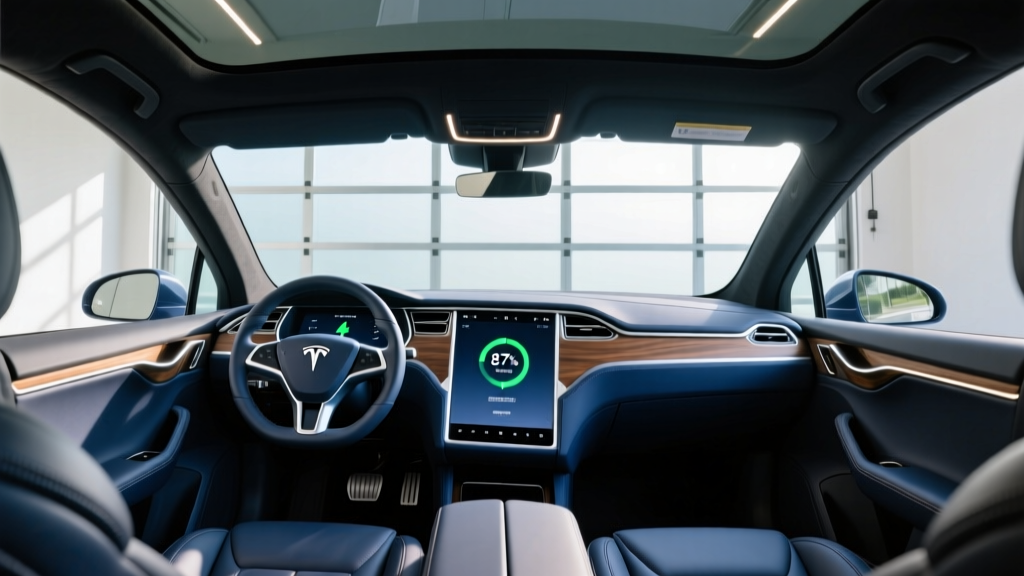
The Model X interior centers on a 17-inch landscape touchscreen running Tesla's proprietary OS. It controls virtually every vehicle function — climate, media, navigation, vehicle settings — with minimal physical buttons. A secondary 8-inch screen in the rear controls climate and entertainment for second-row passengers. The yoke steering wheel (now optional alongside a round wheel) takes adjustment but frees sightlines to the digital instrument cluster.
Standard driver-assistance features include:
- Autopilot: Adaptive cruise control + lane centering (SAE Level 2)
- Full Self-Driving (Supervised): $8,000 option adding auto lane change, traffic light/stop sign control, and navigate-on-autopilot (still SAE Level 2 — driver must remain engaged at all times)
- Automatic emergency braking, blind-spot monitoring, 360° cameras
- Sentry Mode (parked surveillance with recording)
The Model X earned a 5-star overall safety rating from NHTSA, with top marks in frontal, side, and rollover crash tests. The IIHS has not recently tested the Model X, which is a gap worth noting for safety-conscious buyers.
Warranty & Ownership Costs
| Component | Coverage |
|---|---|
| Basic Vehicle | 4 years / 50,000 miles |
| Battery & Drive Unit | 8 years / 150,000 miles (70% minimum capacity retention) |
| Roadside Assistance | 4 years / 50,000 miles |
Tesla's 8-year/150,000-mile battery warranty guarantees the pack will retain at least 70% of its original capacity. If degradation exceeds 30% within that window, Tesla will repair or replace the battery. Real-world data from Tesla's fleet shows average degradation of approximately 12–15% after 150,000 miles for NMC packs, well within the warranty threshold.
A full out-of-warranty battery replacement for the Model X currently ranges from $15,000 to $22,000 depending on pack configuration and labor. This is a worst-case scenario; most packs outlast the vehicle's useful life.
Insurance premiums for the Model X run 20–35% higher than comparable gas SUVs, reflecting repair costs for aluminum body panels and the battery pack. Expect $2,800–$4,200 annually depending on your state, driving record, and coverage level. Tesla Insurance is available in select states and may offer competitive rates based on real-time driving data.
How It Compares: Model X vs. Rivian R1S vs. Kia EV9
| Spec | Tesla Model X LR | Rivian R1S Dual | Kia EV9 GT-Line AWD |
|---|---|---|---|
| EPA Range | 335 mi | 352 mi (Max Pack) | 270 mi |
| Battery (usable) | ~100 kWh NMC | 149 kWh NMC (Max) | 99.8 kWh NMC |
| DC Fast Charge | 250 kW | 220 kW | 210 kW |
| 3rd-Row Legroom | 32.7 in | 34.3 in | 32.0 in |
| Cargo (behind 3rd) | 15.0 cu ft | 17.6 cu ft | 20.2 cu ft |
| 0–60 mph | 3.8 sec | 4.5 sec | 4.9 sec |
| Base MSRP | $79,990 | $79,900 | $59,900 |
| §30D Credit | No (MSRP cap) | No (MSRP cap) | Yes (eligible trims) |
| Towing Capacity | 5,000 lbs | 7,700 lbs | 5,000 lbs |
The Rivian R1S offers a more usable third row, more cargo space, and significantly better off-road capability, but at a similar price point and with a slightly slower charge rate. The Kia EV9 undercuts both by $20,000+, qualifies for the federal credit on eligible trims, and offers the most cargo room — but sacrifices 60+ miles of range and the Supercharger network advantage.
Pros
- Best-in-class Supercharger network access (NACS native)
- Exceptional performance (3.8s 0–60 base, 2.5s Plaid)
- Falcon-wing doors ease child-seat loading
- Over-the-air updates continuously add features
- Standard air suspension and heat pump
Cons
- Third row tight for adults (32.7 in legroom)
- No federal tax credit (MSRP exceeds $80K cap)
- Falcon-wing doors slow in rain and tight garages
- Minimal physical controls; touchscreen-dependent
- High insurance premiums
- Build quality inconsistencies reported by owners
Who Should Buy the 7-Seater Tesla Model X?
Choose the Model X 7-seat if:
- You prioritize Supercharger reliability for frequent road trips
- The third row is primarily for children or occasional adult use
- You want sports-car acceleration in a family SUV
- You value over-the-air feature updates and Tesla's software ecosystem
Look elsewhere if:
- You regularly carry adults in the third row (consider Rivian R1S or a minivan)
- Federal tax credit eligibility is essential to your budget (consider Kia EV9)
- You need maximum cargo space with all seats occupied
- You tow heavy trailers frequently (Rivian R1S tows 7,700 lbs vs. 5,000 lbs)
Frequently Asked Questions
What is the real-world range of the 7-seat Tesla Model X?
The EPA rates the Long Range at 335 miles. In real-world highway driving at 70 mph, expect 270–295 miles. In freezing temperatures, plan for 235–260 miles. Adding passengers and cargo has a modest impact — roughly 3–5% range reduction with a full load of seven occupants and luggage.
How fast does the Model X charge at home and on the road?
On a Tesla Supercharger, the Model X peaks at 250 kW, reaching 10–80% in approximately 30 minutes with battery preconditioning. At home on a Level 2 Wall Connector (48A/11.5 kW), you gain about 34 miles of range per hour, fully replenishing overnight from most daily driving levels.
Does the Tesla Model X qualify for the federal EV tax credit?
Generally no. Under IRS §30D, SUVs must have an MSRP at or below $80,000. The base Model X Long Range starts at $79,990, and any options push it over the cap. Buyer income limits ($300K joint / $150K individual) and battery-sourcing requirements add further restrictions. Consult IRS.gov or a tax professional for your specific situation.
Is the third row comfortable for adults on long trips?
With 32.7 inches of legroom and 37.1 inches of headroom, the third row works for adults up to about 5'8" on trips under an hour. For longer drives, fatigue sets in due to the upright seatback and limited foot space under the second-row seats. Children and teens are far more comfortable here than full-size adults.
How does the Model X compare to the Rivian R1S for families?
The R1S offers a more spacious third row (34.3 in legroom), more cargo room (17.6 cu ft), and 7,700-lb towing. The Model X counters with Supercharger network access, faster acceleration, and a slightly longer EPA range. If third-row comfort and cargo space are priorities, the R1S wins. If charging infrastructure and performance matter more, the Model X has the edge.
What is the total cost of ownership over 5 years?
Factoring in the ~$85,000 as-tested price, estimated electricity costs at $0.14/kWh (~$2,100/year for 12,000 miles), insurance (~$3,500/year), and no federal credit, a 5-year ownership cost lands around $105,000–$115,000 including depreciation. This is competitive with a similarly priced BMW X7 or Mercedes GLS when fuel savings are factored in, but more expensive than a Kia EV9 by roughly $30,000 over the same period.