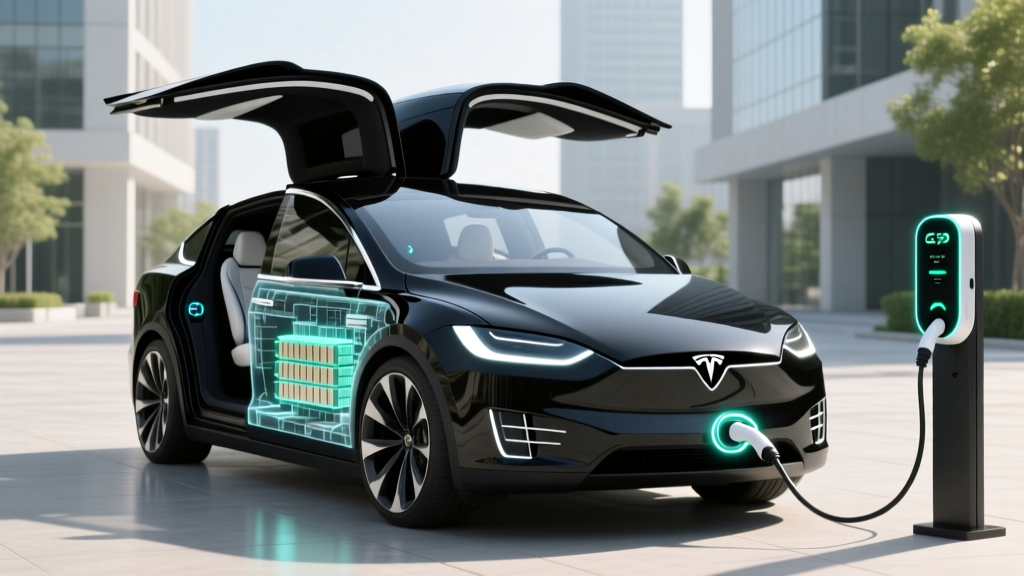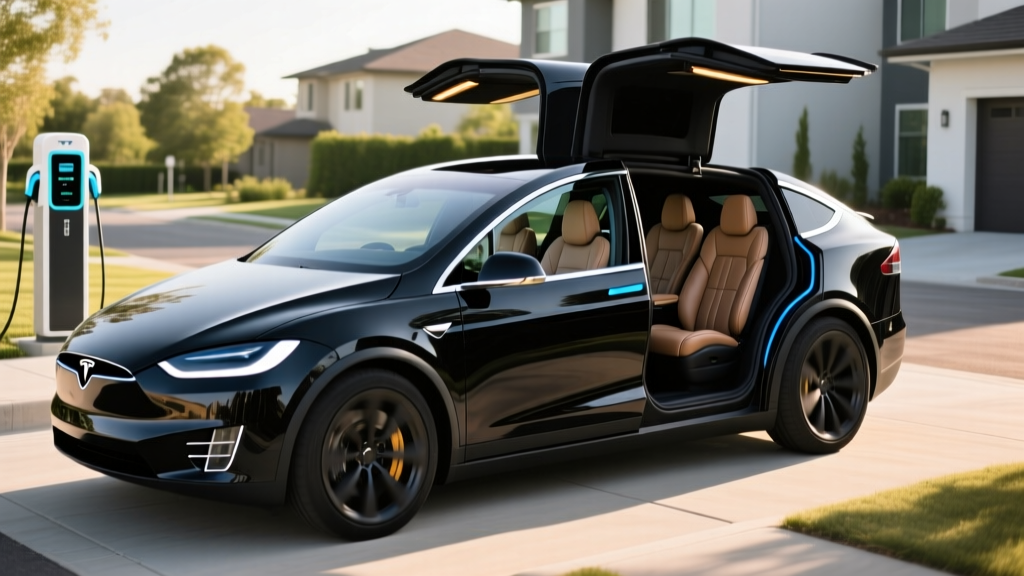
If you are searching for the Tesla that seats 7, there is exactly one answer in the current lineup: the Tesla Model X equipped with the optional six- or seven-seat interior. The 2026 Model X remains a low-volume flagship for Tesla—a large, dual-motor or tri-motor electric SUV with falcon-wing rear doors, a 17-inch center display, and the kind of performance that makes a 5,000-pound family hauler feel absurdly quick. It is also one of the most expensive vehicles Tesla sells, and its third row is better suited to children than adults. Below is a data-driven, owner-relevant review of what it is actually like to buy, charge, and live with the Model X in 2026.
2026 Tesla Model X: Spec Sheet at a Glance
Before we get into real-world range and third-row practicality, here are the exact numbers for the two current trims—Long Range AWD and Plaid (tri-motor AWD). All figures reflect the latest EPA and Tesla-published data for the 2026 model year.
| Specification | Long Range AWD | Plaid (Tri-Motor AWD) |
|---|---|---|
| EPA Range | 348 miles | 326 miles |
| Battery (usable, est.) | ~100 kWh (NMC) | ~100 kWh (NMC) |
| Drivetrain | Dual-motor AWD | Tri-motor AWD |
| Horsepower | 670 hp | 1,020 hp |
| 0–60 mph | 3.8 sec | 2.5 sec |
| Top Speed | 155 mph | 163 mph |
| MPGe (combined) | 102 MPGe | 98 MPGe |
| Efficiency | 33 kWh/100 mi | 34 kWh/100 mi |
| Max DC Fast Charge | 250 kW (peak) | 250 kW (peak) |
| 10–80% DC Time | ~30 min | ~30 min |
| Level 2 Home Charge | 11.5 kW (~34 mi/hr) | 11.5 kW (~34 mi/hr) |
| Seating | 5, 6, or 7 | 5, 6, or 7 |
| Cargo (behind 3rd row) | ~15 cu ft | ~15 cu ft |
| Cargo (all rows folded) | ~88 cu ft | ~88 cu ft |
| Base MSRP | $79,990 | $94,990 |
| Battery Warranty | 8 yr / 150,000 mi | 8 yr / 150,000 mi |
Sources: fueleconomy.gov, Tesla press kit.
Real-World Range: What the EPA Sticker Doesn't Tell You
EPA Sticker: 348 miles (Long Range) / 326 miles (Plaid)
Real-World Expectation: Plan on 260–290 miles on a 75 mph highway run in mild weather. In freezing temperatures (below 30°F), expect 220–250 miles before needing a charger.
The EPA combined cycle is generous to the Model X because it includes substantial low-speed and regenerative-braking driving, where the heavy SUV recovers energy well. Sustained highway speeds, especially above 70 mph, hurt efficiency in any large vehicle, and the Model X's 5,000+ lb curb weight and wide frontal area compound the penalty. In Tesla's own range estimator and independent testing, 75 mph highway driving typically yields 2.5–3.0 miles per kWh, which translates to roughly 250–300 usable miles from the ~100 kWh pack.
Cold weather adds a second hit: battery chemistry (NMC in this case) is less efficient at low temperatures, and cabin heating is a significant load even with the Model X's heat pump. Owners in northern climates should budget a 25–35% range reduction in deep winter. Preconditioning the battery while plugged in—via scheduled departure in the Tesla app—mitigates some of this loss and is strongly recommended.
Charging Speed: DC Fast, Level 2, and the Charge-Curve Reality
| Level | Power | Miles Added per Hour | Notes |
|---|---|---|---|
| Level 1 (120V outlet) | ~1.4 kW | ~3–4 mi/hr | Emergency/trickle only |
| Level 2 (240V / 48A Wall Connector) | 11.5 kW | ~34 mi/hr | Full overnight charge in ~9 hrs |
| DC Fast (Tesla Supercharger V3/V4) | 250 kW peak | ~200 mi in 15 min (10–50%) | Tapers sharply above 60% SoC |
The Model X peaks at 250 kW on a V3 or V4 Supercharger, but that peak is short-lived—typically sustained only between roughly 10% and 35% state of charge. From 35% to 60%, the rate drops to around 150–180 kW, and above 80% it falls below 50 kW as the battery management system protects the cells. The published 10–80% time of roughly 30 minutes assumes ideal battery temperature (preconditioned) and an uncongested charger.
At home on a Tesla Wall Connector wired to a 60A circuit (48A continuous), the onboard charger accepts 11.5 kW, adding about 34 miles of range per hour. A full charge from 10% to 90% takes roughly 8–9 hours—easily achievable overnight. If your home has a 200A electrical panel with spare capacity, installation typically runs $800–$2,000 for the Wall Connector plus wiring; a panel upgrade to 400A can add $2,000–$4,000. Always have a licensed electrician assess your panel before committing.
Interior, Third Row, and Cargo: The 7-Seat Question
The Model X offers three seating configurations: five-seat (two-row bench), six-seat (second-row captains chairs with center pass-through), and seven-seat (second-row bench + third-row bench). The seven-seat layout is a no-cost option at order time.
Here is the honest assessment of the third row:
- Legroom (3rd row): ~32.7 inches—tight for adults on anything longer than a 20-minute trip
- Headroom (3rd row): ~37.1 inches—adequate for children and shorter adults
- Access: The falcon-wing doors and auto-folding second row make third-row entry easier than in most 3-row SUVs, a genuine advantage in tight parking spaces
- Cargo behind 3rd row: ~15 cu ft—enough for a couple of carry-ons or groceries, not a full family luggage load
- Cargo with all rows folded: ~88 cu ft, plus a ~6.5 cu ft front trunk (frunk)
If your 7-passenger need is occasional (carpool twice a week, visiting grandparents once a month), the Model X works. If you regularly carry six or seven adults with luggage, the Rivian R1S or a three-row plug-in hybrid like the Kia EV9 (when equipped with optional third row) offer more usable third-row space. The Model X's third row is best understood as a child-and-carpool seat, not a full-time adult perch.
Performance, Ride, and Driver Assistance
Even the "base" Long Range Model X hits 60 mph in 3.8 seconds with 670 horsepower from its dual-motor all-wheel-drive system. The Plaid's tri-motor setup (one front, two rear) delivers 1,020 hp and a 2.5-second 0–60 time—supercar acceleration in a vehicle with a third row. Air suspension is standard, with adaptive damping and adjustable ride height (useful for rough driveways or speed bumps).
Ride quality is firm but controlled; the Model X prioritizes handling composure over plush isolation. Road noise is well-managed at highway speeds, though the large glass roof and panoramic windshield do let in more ambient sound than a luxury SUV like the BMW iX.
Driver Assistance — SAE Level 2: Tesla's Autopilot (standard) and Full Self-Driving (Supervised) are Level 2 driver-assist systems. The driver must remain attentive, keep hands on the wheel, and be prepared to take over at any moment. FSD (Supervised) handles highway lane changes, on/off-ramps, and some city streets, but it is not autonomous driving. Only Level 4 robotaxi services like Waymo operate without a human driver in defined zones.
The 17-inch center touchscreen runs Tesla's latest infotainment software, which is responsive and feature-rich (navigation, streaming, games, Sentry Mode dashcam). There is no Apple CarPlay or Android Auto—a dealbreaker for some buyers. The yoke steering wheel is standard on Plaid and optional on Long Range; a conventional round wheel is available. Build quality has improved in recent model years but still shows minor panel-gap variance compared to German luxury rivals.
Pricing, Trims, and Federal Tax Credit Eligibility
| Trim | Base MSRP | Typical As-Tested | §30D Federal Credit | Effective Price (if eligible) |
|---|---|---|---|---|
| Long Range AWD | $79,990 | $85,000–$92,000 | Up to $7,500* | ~$72,490–$84,500 |
| Plaid (Tri-Motor) | $94,990 | $100,000–$110,000 | Up to $7,500* | ~$87,490–$102,500 |
*§30D credit eligibility is not automatic. See checklist below.
The Model X's base price places it well above the IRS §30D MSRP cap for SUVs, which is $80,000. This means:
- Long Range AWD at $79,990 base MSRP technically qualifies on MSRP, but adding any options (paint, wheels, FSD, 7-seat config if priced as an option pushing MSRP above $80K) may push the vehicle over the cap. Verify the final MSRP on the window sticker.
- Plaid at $94,990 exceeds the $80,000 SUV MSRP cap and does not qualify for the new-vehicle §30D credit.
- Buyer income caps apply: Modified AGI must not exceed $300,000 (joint), $225,000 (head of household), or $150,000 (single). See IRS §30D rules.
- Battery sourcing requirements: A portion of the credit depends on critical-mineral and battery-component sourcing from the U.S. or FTA partners. Tesla's supply chain has shifted significantly, but final eligibility is determined at point of sale. Confirm with your tax professional.
- Point-of-sale transfer: If eligible, you can transfer the credit to Tesla at purchase, reducing the purchase price directly rather than waiting for a tax refund.
§30D Eligibility Checklist for Model X Long Range:
- Final MSRP at or below $80,000 (SUV cap) — verify window sticker
- Buyer MAGI within IRS limits ($300K joint / $150K single)
- Battery critical minerals and components meet FTA sourcing thresholds
- Vehicle assembled in North America (Model X: Fremont, CA — ✓)
- Purchaser has sufficient federal tax liability to absorb credit (if not transferred at POS)
Ownership Costs, Warranty, and Depreciation
Tesla covers the Model X battery and drive unit for 8 years or 150,000 miles, whichever comes first, with a minimum 70% capacity retention guarantee. The basic vehicle limited warranty is 4 years / 50,000 miles. These terms are competitive with Rivian and slightly better than some luxury rivals on mileage, though the 4-year basic warranty is shorter than Hyundai/Kia's 5/60,000 or BMW's 4/50,000.
Charging at home on a national-average electricity rate of ~$0.16/kWh, a full 100 kWh charge costs roughly $16, yielding about $0.05 per mile. Supercharger costs vary by location and time of day but average $0.28–$0.36/kWh in 2026, or roughly $0.09–$0.12 per mile. For comparison, a gasoline SUV averaging 22 mpg at $3.50/gallon costs about $0.16 per mile—so home-charged Model X ownership delivers meaningful fuel-cost savings, while exclusive Supercharger use narrows the gap.
Insurance premiums for the Model X are elevated—typically $2,800–$4,200/year depending on state, driving record, and coverage. Tesla offers its own insurance product in many states, which uses real-time driving data and can be cheaper for low-risk drivers. Depreciation on the Model X has historically been steeper than the Model Y or Model 3, partly due to its high MSRP and niche positioning; expect roughly 45–55% value retention after 5 years, based on current resale trends.
Pros, Cons, and Who Should Buy the Model X
Pros
- Class-leading 348-mile EPA range (Long Range) among 3-row EVs
- Supercharger network access (now open to other brands, but native for Tesla)
- Falcon-wing doors ease 3rd-row access in tight spaces
- Supercar acceleration even in base Long Range trim
- Over-the-air updates continuously add features
- Strong heat pump for cold-weather efficiency
Cons
- 3rd row is cramped for adults; limited cargo behind it
- MSRP often exceeds §30D $80K SUV cap once options are added
- No Apple CarPlay / Android Auto
- Insurance premiums are significantly above average
- Yoke steering is polarizing; conventional wheel availability varies
- Build-quality consistency still trails German luxury OEMs
Choose the Model X if: You need the Supercharger network for frequent long-distance travel, want the longest EPA range in a 3-row EV, value falcon-wing door practicality for child seats, and can accept the premium price and tight third row.
Consider the Rivian R1S or Kia EV9 instead if: You regularly carry 6–7 adults, need more cargo behind the third row, want a more conventional SUV interior, or need a vehicle that clearly qualifies for the full §30D credit at any trim level.
Frequently Asked Questions
What is the real-world range of the Tesla Model X?
The EPA rates the Long Range at 348 miles and the Plaid at 326 miles. In real-world highway driving at 70–75 mph, expect 260–290 miles in mild weather and 220–250 miles in freezing temperatures. Preconditioning and moderate speeds help maximize usable range.
How fast does the Model X charge at home and on the road?
At home on a 48A Level 2 Wall Connector, the Model X charges at 11.5 kW, adding ~34 miles of range per hour (full overnight charge in ~9 hours). On a 250 kW Supercharger, 10–80% takes roughly 30 minutes with a preconditioned battery, though the charge curve tapers sharply above 60% SoC.
Does the Model X qualify for the $7,500 federal EV tax credit?
Only the Long Range AWD at or below the $80,000 SUV MSRP cap may qualify, and only if the buyer meets IRS income limits and the battery meets critical-mineral sourcing rules. The Plaid trim ($94,990 MSRP) does not qualify. Always verify final MSRP on the window sticker and consult a tax professional. See IRS §30D guidance.
Is the Model X worth buying vs. the Rivian R1S or Kia EV9?
The Model X wins on EPA range (348 mi vs. R1S's ~352 mi on the larger pack, EV9's ~279 mi) and Supercharger convenience. The R1S offers a more usable third row and competitive off-road capability. The EV9 is significantly cheaper and clearly credit-eligible but has shorter range. Your answer depends on whether range and charging network or third-row practicality and price matter more.
Can adults fit in the Model X third row?
Technically yes, but with only ~32.7 inches of legroom, it is uncomfortable for adults on trips longer than 20–30 minutes. Children and smaller teens are fine. The falcon-wing doors and auto-folding second row make access easier than in most 3-row SUVs.
What is the battery warranty on the Model X?
Tesla warrants the battery and drive unit for 8 years or 150,000 miles, whichever comes first, with a guaranteed minimum of 70% capacity retention over that period. The basic vehicle warranty is 4 years / 50,000 miles.
Is Tesla's Full Self-Driving actually self-driving?
No. FSD (Supervised) is an SAE Level 2 driver-assist system. The driver must remain fully attentive, keep hands on the wheel, and be prepared to take over at any moment. It is not autonomous driving.
Specs and pricing reflect 2026 model-year data as published by Tesla and the EPA. Tax credit rules are subject to change; always verify current IRS §30D requirements and consult a tax professional before purchasing.