Quick Verdict: The Model X Six-Seat Experience in 2026
The 2026 Tesla Model X remains one of the few electric SUVs offering a true three-row, six-passenger layout with individual second-row captain's chairs — and pairing it with Tesla's Ultra White premium interior creates the most visually striking cabin in the luxury EV segment. But beyond aesthetics, the Model X Long Range AWD delivers 326 miles of EPA-estimated range, a 250 kW peak DC fast-charge rate, and a 3.8-second 0-60 mph time that defies its 5,185-pound curb weight. The six-seat configuration sacrifices some cargo flexibility for second-row comfort, and the white interior demands regular maintenance. This review breaks down whether the trade-offs make sense for your household.
| Spec | Value |
|---|---|
| EPA Range | 326 miles |
| Battery (Usable) | ~100 kWh, NMC chemistry |
| Drivetrain | Dual-motor AWD |
| Horsepower | 670 hp |
| 0-60 mph | 3.8 seconds |
| Peak DC Fast Charge | 250 kW |
| 10-80% DC Charge | ~32 minutes |
| Level 2 Home Charge | 11.5 kW (~34 mi/hr) |
| MPGe (Combined) | 102 MPGe |
| Efficiency | 33 kWh/100 mi |
| Cargo (Behind 3rd Row) | 15.3 cu ft |
| Cargo (3rd Row Folded) | 42.5 cu ft |
| Cargo (All Rows Folded) | 77.5 cu ft |
| Towing Capacity | 5,000 lbs |
| Battery Warranty | 8 years / 150,000 miles |
| Base MSRP | $79,990 |
Real-World Range: What 326 EPA Miles Actually Means
The EPA rates the 2026 Model X Long Range AWD at 326 miles on a full charge, per fueleconomy.gov. That number is derived from controlled laboratory cycles that blend city and highway driving. In practice, your mileage varies considerably based on speed, temperature, and terrain.
- City / moderate climate (65°F): ~310-330 miles — regenerative braking recovers energy in stop-and-go traffic, often exceeding the EPA estimate.
- Highway (70-75 mph, 75°F): ~265-285 miles — aerodynamic drag on this large SUV dominates at speed. Expect roughly 13-18% below EPA.
- Cold weather (30°F, highway + city mix): ~225-255 miles — battery chemistry slows, cabin heating draws energy, and air density increases drag. Preconditioning mitigates some loss.
- Towing (light trailer, ~3,000 lbs): ~170-200 miles — towing roughly halves efficiency. Plan charging stops accordingly.
The ~100 kWh usable NMC (nickel manganese cobalt) battery pack provides substantial energy reserves, but the Model X's weight and frontal area work against it. Owners in northern climates should budget for 25-30% range reduction in winter. Tesla's heat pump — standard on all current Model X vehicles — helps significantly compared to resistive heating, but physics still applies.
Charging Speed: DC Fast Charging and Home Setup
Charging speed is where the Model X's NMC battery and Tesla's V3/V4 Supercharger network shine — and where the 6-seat family hauler proves practical for road trips.
| Charging Level | Power (kW) | Speed | Notes |
|---|---|---|---|
| Level 1 (120V household) | ~1.4 kW | ~3-4 mi/hr | Emergency/trickle only; full charge takes 3+ days |
| Level 2 (240V, Wall Connector) | 11.5 kW | ~34 mi/hr | Full charge overnight (~9-10 hours from near-empty) |
| Level 2 (48A, NEMA 14-50) | ~11.5 kW | ~34 mi/hr | Requires 60A dedicated circuit |
| DC Fast (Tesla Supercharger V3) | 250 kW peak | ~175 mi in 15 min | 10-80% in ~32 min; tapers significantly above 80% |
| DC Fast (CCS via adapter) | ~150-175 kW peak | Varies by station | CCS adapter included; limited to station output |
Charging curve reality: The 250 kW peak rate applies only between roughly 10-30% state of charge (SoC). The curve tapers progressively — by 60% SoC, you're typically seeing 100-120 kW, and above 80%, speeds drop below 50 kW to protect the NMC cells. This is why the 10-80% metric matters more than peak kW. For a 326-mile vehicle, 80% represents about 260 miles — more than enough for most single-day drives.
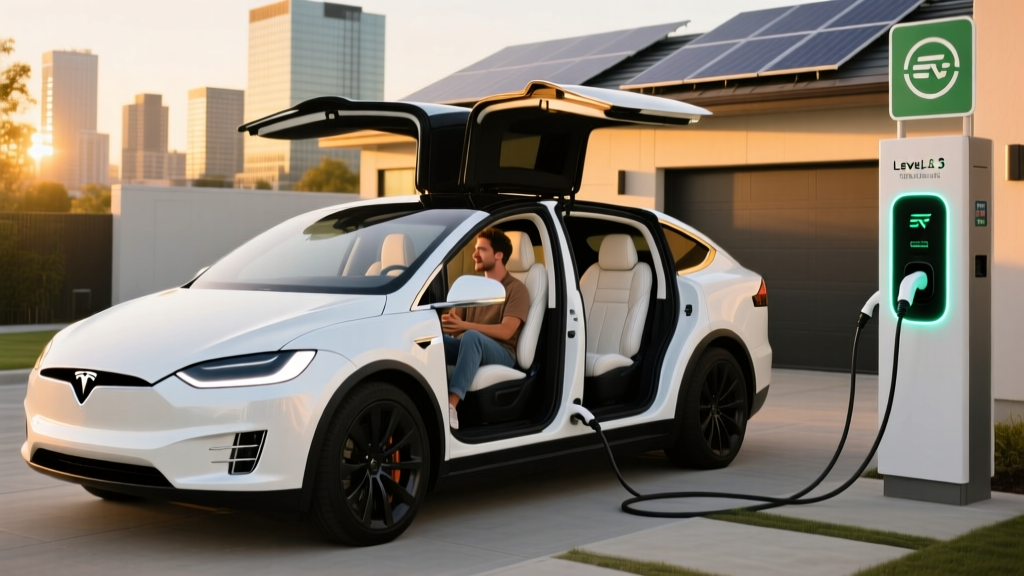
Home charging note: To achieve the full 11.5 kW Level 2 rate, you need a Tesla Wall Connector on a 60-amp dedicated circuit (48A continuous draw). If your electrical panel is 100A or already near capacity, a panel upgrade to 200A may be required — adding $1,500-$3,000 to your installation cost. Always get a quote from a licensed electrician before committing.
Performance and Driving Dynamics
The dual-motor AWD powertrain produces 670 horsepower and delivers a 3.8-second 0-60 mph time — remarkable for a three-row SUV carrying over 5,000 pounds. The instant torque from both motors provides confident highway merging and passing, and the low center of gravity (battery pack mounted under the floor) keeps body roll surprisingly controlled for a vehicle this tall.
The adaptive air suspension offers adjustable ride height, lowering at highway speeds for efficiency and raising for rough roads or driveway clearance. Ride quality is firm but compliant; this is a performance-oriented SUV, not a cloud-like luxury cruiser. The steer-by-wire yoke remains available, though a conventional round steering wheel is standard and preferred by most buyers for low-speed maneuvering.
ADAS — SAE Level 2: Tesla's Autopilot comes standard, with Full Self-Driving (Supervised) available as a $8,000 option or $99/month subscription. Both are SAE Level 2 systems — the driver must remain attentive, keep hands on the wheel, and be prepared to take over at any moment. This is not autonomous driving. FSD (Supervised) handles highway lane changes, on/off-ramp navigation, and some city street scenarios, but performance varies by geography and conditions. It does not replace an engaged driver.
The 6-Seat Layout and White Interior: Form Meets Function
The six-seat configuration replaces the standard second-row bench with two individual captain's chairs separated by a center console with cupholders and a small storage bin. Here's what changes:
| Feature | 5-Seat (Standard) | 6-Seat (Captain's Chairs) | 7-Seat |
|---|---|---|---|
| 2nd Row | 3-passenger bench | 2 individual chairs + console | 3-passenger bench |
| 3rd Row | None | 2-passenger bench | 2-passenger bench |
| Walk-Through to 3rd Row | N/A | Yes — between captain's chairs | No — must fold/slide 2nd row |
| Max Cargo (all folded) | 77.5 cu ft | 77.5 cu ft | 77.5 cu ft |
| 2nd Row Comfort | Standard | Superior — individual recline, armrests | Standard |
| Price Add | Included | +$6,500 | +$4,000 |
The walk-through access is the six-seat layout's biggest practical advantage. Parents can reach third-row passengers without folding seats — critical for child-seat logistics. The captain's chairs themselves are heated, ventilated (front and second row on Premium Interior), and offer more lateral support than the bench.
The Ultra White interior uses Tesla's vegan leather material — a polyurethane-based synthetic that's durable and stain-resistant. It adds $2,000 to the base price. In practice, the white holds up well against jeans transfer and minor spills if wiped promptly, but it shows dirt, scuffs, and pet hair more readily than the black option. Owners with young children or pets should weigh the aesthetic payoff against maintenance frequency. The white interior pairs with white dashboard trim and white door panels, creating an open, airy cabin that contrasts sharply with the all-black alternative.
Pricing, Tax Credits, and Total Cost
The 2026 Model X pricing ladder reflects Tesla's current configuration options:
| Item | Cost |
|---|---|
| Model X Long Range AWD (base) | $79,990 |
| 6-Seat Interior (captain's chairs) | +$6,500 |
| Ultra White Premium Interior | +$2,000 |
| FSD (Supervised) — optional | +$8,000 |
| Destination / Order Fee | +$1,800 |
| As-Tested (without FSD) | $90,290 |
| As-Tested (with FSD) | $98,290 |
Federal Tax Credit Eligibility (§30D)
The Model X faces a significant tax-credit hurdle. Under current IRS §30D rules, the federal EV tax credit of up to $7,500 requires the vehicle's MSRP to fall below specific caps:
- SUVs, vans, and pickups: MSRP cap of $80,000
- Sedans and other vehicles: MSRP cap of $55,000
The base Model X Long Range at $79,990 technically qualifies under the SUV cap — before destination fees and options. However, once you add the 6-seat layout (+$6,500) and white interior (+$2,000), the configured MSRP exceeds $80,000, which likely disqualifies this specific build from the federal credit. Additionally, buyers must meet income thresholds (modified AGI ≤ $300,000 for joint filers, ≤ $150,000 for single filers), and the vehicle must satisfy battery component and critical-mineral sourcing requirements that have tightened significantly under 2025-2026 rules.
Bottom line: A base Model X Long Range (no options beyond color/wheels) may qualify for partial or full credit depending on battery sourcing compliance. A 6-seat white interior build almost certainly exceeds the MSRP cap. Consult IRS.gov §30D guidance and a tax professional before counting on the credit. Point-of-sale transfer is available for eligible purchases, reducing your out-of-pocket at the dealer.
Who Should Buy the Model X 6-Seater?
- 326-mile EPA range is among the highest for any 3-row electric SUV
- 250 kW Supercharger access makes road trips practical with ~32-min 10-80% stops
- Captain's chairs with walk-through access are ideal for families with children in the third row
- 670 hp dual-motor AWD provides effortless acceleration and all-weather confidence
- Over-the-air updates continuously add features
- Access to Tesla's Supercharger network — the most reliable DC fast-charging infrastructure in the U.S.
- 5,000-lb towing capacity for light trailers and boats
- $90,000+ as-configured price; likely ineligible for federal tax credit at this trim
- White interior requires active maintenance with kids or pets
- Third row is best suited for children or shorter adults on longer trips
- Insurance premiums run 20-35% higher than comparable ICE luxury SUVs
- Falcon-wing doors can be slow in tight garages and are expensive to repair
- Panel-gap quality and interior material quality still lag Mercedes, BMW at this price point
- No Android Auto or Apple CarPlay — Tesla's proprietary infotainment only
- You need three rows but rarely carry more than 5-6 people
- You prioritize Supercharger network access for frequent road trips
- Second-row passenger comfort matters more than maximum cargo flexibility
- You have home Level 2 charging and a daily commute under 100 miles
- You accept the premium price for Tesla's tech ecosystem and performance
- You need more than 5 full-size passengers regularly
- Interior build quality and material luxury are top priorities
- You want Apple CarPlay or Android Auto integration
- Tax credit eligibility is a deal-breaker at this price point
Warranty and Long-Term Ownership
Tesla covers the Model X with:
- Basic vehicle warranty: 4 years / 50,000 miles
- Battery and drive unit warranty: 8 years / 150,000 miles, with a guaranteed minimum 70% capacity retention over that period
The 150,000-mile battery warranty on the Model X (vs. 120,000 miles on Model 3/Y) reflects the larger pack and expected higher-mileage use case. NMC chemistry degrades predictably — expect roughly 8-12% capacity loss over 100,000 miles based on fleet data, with the steepest drop in the first 20,000 miles before leveling off. Avoiding routine charges above 90% SoC and minimizing DC fast-charging frequency will extend long-term battery health.
Maintenance costs are low compared to ICE vehicles — no oil changes, no transmission fluid, and regenerative braking extends pad life to 100,000+ miles. Budget for tire replacement every 25,000-35,000 miles (EV-specific tires for the heavy, high-torque platform cost $250-$400 each), cabin air filter replacement annually, and windshield washer fluid.
Frequently Asked Questions
What is the real-world range of the Model X 6-seater?
The EPA rates it at 326 miles. Expect 265-285 miles on highway road trips at 70-75 mph, and as low as 225-255 miles in cold weather (below freezing). City driving in moderate temperatures can approach or slightly exceed the EPA figure thanks to regenerative braking.
How fast does the Model X charge at home and on the road?
At home on a Level 2 Tesla Wall Connector (240V, 60A circuit), it charges at 11.5 kW — adding about 34 miles per hour, or a full charge overnight in roughly 9-10 hours. On a Tesla V3 Supercharger, it peaks at 250 kW and charges from 10-80% in approximately 32 minutes. Charging slows significantly above 80% SoC to protect the battery.
Does the 6-seat Model X with white interior qualify for the federal EV tax credit?
Likely not at this configuration. The IRS §30D SUV MSRP cap is $80,000. The base Model X Long Range at $79,990 is right at the threshold, but adding the 6-seat layout (+$6,500) and white interior (+$2,000) pushes the configured MSRP well above the cap. Income limits ($300,000 joint / $150,000 single MAGI) and battery-sourcing requirements add further restrictions. Verify with a tax professional and IRS.gov before purchasing.
Is the Model X worth it vs. the Rivian R1S or BMW iX?
It depends on priorities. The Model X wins on range (326 vs. ~316 for R1S Dual-Motor Max, ~307 for BMW iX xDrive50), Supercharger network access, and acceleration. The Rivian R1S offers more interior versatility, better off-road capability, and a lower starting price for the dual-motor configuration. The BMW iX delivers superior interior materials and ride comfort but only seats five. For families specifically needing six seats with electric powertrain, the Model X is currently the only option at this price point.
How durable is the white interior with children?
Tesla's vegan leather is stain-resistant and wipes clean easily for most spills — juice, coffee, and food marks come off with a damp microfiber cloth. However, denim dye transfer on seat bolsters, crayon marks on textured surfaces, and pet claw scratches require more effort. Owners report the white holds up better than expected over 2-3 years, but it will show wear sooner than the black option. Seat covers are an option but compromise the aesthetic.
Does the Model X have Apple CarPlay or Android Auto?
No. Tesla uses its proprietary infotainment system exclusively. It supports Bluetooth audio streaming, built-in navigation, Spotify/Tidal/Apple Music integration, and a web browser — but no phone-mirroring protocol. For most Tesla owners, the native system is sufficient, but CarPlay/Android Auto fans should test-drive before committing.