Quick Verdict: The Tesla Model X 6-Seater in 2026
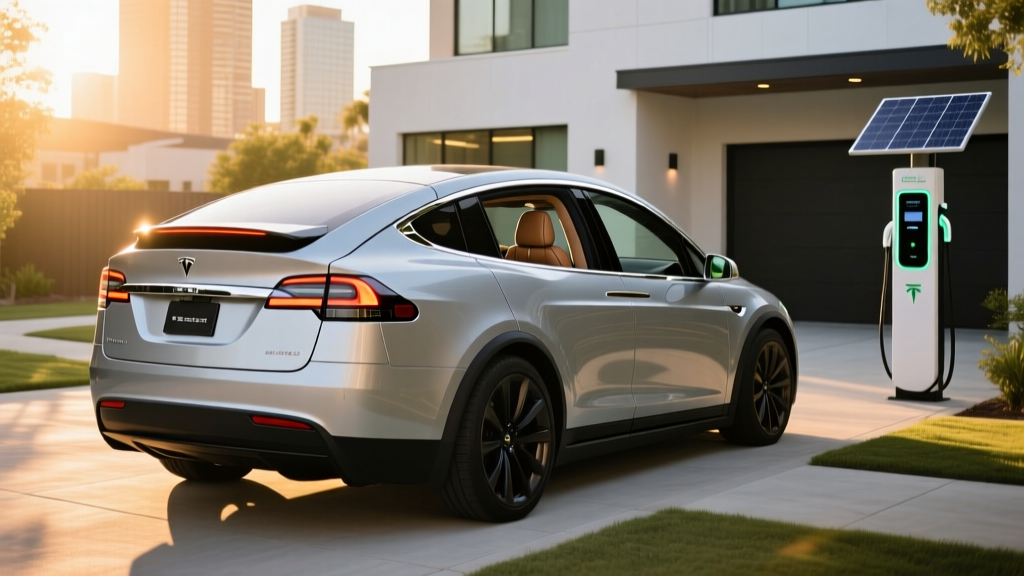
The Tesla Model X remains one of the few electric SUVs offering a true three-row, six-passenger layout with dedicated second-row captain's chairs — and the 2026 Model X Long Range AWD continues to push the envelope with 329 miles of EPA-estimated range, a 100 kWh battery pack, and access to the most reliable fast-charging network in North America. For families who need seating for six without sacrificing cargo space or highway range, the Model X 6-seater occupies a narrow but compelling niche.
But at a starting price hovering around $79,990 (before any incentives), the Model X demands scrutiny. This review breaks down real-world range, charging performance, ownership costs, and whether the 6-seat configuration is worth the premium over the standard 5-seat layout or competing electric SUVs like the Rivian R1S, Kia EV9, and BMW iX.
EPA Estimated: 329 miles (Long Range AWD, 20" wheels)
Real-World Highway (70 mph): ~270–290 miles
Cold Weather (below 32°F): ~230–260 miles depending on cabin heating demands and battery preconditioning
The Model X's large frontal area and ~5,100 lb curb weight penalize highway efficiency more than city driving, where regenerative braking recovers energy. Preconditioning the battery before fast charging or departure is essential for maximizing range and charge speed.
Range, Battery, and Efficiency Breakdown
The 2026 Tesla Model X Long Range AWD uses a 100 kWh (usable ~95 kWh) NMC (nickel manganese cobalt) lithium-ion battery pack. Tesla has not transitioned the Model X to LFP chemistry — LFP remains reserved for the standard-range Model 3 and Model Y due to its lower energy density, which would compromise the Model X's range targets given its heavier platform.
| Specification | Value |
|---|---|
| EPA Range | 329 miles |
| Battery Capacity | 100 kWh (NMC chemistry) |
| EPA Efficiency | 102 MPGe combined / 33 kWh/100 mi |
| Drivetrain | Dual-Motor AWD |
| Horsepower | 670 hp (combined) |
| 0–60 mph | 3.8 seconds |
| Top Speed | 155 mph |
| Curb Weight | ~5,185 lbs |
| Towing Capacity | 5,000 lbs |
| Base MSRP | $79,990 |
| Battery Warranty | 8 years / 150,000 miles (70% retention) |
At 33 kWh per 100 miles combined, the Model X is less efficient than the BMW iX xDrive50 (roughly 86 MPGe combined) or the Rivian R1S Dual-Motor (~31 kWh/100 mi), but the larger battery offsets this with sheer capacity. City driving with frequent regenerative braking pushes efficiency closer to 95–100 MPGe, while sustained 80 mph highway cruising can drop it to the mid-80s MPGe range.
For reference, fueleconomy.gov lists the Model X Long Range AWD efficiency data and allows direct comparison with other electric SUVs.
Charging Speed: DC Fast Charging and Home Level 2
Charging remains a critical ownership factor, and the Model X leverages Tesla's NACS (North American Charging Standard) connector natively — meaning seamless access to the entire Tesla Supercharger network without adapters. With other networks like Electrify America and EVgo increasingly adding NACS cables, the Model X's charging ecosystem advantage continues to grow in 2026.
| Charging Level | Power / Rate | Miles Added per Hour | Notes |
|---|---|---|---|
| Level 1 (120V outlet) | 1.4 kW | ~3–4 mi/hr | Emergency/trickle only |
| Level 2 (240V home) | 11.5 kW (48A) | ~34 mi/hr | Full charge overnight (~10 hrs) |
| DC Fast Charge (peak) | 250 kW | ~175 mi in 15 min | 10–80% in ~30 minutes |
| DC Fast (sustained avg.) | ~150–180 kW | Varies | Peak rate tapers significantly above 50% SoC |
The 250 kW peak DC fast-charge rate applies primarily at V3 and V4 Supercharger stalls and is achievable when the battery is preconditioned (navigating to a Supercharger in the car's nav triggers this automatically). However, the charge curve is not flat: expect peak rates between roughly 10–35% State of Charge, with a progressive taper through 50–80%. A 10–80% session typically takes 28–32 minutes at a V3 Supercharger.
For home charging, the Model X's onboard charger accepts up to 11.5 kW (48 amps) on a 240V Level 2 circuit. This requires a 60-amp dedicated circuit installed by a licensed electrician. A full charge from near-empty takes approximately 10 hours — practical for overnight replenishment if you drive 200+ miles in a day.
Home Level 2 installation costs typically range from $800–$2,500 depending on panel capacity, conduit run length, and local permit requirements. Always consult a licensed electrician for a site-specific quote, and check whether your utility offers rebates for EVSE installation.
Six-Seat Interior: Passenger Space, Cargo, and Practicality
The 6-seat configuration replaces the standard second-row bench with two individual captain's chairs separated by a center console with storage and cupholders. This layout costs an additional $6,500 over the 5-seat configuration on the Model X, bringing the effective starting price to approximately $86,490.
Here's how the interior dimensions stack up:
- Front headroom: 40.5 inches
- Front legroom: 41.2 inches
- Second-row headroom: 38.4 inches
- Second-row legroom: 37.8 inches (captain's chairs)
- Third-row headroom: 37.1 inches
- Third-row legroom: 32.7 inches
- Cargo behind 3rd row: 13.0 cu ft
- Cargo behind 2nd row (3rd row folded): 43.0 cu ft
- Max cargo (2nd + 3rd folded): 75.3 cu ft
- Frunk (front trunk): 6.6 cu ft
The third row is best suited for children or shorter adults on trips under an hour — 32.7 inches of legroom is tight by full-size SUV standards. However, the captain's chair configuration makes second-row access to the third row straightforward via the walk-through gap, a practical advantage over the bench seat where you must fold and slide.
The falcon-wing rear doors remain a polarizing feature. They provide excellent overhead clearance for loading children into car seats and stand up in tight parking spaces (Tesla claims they need as little as 12 inches of lateral clearance). However, they add mechanical complexity and can be slower to operate than conventional doors in rain — the sensors sometimes hesitate before closing.
Performance and Driving Dynamics
With 670 horsepower from its dual-motor AWD powertrain, the Model X Long Range hits 0–60 mph in 3.8 seconds — remarkable for a 5,185-pound family SUV. The Plaid variant (tri-motor, 1,020 hp, 0–60 in 2.5 seconds, starting at ~$94,990) exists for those who want supercar acceleration in a three-row package, but the Long Range delivers more than enough performance for daily driving and highway merging.
The air suspension provides adjustable ride height (useful for clearing rough driveways or reducing drag at highway speed) and a compliant ride quality that absorbs most road imperfections. Steering is precise if somewhat numb — typical of Tesla's electric power steering calibration. The low center of gravity from the floor-mounted battery pack keeps body roll well-controlled for a vehicle of this height.
Regenerative braking in the Model X is aggressive enough to enable one-pedal driving in most conditions, though Tesla has reduced the maximum regen strength in recent software updates compared to earlier model years. Drivers transitioning from ICE vehicles will need a brief adaptation period.
Pricing, Trims, and Federal Tax Credit Eligibility
| Trim / Configuration | MSRP | Federal §30D Credit | Effective Price |
|---|---|---|---|
| Long Range AWD (5-seat) | $79,990 | $0 (exceeds MSRP cap) | $79,990 |
| Long Range AWD (6-seat) | $86,490 | $0 (exceeds MSRP cap) | $86,490 |
| Plaid (5-seat) | $94,990 | $0 (exceeds MSRP cap) | $94,990 |
| Plaid (6-seat) | $101,490 | $0 (exceeds MSRP cap) | $101,490 |
The Tesla Model X does not qualify for the $7,500 federal EV tax credit under IRS §30D. The reason is straightforward: the §30D credit imposes an MSRP cap of $80,000 for SUVs, and even the base 5-seat Model X Long Range at $79,990 sits right at the limit before destination fees push it over. The 6-seat configuration at $86,490 exceeds the cap decisively.
Additionally, §30D has buyer income limits ($300,000 joint / $150,000 single for 2026) and battery component/critical mineral sourcing requirements that change annually. Even if pricing were adjusted, buyers should verify current-year eligibility on irs.gov before counting on any credit.
Some state-level incentives may still apply (California's CVRP, Colorado's innovative motor vehicle credit, and others), but these vary by jurisdiction — check your state's energy office or DMV for current programs.
Technology, Driver Assistance, and Safety
The Model X interior centers on a 17-inch landscape touchscreen running Tesla's proprietary infotainment OS. The system handles navigation, media, climate control, vehicle settings, and even gaming (a Steam-compatible gaming library is available while parked). There is no Apple CarPlay or Android Auto — Tesla's ecosystem is self-contained.
Standard driver assistance includes Tesla's Basic Autopilot (traffic-aware cruise control and lane centering). Enhanced Autopilot ($6,000) adds auto lane change, autopark, and Navigate on Autopilot. Full Self-Driving (Supervised) ($8,000 or $99/month) adds traffic light/stop sign recognition and city-street autosteer capabilities.
All Tesla driver-assistance features — including FSD (Supervised) — are SAE Level 2 systems. The driver must remain fully attentive, keep hands on the wheel, and be prepared to take over at any moment. These are not self-driving systems. Only Level 4 services like Waymo One (available in select metro areas) operate without a human driver in the loop.
Safety ratings for the Model X are strong. The NHTSA awarded it a 5-star overall safety rating, and the IIHS has rated it Good in multiple crash-test categories. Standard active safety features include automatic emergency braking, blind-spot monitoring, lane departure warning, and side collision warning. See nhtsa.gov for the full crash-test database.
Who Should Buy the Tesla Model X 6-Seater?
Choose the Model X 6-Seater if:
- You need three rows of seating and prefer captain's chairs for second-row passengers (car-seat access, individual comfort)
- You value access to the Tesla Supercharger network for road-trip reliability
- You want 300+ miles of EPA range in a three-row electric SUV
- Performance matters — 3.8-second 0–60 in a family hauler is genuinely thrilling
- You can charge at home with Level 2 and don't depend on public charging daily
Look elsewhere if:
- Budget is a primary concern — the Rivian R1S and Kia EV9 offer three rows for significantly less
- You want federal tax credit eligibility (the EV9 GT-Line AWD at ~$67,000 may qualify)
- Third-row adults are a regular use case (the Rivian R1S and Kia EV9 offer more third-row room)
- You prefer Apple CarPlay/Android Auto integration
- 329 miles EPA range — longest of any 3-row EV SUV
- Supercharger network access (native NACS)
- 670 hp dual-motor AWD, 3.8s 0–60
- Falcon-wing doors ease car-seat loading
- Strong safety ratings (5-star NHTSA)
- 5,000-lb towing capacity
- $86,490+ for 6-seat configuration — no federal tax credit
- Third row is tight for adults (32.7" legroom)
- 250 kW peak charge rate trails Hyundai/Kia 800V platforms (~350 kW)
- No Apple CarPlay or Android Auto
- Falcon-wing door sensors can be slow in rain
- Insurance premiums run 20–35% above comparable ICE SUVs
How It Compares: Model X vs. Key 3-Row EV Rivals
The Model X 6-seater competes in a small but growing segment. Here's how it stacks against the most relevant alternatives:
- Rivian R1S Dual-Motor: ~$75,900, 316 mi EPA, more third-row space, qualifies for §30D credit at lower trims, excellent off-road capability. Less charging infrastructure access (CCS, though NACS adapter available).
- Kia EV9 GT-Line AWD: ~$67,000, 270 mi EPA, conventional doors, CarPlay/Android Auto, federal credit eligible, significantly lower price. Less range and slower charging at 210 kW peak.
- BMW iX xDrive50: ~$87,000, 324 mi EPA, luxurious interior, but only two rows (5 seats). Not a direct 6-seat competitor but a price-range benchmark.
The Model X wins on range and charging-network convenience. The R1S wins on third-row practicality and tax-credit potential. The EV9 wins on value. Your priority ranking among these factors should drive the decision.
Frequently Asked Questions
What is the real-world range of the Tesla Model X 6-seater?
Expect approximately 270–290 miles on highway road trips at 70 mph in moderate temperatures. In cold weather (below freezing), range drops to roughly 230–260 miles due to cabin heating demands and reduced battery efficiency. City driving with regenerative braking can approach or occasionally exceed the 329-mile EPA estimate.
How fast does the Model X charge at home and on the road?
At home on a 240V Level 2 charger (48A/11.5 kW), the Model X adds about 34 miles of range per hour, with a full charge taking roughly 10 hours. On a Tesla V3 Supercharger at 250 kW peak, a 10–80% session takes approximately 28–32 minutes. The charge curve tapers significantly above 50% SoC, so plan stops around the 10–80% window for optimal speed.
Does the Tesla Model X qualify for the $7,500 federal EV tax credit?
No. Under current IRS §30D rules, the Model X exceeds the $80,000 MSRP cap for SUVs in all configurations, including the base 5-seat Long Range. The 6-seat version at $86,490 is well above the threshold. Additionally, buyer income limits and battery-sourcing requirements further restrict eligibility. Always verify current rules at irs.gov.
Is the 6-seat configuration worth the $6,500 premium?
If you regularly carry passengers in the second row and need easy walk-through access to the third row (especially with child car seats), the captain's chairs are a meaningful upgrade. The individual seats are more comfortable, and the center console adds storage. However, you lose one seating position (5 seats vs. 7 in the bench configuration) and pay more without gaining any range or performance benefit.
How does the Model X 6-seater handle towing?
The Model X is rated to tow up to 5,000 pounds when properly equipped. However, towing significantly reduces range — expect a 30–50% reduction depending on trailer weight, aerodynamics, and terrain. If you plan to tow frequently, budget for more frequent charging stops and consider whether an ICE or hybrid tow vehicle might be more practical for that specific use case.
What is the battery warranty on the Model X?
Tesla covers the Model X battery and drive unit for 8 years or 150,000 miles, whichever comes first, with a minimum 70% capacity retention guarantee. If the battery degrades below 70% State of Health within that period, Tesla will repair or replace it. Real-world data from high-mileage Model X owners suggests NMC packs typically retain 85–90% capacity at 100,000 miles with proper charging habits (avoiding frequent 100% charges and deep discharges).