If your household needs three rows of seats and a battery-electric drivetrain, the shortlist is frustratingly brief. The 6-seat Tesla Model X remains the only fully electric midsize SUV offering genuine third-row seating with access to the Supercharger network and a sub-4-second 0-60 time. But at a starting price above $80,000, buyers need hard data — not marketing gloss — before signing the delivery paperwork.
We've spent extensive time with the current-generation Model X in its six-passenger configuration (second-row captain's chairs) to break down real-world range, charging behavior, cargo utility, and ownership economics. Here's everything you need to decide if this is the right family EV for you.
2026 Tesla Model X: At-a-Glance Specifications
| Spec | Model X Long Range | Model X Plaid |
|---|---|---|
| EPA Range | 335 miles | 326 miles |
| Battery (usable) | ~100 kWh (NMC) | ~100 kWh (NMC) |
| Drivetrain | Dual-Motor AWD | Tri-Motor AWD |
| Horsepower | 670 hp | 1,020 hp |
| 0-60 mph | 3.8 seconds | 2.5 seconds |
| Peak DC Charge Rate | 250 kW | 250 kW |
| 10-80% DC Fast Charge | ~30 minutes | ~30 minutes |
| Level 2 Home Charging | 11.5 kW (~34 mi/hr) | 11.5 kW (~34 mi/hr) |
| MPGe (combined) | 101 MPGe | 98 MPGe |
| Efficiency | 33 kWh/100 mi | 34 kWh/100 mi |
| Seating Config | 5, 6, or 7 | 5, 6, or 7 |
| Cargo (behind 3rd row) | 15.3 cu ft | 15.3 cu ft |
| Cargo (all rows folded) | 77.5 cu ft | 77.5 cu ft |
| Towing Capacity | 5,000 lbs | 5,000 lbs |
| Base MSRP | $81,630 | $96,630 |
Source: Tesla Model X Design Studio, fueleconomy.gov. Prices reflect current ordering; destination fees may apply.
Real-World Range: What the EPA Number Doesn't Tell You
Real-World Expectation: ~280-300 miles on highway road trips at 70-80 mph; ~220-250 miles in sub-freezing winter conditions with cabin heat. City and suburban driving with regen braking can approach or slightly exceed the EPA figure.
The EPA's 335-mile figure for the Long Range variant assumes a mixed driving cycle. In practice, the Model X's large frontal area and ~5,100-pound curb weight penalize it at sustained highway speeds. On a 75-mph interstate run at 65°F, expect to consume roughly 35-37 kWh/100 miles, translating to about 280-290 usable miles before you'd want to stop and charge.
Cold weather compounds this. Lithium-ion batteries lose efficiency below freezing, and cabin heating in a vehicle this large draws substantial energy. In 25°F conditions with the heat pump running, plan for roughly 30-35% range reduction — bringing usable range to approximately 220-240 miles. Preconditioning the battery (which Tesla's navigation system does automatically when a Supercharger is set as your destination) mitigates charging-speed loss but doesn't fully recover range lost to heating demands.
For daily commuting under 60 miles round-trip, range is a non-issue. You'll charge at home overnight and rarely think about it. Road trips require more planning, but the Supercharger network makes this manageable — more on that below.
Charging Speed and Infrastructure
The Model X supports a peak DC fast-charge rate of 250 kW via its NACS (North American Charging Standard) connector — the native Tesla plug that now serves as the industry standard adopted by Ford, GM, Rivian, and most other automakers.
| Charging Level | Power | Speed (approx.) | Use Case |
|---|---|---|---|
| Level 1 (120V) | ~1.4 kW | ~4 miles/hour | Emergency / overnight trickle |
| Level 2 (240V, 48A) | 11.5 kW | ~34 miles/hour | Home daily charging (Wall Connector) |
| DC Fast Charge | Up to 250 kW | ~175 miles in 15 min | Road trips (Supercharger V3/V4) |
Understanding the Charge Curve
Tesla's 250 kW peak is not sustained across the entire session. The battery management system ramps power aggressively from roughly 10-40% State of Charge (SoC), then tapers to protect the NMC cells. A typical 10-80% session at a V3 Supercharger takes approximately 30 minutes. Above 80%, charging slows dramatically — from 80-100% can add another 25-30 minutes. The practical road-trip strategy is to charge to 80%, then drive on.
Home Charging Setup
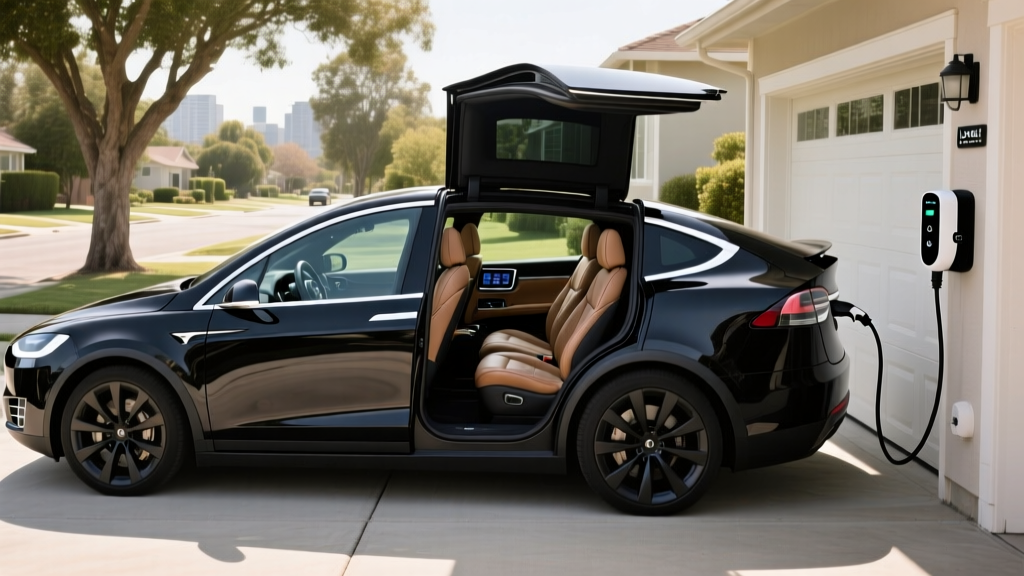
Installing a Tesla Wall Connector on a 60-amp circuit delivers the full 11.5 kW (48 amps continuous). For a 100 kWh battery, a full 0-100% charge takes roughly 9-10 hours — easily achievable overnight. Expect to pay $500-$1,500 for professional installation depending on your panel proximity and local permit requirements. If your home has a 100-amp electrical panel, a panel upgrade to 200 amps may be necessary, adding $1,500-$3,000. Always consult a licensed electrician for final specifications.
Performance and Driving Dynamics
Even the "base" Long Range Model X hits 60 mph in 3.8 seconds with 670 horsepower from its dual-motor all-wheel-drive powertrain. That's sports-car territory in a three-row SUV weighing over two and a half tons. The Plaid's tri-motor setup (one front, two rear) delivers 1,020 horsepower and a 2.5-second 0-60 — genuinely absurd performance that no family will ever need but is undeniably thrilling.
The air suspension is standard and provides adjustable ride height — useful for clearing steep driveways or lowering at highway speeds for efficiency. Ride quality is firm but controlled; this is a performance SUV first, luxury cruiser second. Road noise at highway speeds is noticeable, partly due to the large 20- or 22-inch wheel options and the vehicle's aerodynamic profile.
Regenerative braking is strong enough for one-pedal driving in most scenarios. The Model X does not offer adjustable regen levels like some competitors — it's either on (strong) or in "chill" mode (moderate). Most owners adapt quickly and prefer the one-pedal experience.
Interior, Cargo, and the 6-Seat Configuration
The six-seat layout replaces the second-row bench with two individual captain's chairs separated by a center console with storage and cupholders. This configuration costs $6,500 extra over the standard five-seat layout and eliminates the seventh seat.
Why Choose 6 Seats Over 7?
The captain's chairs provide noticeably better lateral support and individual recline adjustment. More critically, they create a walk-through aisle to the third row — no folding and sliding the second row to access the back. For families who regularly use the third row, this is a meaningful daily convenience improvement.
Third-Row Reality
Let's be direct: the Model X third row is best suited for children or adults on short trips. Legroom is approximately 30.2 inches — tight for anyone over 5'8" on longer journeys. Headroom is adequate thanks to the tall roofline. Compare this to the Rivian R1S, which offers slightly more third-row space, or the Kia EV9, which provides a more genuinely usable third row at a significantly lower price point.
Cargo Capacity
Behind the third row: 15.3 cubic feet — enough for a few grocery bags or a couple of carry-on suitcases. Fold the third row (50/50 split) and you gain a substantial flat load floor. Fold both rear rows and the Model X offers 77.5 cubic feet, competitive with midsize SUV benchmarks. The front trunk (frunk) adds approximately 6.5 cubic feet for charging cables or a small bag.
Pricing, Trims, and Federal Tax Credit Eligibility
| Trim | Base MSRP | 6-Seat Add-On | As-Tested (6-seat) | Federal Credit Eligible? |
|---|---|---|---|---|
| Long Range AWD | $81,630 | +$6,500 | $88,130 | No (exceeds MSRP cap) |
| Plaid AWD | $96,630 | +$6,500 | $103,130 | No (exceeds MSRP cap) |
Here's the critical tax-credit detail many buyers miss: under IRS §30D rules, SUVs must have an MSRP at or below $80,000 to qualify for the up-to-$7,500 federal clean vehicle credit. The Model X, even in base Long Range trim, starts above this cap. No Model X variant qualifies for the federal purchase tax credit.
Additionally, buyer income caps apply to qualifying vehicles ($300,000 joint / $150,000 single filer AGI), and battery critical-mineral and component sourcing requirements must be met. Even if the MSRP were under the cap, these sourcing rules can reduce or eliminate the credit. Always verify current eligibility at IRS.gov and consult a tax professional before relying on credit assumptions in your budget.
The Model X may still qualify for certain state and local incentives — these vary by jurisdiction and change frequently. Check your state's energy office or DMV for current programs.
Autopilot, FSD, and Driver-Assistance Technology
Both Autopilot (standard) and Full Self-Driving Supervised ($8,000 option or $99/month) require continuous driver attention and hands-on-wheel monitoring. The driver is legally responsible for the vehicle at all times. This is not autonomous driving.
Standard Autopilot includes Traffic-Aware Cruise Control and Autosteer (lane centering) on divided highways. It works well for reducing fatigue on long road trips. FSD (Supervised) adds automatic lane changes, navigation-guided on/off-ramp handling, traffic light and stop sign recognition, and enhanced urban street driving. In practice, FSD still requires frequent interventions — particularly in construction zones, complex intersections, and poor weather.
The 17-inch center touchscreen runs Tesla's latest software, which is responsive and feature-rich. The instrument cluster is a secondary 8-inch screen behind the yoke (or optional round steering wheel). Over-the-air updates regularly add features. The premium audio system with 22 speakers and active noise cancellation is genuinely excellent.
Pros, Cons, and Who Should Buy
Pros
- Supercharger network access — the most reliable DC fast-charging ecosystem in North America
- Genuine performance: 3.8s (LR) or 2.5s (Plaid) 0-60 in a three-row SUV
- Falcon-wing rear doors provide excellent curb-side access to second and third rows
- Over-the-air updates continuously improve the vehicle post-purchase
- Strong towing capacity (5,000 lbs) for an EV SUV
- Standard air suspension with adjustable ride height
Cons
- Base price exceeds $80K — no federal tax credit eligibility
- Third-row legroom is tight for adults (30.2 inches)
- Highway range falls notably short of the 335-mile EPA estimate
- Panel gaps and build-quality inconsistencies still reported by some owners
- No Apple CarPlay or Android Auto — Tesla's proprietary infotainment only
- FSD ($8,000) remains a Level 2 system requiring full driver supervision
- Insurance premiums tend to be higher than comparable non-Tesla SUVs
Who This EV Suits Best
The 6-seat Model X is ideal for: Tech-forward families who want three rows, prioritize Supercharger access for road trips, value performance, and have the budget to absorb the premium without relying on federal incentives. If you regularly haul four to five passengers and want the walk-through convenience of captain's chairs, the six-seat configuration is the right call.
Consider alternatives if: You need a genuinely spacious third row for adults (look at the Kia EV9), want federal tax credit eligibility (the Rivian R1S with the dual-motor standard battery may qualify), or are budget-conscious and can wait for more three-row EV options entering the market.
Battery Warranty and Long-Term Ownership
Tesla covers the Model X battery and drive unit with an 8-year / 150,000-mile warranty (whichever comes first), with a guaranteed minimum 70% capacity retention over that period. The NMC chemistry in the Model X has demonstrated moderate degradation in real-world fleet data — typically losing 10-15% capacity over the first 100,000 miles, with the curve flattening thereafter.
Tesla's vehicle limited warranty covers 4 years / 50,000 miles bumper-to-bumper. This is shorter than some luxury competitors (BMW, Mercedes offer 4/50 as well, but Hyundai provides 5/60). For a vehicle at this price point, the basic warranty coverage is merely average.
Long-term ownership costs benefit from lower "fuel" expenses (electricity vs. premium gasoline), fewer moving parts (no oil changes, no transmission fluid), and regenerative braking that extends pad life. However, tire replacement costs are significant — the Model X's weight and torque chew through tires faster than lighter vehicles. Budget for a set of premium 20- or 22-inch tires every 25,000-35,000 miles at roughly $1,200-$2,000 per set.
6-Seat Tesla Model X FAQ
What is the real-world range of the 6-seat Tesla Model X?
The EPA rates the Long Range at 335 miles and the Plaid at 326 miles. Real-world highway driving at 70-80 mph yields approximately 280-300 miles. In cold weather (below freezing), expect 220-250 miles. The six-seat configuration does not meaningfully affect range versus the five-seat layout.
How fast does the Model X charge at home and on the road?
At a V3 Supercharger (250 kW peak), a 10-80% session takes about 30 minutes. At home on a Level 2 Wall Connector (11.5 kW / 48 amps), you'll add approximately 34 miles of range per hour, fully recharging the ~100 kWh battery in 9-10 hours overnight.
Does the Tesla Model X qualify for the $7,500 federal EV tax credit?
No. Under current IRS §30D rules, SUVs must have an MSRP at or below $80,000 to be eligible. The Model X Long Range starts at $81,630, and the Plaid at $96,630 — both exceed the cap. State and local incentives may still apply; check your jurisdiction's programs.
Is the Model X 6-seat worth it versus the Rivian R1S or Kia EV9?
The Model X wins on Supercharger access, raw performance, and software. The Rivian R1S offers better off-road capability, a more traditional SUV interior, and potential tax credit eligibility on lower trims. The Kia EV9 provides a more usable third row and starts under $55,000, though with less range and slower charging. Your priority list determines the winner.
Can the Model X tow, and does towing affect range?
Yes — the Model X is rated to tow up to 5,000 pounds. Towing a loaded trailer will reduce range by approximately 40-50%, bringing usable range to roughly 150-180 miles between charges. Plan road trips with towing accordingly and use Tesla's built-in trip planner, which factors in trailer mode.
How much does insurance cost for the Model X?
Insurance premiums for the Model X are typically higher than comparable ICE SUVs due to repair costs and parts pricing. Expect annual premiums in the range of $3,000-$5,000 depending on your location, driving record, and coverage level. Tesla offers its own insurance product in many states, which uses real-time driving data to calculate premiums — worth comparing against traditional carriers.