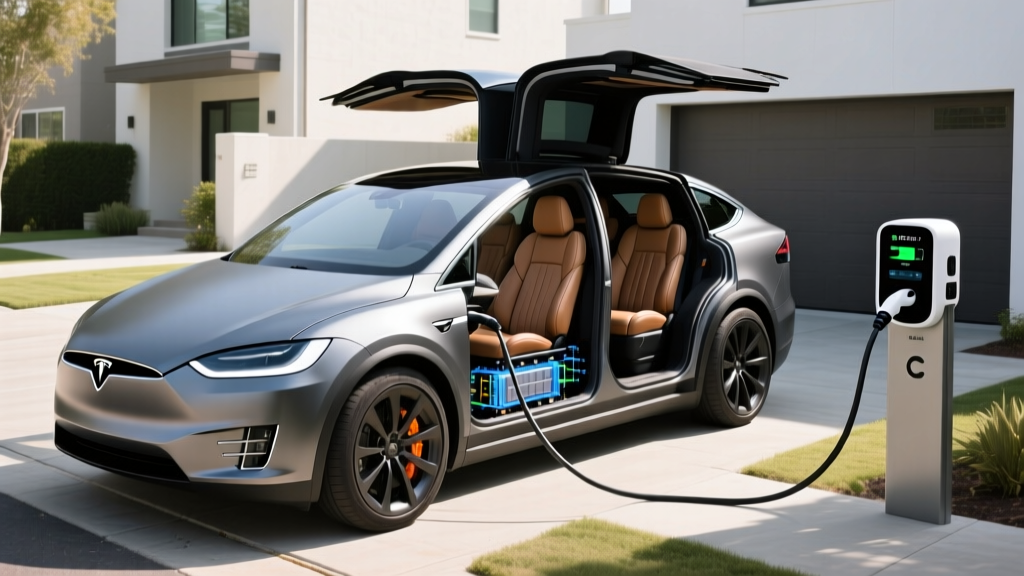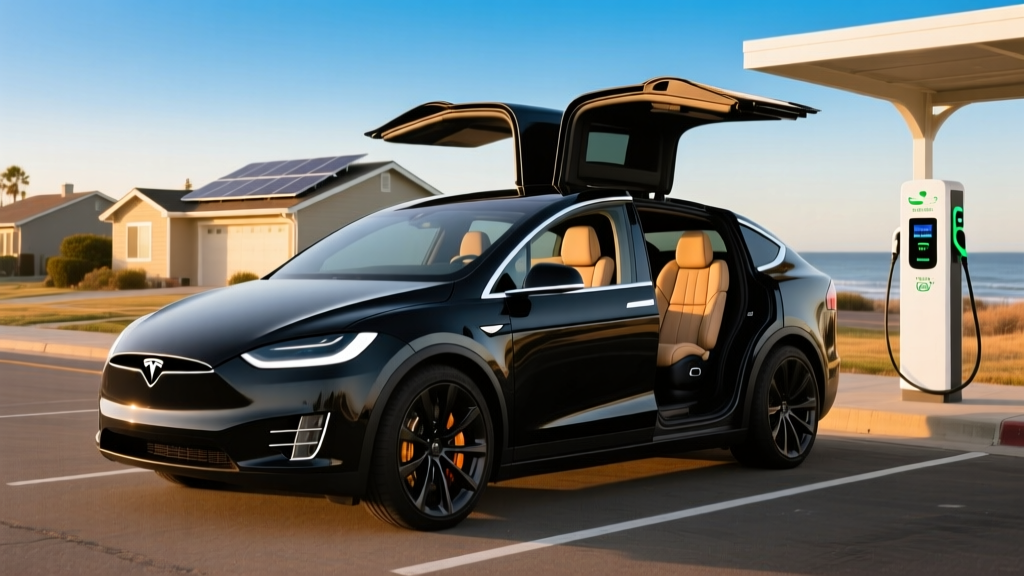
The Tesla Model X has always been the polarizing flagship of the EV SUV segment—falcon-wing doors, a massive glass windshield, and performance that embarrasses sports cars. But for buyers who don't need the optional third row, the Tesla Model X 5-seater configuration is where the value proposition sharpens: you get maximum cargo space behind the second row, a lower starting price than the 6- or 7-seat layouts, and the same 335-mile EPA range that makes it a genuine road-trip machine. This review breaks down the 2026 Model X in its most popular 5-passenger configuration with the data points that actually matter to buyers.
2026 Tesla Model X 5-Seater: Quick Specs at a Glance
| Specification | Value |
|---|---|
| EPA Range | 335 miles |
| Battery (usable) | ~100 kWh, NMC chemistry |
| Drivetrain | Dual-motor AWD |
| Horsepower | 670 hp |
| 0–60 mph | 3.8 seconds |
| Peak DC Fast Charge | 250 kW |
| 10–80% DC Charge Time | ~30 minutes |
| Level 2 Home Charging | 11.5 kW (44 mi/hr) |
| EPA Efficiency | 102 MPGe combined (33 kWh/100 mi) |
| Cargo (behind 2nd row) | 53.9 cu ft |
| Max Cargo (seats folded) | 88.1 cu ft |
| Base MSRP | $79,990 |
| Battery Warranty | 8 years / 150,000 miles |
Real-World Range: What 335 EPA Miles Actually Means
EPA sticker: 335 miles
Highway cruising (70–75 mph, moderate temps): expect ~275–295 miles
Cold weather (below 32°F, highway): expect ~235–260 miles
City/regenerative driving: can approach or exceed 335 miles
The 2026 Model X Long Range carries an EPA-estimated 335 miles of range on its ~100 kWh (usable) NMC battery pack. That number is competitive with the BMW iX xDrive50 (324 miles) and slightly behind the Mercedes EQS SUV 450+ (305 miles RWD, 330 miles AWD), but the Model X's efficiency advantage comes from Tesla's heat pump and aerodynamic tuning.
In real-world highway driving at 70–75 mph in temperate conditions (60–80°F), expect to see roughly 275 to 295 miles before needing to stop. The Model X is a large, heavy vehicle with a wide frontal area, and aerodynamic drag at highway speeds cuts into range noticeably. In sub-freezing temperatures, the battery's internal resistance increases and cabin heating draws additional energy—plan for 235 to 260 miles of usable range on winter road trips. Tesla's heat pump helps mitigate this loss compared to resistive heating, but physics still wins in extreme cold.
For city and suburban driving with frequent regenerative braking opportunities, you can approach or even slightly exceed the EPA figure. The Model X's aggressive regen in "Hold" mode recovers substantial energy in stop-and-go traffic.
Charging Speed: 250 kW Peak, but Watch the Curve
| Charging Level | Power / Rate | Speed |
|---|---|---|
| Level 1 (120V household) | ~1.4 kW | ~4 miles per hour |
| Level 2 (240V, 48A Wall Connector) | 11.5 kW | ~44 miles per hour |
| DC Fast Charge (V3 Supercharger) | 250 kW peak | 10–80% in ~30 minutes |
| DC Fast Charge (V4 Supercharger) | Up to 250 kW | Similar to V3 for Model X |
The Model X supports a peak DC fast-charge rate of 250 kW on Tesla's V3 and V4 Superchargers. In practice, that peak rate is sustained only from roughly 10% to 30% state of charge (SoC). The charge curve tapers progressively: by 60% SoC you're typically seeing ~150 kW, and above 80% it drops below 75 kW to protect the NMC cells. A typical 10–80% session takes about 30 minutes under optimal conditions (battery preconditioned via navigation routing to a Supercharger).
This is an area where the Model X shows its age compared to 800V-architecture competitors like the Hyundai Ioniq 9 or the Kia EV9, which can sustain higher charge rates deeper into the session. Tesla's 400V architecture limits peak power, and while 250 kW is adequate, the taper is noticeable on long road trips where every minute counts.
For home charging, Tesla's Gen 3 Wall Connector on a 60A circuit delivers 11.5 kW (48A continuous), adding roughly 44 miles of range per hour. A full overnight charge from 20% to 90% takes about 7–8 hours—plenty for daily use. Most owners will charge to 80% or 90% daily and reserve 100% for road trips, which is the recommended practice for NMC chemistry longevity. According to Tesla's battery care guidelines, keeping NMC batteries between 20–80% for daily use slows degradation significantly.
Performance: 670 Horsepower in a Family Hauler
The 2026 Model X Long Range uses a dual-motor all-wheel-drive powertrain producing 670 horsepower. The 0–60 mph sprint happens in 3.8 seconds—a remarkable figure for a 5,185-pound SUV carrying five passengers and their cargo. Instant electric torque means highway merging and passing maneuvers happen with zero drama.
For those who want absurd performance, the Model X Plaid (starting at $94,990) delivers 1,020 hp and a 2.5-second 0–60 time via its tri-motor setup, though it sacrifices about 20 miles of EPA range (311 miles) and costs significantly more. For most 5-seater buyers, the Long Range's 3.8-second time is more than sufficient and the range advantage is worth the trade-off.
Ride quality has improved in recent model years with Tesla's adaptive air suspension, which adjusts ride height based on speed and terrain. At highway speeds, the suspension lowers for aerodynamics; on rough roads, it can raise for clearance. The 22-inch turbine wheels (optional) look striking but reduce range by roughly 15–20 miles compared to the standard 20-inch setup—a trade-off worth knowing before configuring.
Interior, Cargo, and the 5-Seat Advantage
The 5-seat Model X uses a traditional second-row bench, which maximizes cargo space behind the passengers: 53.9 cubic feet with the second row upright, expanding to 88.1 cubic feet with seats folded. That's substantially more usable space than the 6-seat (individual captain's chairs) or 7-seat (small third row) configurations, where cargo behind the second row shrinks to 42.5 and 12.6 cubic feet respectively.
Legroom is generous: 41.2 inches up front and 38.4 inches in the second row. Headroom benefits from the massive panoramic windshield that extends over the front occupants, creating an airy, open feeling that no competitor matches. Rear visibility is compromised by the sloping roofline, but the standard rearview camera and proximity sensors mitigate this.
The 17-inch center touchscreen runs Tesla's latest infotainment software, which remains one of the most responsive and feature-rich systems in the industry. Wireless phone charging, a 22-speaker audio system, and rear-seat entertainment screen are standard. The yoke steering wheel is standard, with a traditional round wheel available at no extra charge—choose wisely, as the yoke requires adaptation for low-speed maneuvers and parking.
Notable drawbacks: panel gap consistency has improved but still trails German competitors. The absence of physical buttons for climate and mirror adjustments means everything routes through the touchscreen, which frustrates some drivers. The falcon-wing rear doors are theatrical but can be slow to open in tight spaces and have historically been a reliability concern, though recent model years have improved.
Pricing, Trims, and Federal Tax Credit Eligibility
| Trim | MSRP | Est. After §30D Credit |
|---|---|---|
| Long Range AWD | $79,990 | $72,490* |
| Plaid (Tri-Motor) | $94,990 | $87,490* |
*Tax credit estimates assume buyer eligibility. See below for requirements.
The 2026 Model X Long Range 5-seater starts at $79,990 (including destination). Adding Autopilot is standard; upgrading to Full Self-Driving (Supervised) adds $8,000. Premium paint colors add $1,500–$2,500. A well-equipped Long Range with FSD and premium paint typically lands around $90,000–$93,000 before incentives.
- MSRP cap: SUVs must be under $80,000 — the Model X Long Range at $79,990 just qualifies; the Plaid at $94,990 does not.
- Buyer income cap: Modified AGI must not exceed $150,000 (single), $225,000 (head of household), or $300,000 (joint filers).
- Battery sourcing: Critical minerals and battery components must meet phased-in percentage thresholds from U.S. or FTA-partner countries. Verify current-year compliance on fueleconomy.gov.
- Point-of-sale transfer: Eligible buyers can transfer the credit to the dealer at purchase, reducing the purchase price directly rather than waiting for a tax refund.
- Assembly: Vehicle must undergo final assembly in North America (the Model X is built in Fremont, CA — qualifies).
Source: IRS §30D Clean Vehicle Credit. Rules are subject to change; consult a tax professional before purchasing.
The MSRP cap is the critical detail here: at $79,990, the Long Range squeaks under the $80,000 SUV threshold, but adding any dealer-installed accessory or destination fee increase could push it over. The Plaid, at $94,990, is categorically ineligible. Always verify the final negotiated price against the cap before assuming credit eligibility.
Driver Assistance: Autopilot and FSD Supervised
Tesla Autopilot and Full Self-Driving (Supervised) are Level 2 driver-assistance systems. The driver must remain fully engaged, hands on the wheel (or providing torque input), and eyes on the road at all times. These systems are not self-driving. Only Level 4 services like Waymo operate without a human driver in defined geographic areas.
Every Model X ships with Tesla's Basic Autopilot, which includes adaptive cruise control and lane-centering on highways. The $8,000 Full Self-Driving (Supervised) upgrade adds automatic lane changes, traffic light and stop sign recognition, and the ability to navigate on-ramp to off-ramp with driver confirmation. FSD has improved substantially in its neural-net-based approach, but it still requires active supervision and can make unexpected decisions in construction zones, unmapped areas, or unusual traffic patterns.
Competitors like GM's Super Cruise and Ford's BlueCruise offer hands-free driving on pre-mapped divided highways, which some drivers find more relaxing because the system is clearer about its operational boundaries. Tesla's approach is more ambitious in scope but demands more vigilance. According to NHTSA, all Level 2 systems require continuous driver oversight regardless of branding.
Ownership Costs: Efficiency, Warranty, and Long-Term Value
The Model X Long Range achieves an EPA-rated 102 MPGe combined (33 kWh per 100 miles). At the U.S. average electricity rate of ~$0.16/kWh, that translates to roughly $5.28 per 100 miles—compared to $12–$15 per 100 miles for a similarly sized gas SUV getting 20 MPG at $3.50/gallon. Annual fuel savings over a gas competitor like the BMW X5 or Audi Q7 can exceed $1,500 for a 15,000-mile driver.
Tesla's battery and drive unit warranty covers 8 years or 150,000 miles (whichever comes first), with a minimum 70% capacity retention guarantee. This is competitive with the industry standard for premium EVs. Real-world degradation data from Tesla's fleet suggests most Model X packs retain 85–90% capacity after 100,000 miles when owners follow recommended charging practices (avoiding prolonged 100% SoC storage, using daily charge limits of 80–90%).
The basic vehicle limited warranty covers 4 years or 50,000 miles. Insurance costs tend to run 15–25% higher than comparable gas SUVs due to repair costs and Tesla's direct-repair network limitations. Get quotes before purchasing—insurance can add $300–$600/year over a BMW X5.
Pros, Cons, and Who Should Buy the 5-Seat Model X
- 335-mile EPA range handles most road trips with one stop
- Supercharger network remains the most reliable DC fast-charging ecosystem
- 5-seat cargo volume (53.9 cu ft) leads the luxury EV SUV class
- 3.8-second 0–60 in a 5,000+ lb vehicle is remarkable
- Over-the-air updates continuously add features
- Long Range just qualifies for the $7,500 §30D credit
- 250 kW peak charge rate trails 800V competitors
- Falcon-wing doors slow in tight parking and historically less reliable
- No physical buttons; all controls via touchscreen
- Plaid trim exceeds $80K MSRP cap — no tax credit
- Insurance premiums 15–25% above gas equivalents
- Panel gaps and interior material quality trail German rivals at this price
- Families with 1–2 children who need maximum cargo space for strollers, sports gear, and road-trip luggage
- Tech-forward buyers who value OTA updates, the Supercharger network, and Tesla's software ecosystem
- Performance-minded SUV shoppers who want sports-car acceleration with practicality
- Not ideal for: buyers needing hands-free highway driving (consider GM Super Cruise vehicles), those on tight budgets, or anyone who prioritizes traditional luxury materials over tech
Frequently Asked Questions
What is the real-world range of the 2026 Tesla Model X 5-seater?
The EPA rates it at 335 miles. In real-world highway driving at 70–75 mph, expect 275–295 miles. In cold weather below freezing, plan for 235–260 miles. City driving with regenerative braking can match or slightly exceed the EPA figure.
How fast does the Model X charge at home and on the road?
On a Level 2 Tesla Wall Connector (11.5 kW), it adds about 44 miles per hour—enough for a full overnight charge. On a V3 Supercharger at 250 kW peak, a 10–80% session takes approximately 30 minutes, though the charge curve tapers significantly above 60% SoC.
Does the 2026 Model X qualify for the $7,500 federal EV tax credit?
The Long Range at $79,990 MSRP qualifies—it's under the $80,000 SUV cap. However, buyer income must not exceed IRS thresholds ($300K joint, $150K single), and battery component/critical-mineral sourcing requirements must be met. The Plaid at $94,990 does not qualify. Always verify on fueleconomy.gov and consult a tax professional.
Is the Model X 5-seater worth it versus the BMW iX or Mercedes EQS SUV?
The Model X wins on range (335 vs. 324 for the iX), Supercharger network access, cargo space, and acceleration. The BMW iX wins on interior material quality, ride refinement, and charging architecture. The Mercedes EQS SUV wins on luxury ambiance but trails on range and efficiency. If the Supercharger ecosystem and software experience matter most, the Model X leads. If build quality and traditional luxury are priorities, test-drive the iX before committing.
What's the biggest drawback of the 5-seat configuration?
There isn't one for most buyers—the 5-seat layout maximizes cargo and is the lightest configuration, which preserves range. The only downside is resale: some buyers specifically seek the 6-seat captain's chairs for executive-style rear comfort. If you never need more than 5 passengers, the 5-seat is the optimal choice.