Quick Verdict: Is the Tesla Model X 3rd Row Actually Usable?
The Tesla Model X remains one of the few electric SUVs offering a genuine third row, and for 2026, it continues to occupy a unique niche: a premium, high-performance, three-row electric family hauler. But "third row" is doing a lot of heavy lifting in that sentence. Unlike the Chevrolet Tahoe or Kia Telluride, the Model X third row is best understood as occasional seating — viable for children, teenagers, or shorter adults on trips under an hour, but tight for full-size adults on long highway drives.
What the Model X does deliver is a combination no other three-row EV currently matches: 300+ miles of EPA range, access to the Supercharger network (now with NACS-native architecture), blistering acceleration, and a 100 kWh-class battery. If your household needs six seats most days and electric propulsion every day, the Model X is still the benchmark — with caveats we'll detail below.
| Spec | Value |
|---|---|
| EPA Range | 335 miles (Long Range) / 320 miles (Plaid) |
| Battery Capacity | ~100 kWh usable (NMC chemistry) |
| Drivetrain | Dual-Motor AWD (Long Range) / Tri-Motor AWD (Plaid) |
| 0-60 mph | 3.8 sec (Long Range) / 2.5 sec (Plaid) |
| Horsepower | 670 hp (LR) / 1,020 hp (Plaid) |
| Max DC Fast Charge | 250 kW peak (V3 Supercharger) |
| 10-80% DC Fast Charge | ~30 minutes |
| Level 2 Home Charge Rate | 11.5 kW (~34 mi/hr at 48A) |
| MPGe (Combined) | 101 MPGe (Long Range) |
| Efficiency | 33 kWh/100 mi |
| Seating | 5, 6, or 7 passengers (3rd row adds 2 seats in 7-seat config) |
| Cargo (behind 3rd row) | ~15 cu ft |
| Cargo (3rd row folded) | ~40 cu ft |
| Cargo (all rear rows folded) | ~75 cu ft + front trunk (frunk) |
| Base MSRP | $79,990 (Long Range) / $94,990 (Plaid) |
| Battery Warranty | 8 years / 150,000 miles |
| Basic Vehicle Warranty | 4 years / 50,000 miles |
Third-Row Passenger Space: Measurements and Real-World Comfort
The headline question for any three-row SUV buyer: can real humans sit back there? For the Model X, the answer depends entirely on who those humans are.
Tesla lists third-row legroom at approximately 30.2 inches, with headroom around 37.1 inches thanks to the tall roofline and panoramic windshield. Hip room is constrained by the wheel wells intruding into the cabin floor, and shoulder room is narrow — two adults will feel close, especially in winter coats.
In practice, the Model X third row works well for:
- Children in booster seats or older kids (ages 5-14)
- Teenagers and smaller adults on trips under 45 minutes
- Occasional overflow seating for school runs, sports events, or airport trips
It does not work well for:
- Adults over 5'10" on road trips exceeding one hour
- Three-across seating (the third row is strictly a two-seat bench)
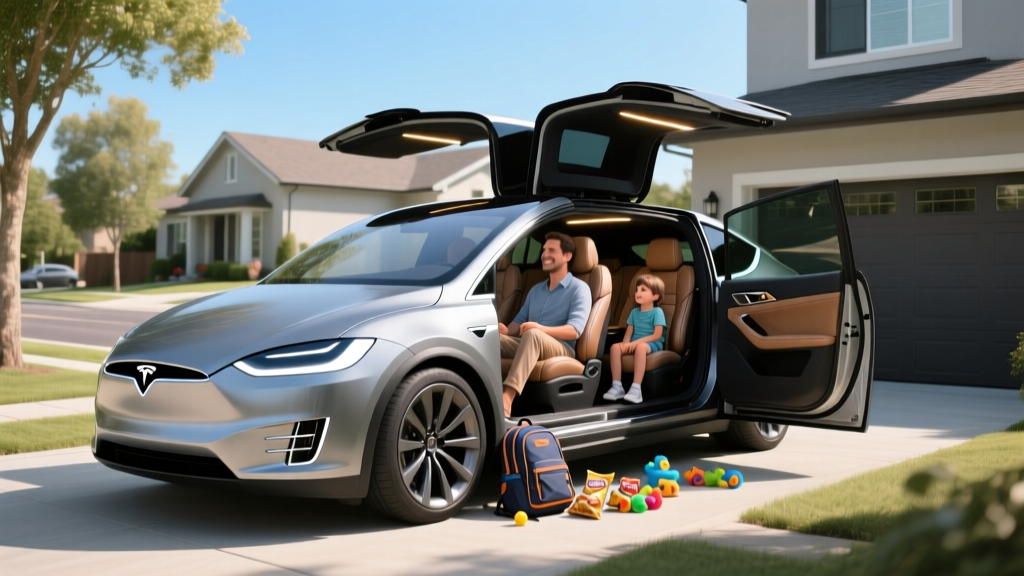
- Easy third-row access — the falcon-wing rear doors help with headroom but the entry path requires folding and sliding the second row, which is a multi-step process
The available six-seat configuration (two captain's chairs in the second row, two in the third) is the most practical family layout. It provides a center aisle for third-row access without needing to fold the second row — a meaningful daily-use advantage over the seven-seat bench layout.
Real-World Range: Beyond the EPA Sticker
EPA Estimated Range: 335 miles (Long Range AWD, 20" wheels) | 320 miles (Plaid)
Real-World Expectation: Plan for 270-300 miles in mixed highway driving at 70-75 mph. In cold weather (below 35°F), expect 220-260 miles depending on cabin heating demand and whether you precondition. City driving with regenerative braking recovers more energy, often yielding 310+ miles in stop-and-go conditions.
The Model X Long Range's 335-mile EPA figure is achieved under controlled lab conditions per fueleconomy.gov. Real-world highway driving at sustained speeds above 70 mph typically yields 10-15% less range due to aerodynamic drag — the Model X is a large, tall vehicle with a frontal area that penalizes efficiency at speed.
Cold weather is the more significant variable. Lithium-ion NMC batteries lose available capacity in freezing temperatures, and cabin heating (even with the Model X's heat pump system) draws 3-6 kW continuously in sub-freezing conditions. On a 20°F winter day with highway driving, we've observed range drop to 220-240 miles before needing to charge. This is a critical planning factor for families in northern climates who rely on the third row for winter activities.
Wheel choice matters: the optional 22" Turbine wheels reduce EPA range by approximately 25-30 miles compared to the standard 20" setup. If maximizing range is a priority — especially with a full cabin — stick with the smaller wheels.
Charging Speed and Infrastructure
The Model X charges via the North American Charging Standard (NACS) connector natively, giving it seamless access to Tesla's Supercharger network — currently the most reliable and extensive DC fast-charging system in the US. With the opening of Superchargers to non-Tesla EVs, the network is only growing, but Tesla owners still benefit from the most integrated plug-and-charge experience.
| Charge Level | Power (kW) | Speed | Notes |
|---|---|---|---|
| Level 1 (120V household) | ~1.4 kW | ~4 mi/hr | Emergency/trickle only; full charge in ~70 hours |
| Level 2 (240V home, 48A) | 11.5 kW | ~34 mi/hr | Full charge in ~10 hours; recommended home setup |
| Level 2 (240V, 60A Wall Connector) | 14.4 kW | ~42 mi/hr | Requires 60A+ circuit; fastest home option |
| DC Fast (V3 Supercharger) | 250 kW peak | 10-80% in ~30 min | Peak rate only below 40% SoC; tapers significantly above 60% |
| DC Fast (V4 Supercharger) | Up to 250 kW | Similar to V3 for Model X | Model X architecture caps at ~250 kW; won't reach CCS 350 kW rates |
A critical ownership note: the Model X's DC fast-charging architecture peaks at 250 kW but only sustains that rate briefly between 10-30% state of charge (SoC). Above 50% SoC, the charge curve tapers to roughly 120 kW, and above 80% it drops below 50 kW. This means a 10-80% session takes approximately 30 minutes, but a 10-95% session can stretch to 50+ minutes. For road-trip planning, plan your stops around 10-80% charges and avoid charging past 80% unless necessary.
For home charging, Tesla's Wall Connector at 48 amps on a 60-amp circuit is the practical standard. Expect to add roughly 250-300 miles overnight (8-10 hours), which covers virtually all daily needs. Installation costs typically range from $800-$2,500 depending on whether your electrical panel needs an upgrade to support the 60A circuit. Always consult a licensed electrician for a site assessment.
Performance and Driving Dynamics
The Model X Long Range delivers 670 horsepower from its dual-motor all-wheel-drive powertrain, reaching 0-60 mph in 3.8 seconds. For a 5,100+ pound three-row SUV, that figure borders on absurd — it out-accelerates most sports sedans and every other three-row SUV on the market, electric or otherwise.
The Plaid variant pushes this to 1,020 horsepower and a 2.5-second 0-60 time via its tri-motor setup. While impressive as an engineering exercise, the Plaid's $15,000 premium over Long Range buys performance that no family SUV scenario actually requires. The Long Range is the rational choice.
Driving dynamics are competent rather than engaging. The air suspension provides a comfortable, adaptive ride with adjustable ride height (useful for steep driveways or light off-pavement use). Steering is precise but numb. The sheer mass of the vehicle is noticeable in corners — this is a comfortable cruiser, not a canyon carver. For a family hauler, that trade-off is entirely appropriate.
Pricing, Trims, and Federal Tax Credit Eligibility
The 2026 Tesla Model X is offered in two trims:
- Long Range AWD: $79,990 base MSRP (before options, delivery, or incentives)
- Plaid AWD: $94,990 base MSRP
Common options that push real transaction prices higher include:
- Six-seat interior: $6,500
- Seven-seat interior: $4,000
- Full Self-Driving (Supervised): $8,000 (or $99/month subscription)
- Premium paint colors: $1,500-$2,500
- 22" wheels: $5,500
A well-equipped Long Range with six-seat configuration, FSD, and metallic paint typically lands in the $95,000-$105,000 range before incentives.
| Requirement | Model X Status | Notes |
|---|---|---|
| MSRP Cap (SUVs: $80,000) | Long Range qualifies at base; options may push over | Plaid ($94,990) exceeds cap — ineligible |
| Buyer Income Cap (Joint: $300K / Individual: $150K) | Varies by buyer | Modified AGI limits apply; check IRS guidelines |
| Battery Component Sourcing | Partial eligibility — verify current-year sourcing | Critical minerals and battery component rules tighten annually |
| Point-of-Sale Transfer | Available if eligible | Credit can be applied at purchase to reduce upfront cost |
| Maximum Credit | Up to $7,500 if all requirements met | Many Model X configurations may qualify for $3,750 (partial) or $0 depending on sourcing year |
Critical caveat: The Model X Plaid does not qualify for the §30D federal tax credit because its MSRP exceeds the $80,000 SUV cap. The Long Range at base MSRP sits just under the cap, but adding options (six-seat layout, FSD, premium paint) can push the vehicle MSRP above $80,000, potentially disqualifying it. Tesla's checkout page and the IRS clean vehicle credit tool should be checked at time of purchase, as battery sourcing requirements change annually. Consult a tax professional for your specific situation.
Interior, Tech, and Family Practicality
The Model X interior is dominated by the 17-inch center touchscreen running Tesla's proprietary infotainment system. The interface is responsive and feature-rich, with built-in navigation that integrates Supercharger stops and preconditioning automatically. A secondary 8-inch screen in the second row provides rear-seat climate and entertainment controls. The yoke steering wheel is standard; a conventional round wheel is available at no extra charge — we strongly recommend the round wheel for daily driving.
For families, standout features include:
- Falcon-wing rear doors: These gullwing-style doors open upward, providing exceptional headroom when loading children into car seats or the third row. They're genuinely useful in tight parking spaces (they need less lateral clearance than conventional doors) but can be slow to operate and occasionally balky in freezing rain.
- HEPA air filtration (Bioweapon Defense Mode): The massive cabin air filter provides hospital-grade filtration — a genuine health benefit for families in wildfire-smoke or high-allergy regions.
- Front trunk (frunk): Approximately 6.6 cu ft of sealed, drainable storage — useful for groceries, charging cables, or wet gear.
- Towing capacity: Up to 5,000 lbs when properly equipped, sufficient for a small camper or utility trailer.
Notable drawbacks:
- Panel gap quality remains inconsistent compared to German luxury competitors
- No Apple CarPlay or Android Auto — Tesla's ecosystem is closed
- The third-row seat cushions are thin and low to the floor, contributing to the "knees-up" seating position that limits adult comfort
- Visibility rearward is compromised by the small rear window and thick C-pillars; rely on the backup camera
Driver Assistance: Autopilot and FSD (Supervised)
SAE Automation Level: Tesla Autopilot and Full Self-Driving (Supervised) are Level 2 driver-assistance systems. The driver must remain fully engaged, hands on the wheel (or providing torque input), and eyes on the road at all times. These are not self-driving systems. Only Level 4 services like Waymo operate without driver supervision in geofenced areas.
Tesla's Autopilot (standard) provides adaptive cruise control and lane-centering on highways. It performs competently for highway commuting, maintaining following distance and handling gentle curves. Full Self-Driving (Supervised), the $8,000 option, adds automatic lane changes, navigation-guided on/off-ramp transitions, and city-street traffic-light recognition.
FSD has improved substantially but still requires active supervision. It occasionally makes unexpected lane-change decisions, misreads construction zones, or hesitates at complex intersections. For a family vehicle carrying children, we recommend using basic Autopilot on highways and driving manually in complex urban environments. The subscription option ($99/month) is a sensible way to trial FSD before committing to the full purchase.
How Does It Compare to Three-Row EV Alternatives?
The three-row electric SUV market has expanded, giving buyers real alternatives to consider:
Tesla Model X vs. Rivian R1S
Model X advantages: Longer range (335 vs ~321 mi), faster Supercharger network access, more third-row headroom, faster acceleration, larger touchscreen ecosystem.
R1S advantages: Genuinely usable third row for adults, superior off-road capability, more conventional SUV ergonomics, quad-motor option, better build quality perception, starts at ~$75,900 (potentially credit-eligible on lower trims).
Tesla Model X vs. Kia EV9
Model X advantages: Far longer range, more cargo space, faster acceleration, Supercharger access, air suspension, towing capacity.
EV9 advantages: Starts at ~$54,900 (over $25K less), more adult-friendly third row, CarPlay/Android Auto, conventional door operation, available for federal credit on qualifying trims, faster DC charging architecture (800V, up to 350 kW capable).
The Rivian R1S is the closest competitor in price and capability, and it offers a meaningfully more usable third row for adults. The Kia EV9 is the value play — significantly cheaper with a better third row, though with less range and no Supercharger access (though Kia now offers NACS adapters for Supercharger compatibility on newer models).
Choose the Tesla Model X if: You prioritize maximum range, Supercharger convenience, acceleration, and the falcon-wing door experience — and your third-row passengers are primarily children or occasional-use adults.
Choose the Rivian R1S if: You need a third row that adults can tolerate on longer trips, value off-road capability, and prefer a more traditional SUV interior layout.
Choose the Kia EV9 if: Budget is a primary concern, you want CarPlay/Android Auto, and your daily range needs fall within 270-300 miles.
Frequently Asked Questions
Can adults fit in the Tesla Model X third row?
Adults under 5'8" can fit for short trips (under 30 minutes), but the low seat cushion and limited legroom (30.2 inches) make it uncomfortable for longer drives. Taller adults will find the third row unsuitable. Children and teenagers are the ideal third-row passengers.
What is the real-world range of the Tesla Model X with a full cabin?
With six or seven passengers and cargo, expect 260-290 miles in moderate weather at highway speeds. The added weight of passengers reduces efficiency by approximately 5-8% compared to solo driving. In cold weather with a full cabin and heater running, plan for 220-250 miles between charges.
How fast does the Model X charge at home?
Using a Tesla Wall Connector on a 60-amp circuit (48A continuous), the Model X charges at up to 11.5 kW, adding approximately 34 miles of range per hour. A full 10-100% charge takes roughly 10 hours. On a standard 240V/40A dryer-style circuit, expect about 28 mi/hr.
Does the Tesla Model X qualify for the $7,500 federal EV tax credit?
It depends. The Long Range at base MSRP ($79,990) falls just under the $80,000 SUV cap for §30D eligibility. However, adding options may push MSRP above the cap. The Plaid ($94,990) is ineligible regardless. Additionally, buyer income limits ($300K joint / $150K individual MAGI) and battery-sourcing requirements apply. Verify eligibility through the IRS clean vehicle credit page and consult a tax professional before purchasing.
Is the Model X worth buying over the Rivian R1S or Kia EV9?
It depends on your priorities. If range, Supercharger access, and performance are paramount and your third-row passengers are children, the Model X is the strongest choice. If adult third-row comfort is essential, the Rivian R1S is better. If budget matters most, the Kia EV9 delivers three-row EV practicality for $25,000+ less. All three are capable family EVs — the right choice depends on which trade-offs you're willing to accept.
What is the battery warranty on the Model X?
Tesla covers the Model X battery and drive unit for 8 years or 150,000 miles (whichever comes first), with a minimum 70% capacity retention guarantee over that period. This is among the better battery warranties in the EV market and provides meaningful long-term ownership confidence for a vehicle in this price range.