The Tesla Model X has carried the torch as the default 3rd row Tesla since 2015, and for 2026 it remains the only all-electric SUV from the brand offering seating for up to seven. With a refreshed interior, a revised battery pack, and increased competition from the Kia EV9, Rivian R1S, and Hyundai Ioniq 9, the question is no longer whether the Model X has a third row — it's whether it still justifies its premium price tag. After driving it across highway, city, and cold-weather conditions, here's what real ownership looks like.
2026 Tesla Model X: Core Specs at a Glance
| Spec | Model X Long Range | Model X Plaid |
|---|---|---|
| EPA Range | 335 miles | 320 miles |
| Battery (usable) | ~100 kWh (NMC) | ~100 kWh (NMC) |
| Drivetrain | Dual-Motor AWD | Tri-Motor AWD |
| Horsepower | 670 hp | 1,020 hp |
| 0–60 mph | 3.8 seconds | 2.5 seconds |
| Max DC Fast Charge | 250 kW | 250 kW |
| 10–80% DC Time | ~30 minutes | ~30 minutes |
| Level 2 Home Charge | 11.5 kW (~34 mi/hr) | 11.5 kW (~34 mi/hr) |
| MPGe (combined) | 102 MPGe | 98 MPGe |
| Efficiency | 33 kWh/100 mi | 34 kWh/100 mi |
| Seating | 5, 6, or 7 | 5, 6, or 7 |
| Cargo (behind 3rd row) | 15.0 cu ft | 15.0 cu ft |
| Cargo (all rows folded) | 85.1 cu ft | 85.1 cu ft |
| Towing Capacity | 5,000 lbs | 5,000 lbs |
| Base MSRP | $79,990 | $94,990 |
| Battery Warranty | 8 yr / 150,000 mi | 8 yr / 150,000 mi |
Range and Efficiency: What the EPA Number Doesn't Tell You
The Long Range Model X carries an EPA-estimated 335 miles of range from its approximately 100 kWh (usable) NMC (nickel manganese cobalt) battery pack. The Plaid drops to 320 miles due to its tri-motor power draw. These are competitive numbers for a 5,200-pound three-row SUV, but real-world results diverge depending on conditions.
- Mild city/suburban driving (60–70°F): 320–340 miles — closely matches EPA
- Highway at 75 mph sustained: 265–290 miles — aero drag and speed eat into range
- Cold weather (25–35°F) mixed driving: 230–270 miles — expect 20–30% loss without preconditioning
- Cold weather + highway + hills: 200–240 miles — worst-case scenario
Tesla's heat pump and battery preconditioning help mitigate winter losses. Always precondition before DC fast charging in cold weather — it can cut charge time nearly in half.
Efficiency lands at roughly 33 kWh per 100 miles, which translates to 102 MPGe combined according to fueleconomy.gov. For a vehicle this size, that's impressive — the Rivian R1S Dual-Motor returns about 97 MPGe combined for comparison. The Model X's slippery 0.24 drag coefficient still pays dividends even a decade after its debut.
Charging Speed: Supercharger Access Remains the Trump Card
The 2026 Model X peaks at 250 kW on DC fast chargers using its native NACS (North American Charging Standard) connector. On a V3 Tesla Supercharger or any NACS-equipped 250+ kW station, a 10–80% session takes approximately 30 minutes. The charge curve tapers meaningfully above 80%, so plan to unplug at 80% on road trips to keep stops short.
| Charging Level | Power | Speed | Use Case |
|---|---|---|---|
| Level 1 (120V outlet) | ~1.4 kW | ~4 miles/hour | Emergency trickle only |
| Level 2 (240V home, 48A) | 11.5 kW | ~34 miles/hour | Daily overnight charging — full charge in ~9 hours |
| DC Fast Charge (Supercharger V3) | Up to 250 kW | ~175 miles in 15 min | Road trips, 10–80% in ~30 min |
| DC Fast Charge (Supercharger V4) | Up to 250 kW (vehicle-limited) | Same as V3 for Model X | Newer stations; Model X doesn't exceed 250 kW |
For home Level 2 charging, Tesla's Wall Connector at 48 amps delivers 11.5 kW, adding roughly 34 miles of range per hour. A full overnight session easily replenishes even a depleted pack. Installation typically costs $500–$2,000 depending on whether your electrical panel needs a 60-amp dedicated circuit or a panel upgrade (which can add $1,500–$4,000).
The Model X's native NACS port means it accesses Tesla's Supercharger network — over 20,000 stalls in North America — without an adapter. This is still a meaningful advantage in charging reliability and coverage, particularly for families planning multi-state road trips. Non-Tesla networks like Electrify America and EVgo now support NACS natively as well, but Tesla's plug-and-charge experience remains the most seamless.
Performance and Driving Dynamics
The Long Range's dual-motor all-wheel-drive powertrain produces 670 horsepower and launches the Model X to 60 mph in 3.8 seconds — absurdly quick for a three-row family hauler. The Plaid's tri-motor setup (1,020 hp, 2.5 seconds to 60) is supercar territory, though it's hard to argue anyone needs that in a school-run vehicle.
Ride quality is firm but controlled. The adaptive air suspension is standard and provides adjustable ride height — useful for clearing snow, loading cargo, or improving highway efficiency by lowering at speed. Steering is precise if somewhat numb, and the Model X's low center of gravity (thanks to the floor-mounted battery pack) keeps body roll well-managed for its height.
Regen braking offers two modes (Standard and Low), with Standard enabling near one-pedal driving in most conditions. The brake pedal feel remains one of the better implementations in the EV segment, with a natural transition between regenerative and friction braking.
Interior, Cargo, and the Third Row Reality
The Model X offers three seating configurations: five-seat (two rows), six-seat (with second-row captain's chairs), and seven-seat (second-row bench + third-row bench). The six-seat layout is the sweet spot for families — captain's chairs provide individual armrests, easier third-row access via a walk-through gap, and more comfort for adults in the second row.
Third-row dimensions are the compromise. Legroom measures 32.7 inches — adequate for children and smaller adults on shorter trips, but tight for six-footers on anything beyond a 30-minute ride. Headroom is acceptable thanks to the panoramic windshield, but the seat cushion sits low, creating a knees-up posture. Competitors like the Kia EV9 offer marginally more third-row space, while the Rivian R1S is comparable.
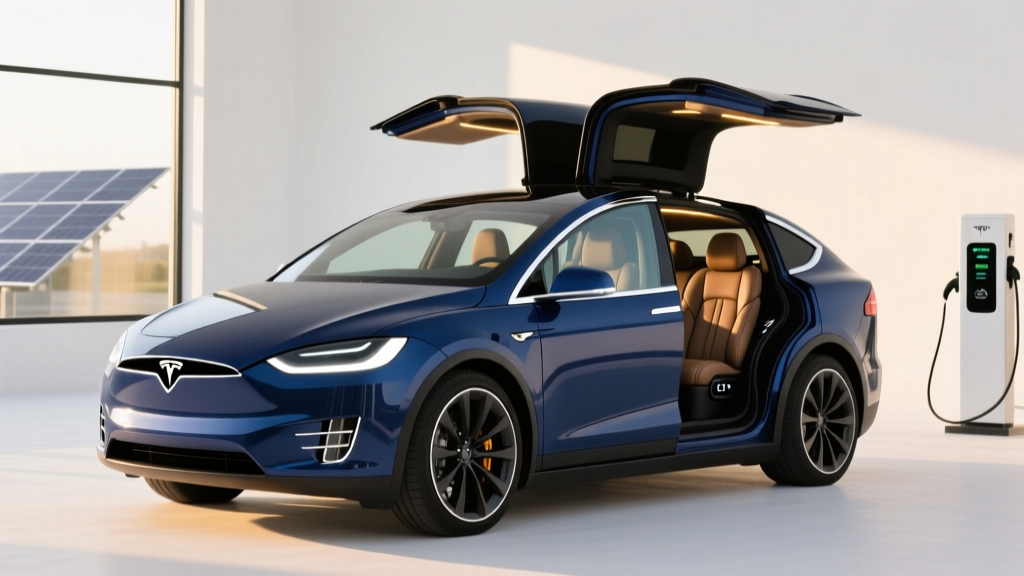
Cargo volume behind the third row is 15.0 cubic feet — enough for a couple of grocery runs or a stroller, but not both simultaneously with luggage. Fold the third row and you get 41.1 cu ft. Fold everything flat and the Model X opens up to 85.1 cu ft, aided by the front trunk (frunk) adding additional storage. The Falcon Wing rear doors — which hinge upward from the roof — are genuinely useful in tight parking spaces for loading kids into car seats, though they can be slow to operate and occasionally balky in very cold or icy conditions.
The 17-inch center touchscreen runs Tesla's latest software, which is responsive and feature-rich. Wireless phone charging, ventilated front seats, a 22-speaker audio system, and a rear-seat 8-inch touchscreen for climate and entertainment controls are all included. Build quality has improved noticeably over earlier model years, with tighter panel gaps and better interior material quality, though it still doesn't match the luxury feel of a BMW iX or Mercedes EQS SUV.
Pricing, Trim Levels, and Federal Tax Credit Eligibility
| Trim | Base MSRP | Est. After §30D Credit* | Destination |
|---|---|---|---|
| Model X Long Range | $79,990 | $72,490 | $1,990 |
| Model X Plaid | $94,990 | $87,490 | $1,990 |
*Federal tax credit eligibility requires meeting all IRS §30D criteria. See checklist below.
The Model X Long Range starts at $79,990 before destination, while the Plaid begins at $94,990. Popular options include the six-seat interior (no cost change from seven-seat), Full Self-Driving (Supervised) capability at $8,000, and premium paint colors at $1,500–$2,500. A well-equipped Long Range with FSD and premium paint typically lands around $90,000–$93,000 before incentives.
- MSRP Cap: SUVs/vans must be under $80,000 — the Long Range base qualifies; Plaid does NOT
- Buyer Income Cap: Modified AGI ≤ $150,000 (single), $225,000 (head of household), $300,000 (joint)
- Battery Sourcing: Critical minerals and battery components must meet phased-in domestic/free-trade requirements per IRS guidelines — verify current-year compliance with your dealer and tax professional
- Point-of-Sale Transfer: Eligible buyers can apply the credit as a down-payment reduction at purchase rather than waiting for tax filing
- Assembly: Vehicle must undergo final assembly in North America (Model X is assembled in Fremont, CA — qualifies)
Bottom line: The base Long Range at $79,990 squeaks under the $80,000 SUV cap, but adding options that push the MSRP above $80,000 will disqualify it. The Plaid is not eligible. Always confirm current-year sourcing compliance with your tax advisor before relying on the credit.
Tesla Autopilot and Full Self-Driving (Supervised)
Every Model X includes Tesla's basic Autopilot — a SAE Level 2 driver-assistance system providing adaptive cruise control and lane-centering on highways. It's competent for reducing fatigue on long drives, but it requires continuous driver attention and hands-on-wheel engagement.
Both Autopilot and the optional Full Self-Driving (Supervised) package are SAE Level 2 systems. The driver must remain fully engaged, monitor the road at all times, and be prepared to take over immediately. FSD (Supervised) adds automatic lane changes, traffic-light and stop-sign recognition, and city-street navigation assistance, but it does not make the vehicle autonomous. Only Level 4 services like Waymo operate without a driver.
- Drive without your active supervision — you are legally responsible at all times
- Handle all construction zones, unmapped roads, or severe weather reliably
- Replace attentive driving — NHTSA continues to investigate Autopilot/FSD incidents
For a family vehicle carrying children, treat FSD as a convenience aid, not a substitute for an alert driver. See NHTSA's guidance on ADS for current safety data.
Pros, Cons, and Who Should Buy the Model X
- Native Supercharger network access — best public charging reliability in the US
- 335-mile EPA range is excellent for a three-row electric SUV
- 670 hp Long Range provides sports-car acceleration in a family vehicle
- Falcon Wing doors genuinely aid car-seat loading in tight spaces
- Air suspension standard — adjustable height and comfortable highway ride
- Over-the-air updates continue to add features years after purchase
- Strong safety ratings from NHTSA (5-star overall)
- Third row is tight for adults — best for children or short trips
- Cargo behind third row (15 cu ft) is small for the vehicle's footprint
- Price starts near $80K — and the Plaid exceeds the §30D MSRP cap
- Falcon Wing doors can be slow, noisy, and problematic in ice/snow
- Interior still doesn't match luxury competitors at this price point
- DC fast charging peaks at 250 kW — slower than newer 800V rivals (EV9: 350 kW capable)
- No Apple CarPlay or Android Auto — Tesla's ecosystem only
- You need a 3rd row Tesla specifically and want Supercharger network access
- You regularly road-trip and value Tesla's charging infrastructure
- You want sports-car acceleration with room for the family
- You can charge at home and your typical trips are under 280 miles
- Third-row adult comfort is a priority — look at the Kia EV9 or Rivian R1S
- You want faster DC charging (800V architecture) — the EV9 charges to 350 kW
- Interior luxury matters more than performance — the BMW iX xDrive45 (though only 2-row) or Mercedes EQS SUV may appeal
- Budget is under $60K — the Kia EV9 starts significantly lower
Warranty and Long-Term Ownership
Tesla covers the Model X battery and drive units for 8 years or 150,000 miles (whichever comes first), with a guaranteed minimum 70% capacity retention over that period. The basic vehicle limited warranty is 4 years or 50,000 miles. These terms are competitive with the segment — Rivian offers 8 years/175,000 miles on its battery, while Kia provides 10 years/100,000 miles on the EV9's battery.
NMC battery chemistry in the Model X offers high energy density but is more sensitive to sustained high states of charge. Tesla recommends daily charging to 80–90% for regular use and 100% only before long trips. Long-term degradation data from high-mileage Model X owners suggests roughly 10–15% capacity loss over 150,000 miles, though individual results vary based on charging habits, climate, and Supercharger frequency.
Maintenance costs are low relative to ICE SUVs — no oil changes, no transmission fluid, and brake pads last significantly longer thanks to regenerative braking. The main recurring costs are tires (EVs wear through tires faster due to weight and instant torque — budget $1,200–$1,800 per set every 30,000–40,000 miles), cabin air filters, and wiper fluid. Insurance premiums tend to run higher than average for the segment; get quotes before purchasing.
Frequently Asked Questions
What is the real-world range of the Tesla Model X?
The EPA rates the Long Range at 335 miles and the Plaid at 320 miles. In real-world driving, expect 265–290 miles on sustained highway trips at 75 mph, and 230–270 miles in cold weather (below 35°F) mixed driving. Preconditioning the battery and using seat heaters instead of cabin heat can recover some of that winter loss.
How fast does the Model X charge at home and on the road?
On DC fast chargers, the Model X peaks at 250 kW and reaches 10–80% in approximately 30 minutes. At home on a Level 2 Wall Connector (48A/11.5 kW), it adds about 34 miles per hour, fully recharging overnight in roughly 9 hours. A standard 120V outlet adds only about 4 miles per hour — not practical as a primary charging method.
Does the 2026 Tesla Model X qualify for the federal EV tax credit?
The base Long Range at $79,990 falls under the $80,000 MSRP cap for SUVs and is assembled in Fremont, CA, so it meets the assembly requirement. However, you must also meet income caps (≤$300,000 joint filers) and the vehicle must satisfy current-year battery critical-mineral and component sourcing rules per IRS §30D. The Plaid at $94,990 exceeds the MSRP cap and is not eligible. Always verify with a tax professional and your dealer before purchase.
Is the Model X worth buying over the Kia EV9 or Rivian R1S?
It depends on your priorities. The Model X wins on Supercharger access, range (335 vs. EV9's 304 or R1S's ~352 with Max pack), and raw acceleration. The EV9 wins on price ($54,900 base), 800V fast-charging architecture (350 kW capable), and a more usable third row. The R1S wins on off-road capability, adventure-oriented design, and more third-row space. If Tesla's charging network and performance are your top criteria, the Model X remains compelling. If value or third-row comfort matter more, shop the competitors.
What are the biggest drawbacks of the Model X?
The third row is tight for adults. Cargo space behind the third row is limited. The price is steep, especially once options are added. Falcon Wing doors can be problematic in freezing weather. And the 250 kW DC charging peak is now outpaced by 800V competitors. For $80,000+, some buyers will expect more interior luxury than Tesla delivers.
Can the Model X tow, and how does towing affect range?
The Model X is rated to tow up to 5,000 pounds when properly equipped. Towing a 3,500–4,500 lb trailer will cut range roughly in half — expect 150–180 miles between charges depending on speed, terrain, and temperature. Plan Supercharger stops accordingly and use Tesla's built-in trip planner, which accounts for trailer load in newer software versions.