If you've ever typed "what Tesla has 3 rows" into a search bar, you've already narrowed the field to exactly one vehicle: the Tesla Model X. As of 2026, it remains the only Tesla with an available third-row seat, making it the default answer for larger families committed to the Supercharger network. But does the Model X justify its premium price tag when three-row EV rivals like the Rivian R1S, Kia EV9, and Hyundai Ioniq 9 are piling on the competition? Here's a data-driven breakdown.
Quick Verdict: The Model X in One Paragraph
The 2026 Tesla Model X is a premium, tech-forward three-row electric SUV that excels at long-distance road trips thanks to its access to the Supercharger network and up to 335 miles of EPA-estimated range. Its falcon-wing rear doors are a genuine differentiator for car-seat loading, and its performance variants embarrass sports cars at stoplights. The trade-offs are a firm ride, a minimalist interior that doesn't quite match its $80K+ price, and the persistent reality that third-row space is best suited for children. For families who prioritize range, charging infrastructure, and over-the-air updates, the Model X still leads the pack—but the gap has narrowed considerably.
Range, Battery, and Real-World Efficiency
EPA Estimated: 335 miles (Long Range AWD) / 326 miles (Plaid)
Real-World Expectation: ~270–295 miles on a highway road trip at 70+ mph; ~220–250 miles in sub-freezing winter conditions. City driving with regenerative braking can push closer to or slightly above the EPA sticker.
The 2026 Model X Long Range AWD uses a ~100 kWh usable battery pack built on NMC (nickel manganese cobalt) chemistry. Tesla has not transitioned the Model X to LFP (lithium iron phosphate), which is reserved for the standard-range Model 3 and Model Y due to LFP's lower energy density. NMC delivers the range and performance this heavy SUV demands, though it means owners should follow the 80% daily charge recommendation to minimize long-term degradation, saving 100% charges for road trips.
Efficiency lands at roughly 100 MPGe combined (Long Range), translating to about 33–35 kWh per 100 miles—reasonable for a 5,100+ lb. three-row SUV, but noticeably thirstier than a Model Y or Ioniq 5. Expect higher consumption when towing; Tesla rates the Model X at up to 5,000 lbs of towing capacity, but range drops significantly under load.
| Spec | Long Range AWD | Plaid |
|---|---|---|
| EPA Range | 335 mi | 326 mi |
| Battery (usable) | ~100 kWh (NMC) | ~100 kWh (NMC) |
| Drivetrain | Dual-Motor AWD | Tri-Motor AWD |
| Horsepower | 670 hp | 1,020 hp |
| 0–60 mph | 3.8 sec | 2.5 sec |
| Top Speed | 155 mph | 163 mph |
| Max DC Fast Charge | 250 kW | 250 kW |
| 10–80% DC Time | ~30 min | ~30 min |
| Level 2 Home Charge | 11.5 kW (~34 mi/hr) | 11.5 kW (~34 mi/hr) |
| Efficiency (combined) | ~100 MPGe | ~98 MPGe |
| Towing Capacity | 5,000 lbs | 5,000 lbs |
Charging Speed: DC Fast, Level 2, and the Supercharger Advantage
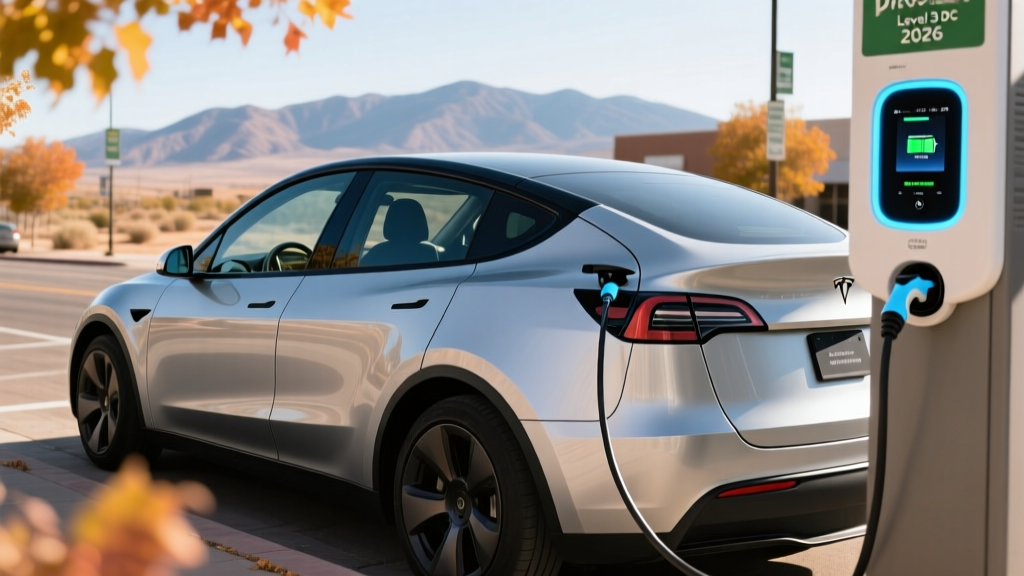
The Model X peaks at 250 kW on DC fast chargers via its native NACS (North American Charging Standard) connector. On a V3 Supercharger or comparable 250+ kW third-party station (Tesla has opened portions of its network to non-Tesla EVs, but Model X owners benefit from seamless plug-and-charge integration), you'll add roughly 175 miles of range in 15 minutes under ideal conditions. The full 10–80% session takes approximately 30 minutes.
Important charging-curve reality: the 250 kW peak is not sustained. The Model X ramps quickly to peak power between roughly 10–30% State of Charge, then progressively tapers. Above 80%, charging slows dramatically to protect battery health—expect the 80–100% top-off to add another 25–35 minutes. For road trips, plan your stops around 10–80% increments for the fastest overall travel time.
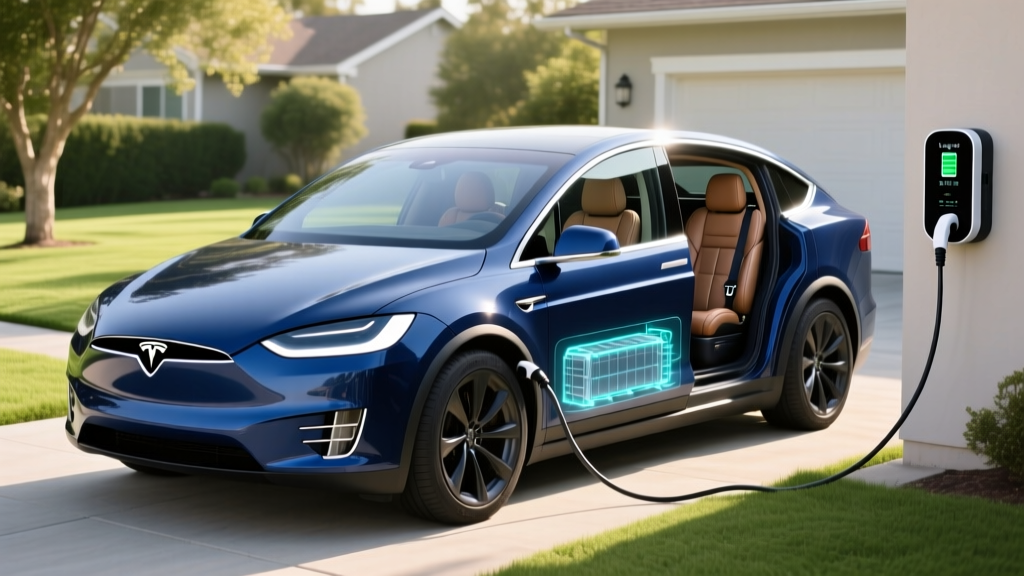
At home on a 48-amp Level 2 wall connector (Tesla's Wall Connector or equivalent on a 60-amp circuit), the Model X charges at up to 11.5 kW, adding about 34 miles of range per hour. An overnight charge from 20% to 80% takes roughly 5–6 hours—easily covering a full day's driving for most owners. On a standard 120V Level 1 outlet, expect only about 3–4 miles of range per hour, which is emergency-use only for a battery this large.
| Level | Power | Miles Added/Hour | Notes |
|---|---|---|---|
| Level 1 (120V) | ~1.4 kW | ~3–4 mi/hr | Emergency/trickle only |
| Level 2 (240V, 48A) | 11.5 kW | ~34 mi/hr | Recommended home setup |
| DC Fast (V3 Supercharger) | Up to 250 kW | ~175 mi in 15 min | 10–80% in ~30 min |
Interior, Cargo, and the Third-Row Reality
The Model X offers two seating configurations: six-passenger (with second-row captain's chairs and a center aisle) and seven-passenger (with a second-row bench). Both include a third row. Here's what the dimensions actually mean for daily use:
- Cargo behind 3rd row: ~15.1 cu ft — enough for a few grocery bags or two small suitcases, tight for a family road trip with all seats occupied.
- Cargo behind 2nd row (3rd row folded): ~41.1 cu ft — generous for a large SUV, handles strollers, sports gear, and luggage easily.
- Max cargo (all rear seats folded): ~81.5 cu ft — approaches small minivan territory.
- Front trunk (frunk): ~6.7 cu ft — useful for a charging cable bag or a small backpack.
- Third-row legroom: ~32.7 inches — adequate for children and smaller teens on shorter trips; adults will find it cramped beyond 30 minutes.
- Second-row legroom: ~38.4 inches — comfortable for adults on long drives.
The falcon-wing rear doors are the Model X's signature party trick and a genuine practical advantage: they open upward, creating a massive aperture for loading rear-facing car seats without hunching over. In tight parking spaces, the doors' ultrasonic sensors adjust the opening arc to avoid adjacent vehicles. The trade-off is complexity—falcon-wing doors have historically been a source of maintenance complaints (seal leaks, sensor issues), though Tesla has improved reliability in recent model years.
Pricing, Trims, and Federal Tax Credit Eligibility
The 2026 Model X is offered in two trims. Pricing reflects Tesla's direct-to-consumer model with no dealer markups, though options and paint colors can push the as-tested price considerably higher:
| Trim | Base MSRP | As-Tested (Typical) | §30D Credit Eligible? |
|---|---|---|---|
| Long Range AWD | $79,990 | $84,000–$89,000 | No (exceeds MSRP cap) |
| Plaid (Tri-Motor) | $94,990 | $99,000–$108,000 | No (exceeds MSRP cap) |
Under current IRS rules, the Model X does not qualify for the $7,500 federal EV tax credit. The §30D credit imposes an MSRP cap of $80,000 for SUVs, and both Model X trims exceed that threshold (the Long Range starts at $79,990 before destination, effectively disqualifying it when fees are included). Additionally, the credit has buyer income caps ($300K joint / $150K single modified AGI) and critical mineral + battery component sourcing requirements that further restrict eligibility. Always verify your specific situation on IRS.gov or with a tax professional.
Performance and Driving Dynamics
The Model X Long Range delivers 670 horsepower from its dual-motor AWD powertrain, hitting 0–60 mph in 3.8 seconds—a figure that would have been exotic-supercar territory a decade ago. The Plaid variant's tri-motor setup produces 1,020 horsepower and a 2.5-second 0–60, making it one of the quickest production SUVs on the planet.
In practice, the Model X drives smaller than its 5,100+ lb. curb weight suggests, thanks to the low center of gravity from its floor-mounted battery pack. Steering is precise, and the air suspension (standard on both trims) provides adjustable ride height for highway efficiency or rough-road clearance. The trade-off is ride quality: even in the most comfortable suspension setting, the Model X transmits more road imperfections than a Rivian R1S or a Kia EV9. It's a sporty SUV, not a plush cruiser—and that distinction matters for families prioritizing comfort on long drives.
Tech, Autopilot, and Software
The Model X centers its tech experience around a 17-inch center touchscreen (landscape orientation) and a 12.3-inch digital instrument cluster behind the yoke-style steering wheel. Rear passengers get their own 8-inch touchscreen for climate controls and entertainment. The infotainment system runs Tesla's proprietary software, which includes native navigation with real-time Supercharger routing, streaming apps (Netflix, YouTube, Spotify while parked), and over-the-air updates that regularly add features.
Autopilot comes standard and includes adaptive cruise control, lane-keeping assist, and automatic emergency braking. Full Self-Driving (Supervised) is an available upgrade (typically $8,000 or a monthly subscription) that adds automated lane changes, on-ramp-to-off-ramp highway driving, and city-street navigation. Important clarification:
Both Autopilot and FSD (Supervised) are SAE Level 2 driver-assistance systems. The driver must remain fully engaged, hands on the wheel (or providing torque input), and eyes on the road at all times. The Model X is not self-driving. Only Level 4 robotaxi services like Waymo operate without a human driver in defined geofenced areas.
Tesla's driver-monitoring camera tracks eye gaze and issues escalating warnings if attention drifts. In our experience, FSD (Supervised) handles most highway scenarios competently but still requires intervention for construction zones, faded lane markings, and complex unprotected left turns. It's an impressive assist, not a replacement for an attentive driver.
Warranty and Ownership Costs
Tesla provides the following warranty coverage for the 2026 Model X:
- Basic Vehicle Limited Warranty: 4 years / 50,000 miles
- Battery & Drive Unit Warranty: 8 years / 150,000 miles (with minimum 70% battery capacity retention over the warranty period)
The 8-year/150,000-mile battery warranty is competitive with rivals. Tesla's NMC chemistry has demonstrated manageable degradation in real-world fleets—most Model X owners report 5–10% range loss over the first 100,000 miles, which is within the warranty threshold. For context, a full battery replacement outside of warranty would cost an estimated $15,000–$22,000 at current pricing, though this is rarely needed within the vehicle's typical ownership lifecycle.
Insurance costs for the Model X are among the highest in the EV segment, averaging $3,500–$4,500 per year depending on state, driving record, and coverage level. Tesla offers its own insurance product in many states that uses real-time driving data to adjust premiums, which can be cheaper for low-mileage, careful drivers but more expensive for aggressive driving profiles.
Pros and Cons
- Access to Tesla Supercharger network (most reliable DC fast-charging in the U.S.)
- 335 mi EPA range — among the best for three-row EVs
- Falcon-wing doors make car-seat loading genuinely easier
- Tri-motor Plaid variant offers absurd performance (2.5s 0–60)
- Over-the-air updates continuously add features
- Standard air suspension with adjustable ride height
- Does NOT qualify for the $7,500 federal EV tax credit
- Third row is tight for adults (32.7" legroom)
- Cargo space behind 3rd row is limited (15.1 cu ft)
- Firm ride quality compared to comfort-oriented rivals
- Falcon-wing doors add mechanical complexity and potential repair cost
- High insurance premiums ($3,500–$4,500/yr average)
- Yoke steering wheel has a steep learning curve
Model X vs. the Three-Row EV Competition
The Model X no longer competes alone. Here's how it stacks up against key rivals for the three-row EV buyer:
- Rivian R1S: More rugged, better off-road, genuine adult-usable third row, qualifies for the $7,500 credit (on certain configurations). Slightly less range (~316 mi max). Trades Supercharger access (though Rivian now has NACS adapters for Supercharger use) for more interior versatility.
- Kia EV9: Significantly cheaper ($55K–$74K range), qualifies for the federal credit, more traditional SUV interior layout, comfortable ride. Less range (~270–304 mi), slower DC charging (~210 kW peak), and no Supercharger access natively.
- Hyundai Ioniq 9 (2026): New entrant with competitive pricing, 800V architecture for fast charging, and credit eligibility. A strong value play that undercuts the Model X on price while offering comparable interior space.
- Choose the Model X if: You prioritize Supercharger network access for frequent road trips, want 330+ miles of range in a three-row SUV, value performance, and the $80K+ price (without a tax credit) fits your budget.
- Choose the Rivian R1S if: You need a genuinely usable third row for adults, want off-road capability, and the $7,500 tax credit matters to your purchase math.
- Choose the Kia EV9 if: You want a more affordable three-row EV with a comfortable ride, federal tax credit eligibility, and don't need 330+ miles of range.
Frequently Asked Questions
What Tesla has 3 rows of seats?
The Tesla Model X is the only Tesla currently available with a third-row seat. It can be configured as a six-passenger (captain's chairs in the second row) or seven-passenger (bench second row) SUV. The Model Y, Model 3, Model S, and Cybertruck do not offer a third row as of 2026.
What is the real-world range of the 2026 Model X?
The EPA rates the Long Range AWD at 335 miles and the Plaid at 326 miles. In real-world highway driving at 70–80 mph, expect roughly 270–295 miles. In cold weather (below 32°F), range can drop to 220–250 miles due to battery resistance and cabin heating demands. Preconditioning the battery (automatic when navigating to a Supercharger) helps mitigate cold-weather charging slowdowns.
How fast does the Model X charge at home and on the road?
On DC fast chargers (V3 Supercharger or equivalent), the Model X peaks at 250 kW and charges from 10–80% in approximately 30 minutes. At home on a 48-amp Level 2 charger (240V), it charges at 11.5 kW, adding about 34 miles per hour—enough to fully replenish overnight. Level 1 (120V) charging adds only 3–4 miles per hour and is impractical for daily use.
Does the 2026 Model X qualify for the federal EV tax credit?
No. Under current IRS §30D rules, the Model X does not qualify for the $7,500 federal tax credit. The SUV MSRP cap is $80,000, and both trims (Long Range at $79,990 and Plaid at $94,990) effectively exceed this threshold when destination fees are included. Buyers must also meet income caps ($300K joint / $150K single) and the vehicle must meet critical-mineral and battery-component sourcing requirements. Always verify on IRS.gov.
Is the Model X worth buying over the Rivian R1S or Kia EV9?
It depends on your priorities. The Model X wins on range (335 mi), Supercharger network access, and raw performance. The Rivian R1S offers a more usable third row, off-road capability, and tax-credit eligibility. The Kia EV9 undercuts both on price by $15K–$25K, offers a comfortable ride and the federal credit, but has less range and no native Supercharger access. If road-trip charging infrastructure and maximum range are your top criteria, the Model X still leads. If value or third-row space matters more, look at the alternatives.
How much does it cost to insure a Tesla Model X?
Average annual insurance premiums for the Model X range from $3,500 to $4,500, depending on your state, driving history, and coverage level. Tesla's own insurance product (available in most states) uses real-time driving behavior to set rates, which can be lower for careful drivers. Always compare quotes from multiple providers.
What is the battery warranty on the Model X?
Tesla covers the Model X battery and drive units for 8 years or 150,000 miles, whichever comes first, with a guaranteed minimum of 70% battery capacity retention over that period. Real-world data from high-mileage Tesla fleets suggests most NMC packs retain 90–95% capacity at 100,000 miles under normal use patterns.