If you search for a Tesla with 3 rows, you land on exactly one option: the Tesla Model X. While the Model Y offers an optional third row, it's cramped for anyone over elementary-school age. The Model X remains Tesla's flagship family hauler — a full-size, three-row electric SUV with falcon-wing rear doors, genuine adult-capable third-row seating, and the Supercharger network advantage. For 2026, the Model X continues with a 100 kWh battery pack, dual- and tri-motor powertrains, and a starting price that now reflects Tesla's recent price adjustments.
This review covers everything you need to decide if the Model X earns a spot in your garage: real-world range versus the EPA sticker, charging speeds at home and on the road, federal tax credit eligibility under current IRS §30D rules, and how it stacks up against three-row EV rivals like the Rivian R1S and Kia EV9.
2026 Tesla Model X Core Specifications
| Specification | Long Range (Dual Motor) | Plaid (Tri-Motor) |
|---|---|---|
| EPA Range | 335 miles | 326 miles |
| Battery (Usable) | ~100 kWh (NMC) | ~100 kWh (NMC) |
| Drivetrain | Dual Motor AWD | Tri-Motor AWD |
| Horsepower | 670 hp | 1,020 hp |
| 0-60 mph | 3.8 seconds | 2.5 seconds |
| Top Speed | 155 mph | 163 mph |
| Max DC Fast Charge | 250 kW | 250 kW |
| 10-80% DC Charge | ~30 minutes | ~30 minutes |
| Level 2 Charge Rate | 11.5 kW (~34 mi/hr) | 11.5 kW (~34 mi/hr) |
| MPGe (Combined) | 98 MPGe | 96 MPGe |
| Efficiency | 34 kWh/100 mi | 35 kWh/100 mi |
| Cargo (Behind 3rd Row) | 15.3 cu ft | 15.3 cu ft |
| Cargo (All Rows Folded) | 85.1 cu ft | 85.1 cu ft |
| 3rd Row Legroom | 32.7 inches | 32.7 inches |
| Towing Capacity | 5,000 lbs | 5,000 lbs |
| Base MSRP | $79,990 | $94,990 |
| Battery Warranty | 8 yr / 150,000 mi | 8 yr / 150,000 mi |
| Basic Warranty | 4 yr / 50,000 mi | 4 yr / 50,000 mi |
Sources: fueleconomy.gov, Tesla Model X official specs. Prices reflect 2026 model year MSRP before destination fees.
Range and Efficiency: EPA Sticker vs. Real World
EPA Estimate: 335 miles (Long Range) / 326 miles (Plaid)
Real-World Expectation: Plan for 270–300 miles on highway road trips at 70-75 mph. In cold weather (below 32°F), expect a 20–30% reduction, dropping effective range to roughly 210–250 miles depending on cabin heating use and terrain.
The Model X's 100 kWh NMC (nickel-manganese-cobalt) battery pack delivers strong EPA numbers, but the real-world story is more nuanced. On a mixed-drive cycle with city regeneration opportunities, you'll approach the 335-mile sticker. However, this is a heavy, aerodynamically challenged SUV — highway efficiency drops noticeably above 70 mph.
In our experience with the Model X platform on multi-state road trips, sustained highway driving at 75 mph with climate control running yields roughly 3.0–3.2 miles per kWh, translating to 300–320 miles before you need to stop. That's before accounting for elevation gain, headwinds, or a fully loaded cabin with cargo on the roof. Cold weather is the bigger penalty: NMC chemistry loses meaningful capacity in freezing temperatures, and resistive cabin heating (the Model X uses a heat pump, which helps, but extreme cold still bites) further erodes range.
At 34 kWh/100 miles combined, the Long Range Model X is less efficient than the Model Y (roughly 28 kWh/100 mi) but competitive with the Rivian R1S Dual-Motor (around 37 kWh/100 mi). For context, that's approximately $0.11–$0.14 per mile at the national average residential electricity rate of $0.16/kWh — or $0.07–$0.09/mi if you have access to off-peak utility rates.
Charging: DC Fast, Level 2, and Home Setup
Charging speed is where the Model X benefits enormously from Tesla's vertically integrated ecosystem. Here's the breakdown by charging level:
| Charging Level | Power | Speed (Miles Added/Hour) | Use Case |
|---|---|---|---|
| Level 1 (120V) | ~1.4 kW | ~3–4 mi/hr | Emergency / trickle only |
| Level 2 (240V, 48A) | 11.5 kW | ~34 mi/hr | Overnight home charging |
| DC Fast (Supercharger V3) | Peak 250 kW | ~175 mi in 15 min | Road trips |
DC Fast Charging Reality: The Model X peaks at 250 kW on V3 Superchargers, but — as with all EVs — that peak is not sustained. The charge curve tapers significantly above 50% state of charge (SoC). Expect roughly 10–80% in about 30 minutes under ideal conditions (battery preconditioned, warm ambient temperature, V3 or V4 stall available). From 80–100%, charging slows dramatically to protect the NMC cells, adding another 25–35 minutes. For road trips, the practical strategy is charging from 10–80% and moving on.
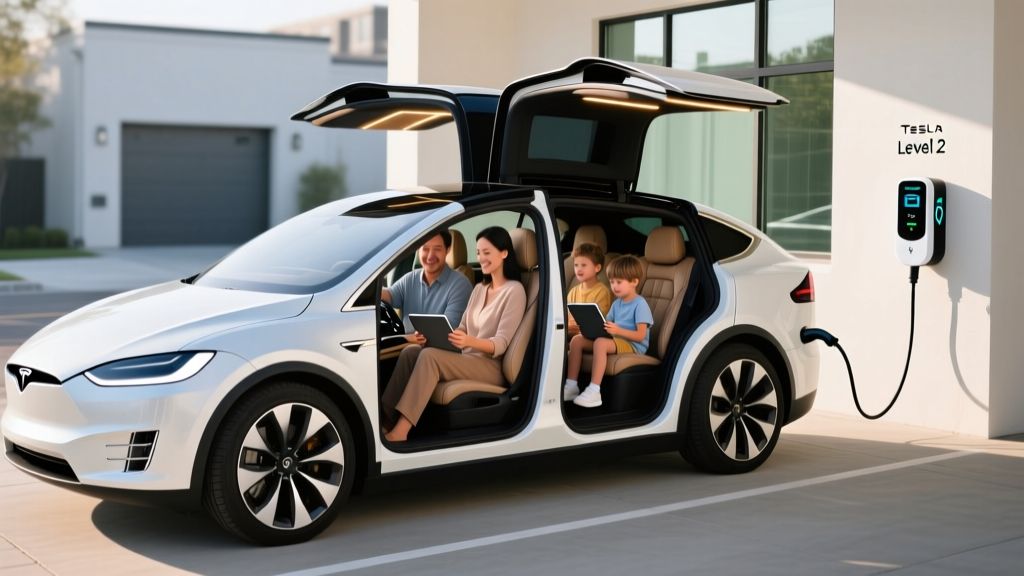
Home Level 2 Charging: With a Tesla Wall Connector on a 60-amp circuit (48A continuous), you'll get the full 11.5 kW charge rate, adding roughly 34 miles of range per hour. A full overnight charge from 20% to 90% takes about 8–9 hours — more than enough for daily use. Installation typically requires a 240V/60A circuit; if your electrical panel doesn't have capacity, a panel upgrade ($1,500–$3,000) may be necessary on top of the $500–$1,500 installation for the circuit and Wall Connector hardware ($475 direct from Tesla).
Supercharger Network Advantage: The Model X uses the native NACS (North American Charging Standard) connector. With over 6,000 Supercharger stations and 65,000+ stalls across North America as of 2026, route planning on road trips is genuinely seamless via Tesla's built-in navigation. Non-Tesla networks (Electrify America, EVgo) are accessible with a NACS-to-CCS adapter, but reliability and stall availability still favor the Supercharger network in most corridors.
Performance and Driving Dynamics
The Model X Long Range hits 60 mph in 3.8 seconds with 670 horsepower from its dual-motor all-wheel-drive setup. That's sports-car acceleration in a 5,100-pound three-row SUV — genuinely startling the first time you floor it from a stoplight.
The Plaid variant is almost absurd: 1,020 horsepower from three motors (one front, two rear) and a 2.5-second 0-60 time. On a drag strip or freeway on-ramp, it's one of the quickest production vehicles on the planet, regardless of powertrain. But for family buyers, the Long Range is the rational choice — you save $15,000 and gain 9 miles of EPA range, while still having more acceleration than you'll ever need.
Ride quality is firm but composed. The adaptive air suspension (standard on all Model X trims) adjusts ride height for highway efficiency and rough roads, and you can manually raise it for steep driveways or light off-road paths. Steering is precise and weighted appropriately for the vehicle's mass. Where the Model X shows its age is in body roll through tight corners — this is a tall, heavy vehicle, and no amount of software tuning fully hides that physics.
Regenerative braking is strong and adjustable, enabling near one-pedal driving in most conditions. The brake pedal feel, however, remains somewhat numb — a common Tesla criticism that persists in the 2026 model year.
Interior, Cargo, and Family Practicality
The Model X's party trick remains its falcon-wing rear doors. They articulate upward on a double hinge, opening wide enough for parents to stand nearly upright while loading children into second- or third-row car seats. In tight parking spaces, they require less lateral clearance than conventional swing-out doors (though they need overhead clearance — low garage ceilings can be an issue).
Seating Configurations:
- 5-seat (2-row): Standard on base; maximizes cargo at 85.1 cu ft behind the front seats
- 6-seat (2+2+2): Individual second-row captain's chairs with a center walkway to the third row — the most practical family configuration
- 7-seat (2+3+2): Bench second row; adds one more seatbelt but makes third-row access more difficult
Third-row legroom at 32.7 inches is genuinely usable for adults on short trips and comfortable for children and teens on longer journeys. Headroom is generous thanks to the tall roofline. Behind the third row, 15.3 cu ft of cargo space handles groceries and a couple of carry-on bags — comparable to a midsize sedan trunk. Fold the third row, and you get 37.1 cu ft. Fold everything, and the 85.1 cu ft maximum rivals full-size SUVs.
The front trunk (frunk) adds 6.6 cu ft of enclosed storage — useful for charging cables, a laptop bag, or groceries you want to keep separate from the rear cargo area.
Pricing, Tax Credits, and Ownership Cost
| Trim | Base MSRP | Destination | Est. After §30D Credit* |
|---|---|---|---|
| Long Range (5-seat) | $79,990 | $1,990 | $74,480† |
| Long Range (6-seat) | $83,990 | $1,990 | $78,480† |
| Plaid (5-seat) | $94,990 | $1,990 | Not eligible‡ |
*Federal §30D tax credit is up to $7,500 and can be transferred to the dealer at point of sale as an instant price reduction, per current IRS rules. Eligibility depends on buyer income, battery component sourcing, and MSRP caps.
† Assumes full $7,500 credit eligibility. Actual credit may be $3,750 or $0 depending on critical-mineral and battery-component sourcing requirements for the specific build month. Verify at IRS qualified vehicle list before purchasing.
‡ The Plaid trim exceeds the §30D MSRP cap of $80,000 for SUVs, making it ineligible for the federal credit regardless of buyer income or battery sourcing.
Key §30D Eligibility Rules (2026):
- MSRP Cap: SUVs must have an MSRP at or below $80,000 — the Long Range 5-seat qualifies; 6-seat and Plaid trims may not depending on exact MSRP after options
- Buyer Income Cap: Modified AGI ≤ $300,000 (joint filers), $225,000 (head of household), $150,000 (single)
- Battery Sourcing: $3,750 requires critical-mineral sourcing from US/FTA partners; additional $3,750 requires battery components manufactured in North America. These thresholds tighten annually
- Point-of-Sale Transfer: You can transfer the credit to Tesla at purchase for an instant price reduction rather than waiting to claim it on your tax return
5-Year Ownership Cost Snapshot: Compared to a similarly priced gas SUV (like the BMW X5 xDrive40i at ~$72,000), the Model X Long Range saves an estimated $4,000–$6,000 in fuel costs over five years (15,000 mi/yr) depending on local electricity and gas prices. However, insurance premiums for the Model X run 20–40% higher than comparable gas SUVs due to repair costs and vehicle value. Budget $2,800–$4,200/year for insurance depending on your state and driving record.
Technology and Driver Assistance
The Model X runs Tesla's current infotainment stack on a 17-inch center touchscreen with a secondary 8-inch rear passenger display. The system is responsive and feature-rich: native navigation with real-time Supercharger routing, streaming media (Netflix, YouTube, Spotify), a full web browser, and over-the-air updates that periodically add features.
Driver Assistance — SAE Level 2: Tesla's Autopilot (standard) and Full Self-Driving Supervised ($8,000 option or $99/month subscription) are SAE Level 2 driver-assistance systems. The driver must remain fully attentive, hands on or near the wheel, and ready to take over at any moment. FSD Supervised handles highway lane changes, traffic-light recognition, and city-street navigation, but it is not autonomous driving. Only Level 4 services like Waymo operate without a human driver.
Autopilot's highway cruising and lane-centering are among the best in the industry for reducing fatigue on long trips. FSD Supervised has improved markedly in city driving, but still makes occasional erratic decisions at complex intersections — it's a useful assistant, not a replacement for your attention. Competing Level 2 systems like GM's Super Cruise (hands-free on mapped highways) and Ford's BlueCruise offer comparable highway assistance with different engagement requirements.
Other tech highlights: a premium 22-speaker audio system, HEPA air filtration with Bioweapon Defense Mode (genuinely effective for wildfire smoke and pollution), a panoramic windshield that extends over front-seat occupants, and Tesla's Sentry Mode dashcam system that records surroundings when parked.
Pros, Cons, and Competition
Pros
- Genuine adult-usable third row with falcon-wing door access
- Supercharger network for stress-free road trips
- Class-leading acceleration (even Long Range at 3.8s 0-60)
- OTA updates continuously improve the vehicle
- Strong 5,000-lb towing capacity for an EV SUV
- Excellent front trunk + rear cargo flexibility
Cons
- High starting price; Plaid exceeds tax-credit MSRP cap
- Falcon-wing doors can struggle in low-ceiling garages
- Firm ride quality on rough pavement
- Interior materials don't match luxury rivals at this price point
- No Apple CarPlay or Android Auto
- Insurance costs significantly above segment average
Key Competitors:
- Rivian R1S: More off-road capable, better interior materials, tri-motor option, but smaller Supercharger-equivalent network. Starts around $79,900.
- Kia EV9: Far more affordable (starts ~$54,900), good third row, 800V architecture for fast charging, but shorter range (EPA 304 mi max) and less power.
- Mercedes EQS SUV: More luxurious interior, comparable third row, but starts above $104,000 and has lower efficiency.
Who Should Buy the Tesla Model X?
Choose the Model X if:
- You need a three-row EV with genuine adult-capable third-row seating
- Road-trip charging convenience is a priority (Supercharger network)
- You want supercar acceleration in a family vehicle
- You frequently load children into car seats (falcon-wing doors are transformative here)
- You tow up to 5,000 lbs occasionally (small boat, utility trailer)
Look elsewhere if:
- Your budget is under $65,000 (consider the Kia EV9 or a used Model X)
- You want a more traditional luxury interior (Rivian R1S, Mercedes EQS SUV)
- You primarily drive in cities where the Model X's size is a liability
- You need Apple CarPlay/Android Auto integration
Frequently Asked Questions
What is the real-world range of the 2026 Tesla Model X?
The EPA rates the Long Range at 335 miles and the Plaid at 326 miles. In real-world highway driving at 70-75 mph, plan for 270–300 miles. In freezing weather, effective range drops to approximately 210–250 miles depending on conditions. Preconditioning the battery before driving helps mitigate cold-weather losses.
How fast does the Model X charge at home and on the road?
On a Tesla V3 Supercharger, the Model X peaks at 250 kW and charges from 10–80% in roughly 30 minutes. At home on a Level 2 Wall Connector (11.5 kW), it adds about 34 miles per hour, fully replenishing overnight. Level 1 (120V) charging adds only 3–4 miles per hour and is suitable only for emergencies.
Does the Tesla Model X qualify for the federal EV tax credit?
It depends on the trim and your income. The Long Range 5-seat (MSRP $79,990) falls under the §30D $80,000 SUV cap and may qualify for up to $7,500 — split between critical-mineral ($3,750) and battery-component ($3,750) requirements. The Plaid (MSRP $94,990) exceeds the MSRP cap and does not qualify. Buyer income must be under $300,000 (joint) to be eligible. Always check the IRS qualified vehicles list for the specific build you're considering, as sourcing requirements change.
Is the Model X worth buying versus the Rivian R1S or Kia EV9?
The Model X wins on Supercharger access, acceleration, and tech integration. The Rivian R1S offers a more premium interior and better off-road capability at a similar price. The Kia EV9 is the value pick — significantly cheaper with a usable third row, though with less range and no Supercharger access. If road-trip charging ease is your top priority, the Model X still holds the edge. If interior luxury matters more, drive the R1S. If budget is the constraint, the EV9 is the answer.
What are the biggest drawbacks of the Model X?
The most common owner complaints center on the high purchase price, premium insurance costs, firm ride quality, interior materials that don't match the price point (compared to Mercedes or BMW), and the lack of Apple CarPlay/Android Auto. The falcon-wing doors, while practical for car-seat loading, can be slow to operate and require overhead clearance that some older garages lack.
How long will the Model X battery last?
Tesla warranties the battery for 8 years or 150,000 miles (whichever comes first) with a minimum 70% capacity retention threshold. NMC batteries in Tesla vehicles have demonstrated strong longevity data — most owners report 8–12% degradation over the first 100,000 miles. With proper care (avoiding frequent 100% charges, using daily limits of 80–90%), the pack should outlast 200,000 miles before approaching the warranty threshold.