Quick Verdict: The Premium 3-Row Tesla Family Hauler
The Tesla Model X remains the only all-electric, three-row SUV with a usable third row, falcon-wing rear doors, and access to the Supercharger network. For 2026, it continues as a dual-motor Long Range and a tri-motor Plaid variant, offering EPA range up to 335 miles and peak DC fast charging at 250 kW. Starting at roughly $77,990 before destination, it competes against the Rivian R1S, Kia EV9, and the upcoming electric offerings from legacy luxury brands.
This review breaks down the real-world range, charging behavior, interior practicality, and ownership costs of the 2026 Model X as a 3-row Tesla for families. We'll also cover IRS §30D federal tax credit eligibility, which is heavily restricted for this model due to MSRP caps and battery-sourcing requirements.
Range, Efficiency, and Real-World Expectations
The 2026 Model X Long Range AWD is EPA-rated at 335 miles of range, while the tri-motor Plaid variant drops to approximately 311 miles due to its higher power output and added weight. Both variants use a ~100 kWh (usable) NMC (nickel manganese cobalt) battery pack.
EPA: 335 mi (Long Range) / 311 mi (Plaid)
Highway (70-75 mph): expect ~270-290 mi
Cold weather (below 32°F): expect ~230-260 mi
Combined mixed driving: ~290-310 mi
The Model X's large frontal area and boxy profile hurt highway efficiency more than sedans like the Model S. In cold weather, battery preconditioning and cabin heating draw significant energy — a heat pump helps but doesn't eliminate the loss. Plan road trips around 250-mile segments in winter to maintain a safety buffer.
Efficiency is rated at approximately 100 MPGe combined (Long Range), translating to roughly 34 kWh per 100 miles. That's competitive for a 5,000+ lb three-row SUV but trails smaller crossovers like the Model Y (28 kWh/100 mi).
| Metric | Long Range AWD | Plaid (Tri-Motor) |
|---|---|---|
| EPA Range | 335 mi | 311 mi |
| Battery (usable) | ~100 kWh, NMC | ~100 kWh, NMC |
| MPGe (combined) | ~100 MPGe | ~92 MPGe |
| kWh/100 mi | ~34 | ~37 |
Charging Speed: DC Fast, Level 2, and Home Setup
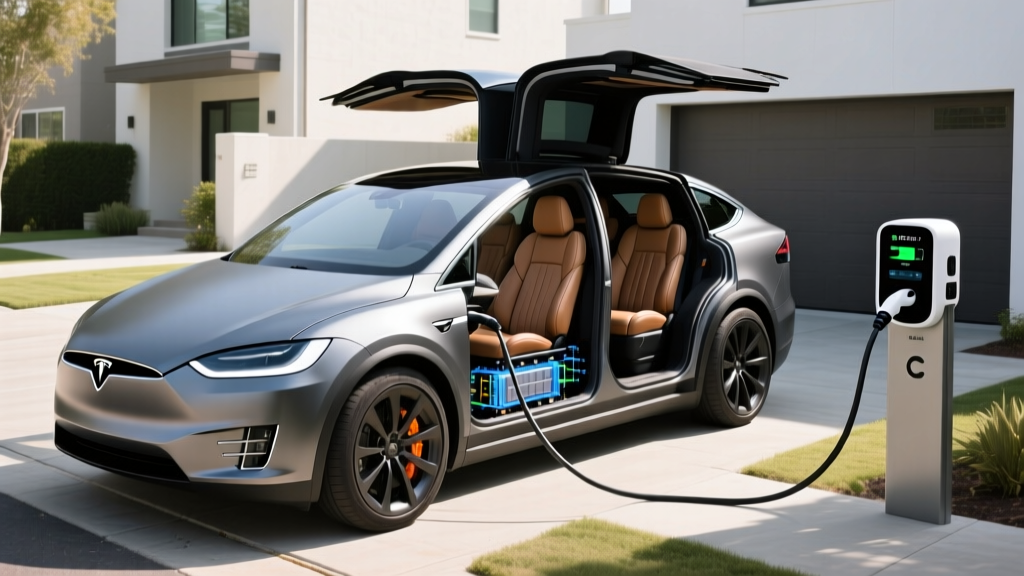
The Model X supports a peak DC fast-charge rate of 250 kW on V3 Superchargers and compatible CCS stations (via the included NACS connector, now standard). In optimal conditions — battery preconditioned, starting at ~10% SoC — the Model X can add up to 175 miles of range in 15 minutes, with a 10-80% charge taking approximately 30-35 minutes.
However, the charge curve tapers significantly above 50% SoC. Peak 250 kW is only sustained between roughly 10-30% SoC. By 60%, you're closer to 100 kW, and above 80%, speeds drop below 50 kW. This is standard behavior for large NMC packs but worth understanding for road-trip planning.
| Charging Level | Power | Speed / Time |
|---|---|---|
| DC Fast Charge (V3 Supercharger) | Up to 250 kW peak | 10-80% in ~30-35 min; 175 mi in 15 min |
| DC Fast Charge (50 kW station) | 50 kW | 10-80% in ~2.5 hours |
| Level 2 (Tesla Wall Connector, 48A) | 11.5 kW | ~34 mi/hr; full charge in ~10 hours |
| Level 2 (32A public charger) | 7.7 kW | ~23 mi/hr; full charge in ~14 hours |
| Level 1 (120V household) | ~1.4 kW | ~4 mi/hr; not practical for daily use |
Home charging recommendation: Install a Tesla Wall Connector on a 60A circuit for the full 48A (11.5 kW) charge rate. Expect $800-$1,500 for a standard installation if your electrical panel has capacity. A panel upgrade (to 200A service) can add $1,500-$3,000. Consult a licensed electrician for your specific situation.
Performance: 0-60, Horsepower, and Drivetrain
The dual-motor Long Range Model X produces 670 horsepower and achieves a 0-60 mph time of 3.8 seconds — remarkable for a three-row SUV weighing over 5,100 lbs. All-wheel drive is standard, with independent front and rear motors providing torque vectoring and traction in all conditions.
The Plaid variant uses three motors (one front, two rear) for 1,020 horsepower and a 0-60 time of 2.5 seconds. While impressive, the Plaid sacrifices 24 miles of EPA range and adds roughly $10,000 to the price. For most families, the Long Range delivers more than enough performance.
| Variant | Drivetrain | Horsepower | 0-60 mph | Top Speed |
|---|---|---|---|---|
| Long Range | Dual-Motor AWD | 670 hp | 3.8 sec | 155 mph |
| Plaid | Tri-Motor AWD | 1,020 hp | 2.5 sec | 163 mph |
Interior, Cargo, and 3-Row Practicality
The Model X is one of the few EVs offering a genuine three-row configuration seating up to seven passengers (2-3-2 layout). A six-seat configuration with second-row captain's chairs is also available.
Key interior dimensions (approximate, based on current model-year data from Tesla's spec page):
- Cargo (behind 3rd row): ~15 cu ft
- Cargo (3rd row folded): ~41 cu ft
- Cargo (all rear rows folded): ~82 cu ft
- Front trunk (frunk): ~7 cu ft
- 3rd-row legroom: ~32.7 inches — usable for children and shorter adults on trips under 2 hours
- 2nd-row legroom: ~38.4 inches
The falcon-wing rear doors are a signature feature, providing wide opening access to the second and third rows — genuinely helpful for loading child seats. However, they require overhead clearance (the car's ultrasonic sensors detect obstacles) and can be slower to open/close than conventional doors in tight parking spots.
Tech highlights:
- 17-inch center touchscreen with gaming-capable hardware (AMD Ryzen)
- Second-row 8-inch touchscreen for rear passengers (climate, media)
- 22-speaker premium audio system
- HEPA air filtration with Bioweapon Defense Mode
- Over-the-air software updates
Drawbacks: The yoke steering wheel (optional) is controversial and not ideal for low-speed maneuvering. Build quality has improved but still shows occasional panel-gap inconsistencies vs. luxury competitors like BMW or Mercedes. The third row, while usable, is tighter than the Rivian R1S or the Kia EV9.
Pricing, Trims, and Federal Tax Credit Eligibility
The 2026 Tesla Model X is offered in two trims:
| Trim | Base MSRP | Destination | Total Before Credits |
|---|---|---|---|
| Long Range AWD | $77,990 | $1,995 | $79,985 |
| Plaid (Tri-Motor) | $87,990 | $1,995 | $89,985 |
Options like the six-seat interior, 22-inch wheels, and Full Self-Driving (Supervised) capability add $2,000-$8,000 to the final price.
The Model X faces significant hurdles for the $7,500 federal EV tax credit:
- MSRP cap: SUVs must be under $80,000 MSRP. The Long Range at $77,990 qualifies; the Plaid at $87,990 does not.
- Buyer income cap: AGI must not exceed $300,000 (joint), $225,000 (head of household), or $150,000 (individual).
- Battery sourcing: Critical minerals and battery components must meet escalating North American/free-trade-partner thresholds. As of 2026, many Tesla vehicles assembled in the US qualify for partial or full credit, but final eligibility depends on the specific VIN and battery batch. Check fueleconomy.gov for the current qualifying list.
- Point-of-sale transfer: If eligible, you can transfer the credit to the dealer at purchase for an immediate price reduction, rather than waiting for a tax refund.
Bottom line: A Long Range Model X buyer with qualifying income may receive up to $7,500 off, bringing the effective price to ~$72,485. However, battery-sourcing rules are strict — verify your specific vehicle's eligibility before committing. Consult a tax professional or IRS guidance for your situation.
Warranty and Ownership Costs
Tesla covers the Model X with:
- Basic vehicle warranty: 4 years / 50,000 miles
- Battery & drive unit warranty: 8 years / 150,000 miles (Long Range); 8 years / 150,000 miles (Plaid), with minimum 70% capacity retention
Real-world degradation data from Tesla's fleet suggests NMC packs in the Model X lose approximately 10-12% capacity over 150,000 miles, meaning most owners will remain well within the warranty threshold. Replacement cost for a Model X battery pack, if needed out of warranty, is estimated at $15,000-$22,000 (parts and labor).
Insurance premiums for the Model X are higher than average for a three-row SUV — expect $2,500-$4,000/year depending on your profile, driven by repair costs and the vehicle's performance. Always get a quote before purchasing.
Who the 3-Row Model X Is Best For
- You need a three-row electric SUV with access to the Tesla Supercharger network
- Falcon-wing doors appeal for child-seat loading and accessibility
- You want 300+ miles of EPA range and 250 kW fast charging
- You value over-the-air updates and Tesla's software ecosystem
- Your household income qualifies for the §30D credit and you're buying Long Range
- Third-row space is a priority (Rivian R1S and Kia EV9 offer more room)
- You want a lower entry price (Kia EV9 starts ~$20,000 less)
- You prefer a conventional steering wheel over the optional yoke
- Build quality and panel consistency are top priorities
Pros and Cons at a Glance
- 335 mi EPA range (Long Range) — longest of any 3-row EV SUV
- 250 kW DC fast charging; Supercharger network access
- Genuine 7-seat configuration with usable third row
- Falcon-wing doors ease child-seat access
- 670-1,020 hp; 2.5-3.8 sec 0-60 (fastest in class)
- Frunk + generous cargo capacity when rows are folded
- Class-leading software, OTA updates, and infotainment
- Starts at ~$80K; Plaid exceeds $80K tax-credit MSRP cap
- Third-row legroom tighter than Rivian R1S and Kia EV9
- Falcon-wing doors slower in tight spaces; require overhead clearance
- Yoke steering (optional) divisive and impractical for some
- Insurance premiums significantly above class average
- Build quality still trails German luxury competitors
- Tax credit eligibility uncertain due to battery-sourcing rules
Frequently Asked Questions
What is the real-world range of the 2026 Tesla Model X?
The EPA rates the Long Range at 335 miles and the Plaid at 311 miles. In real-world highway driving at 70-75 mph, expect 270-290 miles. In cold weather (below freezing), plan for 230-260 miles due to battery and cabin heating demands.
How fast does the Model X charge at home and on the road?
On a V3 Supercharger, the Model X peaks at 250 kW and charges 10-80% in about 30-35 minutes. At home on a 48A Tesla Wall Connector (11.5 kW), you'll add roughly 34 miles per hour, fully charging overnight in ~10 hours.
Does the 2026 Model X qualify for the $7,500 federal EV tax credit?
The Long Range (MSRP $77,990) is under the $80,000 SUV cap and may qualify, pending buyer income limits (≤$300K joint) and battery-sourcing compliance. The Plaid ($87,990) exceeds the MSRP cap and does not qualify. Always verify on fueleconomy.gov and consult a tax professional.
Is the Model X worth it vs. the Rivian R1S or Kia EV9?
The Model X wins on range (335 mi vs. R1S ~352 mi but at higher trims), Supercharger access, and performance. The Rivian R1S offers a more usable third row, better off-road capability, and a lower starting price (~$75,900). The Kia EV9 starts around $54,900 with ~304 miles of range, making it the value pick — though it lacks the Supercharger network and uses CCS (NACS adapter available for Tesla Superchargers). Your choice depends on budget, third-row needs, and charging-network preference.
Is Tesla's Autopilot or Full Self-Driving actually self-driving?
No. Both Autopilot and FSD (Supervised) are SAE Level 2 driver-assistance systems. The driver must remain fully attentive, hands on the wheel (or torque-applied with the yoke), and ready to take over at any moment. True self-driving (Level 4) is currently limited to geofenced robotaxi services like Waymo in select cities.
How long will the Model X battery last?
Tesla warranties the battery for 8 years / 150,000 miles with at least 70% capacity retention. Fleet data suggests NMC packs in the Model X degrade roughly 10-12% over 150,000 miles. Many owners report minimal degradation with regular charging habits (keeping SoC between 20-80% for daily use, charging to 100% only for road trips).