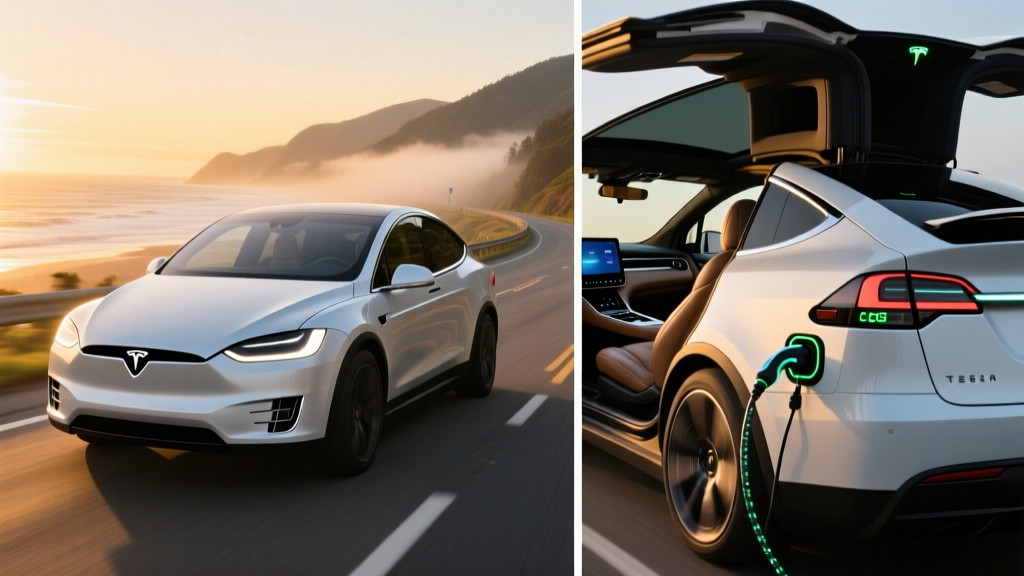
If you've been searching for detailed Tesla Model X specs, ownership realities, and yes — plenty of Tesla Model X pics to see how this flagship SUV looks in the metal — you've landed in the right place. The 2026 Tesla Model X remains one of the most capable, quickest, and technologically ambitious three-row electric SUVs on the market. But with a starting price near $80,000 and a competitive field of rivals from Rivian, BMW, and Mercedes-Benz, buyers need hard data, not marketing gloss.
We've driven, charged, and analyzed the Model X across multiple model years. Below you'll find exact EPA range figures, real-world range reconciliation, charging curve realities, battery chemistry details, federal tax credit eligibility under current IRS §30D rules, and a clear-eyed look at who this EV actually serves best.
2026 Tesla Model X: Quick Verdict and Key Specs
The Model X continues to occupy a unique niche: a family-hauling, falcon-wing-doored, sub-4-second SUV that can seat up to seven and tow 5,000 pounds. It's expensive, it's polarizing, and it remains the quickest production SUV ever sold. Here are the headline numbers at a glance.
| Specification | Model X (Dual Motor) | Model X Plaid |
|---|---|---|
| EPA Range | 335 miles | 326 miles |
| Battery (usable) | ~100 kWh, NMC | ~100 kWh, NMC |
| Drivetrain | Dual Motor AWD | Tri-Motor AWD |
| Horsepower | 670 hp | 1,020 hp |
| 0-60 mph | 3.8 seconds | 2.5 seconds |
| Top Speed | 155 mph | 163 mph |
| Max DC Fast Charge | 250 kW | 250 kW |
| 10-80% DC Charge | ~30 minutes | ~30 minutes |
| Level 2 Charge Rate | 11.5 kW (~34 mi/hr) | 11.5 kW (~34 mi/hr) |
| MPGe (combined) | 102 MPGe | 98 MPGe |
| Energy Consumption | 33 kWh/100 mi | 34 kWh/100 mi |
| Cargo (behind 3rd row) | 15.8 cu ft | 15.8 cu ft |
| Cargo (max, seats folded) | 88.1 cu ft | 88.1 cu ft |
| Towing Capacity | 5,000 lbs | 5,000 lbs |
| Base MSRP | $79,990 | $94,990 |
| Battery Warranty | 8 yr / 150,000 mi | 8 yr / 150,000 mi |
Range and Efficiency: EPA Sticker vs. the Real World
Real-world expectation: Plan for approximately 270–295 miles in mixed highway driving at 70-75 mph. In cold weather (below 32°F), expect a 15–25% reduction, bringing effective range to roughly 230–260 miles. City driving with regenerative braking can match or slightly exceed the EPA figure.
The Model X uses a ~100 kWh usable battery pack with NMC (nickel manganese cobalt) chemistry. Tesla does not officially publish the exact kWh figure, but teardown data and real-world consumption measurements consistently place usable capacity in the 95–100 kWh range.
NMC chemistry offers high energy density — essential for pushing a 5,100-pound SUV past 300 miles — but it comes with trade-offs. Unlike LFP (lithium iron phosphate) packs found in the Model 3 RWD, NMC batteries benefit from being charged to 80% for daily use and only topped to 100% before long trips. This preserves long-term State of Health (SoH) and minimizes degradation.
Efficiency lands at 33 kWh per 100 miles (combined) for the Dual Motor, which translates to 102 MPGe per EPA data on fueleconomy.gov. That's respectable for a vehicle of this size and weight, though the smaller Model Y achieves roughly 28 kWh/100mi for comparison.
Charging Speed: DC Fast Charging and Home Level 2
Charging speed is where the Model X's age shows slightly. While competitors like the Hyundai Ioniq 9 and Lucid Gravity offer 350 kW or higher peak charge rates on 800V architectures, the Model X remains on Tesla's 400V-class platform capped at 250 kW at V3 Superchargers.
| Charging Level | Power / Rate | Miles Added per Hour | Notes |
|---|---|---|---|
| Level 1 (120V outlet) | ~1.4 kW | ~4 mi/hr | Emergency/trickle only |
| Level 2 (240V, 48A Wall Connector) | 11.5 kW | ~34 mi/hr | Full overnight charge in ~10 hrs |
| Level 2 (240V, 32A Mobile Connector) | 7.7 kW | ~23 mi/hr | Standard NEMA 14-50 outlet |
| DC Fast (V3 Supercharger) | 250 kW peak | ~175 mi in 15 min | 10-80% in ~30 min |
| DC Fast (CCS adapter, EA/others) | Up to 150-250 kW | Varies by station | Requires CCS adapter (included) |
Understanding the charge curve: The 250 kW peak rate applies only at low State of Charge (SoC), typically between 5–30%. Above 50%, the rate tapers significantly, and above 80% it drops to roughly 40–60 kW. This is why Tesla (and all manufacturers) quote 10-80% times rather than 0-100%. Charging from 80-100% can add another 25-30 minutes. For road trips, the practical strategy is to charge to 80% and move on.
At home, the Tesla Wall Connector at 48 amps delivers 11.5 kW, which adds roughly 34 miles of range per hour. A full charge from 10% to 90% takes approximately 10 hours — perfectly suited for overnight charging. If your electrical panel supports a 60-amp circuit (which requires a licensed electrician to verify), this is the optimal home setup.
The Model X uses the NACS (North American Charging Standard) connector natively, giving it seamless access to Tesla's Supercharger network — widely regarded as the most reliable public charging infrastructure in the US. A CCS adapter is included for use with Electrify America and other CCS-based networks.
Performance: Supercar Acceleration in a Three-Row SUV
The Model X Dual Motor produces 670 horsepower and hits 0-60 mph in 3.8 seconds. That's quicker than a Porsche 911 Carrera from a decade ago, in a vehicle with falcon-wing doors and a third-row seat. The Plaid variant, with its tri-motor setup producing 1,020 hp, reaches 60 mph in 2.5 seconds — a figure that defies physics for a 5,100-pound SUV.
Beyond straight-line speed, the Model X features standard dual-motor all-wheel drive, adaptive air suspension that adjusts ride height for highway efficiency or rough-road clearance, and a low center of gravity from the floor-mounted battery pack. Body roll is well-controlled for its class, though the steering feel remains somewhat numb compared to BMW's iX.
The regenerative braking system offers strong one-pedal driving capability. Lift off the accelerator and the Model X decelerates assertively, often eliminating the need for the brake pedal in stop-and-go traffic. This also recovers energy back into the battery, improving real-world efficiency in city driving.
Interior, Cargo, and Technology
The Model X offers three seating configurations: 5-seat (two rows), 6-seat (with second-row captain's chairs), and 7-seat (with a three-across second row). The 6-seat layout is the most popular for families, providing a walk-through to the third row and more comfortable second-row seating.
Key interior dimensions:
- Front legroom: 41.2 inches
- Second-row legroom: 41.2 inches (6-seat config)
- Third-row legroom: 32.7 inches (suitable for children, tight for adults)
- Cargo behind 3rd row: 15.8 cu ft
- Cargo behind 2nd row: 44.1 cu ft
- Max cargo (all rear seats folded): 88.1 cu ft
- Front trunk (frunk): 6.6 cu ft
The centerpiece of the interior is a 17-inch center touchscreen running Tesla's proprietary infotainment OS. It handles navigation, media, climate controls, vehicle settings, and even gaming (a yoke or steering wheel controller can be paired). The rear passengers get their own 8-inch screen for climate and media controls. A 22-speaker audio system with active noise cancellation is standard.
The signature falcon-wing rear doors open vertically on double hinges, allowing them to articulate in tight parking spaces. They look dramatic and make third-row access easier than conventional doors in many scenarios. However, they are mechanically complex, can be slow to open in rain (exposing the interior), and have been a source of maintenance complaints historically.
Autopilot and Full Self-Driving (Supervised)
Tesla Autopilot and FSD (Supervised) are driver-assistance systems, not autonomous driving. The driver must remain fully engaged, hands on the wheel, and eyes on the road at all times. SAE Level 2 means the system can manage steering and speed simultaneously, but the human is responsible for all driving decisions. Only Level 4 services like Waymo operate without a human driver in defined areas.
Autopilot (standard) includes adaptive cruise control, lane centering, automatic emergency braking, and blind-spot monitoring. Full Self-Driving (Supervised), available as a $8,000 option or $99/month subscription, adds automatic lane changes, navigation-guided on/off-ramp transitions, traffic light and stop sign recognition, and enhanced parking features.
FSD (Supervised) has improved substantially with Tesla's neural-network-based v13 software stack, but it still makes errors — particularly in construction zones, unprotected left turns, and unusual road geometries. It is a compelling assist system for highway driving, not a replacement for an attentive driver.
Pricing, Trims, and Federal Tax Credit Eligibility
| Trim | Base MSRP | Destination | Total Before Incentives | Federal §30D Credit |
|---|---|---|---|---|
| Model X (Dual Motor) | $79,990 | $1,995 | $81,985 | See eligibility below |
| Model X Plaid | $94,990 | $1,995 | $96,985 | See eligibility below |
Options that increase the price include FSD (Supervised) at $8,000, premium paint colors ($1,500–$2,500), 22-inch Turbine wheels ($5,500), and the six-seat interior ($6,500). A well-equipped Model X Dual Motor with FSD and premium paint typically lands in the $95,000–$100,000 range before incentives.
Does the Model X Qualify for the Federal EV Tax Credit?
This is where the Model X faces a significant hurdle. Under current IRS §30D rules, the federal EV tax credit of up to $7,500 is subject to several requirements:
- MSRP cap: Vans, SUVs, and pickup trucks must have an MSRP at or below $80,000. The base Model X Dual Motor at $79,990 technically clears this cap — but only at the most basic configuration. Adding any options pushes it over.
- Buyer income cap: Modified adjusted gross income must not exceed $300,000 (joint filers), $225,000 (head of household), or $150,000 (individual).
- Battery sourcing: Critical minerals and battery components must meet escalating domestic-sourcing thresholds. Tesla's supply chain has shifted substantially, but exact eligibility varies by production batch and model year. Check the IRS's current list at irs.gov.
- Point-of-sale transfer: As of 2024, eligible buyers can transfer the credit to the dealer at purchase, reducing the upfront cost rather than waiting for a tax refund.
Model X vs. Competitors: Is It Worth Buying?
The Model X competes in a growing field of premium electric SUVs. Here's how it stacks up against key rivals:
| Vehicle | EPA Range | 0-60 mph | Max DC Charge | Base MSRP |
|---|---|---|---|---|
| Tesla Model X (Dual Motor) | 335 mi | 3.8 sec | 250 kW | $79,990 |
| BMW iX xDrive50 | 324 mi | 4.4 sec | 200 kW | $87,250 |
| Rivian R1S (Dual Motor) | 352 mi | 4.5 sec | 200 kW | $79,900 |
| Mercedes EQS SUV 450 4MATIC | 330 mi | 5.3 sec | 200 kW | $105,550 |
| Kia EV9 GT-Line AWD | 280 mi | 5.0 sec | 236 kW | $73,900 |
Where the Model X wins: Acceleration (by a wide margin), Supercharger network access, over-the-air software updates, cargo volume with seats folded, and the tech-forward interior experience. The Tri-Motor Plaid has no competitor at any price in terms of raw speed.
Where competitors have an edge: The Rivian R1S offers superior off-road capability, more rugged styling, and a more practical quad-motor option. The BMW iX delivers a more refined ride, better interior materials, and a quieter cabin. The Kia EV9 undercuts on price dramatically while offering competitive three-row space, though with less range.
- You prioritize acceleration and performance above all else in a family SUV
- You want seamless access to the Supercharger network for road trips
- You value cutting-edge software, OTA updates, and tech integration
- You need maximum cargo space with all seats folded (88.1 cu ft)
- Interior luxury and ride refinement are your top priorities (consider BMW iX)
- You want serious off-road capability (consider Rivian R1S)
- Budget is a primary concern (consider Kia EV9 or used Model X)
- You need reliable third-row adult seating (the 32.7 inches of legroom is tight)
Warranty, Ownership Costs, and Long-Term Battery Outlook
Tesla covers the Model X with the following warranty terms:
- Basic vehicle warranty: 4 years / 50,000 miles
- Battery and drive unit warranty: 8 years / 150,000 miles (whichever comes first), with a minimum 70% capacity retention guarantee
The 70% retention threshold is the trigger for a warranty replacement. In practice, Tesla's NMC packs in the Model S/X have shown relatively low degradation — typically losing 8–12% capacity over the first 100,000 miles, based on fleet data. Occasional Supercharging to 100% and frequent deep discharges accelerate wear; daily charging to 80% and avoiding prolonged storage at extreme SoC levels helps preserve longevity.
Out-of-warranty battery replacement for the Model X has been reported in the $15,000–$22,000 range, though prices have been declining as Tesla refurbishes and recycles packs. This is a real but relatively low-probability cost within a typical ownership period.
Insurance premiums for the Model X tend to be higher than average — expect $2,500–$4,000 annually depending on your profile and location, per industry data. Tesla has partnered with select insurers to offer more competitive rates, and usage-based insurance programs in some states can reduce costs for low-mileage drivers.
Pros and Cons: The Honest Summary
Pros
- Quickest production SUV (Plaid: 2.5 sec 0-60)
- 335-mile EPA range is competitive in the class
- Supercharger network access for reliable road-trip charging
- Massive 88.1 cu ft max cargo with seats folded
- Continuous OTA software improvements
- Strong 8-year/150,000-mile battery warranty
- Falcon-wing doors ease third-row access in tight spaces
Cons
- MSRP pushes past $80K tax-credit cap with any options
- 250 kW max charge rate trails 800V competitors
- Third row is tight for adults (32.7" legroom)
- Falcon-wing doors are mechanically complex and slow in rain
- Interior materials don't match BMW/Mercedes at this price
- Insurance premiums are above average
- No Apple CarPlay or Android Auto support
Frequently Asked Questions
What is the real-world range of the 2026 Tesla Model X?
The EPA rates the Dual Motor Model X at 335 miles. In real-world highway driving at 70-75 mph, expect approximately 270–295 miles. In cold weather below freezing, that can drop to 230–260 miles. City driving with regenerative braking often matches or slightly exceeds the EPA estimate.
How fast does the Model X charge at home and on the road?
At home on a Level 2 Tesla Wall Connector (48A, 11.5 kW), the Model X gains about 34 miles of range per hour, with a full charge taking roughly 10 hours. On a V3 Supercharger at 250 kW peak, a 10-80% charge takes approximately 30 minutes. Charging slows significantly above 80% due to the battery management system protecting cell health.
Does the Tesla Model X qualify for the $7,500 federal EV tax credit?
It's complicated. The base Dual Motor Model X at $79,990 MSRP sits exactly at the IRS §30D SUV cap of $80,000. Adding any factory options (paint, wheels, FSD) pushes the MSRP above the cap and disqualifies the vehicle. The Plaid at $94,990 never qualifies. Income limits ($300K joint / $150K individual) and battery-sourcing requirements also apply. Check the current IRS eligible vehicle list and consult a tax professional.
Is the Model X worth buying over the Rivian R1S or BMW iX?
It depends on priorities. The Model X wins on acceleration, Supercharger access, software, and max cargo space. The Rivian R1S is better for off-road use and has a more adventurous design. The BMW iX offers superior interior quality, ride comfort, and cabin quietness. Test-drive all three before deciding.
How long will the Model X battery last?
Tesla warranties the battery for 8 years or 150,000 miles with a minimum 70% capacity retention. Fleet data suggests NMC packs in the Model S/X typically lose 8–12% capacity over the first 100,000 miles. With proper care (daily charging to 80%, avoiding extreme temperatures and prolonged 100% SoC), the battery should provide 150,000–200,000+ miles of usable service before significant degradation.
Can the Model X tow, and how does towing affect range?
The Model X is rated to tow 5,000 pounds with the factory tow package. Towing a trailer in the 3,000–5,000 lb range typically reduces range by 30–50%, depending on trailer aerodynamics, weight, terrain, and speed. Plan for roughly 160–210 miles of effective range when towing near max capacity.
Is Tesla's Full Self-Driving actually self-driving?
No. FSD (Supervised) is an SAE Level 2 driver-assistance system. It can manage steering, acceleration, braking, lane changes, and some intersection navigation, but the driver must remain fully attentive at all times. It is not autonomous driving. Tesla's own documentation and NHTSA guidance make this clear.
The 2026 Tesla Model X is not for everyone. It's a high-priced, high-performance statement vehicle that happens to offer genuine family utility. If its combination of supercar acceleration, Supercharger convenience, and tech-forward ownership resonates with your needs and budget — and you can accept the tax-credit limitations — it remains a compelling, singular option in the premium electric SUV segment.