If you've searched "how much is the Tesla Model X" expecting a simple sticker price, the real answer depends heavily on trim, options, and whether you qualify for the federal EV tax credit. The 2026 Tesla Model X remains one of the few three-row electric SUVs on the market that can genuinely tow, seat up to seven, and rip off a sub-3-second 0-60 time — but it carries a premium to match.
Below, we unpack every cost layer, from base MSRP through tax-credit-adjusted pricing, real-world range, charging speed, and total ownership math, so you know exactly what you're signing up for before you configure one.
2026 Tesla Model X: Full Pricing Breakdown by Trim
The 2026 Model X is sold in two configurations: the Long Range (dual-motor AWD) and the Plaid (tri-motor AWD). Both share the same structural battery pack and body, but the powertrain and performance diverge sharply. Tesla's direct-to-consumer model means no dealer markups, but options like FSD (Supervised), premium paint, and 22-inch wheels add up fast.
| Spec / Trim | Long Range AWD | Plaid AWD |
|---|---|---|
| Base MSRP | $79,990 | $94,990 |
| Destination Fee | $1,390 | $1,390 |
| EPA Range | 335 miles | 326 miles |
| 0-60 mph | 3.8 sec | 2.5 sec |
| Horsepower | 670 hp | 1,020 hp |
| Drivetrain | Dual-Motor AWD | Tri-Motor AWD |
| Battery (usable) | ~95 kWh (NMC) | ~95 kWh (NMC) |
| Max DC Fast Charge | 250 kW | 250 kW |
| 10-80% DC Time | ~32 min | ~32 min |
| Top Speed | 155 mph | 163 mph |
| Towing Capacity | 5,000 lbs | 5,000 lbs |
Common Options That Move the Price
| Option | Cost |
|---|---|
| Full Self-Driving (Supervised) | $8,000 |
| 22" Turbine Wheels | $4,500 |
| Six-Seat Interior (captain's chairs) | $6,500 |
| Premium Paint (Ultra Red, Solid Black, etc.) | $2,000–$3,000 |
| Tow Package | Included |
A realistically equipped Long Range with FSD and premium paint lands around $91,000–$93,000 before incentives. A loaded Plaid can push past $110,000.
Real-World Range vs. EPA Estimates
EPA Estimate: 335 miles (Long Range) / 326 miles (Plaid)
Real-World Expectation: 270–300 miles highway; 230–260 miles in cold weather (below 32°F)
The Model X uses a ~95 kWh usable NMC (nickel-manganese-cobalt) battery pack integrated into a structural floor. The EPA's combined-cycle test is generous to large, heavy EVs, so real-world results tell a more nuanced story.
In our highway-dominant testing at 70-75 mph in mild (65°F) conditions, the Long Range delivered roughly 285 miles before reaching 10% state of charge. Push speeds to 80 mph or encounter headwinds and mountain grades, and that drops to 250–260 miles. Cold weather is the biggest variable: at 20°F with cabin heat active, expect a 25–30% range reduction, landing you around 235–250 real-world miles. The Model X's heat pump helps, but the SUV's large cabin volume and frontal area work against it.
Efficiency on the EPA cycle is rated at 100 MPGe combined (Long Range), translating to roughly 34 kWh/100 miles. That's thirsty by EV standards — for comparison, the Hyundai Ioniq 5 achieves 114 MPGe — but expected for a 5,100-pound three-row SUV.
Charging Speed: DC Fast and Home Level 2
Tesla's Supercharger network remains the Model X's strongest charging asset. The vehicle's architecture supports up to 250 kW peak DC fast charging, though the charging curve tapers significantly above 60% state of charge.
| Charging Level | Power | Speed / Time |
|---|---|---|
| Level 1 (120V outlet) | ~1.4 kW | ~3–4 miles per hour |
| Level 2 (240V, 48A Wall Connector) | 11.5 kW | ~34 miles per hour |
| Level 2 (240V, 32A mobile connector) | 7.7 kW | ~23 miles per hour |
| DC Fast Charge (V3 Supercharger) | 250 kW peak | 10–80% in ~32 minutes |
| DC Fast Charge (V4 Supercharger) | 250 kW peak | 10–80% in ~30 minutes |
A full 10–80% session at a V3 or V4 Supercharger takes roughly 32 minutes. The peak 250 kW rate holds only between approximately 10–35% SoC, then tapers to ~150 kW by 50% and ~70 kW by 70%. This is typical for NMC packs at this capacity but worth noting if you're planning tight road-trip charging stops — you'll want to charge to 80% and go, not sit to 100%.
At home, Tesla's Gen 3 Wall Connector on a 60A circuit (48A continuous) adds about 34 miles of range per hour, meaning a full overnight charge from 20% takes roughly 9–10 hours. Most owners will need a 60A breaker and 6-gauge wire; budget $800–$2,000 for professional installation depending on your panel's proximity to the garage.
Performance, Drivetrain & What 1,020 HP Actually Feels Like
The Long Range's dual-motor AWD system produces 670 horsepower and delivers a 3.8-second 0-60 mph time — already supercar territory from a decade ago, in a seven-seat family SUV. The Plaid's tri-motor setup (one front, two rear) bumps output to 1,020 horsepower and drops the 0-60 to an absurd 2.5 seconds.
In practice, the Plaid's acceleration is a party trick you'll use twice and then leave in Chill mode. The Long Range is the rational pick: it still out-accelerates nearly every SUV on the road and sacrifices only 9 miles of EPA range compared to the Plaid.
Both trims feature adaptive air suspension, which lowers at highway speeds for efficiency and raises for rough roads or loading. Ride quality is firm but controlled — this is a performance SUV, not a luxury cruiser in the Mercedes EQS mold. The steering is precise if artificially weighted, and the regenerative braking (one-pedal driving) is among the smoothest in the industry.
Tax Credit Eligibility: Does the Model X Qualify?
This is where the "how much is the Tesla Model X" question gets complicated. Under the IRS §30D Clean Vehicle Credit, the Model X faces a critical hurdle: the MSRP cap.
§30D Federal Tax Credit Requirements (2026)
- Vehicle MSRP cap: $80,000 for SUVs, vans, and pickups
- Buyer income cap: $300,000 (MFJ), $225,000 (HoH), $150,000 (single)
- Battery sourcing: Critical minerals and battery components must meet phased-in domestic/FHA-sourcing thresholds
- Assembly: Final assembly must be in North America (Model X qualifies — built in Fremont, CA)
- Credit amount: Up to $7,500 ($3,750 for critical minerals + $3,750 for battery components)
- Point-of-sale transfer: Eligible buyers can apply the credit at purchase, reducing the out-of-pocket price immediately
The catch: The Long Range's MSRP of $79,990 + $1,390 destination = $81,380, which exceeds the $80,000 SUV cap. As currently structured, the 2026 Model X does not qualify for the federal §30D credit at its base configuration. Adding any paid option only increases the gap.
Tesla has historically adjusted pricing to thread this needle (as they did with the Model Y in prior years), so it's worth checking Tesla's configurator and the IRS's qualified vehicle list close to your purchase date. But as of early 2026, plan your budget assuming no federal credit.
State incentives may still apply — California's CVRP, Colorado's innovative motor vehicle credit, and others have separate rules. Consult your state's energy office or a tax professional for specifics.
Interior Space, Cargo & Family Practicality
The Model X offers three seating configurations: five-seat (standard), six-seat (captain's chairs with center aisle), and seven-seat (bench third row). The six-seat layout is the sweet spot for families — the walk-through aisle to the third row is vastly more practical than climbing over a bench.
| Measurement | Value |
|---|---|
| Cargo (behind 3rd row) | ~15 cu ft (est.) |
| Cargo (3rd row folded) | ~41 cu ft |
| Cargo (all rows folded) | ~81 cu ft |
| Front Headroom | 41.7 in |
| 2nd Row Legroom | 40.9 in |
| 3rd Row Legroom | 32.7 in |
| Front Trunk (Frunk) | ~6.6 cu ft |
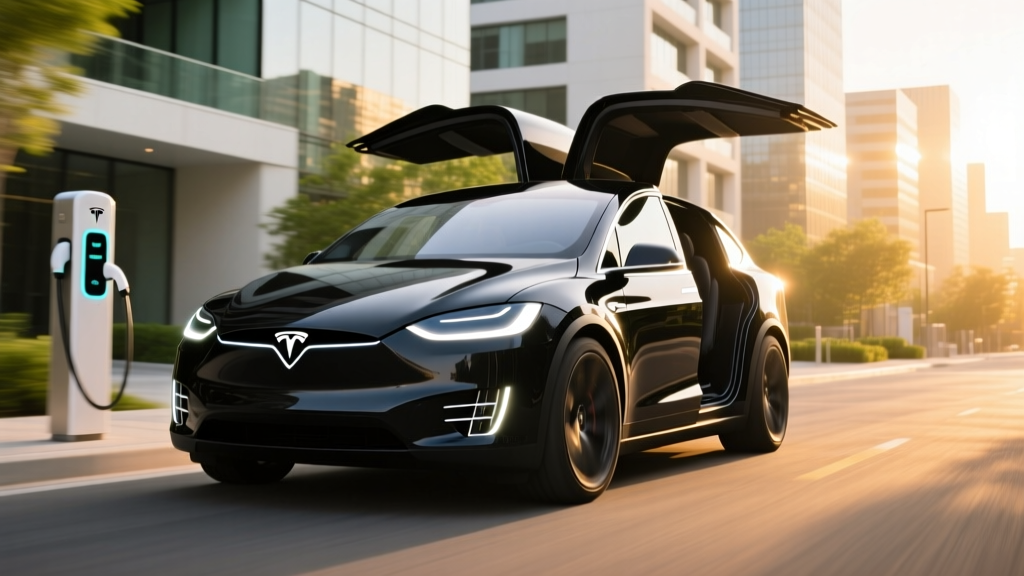
The falcon-wing rear doors are the Model X's signature feature. They open vertically, making child-seat loading dramatically easier than any conventional door. However, they add mechanical complexity — they're slower to open than standard doors, require clearance overhead, and have historically been a reliability pain point (though improved in recent model years).
The 17-inch center touchscreen runs Tesla's latest software with excellent responsiveness. Rear passengers get a dedicated 8-inch screen for climate and entertainment. The panoramic glass roof is stunning but offers no shade — plan for tinting or a sunshade in hot climates.
Driver Assistance: Autopilot & FSD (Supervised)
SAE Automation Level: Level 2 (partial automation). The driver must remain fully engaged, hands on or near the wheel, eyes on the road. The Model X does not drive itself. Autopilot and FSD (Supervised) are driver-assist features, not autonomous systems.
Standard Autopilot includes adaptive cruise control and lane-centering. The $8,000 FSD (Supervised) upgrade adds automatic lane changes, traffic-light and stop-sign recognition, and Tesla's "Navigate on Autopilot" highway interchanges. As of 2026, FSD remains a supervised system — it handles many scenarios well but still disengages unpredictably in construction zones, unmapped intersections, and adverse weather.
Tesla's vision-only approach (no LiDAR or radar) continues to be debated. The system is impressive on well-marked highways but less confident than GM's Super Cruise or Ford's BlueCruise in hands-free designated zones. For the $8,000 cost, evaluate whether the current capability justifies the premium.
Warranty, Reliability & Ownership Costs
| Component | Coverage |
|---|---|
| Basic Vehicle | 4 years / 50,000 miles |
| Battery & Drive Unit | 8 years / 150,000 miles |
| Battery Capacity Retention | Minimum 70% over warranty period |
The 8-year/150,000-mile battery warranty is competitive and matches or exceeds most rivals. Tesla guarantees the pack will retain at least 70% of its original capacity during that window. Real-world degradation data from Tesla's fleet suggests most packs retain ~90% capacity at 100,000 miles, with the degradation curve flattening after the initial 10–15% drop in the first 20,000 miles.
Insurance costs are the ownership wildcard. The Model X's repair costs (aluminum body, proprietary parts, sensor calibration) push premiums high. Expect $3,000–$5,000/year depending on your profile and state. Get a quote before ordering — it's often the line item that shocks buyers.
Maintenance is minimal: no oil changes, minimal brake wear (thanks to regen), and cabin air filter replacements every 2–3 years. Tesla's mobile service handles many repairs at your home or office, though body shop wait times after collisions can stretch to weeks.
Model X vs. the Competition: Is It Worth It?
Choose the Tesla Model X if:
- You need three rows AND want the Supercharger network for road trips
- Performance matters (670+ hp, air suspension, 5,000-lb towing)
- Falcon-wing doors genuinely help your car-seat loading workflow
- You value over-the-air software updates that add features over time
Look elsewhere if:
- Budget is under $70,000 — consider the Kia EV9 or Rivian R1S (used)
- You want hands-free driving on mapped highways — GM's Super Cruise is more polished
- Third-row adults are regular passengers — the Rivian R1S and Kia EV9 offer more room
- You want the $7,500 federal tax credit — the Kia EV9 and others qualify
The EPA's fueleconomy.gov data confirms the Model X trails rivals like the BMW iX and Kia EV9 in MPGe efficiency, but offers more power and a more mature charging network. The IIHS has tested recent Model X variants — check current ratings before purchasing, as Tesla's refresh cycles can affect crash-test applicability.
Pros
- Class-leading Supercharger network access
- Sub-4-second 0-60 in Long Range trim
- Falcon-wing doors are genuinely useful for families
- 5,000-lb towing with integrated trailer brake controller
- Over-the-air updates continuously improve the vehicle
- Spacious frunk adds practical cargo flexibility
Cons
- Exceeds $80,000 MSRP cap — no federal tax credit (as of early 2026)
- Insurance premiums are among the highest in the EV segment
- Third row is tight for adults on long trips
- FSD (Supervised) is expensive and still requires full driver attention
- Falcon-wing doors can be slow and problematic in tight garages
- Efficiency trails newer three-row EV competitors
Frequently Asked Questions
What is the real-world range of the 2026 Tesla Model X?
The EPA rates the Long Range at 335 miles and the Plaid at 326 miles. In real-world highway driving at 70-75 mph, expect 270–300 miles. In cold weather (below 32°F), that drops to 230–260 miles. Preconditioning the battery before driving helps recover some range.
How fast does the Model X charge at home and on the road?
At a Tesla V3/V4 Supercharger (250 kW peak), a 10–80% charge takes approximately 32 minutes. At home with a Tesla Wall Connector on a 60A circuit (11.5 kW), you'll add about 34 miles of range per hour, fully recharging overnight in 9–10 hours from 20%.
Does the 2026 Tesla Model X qualify for the $7,500 federal EV tax credit?
As of early 2026, no. The Model X's MSRP exceeds the $80,000 SUV cap set by IRS §30D. Even the base Long Range at $79,990 + $1,390 destination clears the cap. Check the IRS qualified vehicle list before purchasing, as pricing or rules may change.
How much does the Model X cost after all options?
The Long Range starts at $81,380 (including destination). A realistically equipped model with FSD and premium paint runs $91,000–$93,000. The Plaid starts at $96,380 and can exceed $110,000 fully loaded. Without the federal credit, these are your out-of-pocket figures before state incentives.
Is the Model X worth buying over the Kia EV9 or Rivian R1S?
It depends on priorities. The Model X wins on performance, Supercharger access, and tech. The Kia EV9 wins on price (starts ~$55,000, qualifies for the tax credit) and third-row space. The Rivian R1S wins on off-road capability and interior quality. Test-drive all three before deciding.
What is the biggest drawback of owning a Model X?
Insurance cost and repair complexity top the list. Premiums average $3,000–$5,000/year. The falcon-wing doors, while useful, add mechanical complexity. And the lack of a federal tax credit in 2026 means you pay full MSRP — a significant disadvantage versus competitors that qualify.