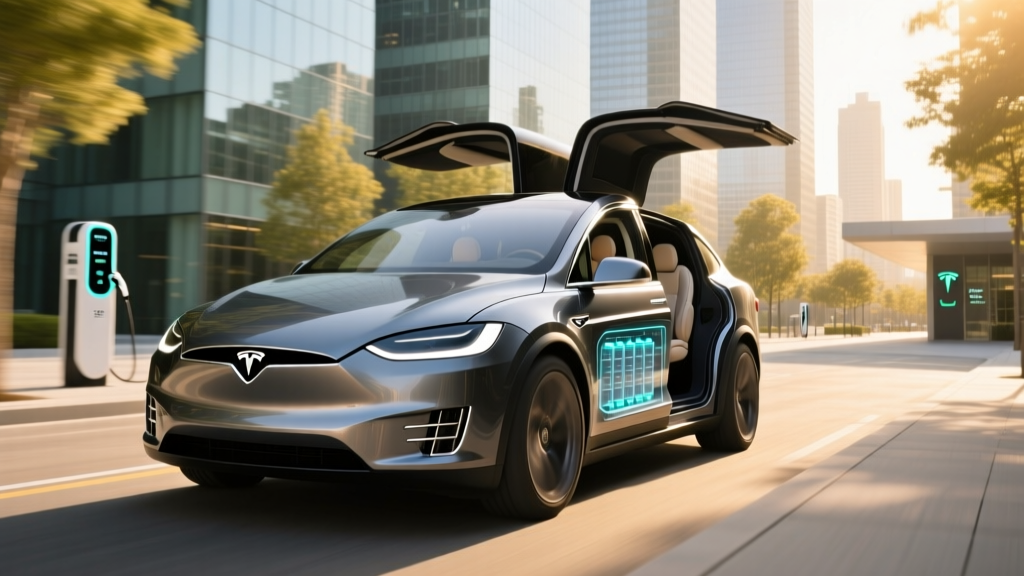
When people search for a "Tesla limo," they aren't looking for a stretched Lincoln. They're hunting for the most spacious, luxurious, and tech-forward electric vehicle Tesla makes — and that title belongs squarely to the Tesla Model X. Now in its 2026 model year with a refreshed interior and updated powertrain efficiency, the Model X remains the only EV SUV on the market that combines falcon-wing rear doors, up to seven-passenger seating, and access to the Supercharger network. But at a starting price above $77,000, does this flagship SUV justify its premium? We put the numbers to the test.
2026 Tesla Model X: Quick Verdict
The Model X is Tesla's most polarizing vehicle. It's also the most practical for large families who want electric. The falcon-wing doors aren't just theater — they genuinely make loading car seats and passengers easier in tight parking spots. The 2026 refresh brings a slightly more efficient powertrain, a ventilated-seat upgrade, and the latest HW4 Autopilot computer. However, its massive footprint, firm ride, and panel-gap inconsistencies keep it from unseating luxury rivals like the BMW iX or Rivian R1S in overall refinement.
| Spec | Long Range (AWD) | Plaid (Tri-Motor AWD) |
|---|---|---|
| EPA Range | 335 miles | 320 miles |
| Battery (usable) | ~100 kWh (NMC) | ~100 kWh (NMC) |
| Peak DC Fast Charge | 250 kW | 250 kW |
| 10–80% DC Time | ~30 minutes | ~30 minutes |
| Level 2 Home Charging | 11.5 kW (44 mi/hr) | 11.5 kW (44 mi/hr) |
| 0–60 mph | 3.8 sec | 2.5 sec |
| Horsepower | 670 hp | 1,020 hp |
| Drivetrain | Dual-Motor AWD | Tri-Motor AWD |
| EPA Efficiency | 103 MPGe (33 kWh/100mi) | 98 MPGe (34 kWh/100mi) |
| Base MSRP | $77,990 | $92,990 |
| Battery Warranty | 8 yr / 150,000 mi | 8 yr / 150,000 mi |
Real-World Range: What the EPA Number Doesn't Tell You
Real-World Expectation: 270–295 miles highway at 75 mph; 225–250 miles in sub-30°F cold weather
The Model X Long Range carries an EPA rating of 335 miles, according to fueleconomy.gov. That figure is achievable in mixed city/suburban driving at moderate speeds with mild weather. However, the Model X is a large, heavy SUV (over 5,100 lbs curb weight) with the aerodynamic profile of a tall crossover. On a 75 mph highway run, expect to use around 34–36 kWh per 100 miles, which drops effective range to roughly 275–295 miles.
In freezing temperatures (below 30°F), the NMC battery requires energy for thermal management and cabin heating. Even with Tesla's heat pump — standard on all 2026 models — cold-weather range loss typically runs 20–30%, putting realistic winter range at approximately 225–250 miles. Preconditioning the battery while plugged in at home mitigates some of this loss, but it's a factor buyers in northern climates must plan for.
The Plaid trim loses about 15 miles of EPA range due to its tri-motor setup and slightly higher energy draw. For road-trippers, the Long Range is the efficiency sweet spot.
Charging Speed: DC Fast Charging and Home Setup
The Model X uses the NACS (North American Charging Standard) connector natively — no adapter needed for Tesla Superchargers. With the 2026 model year, Tesla has not upgraded the Model X to its newer 4680-cell architecture, so peak DC charging remains at 250 kW (V3 Supercharger maximum).
| Charging Level | Power | Speed (Approx.) | Use Case |
|---|---|---|---|
| Level 1 (120V) | ~1.4 kW | ~5 miles/hour | Emergency / overnight trickle |
| Level 2 (240V, 48A) | 11.5 kW | ~44 miles/hour | Home daily charging |
| DC Fast Charge | 250 kW peak | 10–80% in ~30 min | Road trips, Supercharger stops |
The charging curve matters. The Model X hits its 250 kW peak only between roughly 10–25% state of charge. From 25–50%, it tapers to approximately 150–175 kW, and above 80%, it drops below 50 kW to protect the NMC cells. This means a 10–80% session takes about 30 minutes at a V3 Supercharger, but a 10–90% session can stretch to 45+ minutes. Plan your road-trip stops accordingly — charge to 80% and go.
For home charging, the onboard charger accepts up to 11.5 kW on a 60-amp circuit (48 amps continuous). A full overnight charge from 20% to 80% takes about 5–6 hours on a Tesla Wall Connector. If your home has a standard 50-amp dryer circuit, you'll get roughly 9.6 kW (37 mi/hr), which is still sufficient for daily use given most drivers travel under 40 miles per day.
Performance: Supercar Speeds in a Family Hauler
The Model X has always been absurdly quick for its size, and the 2026 lineup continues that tradition. The Long Range dual-motor AWD setup produces 670 horsepower and rockets to 60 mph in 3.8 seconds — faster than most sports sedans. The Plaid tri-motor variant delivers 1,020 hp and a 2.5-second 0–60 time, making it one of the quickest production SUVs ever built.
Real-world driving impressions tell a more nuanced story. The Model X rides firmly — some would say harshly — on its standard 20-inch wheels, and the 22-inch turbine wheels (a $4,500 option) amplify road imperfections noticeably. Steering is precise but lacks the feedback of a BMW iX. Where the Model X excels is effortless highway passing power and a near-silent cabin at cruising speeds.
Towing capacity is rated at 5,000 lbs with the optional tow package ($1,000), adequate for a small boat or utility trailer but below what the Rivian R1S (7,700 lbs) can handle.
Interior, Cargo, and the Falcon-Wing Factor
The Model X offers three seating configurations: 5-seat, 6-seat (second-row captains chairs), and 7-seat. The 6-seat layout is the most popular and arguably the "limo" configuration that gives this SUV its reputation — individual second-row seats with a center console, heated and ventilated, with generous legroom.
Cargo volume behind the third row is 15.8 cu ft, expanding to 43.9 cu ft with the third row folded and a massive 85.1 cu ft with both rear rows down. The front trunk (frunk) adds 6.6 cu ft of secure storage — useful for charging cables or a gym bag.
Second-row legroom measures approximately 40.9 inches, while third-row legroom is a tight 32.7 inches — best suited for children on longer trips. Headroom is generous across all rows thanks to the tall roofline and standard panoramic glass roof.
The falcon-wing doors use ultrasonic sensors to detect overhead and side obstacles, opening in tighter spaces than conventional doors. They're genuinely useful in rain (providing overhead cover) and for car-seat installation. The trade-off: they add mechanical complexity, and repair costs out of warranty can be significant.
Pricing, Trims, and Federal Tax Credit Eligibility
| Trim | Base MSRP | Federal §30D Credit | Effective Price (if eligible) |
|---|---|---|---|
| Long Range AWD | $77,990 | Up to $7,500 | ~$70,490 |
| Plaid Tri-Motor AWD | $92,990 | Up to $7,500 | ~$85,490 |
The 2026 Model X qualifies for the full $7,500 federal EV tax credit under IRS §30D rules, provided the buyer meets all eligibility criteria:
- MSRP cap: The Model X is classified as an SUV, so the cap is $80,000. The Long Range qualifies; the Plaid at $92,990 does not qualify for the federal credit.
- Buyer income limits: AGI must not exceed $300,000 (married filing jointly), $225,000 (head of household), or $150,000 (single).
- Battery sourcing: Tesla's U.S.-assembled battery packs and North American critical-mineral sourcing currently meet §30D requirements for the full $7,500.
- Point-of-sale transfer: Eligible buyers can transfer the credit to the dealer at purchase, reducing the out-of-pocket price immediately rather than waiting for a tax refund.
Options can push the Long Range above the $80,000 SUV cap. A fully loaded Long Range with 22-inch wheels, FSD, and premium paint can exceed $87,000 — at which point the credit is lost. Buyers should carefully configure their vehicle to stay under the cap if the tax credit is a priority.
Warranty and Long-Term Battery Durability
Tesla covers the Model X battery and drive units for 8 years or 150,000 miles (whichever comes first), with a guaranteed minimum of 70% capacity retention over that period. The basic vehicle limited warranty is 4 years / 50,000 miles.
The NMC (nickel manganese cobalt) chemistry in the Model X offers high energy density but is more sensitive to sustained high states of charge than LFP. Tesla recommends daily charging to 80–90% and only charging to 100% for long trips. Real-world degradation data from Tesla's fleet suggests approximately 10–12% capacity loss over 150,000 miles, which aligns with the warranty threshold.
Out-of-warranty battery replacement for the Model X is estimated between $18,000 and $25,000 depending on the service center and whether a refurbished pack is available. This is a significant long-term ownership cost that buyers should factor in.
Tech, Driver Assistance, and Software
The 2026 Model X runs Tesla's latest software on a 17-inch center touchscreen with a rear-seat 8-inch display. The UI is responsive and feature-rich, including native navigation with real-time Supercharger routing, streaming media, and Tesla's app ecosystem.
Autopilot (standard) includes adaptive cruise control and lane-centering. Full Self-Driving (Supervised) is an $8,000 option (or $99/month subscription) that adds automatic lane changes, navigation-guided on/off-ramp handling, traffic-light recognition, and Smart Summon. While FSD has improved significantly, it still struggles with construction zones, unprotected left turns, and inconsistent lane markings. It's best understood as an advanced driver aid, not an autonomous system.
The 2026 Model X includes the HW4 computer with higher-resolution cameras and improved object detection compared to HW3. Safety ratings from NHTSA show a 5-star overall rating.
Pros and Cons
Pros
- Best-in-class Supercharger network access (17,000+ U.S. stations)
- Falcon-wing doors genuinely improve rear-seat access
- Up to 7-passenger seating in an EV (rare in this segment)
- Blistering acceleration even in base Long Range trim
- Over-the-air updates continuously add features
- Strong real-world efficiency for a large SUV (33 kWh/100mi)
Cons
- Plaid trim exceeds $80K MSRP cap — no federal tax credit
- Firm ride quality, especially on 22-inch wheels
- Third row is cramped for adults on long trips
- Panel gaps and paint quality inconsistent at this price point
- FSD remains a Level 2 system despite its name and $8K cost
- Falcon-wing doors add repair-complexity risk post-warranty
Who Should Buy the Tesla Model X?
Choose the Model X if: You need 6+ passenger seating in an EV, rely on the Supercharger network for road trips, want falcon-wing door convenience for car seats, and can configure under the $80K MSRP cap for the tax credit.
Consider alternatives if: You want a plush luxury ride (BMW iX), need serious off-road or towing capability (Rivian R1S), want a third row adults can actually use (Kia EV9), or need to stay under $60K.
The Model X is best suited for tech-forward families who regularly haul 4–6 passengers, take road trips leveraging Tesla's charging network, and value performance. It's less ideal for buyers prioritizing traditional luxury refinement or those who need a genuinely adult-friendly third row.
Frequently Asked Questions
What is the real-world range of the 2026 Tesla Model X?
The EPA rates the Long Range at 335 miles and the Plaid at 320 miles. In real-world highway driving at 75 mph, expect 275–295 miles. In freezing weather, that drops to approximately 225–250 miles due to battery thermal management and cabin heating demands.
How fast does the Model X charge at home and on the road?
At home on a 240V/48A Level 2 charger, the Model X adds about 44 miles of range per hour (11.5 kW). On a V3 Supercharger, it peaks at 250 kW and charges from 10–80% in approximately 30 minutes, though the charge curve tapers significantly above 50% SoC.
Does the Tesla Model X qualify for the $7,500 federal tax credit?
The Long Range trim qualifies if configured under the $80,000 SUV MSRP cap and the buyer meets income limits ($300K joint / $150K single). The Plaid at $92,990 base does not qualify. Battery sourcing requirements are currently met. Consult a tax professional and verify current IRS §30D rules before purchasing.
Is the Model X worth buying over the Rivian R1S or BMW iX?
The Model X wins on Supercharger access, acceleration, and falcon-wing convenience. The Rivian R1S offers better off-road capability, more adult-friendly third-row space, and higher towing capacity. The BMW iX delivers superior ride comfort and interior luxury but seats only five. Your priorities determine the winner.
How long will the Model X battery last?
Tesla warranties the battery for 8 years/150,000 miles with a 70% capacity retention guarantee. Fleet data suggests 10–12% degradation over 150,000 miles. With proper charging habits (daily limit of 80–90%), many owners report the battery lasting well beyond the warranty period. Out-of-warranty replacement costs $18,000–$25,000.
Is Tesla's Full Self-Driving actually self-driving?
No. FSD (Supervised) is an SAE Level 2 driver-assist system. It requires continuous driver supervision, hands on the wheel, and readiness to intervene. It does not make the Model X autonomous. Only Level 4 services like Waymo operate without a driver.