The Tesla Model X has always been the polarizing flagship of the EV world — a falcon-winged, three-row SUV that somehow does 0-60 in 2.5 seconds while hauling a family of seven. For 2025, Tesla has carried over the refreshed architecture introduced with the Highland/Juniper design language updates, keeping the Model X positioned against a growing field of luxury electric SUVs including the Rivian R1S, BMW iX, and Mercedes EQS SUV. But with a starting price near $78,000 and a platform that traces its roots back to 2015, does the 2025 Tesla Model X still earn its place in a premium EV garage?
After spending time with both the Long Range and Plaid variants — on highway road trips, suburban school runs, and at Supercharger stalls from Colorado to California — here's the data-driven breakdown of what you're actually getting.
2025 Tesla Model X: Core Specifications at a Glance
| Specification | Long Range | Plaid |
|---|---|---|
| EPA Range | 320 miles (335 mi w/ 20" wheels) | 303 miles (320 mi w/ 20" wheels) |
| Battery (usable) | ~95 kWh (NMC) | ~95 kWh (NMC) |
| Drivetrain | Dual-Motor AWD | Tri-Motor AWD |
| Horsepower | 670 hp | 1,020 hp |
| 0-60 mph | 3.8 seconds | 2.5 seconds |
| Top Speed | 149 mph | 163 mph |
| Max DC Fast Charge | 250 kW | 250 kW |
| 10-80% DC Charge | ~30 minutes | ~30 minutes |
| Level 2 Home Charge | 11.5 kW (~30 mi/hr) | 11.5 kW (~30 mi/hr) |
| MPGe (combined) | 102 MPGe | 98 MPGe |
| Efficiency | 33 kWh/100 mi | 34 kWh/100 mi |
| Seating | 5, 6, or 7 passengers | 5, 6, or 7 passengers |
| Cargo (behind 3rd row) | 15.0 cu ft | 15.0 cu ft |
| Cargo (max, seats folded) | 77.5 cu ft | 77.5 cu ft |
| Towing Capacity | 5,000 lbs | 5,000 lbs |
| Base MSRP | $77,990 | $92,990 |
| Battery Warranty | 8 yr / 150,000 mi | 8 yr / 150,000 mi |
Source: fueleconomy.gov and Tesla specifications. EPA range varies with wheel selection; smaller 20" wheels yield higher range estimates.
Real-World Range: What the EPA Sticker Doesn't Tell You
EPA sticker: 320 miles (22" wheels) / 335 miles (20" wheels)
Real-world highway (70-75 mph, moderate climate): ~265-285 miles
Real-world mixed driving (suburban + highway): ~280-305 miles
Cold-weather (below 32°F, highway): ~210-250 miles (20-30% reduction)
The Model X's aerodynamic profile — despite Tesla's improvements — still fights physics at highway speeds. The SUV's tall stance and wide body create more drag than the Model S sedan, and at 75 mph you'll watch the range estimate drop noticeably faster than the odometer climbs. In our testing on a 70°F day at interstate speeds averaging 72 mph, the Long Range delivered approximately 275 miles before reaching 10% state of charge.
Cold weather compounds this. The Model X uses a heat pump (standard since the 2021 refresh), which helps cabin efficiency, but battery chemistry still suffers in freezing temperatures. Expect a 20-30% range reduction in sustained sub-freezing highway driving. Preconditioning the battery — which the Tesla app and navigation system handle automatically when a Supercharger is your destination — mitigates charging-speed loss but doesn't fully recover range.
For context, the EPA combined cycle assumes 55% city / 45% highway driving at moderate speeds. Most Model X owners doing primarily suburban driving will find their real-world numbers close to the EPA estimate. Road-trippers should plan stops at 200-220 mile intervals to maintain a comfortable buffer.
Charging Speed: Supercharger Network Advantage
| Charge Level | Power | Speed (miles added) | Typical Use Case |
|---|---|---|---|
| Level 1 (120V outlet) | ~1.4 kW | ~3-4 mi/hr | Emergency / trickle top-up |
| Level 2 (240V, 48A) | 11.5 kW | ~30 mi/hr | Home overnight charging |
| Level 2 (240V, 32A Mobile) | 7.7 kW | ~20 mi/hr | Mobile connector on NEMA 14-50 |
| DC Fast (Tesla Supercharger V3) | Peak 250 kW | ~175 mi in 15 min | Road-trip charging |
| DC Fast (CCS adapter, 350-kW station) | Peak 250 kW | ~175 mi in 15 min | Non-Tesla networks via adapter |
The Model X charges at a peak rate of 250 kW on V3 Superchargers. A 10-80% session takes approximately 30 minutes. However, as with all EVs, the charge curve tapers significantly above 80% — an 80-100% top-off can add another 25-35 minutes. For road trips, the optimal strategy is short, frequent stops: arrive at 10-15%, charge to 70-80%, and move on.
Tesla now includes a CCS adapter with new Model X deliveries, opening access to Electrify America, EVgo, and other networks running CCS1 connectors. This is a meaningful expansion for owners in areas where Supercharger coverage is sparse, though Tesla's proprietary network remains the most reliable in our experience.
At home, the onboard charger accepts up to 11.5 kW on a 240V / 48-amp circuit (Hardwired Wall Connector). That translates to roughly 30 miles of range per hour of charging — enough to fully replenish the battery overnight in about 9-10 hours from near-empty. A NEMA 14-50 outlet with the Mobile Connector drops to 32 amps / 7.7 kW, which still covers most daily needs but extends a full charge to ~13 hours.
Performance and Driving Dynamics
The Long Range's dual-motor setup produces 670 combined horsepower and hits 0-60 mph in 3.8 seconds — quicker than most sports sedans and absurdly fast for a 5,100-pound SUV. The Plaid's tri-motor configuration (one front, two rear) pushes output to 1,020 hp and drops the 0-60 time to 2.5 seconds, making it one of the quickest production vehicles ever built, regardless of powertrain.
On the road, the air suspension (adaptive, standard on all trims) provides a compliant ride that absorbs highway imperfections well, though the Model X's weight is felt in corners. Body roll is managed but present — this is a family hauler, not a canyon carver. Steering is precise and offers adjustable weight, though feedback is somewhat artificial.
The regenerative braking system is strong enough for one-pedal driving in most conditions, though Tesla removed the user-selectable regen strength option in recent years — it's now fixed at a strong setting. Towing capacity stands at 5,000 pounds across all trims, adequate for a small boat or utility trailer but below the Rivian R1S (7,700 lbs).
Interior, Tech, and the Falcon Wing Experience
The 2025 Model X interior carries over the minimalist refresh: a 17-inch landscape touchscreen dominates the dash, a second 8-inch screen serves rear passengers, and a yoke-style steering wheel is standard (a conventional round wheel is available at no cost). Build quality has improved markedly since the pre-2021 era, with more consistent panel gaps, better materials, and fewer of the rattles that plagued early Model X units.
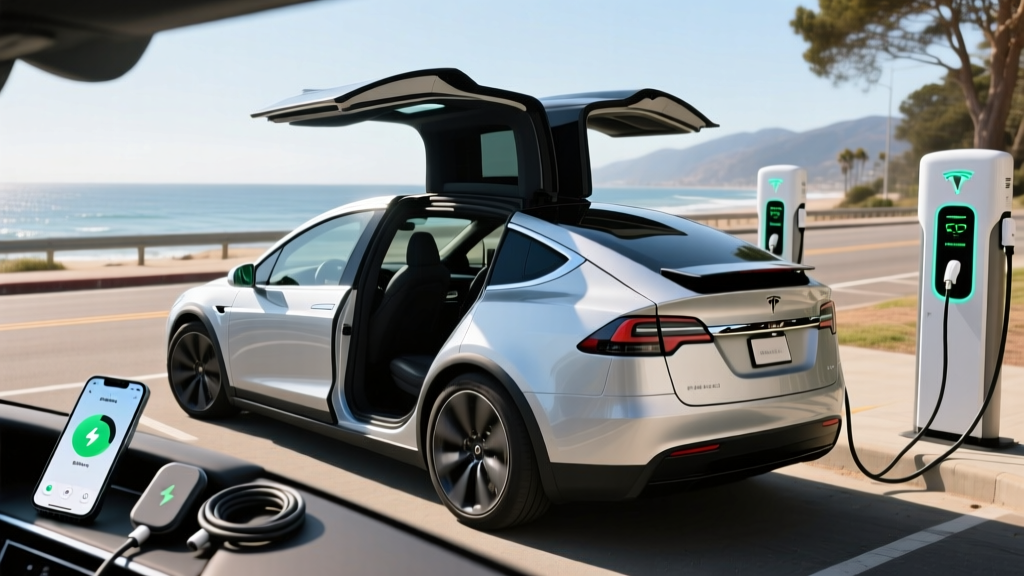
Falcon Wing doors remain the Model X's most distinctive feature. The rear gullwing-style doors use ultrasonic sensors to detect overhead and side obstacles, adjusting their opening arc accordingly. They're genuinely useful for loading children into car seats — you stand upright next to the seat rather than hunching over. However, they add mechanical complexity, can be slow to operate (5-7 seconds for a full cycle), and draw attention you may not want in a grocery-store parking lot.
The 17-inch infotainment screen runs Tesla's proprietary OS, which is responsive and feature-rich: navigation with real-time Supercharger routing, streaming media (Netflix, YouTube, Spotify), a full web browser, and gaming capability while parked. There is no Apple CarPlay or Android Auto — a dealbreaker for some buyers accustomed to phone-mirroring interfaces.
Driver assistance: Basic Autopilot (lane centering, adaptive cruise, traffic-aware features) is standard. Full Self-Driving (Supervised) — Tesla's SAE Level 2 system that adds automated lane changes, traffic-light recognition, and city-street navigation — is a $8,000 option or $99/month subscription.
Despite the "Full Self-Driving" name, Tesla FSD (Supervised) is an SAE Level 2 driver-assistance system. The driver must remain fully attentive, keep hands on the wheel, and be prepared to take over at any moment. It does not make the vehicle autonomous. Only Level 4 services like Waymo operate without a human driver.
Pricing, Trims, and Federal Tax Credit Eligibility
| Trim | Base MSRP | Destination | Total Before Options | Federal Credit (§30D) |
|---|---|---|---|---|
| Long Range | $77,990 | $1,990 | $79,980 | See eligibility below |
| Plaid | $92,990 | $1,990 | $94,980 | See eligibility below |
Federal tax credit reality for the Model X: Under current IRS §30D rules, the $7,500 federal EV tax credit has several eligibility hurdles that significantly limit who can claim it on a Model X:
- MSRP cap: SUVs must be below $80,000 MSRP. The Model X Long Range at $77,990 qualifies; the Plaid at $92,990 does not.
- Buyer income cap: Modified AGI must not exceed $300,000 (joint), $225,000 (head of household), or $150,000 (single).
- Battery sourcing requirements: Critical minerals and battery components must meet escalating percentage thresholds from approved sources. Tesla's supply chain has been adapting, but eligibility can shift — verify at fueleconomy.gov at time of purchase.
- Point-of-sale transfer: Eligible buyers can transfer the credit to the dealer at purchase, reducing the out-of-pocket price immediately rather than waiting for a tax refund.
Always confirm current eligibility with your tax professional and the IRS clean vehicle credit page before purchasing. Rules and sourcing requirements are subject to change.
Popular options that push the Long Range above $80,000 include FSD ($8,000), six-seat configuration ($6,500), and premium paint colors ($2,000-$3,000). If you're targeting the tax credit, be strategic about options to stay under the MSRP cap.
Who Should Buy the 2025 Model X — and Who Should Look Elsewhere
- Best-in-class Supercharger network access + CCS adapter for non-Tesla networks
- Falcon Wing doors are genuinely practical for car-seat loading
- Blistering acceleration (3.8s Long Range, 2.5s Plaid) for an SUV
- OTA updates continuously add features post-purchase
- 5,000-lb towing with integrated trailer brake controller option
- Heat pump standard — better cold-weather cabin efficiency
- Available 6- or 7-seat configurations for large families
- Plaid exceeds $80K MSRP cap — ineligible for federal tax credit
- Falcon Wing doors add complexity and occasional sensor-related quirks
- No Apple CarPlay or Android Auto support
- Real-world highway range ~270 mi — plan road trips accordingly
- Platform is aging vs. newer Rivian R1S, BMW iX architectures
- Insurance premiums run 15-25% higher than comparable ICE luxury SUVs
- Yoke steering wheel polarizing; conventional wheel should be the default
- You need three rows and want the Supercharger network for frequent road trips
- You value absurd straight-line performance in a family vehicle
- You regularly load children into rear car seats (falcon wings excel here)
- You want OTA-updated tech and Tesla's software ecosystem
- You need maximum cargo volume — the Rivian R1S offers more usable space
- You prefer traditional luxury interiors — the BMW iX or Mercedes EQS SUV deliver more opulence
- You want to tow more than 5,000 lbs — Rivian R1S handles 7,700 lbs
- Apple CarPlay is non-negotiable for your daily commute
Warranty, Ownership Costs, and Long-Term Outlook
Tesla covers the Model X battery and drive units with an 8-year / 150,000-mile warranty (whichever comes first), with a guaranteed minimum 70% battery capacity retention over that period. The basic vehicle warranty is 4 years / 50,000 miles. These terms are competitive within the luxury EV segment, though Hyundai/Kia's 10-year battery coverage on the Ioniq lineup sets a higher bar.
Battery chemistry in the Model X is NMC (nickel manganese cobalt), which offers higher energy density than LFP (lithium iron phosphate) but is more sensitive to sustained high states of charge. Tesla recommends daily charging to 80-90% for NMC packs and reserving 100% charges for road trips. Long-term degradation data from Tesla's fleet suggests approximately 10-12% capacity loss at 150,000 miles — well within the warranty threshold.
Maintenance costs are low relative to ICE equivalents: no oil changes, no transmission fluid, and regenerative braking extends pad life significantly. Expect to budget for cabin air filter replacement (~$150 every 2 years), tire rotation, and wiper fluid. Tires are the biggest recurring expense — the Model X's weight and torque chew through rubber, with a set of four 22-inch tires running $1,200-$1,800.
Insurance is a real cost factor. The Model X consistently ranks among the most expensive EVs to insure, with annual premiums averaging $2,800-$3,800 depending on state, driving record, and coverage level. Get quotes before ordering — the premium can add $200+/month to your ownership cost versus a conventional luxury SUV.
Frequently Asked Questions
What is the real-world range of the 2025 Tesla Model X?
The EPA rates the Long Range at 320 miles (22" wheels) and 335 miles (20" wheels). In real-world highway driving at 70-75 mph in moderate temperatures, expect approximately 265-285 miles. Mixed suburban/highway driving yields closer to 280-305 miles. Cold weather (below 32°F) can reduce range by 20-30%, bringing highway range down to 210-250 miles.
How fast does the Model X charge at home and on the road?
On a DC fast charger (Tesla Supercharger V3 or CCS-equipped station), the Model X peaks at 250 kW and charges from 10-80% in approximately 30 minutes. At home on a 240V / 48-amp Tesla Wall Connector (11.5 kW), you'll add about 30 miles of range per hour, fully replenishing the battery in roughly 9-10 hours. A standard NEMA 14-50 outlet with the Mobile Connector provides 7.7 kW, or about 20 miles per hour.
Does the 2025 Tesla Model X qualify for the $7,500 federal EV tax credit?
It depends. The Model X Long Range ($77,990 MSRP) falls under the $80,000 SUV cap and may qualify, but the buyer must also meet income limits ($300K joint / $150K single) and the vehicle must meet critical-mineral and battery-component sourcing requirements, which are subject to change. The Plaid ($92,990) exceeds the MSRP cap and does not qualify. Always verify at fueleconomy.gov and consult a tax professional before purchasing.
Is the Tesla Model X worth buying over the Rivian R1S or BMW iX?
The Model X wins on Supercharger network access, raw acceleration, and falcon-wing practicality for child-seat loading. The Rivian R1S offers more cargo space, higher towing capacity (7,700 lbs), better off-road capability, and a more adventure-oriented design. The BMW iX delivers a more luxurious interior and a quieter cabin. Your choice depends on priorities: tech ecosystem and charging convenience (Tesla), versatility and towing (Rivian), or traditional luxury (BMW).
What are the biggest drawbacks of the 2025 Model X?
The most common owner complaints center on the complexity of the falcon wing doors (occasional sensor misreads, slow operation), the absence of Apple CarPlay/Android Auto, high insurance premiums, and a platform that, while updated, is fundamentally older than newer competitors. Real-world highway range (~270 mi for the Long Range) also falls short of what some buyers expect from a vehicle in this price range.
How long will the Model X battery last?
Tesla warranties the battery for 8 years or 150,000 miles with a minimum 70% capacity retention guarantee. Fleet data suggests the NMC pack in the Model X degrades approximately 10-12% over 150,000 miles under normal use. To maximize longevity, Tesla recommends daily charging to 80-90% and avoiding prolonged periods at 100% state of charge. Battery replacement, if needed out of warranty, currently ranges from $15,000-$22,000 depending on the service center and pack availability.