Quick Verdict: Still the Benchmark Three-Row Electric SUV
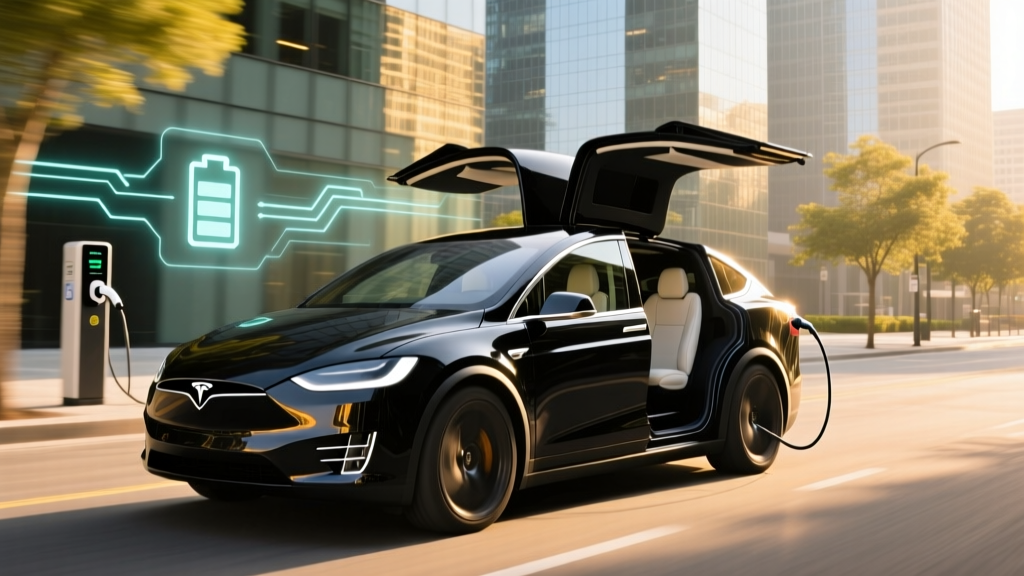
The Tesla Model X 2023 remains one of the few electric SUVs offering genuine three-row seating, supercar-level acceleration, and access to the most reliable DC fast-charging network in North America. With an EPA-estimated 348 miles of range in Long Range trim, falcon-wing rear doors, and a 17-inch cinematic touchscreen, it occupies a niche that competitors like the Rivian R1S and BMW iX haven't fully replicated. But at a starting MSRP above $80,000 (before any credits), and with real-world range that drops noticeably on the highway and in cold weather, the Model X demands a buyer who values performance and Tesla's ecosystem over value-per-mile efficiency.
This review breaks down the exact specs, charging behavior, ownership costs, and federal tax credit eligibility you need to evaluate before signing a purchase agreement in 2026.
Range, Battery, and Efficiency: The Numbers That Matter
| Spec | Value |
|---|---|
| EPA Estimated Range | 348 miles |
| Battery Pack (Usable) | ~100 kWh (NMC chemistry) |
| Efficiency (EPA Combined) | 109 MPGe / 31 kWh/100 mi |
| Drivetrain | Dual Motor AWD |
| 0-60 mph | 3.8 seconds |
| Horsepower | 670 hp |
| Top Speed | 155 mph |
| Towing Capacity | 5,000 lbs |
The Model X Long Range uses a nickel-manganese-cobalt (NMC) lithium-ion pack — Tesla does not publish exact usable kWh, but independent teardowns and EPA test data place usable capacity near 100 kWh. NMC offers higher energy density than the LFP (lithium iron phosphate) chemistry found in some Model 3/Y Standard Range vehicles, which is necessary here given the vehicle's 5,185-pound curb weight.
EPA 348 miles is the combined-cycle sticker number. In real-world testing:
- Highway (70-75 mph, moderate temps): Expect 280–310 miles. The Model X's tall, bluff front profile and ~2,350 kg mass hurt efficiency at sustained speed.
- City / suburban mixed driving: 320–345 miles is achievable thanks to aggressive regenerative braking recapturing energy.
- Cold weather (below 32°F / 0°C): Range drops 20–30%, putting real winter range at approximately 240–280 miles. The Model X uses a heat pump (standard), which mitigates cabin-heating losses compared to resistive heaters, but battery chemistry still suffers in deep cold.
At 31 kWh per 100 miles combined, the Model X is less efficient than the BMW iX xDrive50 (which returns roughly 86 MPGe combined with a smaller, lighter platform) but competitive with the Rivian R1S Dual-Motor Large Pack. Efficiency matters less if you charge at home overnight at $0.13/kWh, but it directly impacts road-trip charging frequency and cost.
Charging Speed: DC Fast Charging and Home Level 2
The Model X's charging architecture uses Tesla's proprietary NACS (North American Charging Standard) connector, which as of 2025–2026 has been adopted by nearly every major automaker. For 2023 Model X buyers, this means native access to the entire Tesla Supercharger network — still the most reliable and widely deployed DC fast-charging system in the US.
| Charging Level | Power / Rate | Speed |
|---|---|---|
| DC Fast Charge (Peak) | 250 kW (V3 Supercharger) | ~175 miles in 15 min; 10–80% in approximately 30–32 minutes |
| DC Fast Charge (Sustained avg.) | ~150–170 kW average | Charge curve tapers significantly above 60% SoC |
| Level 2 (Tesla Wall Connector) | 11.5 kW (48A on 60A circuit) | ~34 miles of range per hour |
| Level 2 (Generic J1772 w/ adapter) | Up to 11.5 kW | ~34 mi/hr (adapter included with vehicle) |
| Level 1 (120V household) | ~1.4 kW | ~4–5 mi/hr (emergency/trickle only) |
Charging curve reality: The 250 kW peak is available only between roughly 10–30% State of Charge (SoC) with a preconditioned battery. Above 50%, the rate drops to approximately 120 kW; above 80%, it falls below 50 kW. Tesla's navigation system automatically preconditions the battery when a Supercharger is set as your destination — this is critical, as arriving at a charger with a cold battery can cut peak power in half.
For home charging, the Tesla Wall Connector at $475 (hardware only) is the recommended Level 2 solution. Installation by a licensed electrician typically runs $500–$2,000 depending on panel proximity and whether your home's electrical panel needs a 200A upgrade (which can add $1,500–$3,500). Always consult a licensed electrician for final specs — the 60A circuit requirement is non-negotiable for full 11.5 kW throughput.
Performance and Driving Dynamics
The 2023 Model X Long Range produces 670 horsepower from its dual-motor all-wheel-drive powertrain, launching to 60 mph in 3.8 seconds — a figure that embarrasses most V8 performance SUVs. The Plaid trim (tri-motor, 1,020 hp, 0-60 in 2.5 seconds) exists in the lineup but commands a substantial premium and sacrifices roughly 30 miles of EPA range.
Ride quality improved markedly with Tesla's adaptive air suspension, which is standard on all Model X trims. The system lowers the vehicle at highway speeds for efficiency and raises it for rough roads or driveway clearance. Steering is precise but numb — a hallmark of Tesla's electric power steering calibration. Body roll is well-controlled given the height, but the Model X is a heavy vehicle and you feel that mass during aggressive cornering.
One-pedal driving via regenerative braking is strong enough to bring the vehicle to a complete stop in most conditions, though Tesla removed the driver-adjustable regen setting years ago — you get Tesla's chosen calibration or nothing.
Interior Space, Cargo, and Technology
The Model X seats up to seven passengers in a 2-3-2 configuration (six-seat config with second-row captain's chairs is optional). Third-row legroom is 32.7 inches — adequate for children or short trips but tight for adults on long journeys. Second-row legroom is a generous 41.0 inches.
| Dimension | Measurement |
|---|---|
| Cargo (behind 3rd row) | 37.1 cu ft |
| Cargo (3rd row folded) | 72.3 cu ft |
| Cargo (all rear rows folded) | 85.1 cu ft |
| Front Trunk (Frunk) | 6.6 cu ft |
| 2nd-Row Legroom | 41.0 in |
| 3rd-Row Legroom | 32.7 in |
The signature falcon-wing rear doors open vertically, providing excellent overhead access to the second and third rows — particularly useful in tight parking spaces where a conventional door swing would be blocked. However, they add mechanical complexity and have historically been a source of seal and sensor issues in earlier model years.
The 17-inch center touchscreen runs Tesla's proprietary infotainment OS, which remains one of the most responsive in the industry. Wireless phone mirroring is absent — Tesla uses its own app ecosystem. A rear-seat 8-inch touchscreen controls climate and entertainment for second-row passengers. The yoke steering wheel was optional in 2023 (a conventional round wheel was standard); most reviewers find the yoke impractical for low-speed maneuvers and parking despite its futuristic appeal.
Pricing, Trims, and Federal Tax Credit Eligibility
| Trim | Base MSRP | Est. After §30D Credit* |
|---|---|---|
| Long Range (Dual Motor) | $81,630 (2023 launch); adjusted to ~$79,990 by late 2023 | $72,490–$79,990 (credit eligibility varies) |
| Plaid (Tri-Motor) | $94,990 | Not eligible (exceeds MSRP cap — see below) |
*Destination fee of $1,390 additional. Prices reflect Tesla's dynamic pricing adjustments during the 2023 model year.
If you are purchasing a new remaining-inventory 2023 Model X in 2026, or evaluating a used 2023 Model X under the separate used-EV credit (§25E), these rules apply:
- New EV credit (up to $7,500): The vehicle MSRP must not exceed $80,000 for SUVs. The Long Range trim barely qualifies depending on exact configuration and Tesla's current listed price. The Plaid trim does not qualify.
- Buyer income caps: AGI must not exceed $300,000 (married filing jointly), $225,000 (head of household), or $150,000 (single).
- Battery sourcing requirements: Critical minerals and battery component sourcing thresholds increase annually. A vehicle that qualified in 2023 may have different eligibility in 2026 due to updated sourcing rules. Always verify on fueleconomy.gov and consult a tax professional.
- Point-of-sale transfer: As of 2024, the credit can be transferred to the dealer at purchase, reducing your out-of-pocket cost immediately rather than waiting for tax filing.
- Used EV credit (§25E): If buying a pre-owned 2023 Model X from a dealer, you may qualify for up to $4,000 or 30% of the sale price (whichever is less), subject to a $25,000 maximum sale price — which effectively excludes most used Model X vehicles from this credit given their residual values.
Source: IRS.gov — Clean Vehicle Credits
Warranty and Long-Term Battery Outlook
Tesla covers the 2023 Model X with:
- Basic Vehicle Limited Warranty: 4 years / 50,000 miles
- Battery and Drive Unit Warranty: 8 years / 150,000 miles, with a guaranteed minimum 70% capacity retention over that period
The 150,000-mile battery warranty threshold is competitive with the industry standard (Rivian offers 8yr/175,000mi; BMW offers 8yr/100,000mi). NMC chemistry in Tesla's pack has demonstrated relatively low degradation in fleet data — most Model S/X vehicles from 2016–2020 show approximately 10–15% capacity loss at 100,000 miles, plateauing thereafter. A full battery replacement out of warranty, however, can cost $15,000–$22,000 based on current Tesla service center estimates — a figure worth budgeting for if you plan to own the vehicle beyond the warranty window.
Driver Assistance: Autopilot and FSD (Supervised)
Tesla Autopilot and Full Self-Driving (Supervised) are SAE Level 2 driver-assistance systems. They do not make the vehicle self-driving. The driver must remain attentive, keep hands on the steering wheel, and be prepared to take over at any moment. No Tesla vehicle sold to consumers operates at SAE Level 3 or above. Autonomous ride-hail services like Waymo One operate at Level 4 in geofenced areas — an entirely different technology class.
Autopilot (standard) includes adaptive cruise control and lane centering. FSD (Supervised), a $15,000 add-on or $199/month subscription as of 2023, adds automatic lane changes, traffic-light and stop-sign recognition, and Navigate on Autopilot for highway interchanges. Real-world FSD performance in 2023 was capable but inconsistent — phantom braking, construction-zone confusion, and unprotected left-turn hesitation remain documented issues. NHTSA has investigated Tesla's Autopilot/FSD in multiple crash incidents; buyers should treat it as a convenience feature, not a substitute for attentive driving.
Pros, Cons, and Who Should Buy the 2023 Model X
Pros
- 348-mile EPA range — among the highest for any 3-row SUV
- Access to the full Supercharger network (17,000+ stalls in North America)
- Supercar acceleration (3.8s 0-60) in a family vehicle
- Falcon-wing doors offer unmatched rear-row access in tight spaces
- 5,000-lb towing capacity (with tow package)
- Over-the-air updates continuously add features
- Class-leading 85.1 cu ft max cargo volume
Cons
- MSRP above $80K — tax credit eligibility is borderline or excluded
- Real-world highway range drops to ~280–310 miles
- Cold-weather range loss of 20–30% is significant
- Third-row legroom (32.7 in) is tight for adults
- Falcon-wing doors: added complexity, potential seal/sensor issues
- No Apple CarPlay or Android Auto
- FSD ($15K add-on) remains Level 2, not autonomous
- Insurance premiums run 20–40% higher than comparable ICE SUVs
Who Is the 2023 Model X For?
Choose the Model X if: You need three rows of seating for a family of 5–7, prioritize access to Tesla's Supercharger network for frequent road trips, want supercar-level acceleration in a daily driver, and have reliable home Level 2 charging. The 5,000-lb tow rating also makes it viable for boat or small-trailer duty.
Look elsewhere if: Budget is a primary concern (the Rivian R1S starts lower and offers competitive range), you rarely use a third row (the Model Y or BMW iX are more efficient two-row options), you need Apple CarPlay, or you live in an area with limited Supercharger coverage and rely on Electrify America or other CCS networks (though the Model X can use CCS adapters).
Frequently Asked Questions
What is the real-world range of the 2023 Tesla Model X?
The EPA rates the Long Range at 348 miles combined. Real-world highway driving at 70–75 mph yields approximately 280–310 miles. In cold weather (below freezing), expect 240–280 miles. City driving with regenerative braking can approach the EPA figure.
How fast does the 2023 Model X charge?
On a V3 Supercharger (250 kW DC), the 10–80% charge takes approximately 30–32 minutes. At home on a Level 2 Tesla Wall Connector (11.5 kW), you gain roughly 34 miles of range per hour — an overnight charge from 20% to 80% takes about 6–7 hours. Peak DC charging speed requires battery preconditioning via navigation routing.
Does the 2023 Tesla Model X qualify for the federal EV tax credit?
It depends on the trim and your income. The Long Range trim, priced near $79,990, may qualify for up to $7,500 under §30D if the buyer's AGI is within limits and the vehicle meets battery-sourcing requirements (which tighten annually). The Plaid trim exceeds the $80,000 SUV MSRP cap and does not qualify. Verify current eligibility on fueleconomy.gov and consult a tax professional — rules change yearly.
Is the 2023 Model X worth buying vs. competitors?
Against the Rivian R1S, the Model X offers more range (348 vs. ~321 miles for the Large Pack), faster Supercharger access, and a more refined infotainment system. The R1S counters with lower starting price, more rugged off-road capability, and a conventional SUV design. The BMW iX is more efficient and luxurious but only seats five. The Model X wins for three-row families who road-trip frequently; the R1S wins for value and adventure use.
What are the biggest ownership costs beyond the purchase price?
Insurance averages $2,800–$3,600 annually depending on state and driving record — significantly above the SUV average. Home Level 2 charger installation runs $1,000–$3,000 including equipment and electrical work. Electricity costs for charging average $0.13/kWh nationally, translating to roughly $0.04–$0.05 per mile — about one-third the per-mile fuel cost of a comparable gas SUV. Tire replacement costs are elevated due to the vehicle's weight and performance tire specifications; expect $1,200–$1,800 per set.
How reliable is the 2023 Model X?
Tesla's build quality has improved since the 2021 Model X refresh (which introduced the current interior and powertrain), but panel-gap inconsistency and falcon-wing door sensor glitches remain reported issues on owner forums. The powertrain and battery pack have demonstrated strong long-term reliability in fleet data. NHTSA awarded the Model X a 5-star overall safety rating. IIHS has not tested the current-generation Model X as of early 2026.