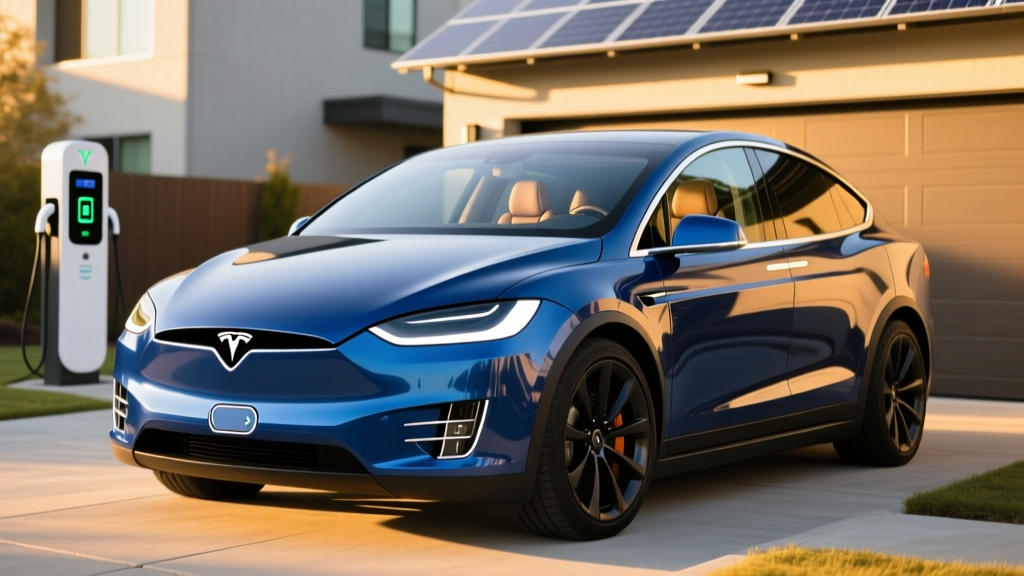
If you've been searching for a 100d tesla model x, you're likely referencing the legendary 100 kWh battery variant that defined Tesla's flagship SUV from 2017 through 2020. That specific "100D" badge is long retired — Tesla dropped alphanumeric battery-size naming in favor of "Long Range" and "Plaid" designations during its 2021 refresh. But the spirit of the 100D lives on in the current 2025 Tesla Model X Long Range, which carries a roughly 100 kWh (usable) battery pack, dual-motor all-wheel drive, and the most range of any electric SUV on the market.
This review covers the current-generation Model X Long Range as the direct descendant and modern equivalent of the original 100D. We'll break down real-world range expectations, charging performance, pricing with tax credit nuances, and whether this $80,000+ family hauler still justifies its premium in 2026.
Spec Sheet: Tesla Model X Long Range at a Glance
| Specification | Value |
|---|---|
| EPA Range | 348 miles |
| Battery Capacity (usable) | ~100 kWh (NMC chemistry) |
| Drivetrain | Dual-Motor AWD |
| Horsepower | 670 hp |
| 0–60 mph | 3.8 seconds |
| Peak DC Fast Charge Rate | 250 kW |
| 10–80% DC Charge Time | ~30 minutes |
| Level 2 Home Charging | 11.5 kW (440V/48A Wall Connector) |
| Efficiency | 102 MPGe combined / 33 kWh/100mi |
| Cargo (behind 2nd row) | 53.9 cu ft (5-seat) / 37.1 cu ft (6-seat) |
| Max Cargo (seats folded) | 88.1 cu ft |
| Towing Capacity | 5,000 lbs |
| Base MSRP | $79,990 (excl. $1,390 dest.) |
| Battery Warranty | 8 years / 150,000 miles |
Range Reality: What the EPA Sticker Doesn't Tell You
Real-World Expectation: ~280–310 miles on highway road trips (70–80 mph); ~240–270 miles in freezing temperatures with cabin heat. City/regenerative driving can approach or exceed the EPA figure.
The Model X Long Range's 348-mile EPA rating is the highest of any production electric SUV, edging past the Rivian R1S (up to 410 miles with the Max Pack, though that's a larger battery) and far ahead of the BMW iX xDrive50's 324 miles. According to fueleconomy.gov, the combined efficiency rating is 102 MPGe.
However, the Model X is a large, heavy vehicle (5,185 lbs curb weight) with the aerodynamic profile of a tall crossover. On sustained highway driving at 75–80 mph — the kind of trip where you actually need range — expect to use about 33–36 kWh/100mi, translating to roughly 280–310 real-world miles before hitting 0%. In cold weather (below 32°F), battery resistance and cabin heating can drop usable range by 20–30%, putting you closer to 240–270 miles. Tesla's heat pump, standard on all current Model X vehicles, mitigates this somewhat compared to older resistance-heater EVs, but physics still applies.
If you're coming from the original 100D (which was rated at 295 miles EPA when new), the current Long Range represents a meaningful ~50-mile improvement thanks to the refreshed powertrain efficiency, heat pump, and slight battery capacity gains.
Charging Performance: 250 kW Peak, But Mind the Curve
| Charging Level | Power | Rate / Speed | Typical Use Case |
|---|---|---|---|
| Level 1 (120V outlet) | ~1.4 kW | ~3–4 miles/hour | Emergency / trickle |
| Level 2 (240V, 48A Wall Connector) | 11.5 kW | ~34 miles/hour | Overnight home charging |
| Level 2 (240V, 32A Mobile Connector) | 7.7 kW | ~23 miles/hour | Dryer-outlet / NEMA 14-50 |
| DC Fast Charge (V3 Supercharger) | 250 kW peak | 10–80% in ~30 min | Road trips |
| DC Fast Charge (V4 Supercharger) | 250 kW peak | 10–80% in ~30 min | Newer Supercharger stalls |
The Model X Long Range charges at a peak of 250 kW on Tesla V3 and V4 Superchargers. In practice, you'll see this peak rate only in a narrow state-of-charge window — roughly 10–25% SoC with a preconditioned battery. The charge curve tapers progressively: by 50% SoC, you're typically seeing 120–150 kW, and above 80%, rates drop sharply to protect battery longevity, falling below 50 kW.
A 10–80% session takes approximately 30 minutes under ideal conditions (battery preconditioned via navigation to a Supercharger). Plan for 35–40 minutes if the battery is cold or if you arrive at a shared stall with V2-era power cabinets splitting capacity.
For home charging, the Tesla Wall Connector at 48 amps (11.5 kW) adds roughly 34 miles of range per hour. A full 0–100% charge from empty takes about 9–10 hours. Most owners who plug in nightly never need a full charge — a typical 40–60 mile daily commute is replenished in under two hours.
Connector note: The Model X uses Tesla's proprietary NACS connector natively. With Tesla's Supercharger network now open to other brands via NACS adoption, Model X owners retain first-party access to the most reliable DC fast-charging network in North America — a significant ownership advantage over CCS-equipped rivals still dependent on Electrify America or third-party networks.
Performance and Driving Dynamics
The dual-motor Long Range produces 670 horsepower and rockets to 60 mph in 3.8 seconds — remarkable for a three-row SUV weighing over 5,000 lbs. For context, that's quicker than a Porsche Cayenne S and nearly matches a BMW X5 M in straight-line acceleration, while producing zero tailpipe emissions.
If you want even more, the Model X Plaid (tri-motor, 1,020 hp, 2.5-second 0–60) exists at $94,990, but the Long Range is the rational choice for most buyers. It's the range champion of the lineup, and 3.8 seconds is more than sufficient for highway merging and passing.
The adaptive air suspension offers adjustable ride height (useful for rough driveways or aero efficiency at highway speed), and the regenerative braking system enables effective one-pedal driving in most conditions. Steering is direct if somewhat numb — this is a comfort-oriented cruiser, not a canyon carver.
Interior, Cargo, and Family Practicality
The Model X is available in five-seat, six-seat (with second-row captain's chairs), and seven-seat configurations. The six-seat layout is the most popular for families, offering easy third-row access via the gap between captain's chairs.
Cargo volume is generous: 53.9 cu ft behind the second row in the five-seat configuration, expanding to 88.1 cu ft with both rear rows folded. The front trunk (frunk) adds another 6.6 cu ft — enough for a charging cable bag and a small cooler.
Second-row legroom measures 40.9 inches, and the third row fits adults on short trips with 32.7 inches of legroom. The panoramic windshield extends overhead, creating an airy cabin feel that passengers consistently praise.
The 17-inch center touchscreen runs Tesla's latest software with a responsive interface, integrated navigation with Supercharger routing, streaming entertainment (Netflix, YouTube while parked), and a 22-speaker audio system. The secondary 8-inch rear touchscreen controls rear climate and entertainment.
Notable drawbacks: Panel fit remains inconsistent on some vehicles (a known Tesla concern). The yoke steering wheel, while available, is controversial for daily use. There are no physical buttons for climate or wipers — everything routes through the touchscreen, which some drivers find distracting. The falcon-wing rear doors, while dramatic, can be slow to open in tight spaces and have had reliability issues in earlier model years, though recent versions are improved.
Autopilot, FSD, and Driver Assistance
Every Model X ships with Tesla's Basic Autopilot, which includes Traffic-Aware Cruise Control and Autosteer (lane-centering). The optional Full Self-Driving (Supervised) package ($8,000 one-time or $99/month as of early 2026) adds Navigate on Autopilot, Auto Lane Change, Autopark, Summon, Smart Summon, and traffic light/stop sign recognition.
FSD has improved substantially in its v12+ neural-network-based architecture, but it remains a Level 2 driver-assist system. It can handle many highway and surface-street scenarios impressively, but it makes errors — phantom braking, misread construction zones, and occasional routing mistakes. You must remain fully engaged.
Compared to GM's Super Cruise (which operates hands-free on mapped highways) or Ford's BlueCruise, Tesla's system offers broader geographic coverage but requires more active supervision. According to NHTSA, all Level 2 systems demand driver readiness regardless of marketing language.
Pricing, Trims, and Federal Tax Credit Eligibility
| Trim | MSRP (excl. dest.) | Est. §30D Credit | Effective Price |
|---|---|---|---|
| Long Range (Dual Motor) | $79,990 | $0 (exceeds MSRP cap) | $79,990 |
| Plaid (Tri Motor) | $94,990 | $0 (exceeds MSRP cap) | $94,990 |
Critical tax credit detail: Under the current IRS §30D Clean Vehicle Credit rules, SUVs must have an MSRP at or below $80,000 to qualify. The Model X Long Range at $79,990 sits right at the threshold — but once you add the mandatory $1,390 destination charge, the total exceeds $81,000, which pushes it above the cap. As configured by Tesla (destination included in the purchase price), the Model X does not qualify for the $7,500 federal tax credit.
Even if MSRP eligibility were met, buyers must also satisfy income caps ($300,000 joint / $150,000 single modified AGI) and the vehicle must meet critical-mineral and battery-component sourcing requirements that shift annually. Tesla's supply chain has been evolving to meet these requirements, but the MSRP cap is the binding constraint for the Model X.
State incentives may still apply — states like California, Colorado, and others offer additional rebates or tax credits that aren't subject to the same MSRP caps. Check your state's energy office or DMV for current programs.
Adding FSD ($8,000), premium paint ($2,000–$3,000), 22-inch wheels ($4,500), and six- or seven-seat layouts ($6,500) can push a Long Range to $95,000–$100,000+ before any incentives.
Ownership Costs, Warranty, and Longevity
Tesla covers the Model X with a 4-year/50,000-mile basic vehicle warranty and an 8-year/150,000-mile battery and drive unit warranty with a guaranteed minimum 70% capacity retention over that period. This is competitive with the industry — most EV makers offer 8 years on the battery pack.
The battery chemistry in the Model X Long Range is NMC (nickel manganese cobalt), which offers high energy density (necessary for the 348-mile range in this package) but is more sensitive to sustained high SoC than LFP. Tesla recommends daily charging to 80–90% for NMC packs, reserving 100% for road trips. Following this guidance, real-world degradation data from fleet monitoring suggests most Model X packs retain 88–92% capacity after 100,000 miles.
Insurance costs are notably higher than average for the Model X — expect annual premiums of $2,800–$4,200 depending on your profile and location, reflecting the vehicle's repair costs and performance category. According to industry data, Tesla insurance through the company's own program can sometimes offer competitive rates using real-time driving data.
Maintenance is minimal: no oil changes, no spark plugs, no transmission fluid. Cabin air filter replacement ($50–$100) and tire rotation are the primary scheduled items. Brake pad wear is negligible thanks to regenerative braking — many owners report original pads past 80,000 miles.
Pros and Cons
✓ Pros
- 348-mile EPA range — best-in-class for a 3-row electric SUV
- Access to Tesla Supercharger network (17,000+ stalls in North America)
- 3.8-second 0–60 mph with 670 hp — effortless highway power
- Generous cargo space (up to 88.1 cu ft) and 5,000-lb towing
- Over-the-air updates continuously add features
- Best-in-class infotainment and software experience
- Heat pump standard for efficient cold-weather operation
✗ Cons
- Does not qualify for $7,500 federal tax credit (MSRP cap)
- $80,000+ starting price — steep entry for an SUV
- Falcon-wing doors can be slow and problematic in tight garages
- No physical controls — touchscreen dependency for basics
- Panel fit inconsistency on some vehicles
- High insurance premiums ($3,000–$4,000+ annually)
- FSD costs $8,000 extra and remains Level 2 (not autonomous)
- Third-row space is tight for adults on longer trips
How It Compares: Model X vs. Key Rivals
If you're cross-shopping the Model X Long Range, the main alternatives in the three-row electric SUV segment include:
- Rivian R1S (Dual-Motor Max Pack): Up to 410 miles range, superior off-road capability, more traditional SUV styling, better panel fit. But it starts around $84,000 and relies on CCS charging (limited network). Best for: adventure-oriented families.
- BMW iX xDrive50: 324 miles EPA, more luxurious interior, quieter ride, but only two rows of seats. Best for: luxury-focused buyers who don't need a third row.
- Kia EV9 GT-Line AWD: Starting around $74,000, 270 miles range, three rows, qualifies for the $7,500 tax credit. Best for: budget-conscious families who want a credit-eligible option.
- Mercedes EQS SUV 450 4MATIC: 305 miles EPA, ultra-premium interior, three rows available, but starts above $105,000. Best for: buyers who prioritize luxury badge and interior quality above all.
Who Should Buy the Model X Long Range?
Choose the Model X if: You need three rows, want maximum range in an electric SUV, rely on frequent road trips where Supercharger access is critical, value cutting-edge software, and can absorb the $80,000+ price without a federal tax credit.
Look elsewhere if: Tax credit eligibility is essential to your budget (consider the Kia EV9 or Hyundai Ioniq 9), you prioritize off-road capability (Rivian R1S), you want a more traditional luxury experience (BMW iX, Mercedes EQS SUV), or you only need two rows.
Frequently Asked Questions
What is the real-world range of the Tesla Model X Long Range (the 100D successor)?
The EPA rates it at 348 miles. In real-world highway driving at 70–80 mph, expect approximately 280–310 miles. In cold weather (below freezing), plan for 240–270 miles. City driving with regenerative braking can match or slightly exceed the EPA figure.
How fast does the Model X charge at home and on road trips?
On a Tesla V3 Supercharger (250 kW peak), a 10–80% charge takes about 30 minutes with a preconditioned battery. At home on a Level 2 Wall Connector (11.5 kW), you gain roughly 34 miles of range per hour, and a full charge takes 9–10 hours.
Does the Tesla Model X qualify for the federal EV tax credit?
No — under current IRS §30D rules, the Model X exceeds the $80,000 MSRP cap for SUVs when the destination charge is included, making it ineligible for the $7,500 credit. State-level incentives may still apply.
Is the Model X worth buying versus competitors in 2026?
It depends on your priorities. The Model X wins on range (348 mi), Supercharger network access, software, and performance. It loses on price (no tax credit), panel fit consistency, and door practicality. If road-trip charging infrastructure and range are your top concerns, it's the strongest option. If budget and tax credit eligibility matter more, the Kia EV9 or a similarly priced rival may serve better.
What battery does the current Model X Long Range use?
It uses an NMC (nickel manganese cobalt) lithium-ion pack with approximately 100 kWh of usable capacity. NMC offers the highest energy density for maximum range but should be charged to 80–90% daily rather than 100% for optimal longevity. The battery is warranted for 8 years or 150,000 miles with a minimum 70% capacity retention guarantee.
Can the Model X tow, and how does towing affect range?
Yes — the Model X Long Range is rated to tow up to 5,000 lbs. When towing near max capacity, expect range to drop by 40–50%, putting you in the 150–180 mile range. Trailer mode adjusts stability control and regenerative braking accordingly.
What happened to the original Tesla Model X 100D?
The Model X 100D was sold from 2017–2020 with a 100 kWh battery, rated at 295 miles EPA (289 mi in later model years). Tesla retired the "100D" naming convention with the 2021 refresh, replacing it with "Long Range" (dual-motor) and "Plaid" (tri-motor). The current Long Range is the direct successor with improved efficiency, range, and performance.