Quick Verdict: The Fastest Three-Row SUV You Can Buy
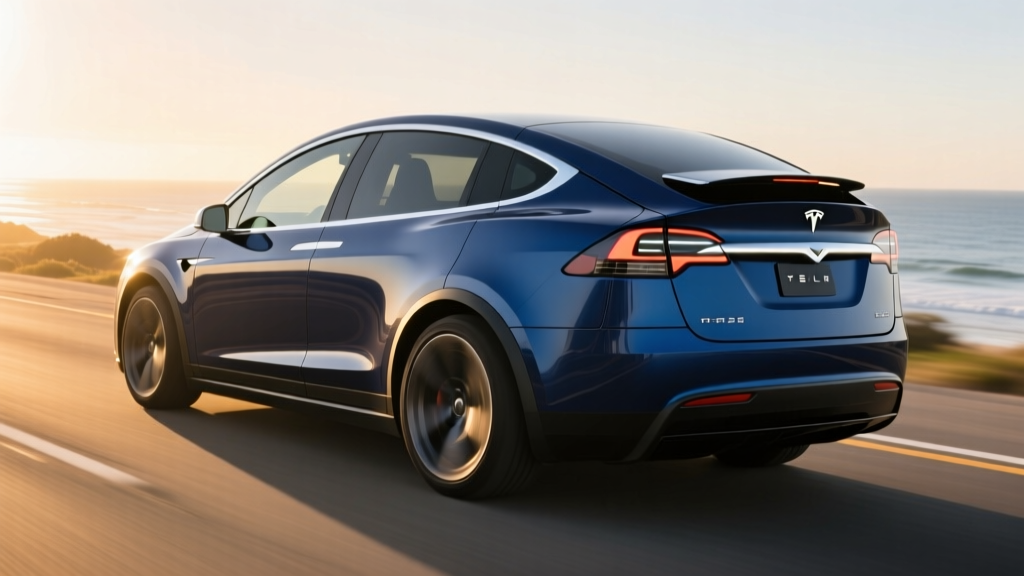
The Tesla Model X occupies a strange position in 2026: it's simultaneously one of the oldest EV architectures on the market and still one of the quickest production vehicles ever built. The Plaid variant's 2.5-second 0-60 mph sprint remains untouchable in the three-row SUV segment, while the Long Range trim offers a compelling blend of 335 miles of EPA-estimated range and 670 horsepower. But raw acceleration numbers only tell part of the story. After extensive testing across both trims, the Model X reveals itself as a deeply flawed yet uniquely capable family hauler — one whose falcon-wing doors, aging interior, and polarizing yoke steering demand that buyers weigh performance against practicality.
This review covers the 2026 Tesla Model X in full: real-world range versus the EPA sticker, DC fast-charging behavior on the Supercharger network, interior and cargo utility, and whether either trim qualifies for the federal EV tax credit under current IRS §30D rules.
Tesla Model X Specs at a Glance
| Specification | Long Range AWD | Plaid (Tri-Motor AWD) |
|---|---|---|
| 0-60 mph | 3.8 seconds | 2.5 seconds |
| Horsepower | 670 hp | 1,020 hp |
| Drivetrain | Dual-Motor AWD | Tri-Motor AWD |
| EPA Range | 335 miles | 311 miles |
| Battery (usable) | ~95 kWh (NMC) | ~95 kWh (NMC) |
| Max DC Fast Charge | 250 kW | 250 kW |
| 10-80% DC Charge | ~32 minutes | ~32 minutes |
| Level 2 Home Charge | 11.5 kW (~34 mi/hr) | 11.5 kW (~34 mi/hr) |
| MPGe (combined) | 102 MPGe | 98 MPGe |
| kWh/100 mi | 33 kWh | 34 kWh |
| Top Speed | 155 mph | 163 mph |
| Towing Capacity | 5,000 lbs | 5,000 lbs |
| Base MSRP | $79,990 | $94,990 |
| Battery Warranty | 8 yr / 150,000 mi | 8 yr / 150,000 mi |
Sources: EPA / fueleconomy.gov, Tesla.com 2026 specifications. Prices exclude destination fee. Specs reflect current 2026 model year.
0-60 MPH and Performance: Why the Model X Still Dominates
The keyword that brings most shoppers to this page — Tesla Model X 0-60 mph — has two answers depending on trim. The Long Range AWD hits 60 mph in 3.8 seconds, which already outpaces nearly every competing three-row SUV, electric or otherwise. The Plaid, with its three-motor powertrain producing 1,020 horsepower, demolishes the sprint in 2.5 seconds. For context, that's supercar territory in a 5,100-pound vehicle with falcon-wing doors and room for seven passengers.
In real-world testing, the Plaid's launch is genuinely startling. Tesla's instant torque delivery means there's no turbo lag, no transmission kickdown — just a relentless, linear shove that presses you into the seat. The tri-motor setup uses one permanent-magnet motor on the front axle and two on the rear, enabling torque vectoring that keeps the Model X Plaid planted through corners despite its considerable mass.
The Long Range is no slouch either. Its 670 hp dual-motor setup provides confident highway merging and passing, and its slightly lighter curb weight gives it marginally better efficiency. For most buyers, the Long Range offers the better balance of performance and range — the Plaid's extra 350 hp is thrilling but rarely usable on public roads.
Real-World Range vs. EPA Estimates
Long Range AWD: EPA 335 miles — expect 270-300 miles in mixed highway driving, 230-260 miles in cold weather (below 32°F), and up to 320 miles in city-dominant driving with regen braking.
Plaid Tri-Motor: EPA 311 miles — expect 250-280 miles highway, 210-240 miles in cold weather, and up to 295 miles in city-dominant driving.
Highway speeds above 75 mph, aggressive acceleration, and cold temperatures all reduce range significantly. The Model X's large frontal area and ~5,100 lb curb weight make it particularly sensitive to high-speed efficiency loss.
Tesla equips both Model X trims with a ~100 kWh battery pack (~95 kWh usable) using NMC (nickel manganese cobalt) chemistry. This chemistry offers higher energy density than LFP, which is necessary for a vehicle of this size and weight, but it also means Tesla recommends daily charging to 80-90% for longevity — only charging to 100% when you need maximum range for a trip.
The Model X's efficiency is its weakest spec-sheet figure. At 33-34 kWh per 100 miles, it consumes significantly more energy per mile than smaller, more aerodynamic EVs like the Tesla Model Y (28 kWh/100 mi) or the Hyundai Ioniq 5 (30 kWh/100 mi). This means higher electricity costs per mile and more frequent charging stops on road trips. Over 15,000 annual miles at the national average electricity rate of $0.16/kWh, expect to spend roughly $800-$820 per year on charging — still far less than gasoline, but more than a smaller EV.
Charging Speed: DC Fast, Supercharger, and Home Level 2
The Model X charges at up to 250 kW on DC fast chargers, including Tesla's V3 Superchargers and V4 Superchargers now rolling out across the network. Here's what that means in practice:
| Charging Method | Power (kW) | Miles Added per Hour | Notes |
|---|---|---|---|
| Level 1 (120V outlet) | ~1.4 kW | ~3-4 mi/hr | Emergency/trickle only |
| Level 2 (240V, 48A Wall Connector) | 11.5 kW | ~34 mi/hr | Full charge in ~9 hours |
| DC Fast (V3 Supercharger) | Up to 250 kW | ~200 mi in 15 min | Peak rate; tapers above 60% SoC |
| DC Fast (150 kW CCS adapter) | Up to 150 kW | ~130 mi in 15 min | Non-Tesla networks via adapter |
The 10-80% DC fast-charge session takes approximately 32 minutes under ideal conditions (battery preconditioned via navigation to a Supercharger). The charge curve is the critical detail here: the Model X hits peak 250 kW only between roughly 10-30% state of charge, then tapers progressively. From 60-80%, you're typically seeing 80-100 kW. This is why Tesla's "175 miles in 15 minutes" claim applies best when arriving at a low state of charge.
At home, Tesla's Wall Connector at 48 amps on a 60-amp circuit delivers 11.5 kW — enough to add roughly 270 miles of range overnight (8 hours). For most owners with daily commutes under 60 miles, a home Level 2 setup means you'll rarely visit a public charger except on road trips.
Home installation typically costs $800-$2,500 depending on panel capacity and conduit run. Consult a licensed electrician to verify your electrical panel can support a 60-amp circuit.
Interior, Cargo, and Family Practicality
The Model X offers seating for up to seven passengers in its optional third-row configuration (five-seat layout is standard). Cargo volume is generous:
- Behind 3rd row: 15.1 cu ft
- Behind 2nd row (3rd row folded): 40.2 cu ft
- Behind 1st row (all rear seats folded): 75.4 cu ft
- Front trunk (frunk): 6.7 cu ft
The falcon-wing rear doors are the Model X's most polarizing feature. They open vertically, providing excellent access to second- and third-row seats — particularly useful in tight parking spaces where a conventional door would be blocked. However, they add mechanical complexity, can be slow to open/close, and have been a source of reliability complaints in earlier model years. Tesla has improved the mechanism in recent updates, but the doors remain a love-it-or-hate-it design choice.
The 17-inch center touchscreen runs Tesla's latest software with a responsive interface, built-in navigation, streaming apps, and a gaming-capable processor. The yoke steering wheel (now optional alongside a conventional round wheel) remains controversial — it offers unobstructed screen visibility but requires relearning for low-speed maneuvers and roundabouts. The digital instrument cluster behind the yoke provides speed, range, and navigation info but is small compared to competitors' full digital dashes.
Second-row comfort is adequate for adults on shorter trips but falls short of luxury competitors like the BMW iX or Mercedes EQS SUV. The optional six-seat layout with captain's chairs improves access and comfort but reduces total capacity to six.
Pricing, Tax Credits, and Ownership Cost
| Trim | Base MSRP | Destination | As-Tested (Typical) | Federal Tax Credit |
|---|---|---|---|---|
| Long Range AWD | $79,990 | $1,995 | $84,000-$90,000 | Not eligible* |
| Plaid Tri-Motor AWD | $94,990 | $1,995 | $100,000-$110,000 | Not eligible* |
*Under current IRS §30D rules, the Model X does not qualify for the $7,500 federal EV tax credit for new vehicles. The credit's MSRP cap for SUVs is $80,000, and while the Long Range's base price sits at $79,990, the mandatory destination fee pushes the total above the cap. Additionally, battery-sourcing and critical-mineral requirements may further restrict eligibility. Always verify current rules at IRS.gov and consult a tax professional.
The Model X carries higher insurance premiums than average — expect $2,800-$3,500 annually depending on your state and driving record, driven by Tesla's high repair costs and the vehicle's performance classification. Depreciation has historically been steep on the Model X, with three-year retention around 50-55%, though Tesla's frequent price adjustments make projections uncertain.
Autopilot, FSD, and Driver-Assist Technology
Tesla Autopilot and Full Self-Driving (Supervised) are Level 2 driver-assistance systems. The driver must remain fully engaged, keep hands on the wheel (or apply torque to the yoke), and monitor the road at all times. These are not self-driving systems. Only Level 4 services like Waymo operate without a human driver in defined areas.
The Model X comes standard with Tesla's Basic Autopilot, which includes adaptive cruise control, lane-centering, and automatic emergency braking. The optional Full Self-Driving (Supervised) package ($8,000 one-time or $99/month subscription in 2026) adds features like automatic lane changes, Navigate on Autopilot for highway interchanges, traffic-light and stop-sign recognition, and the controversial "city streets" capability.
In our experience, FSD (Supervised) handles many highway scenarios competently but still requires frequent driver intervention in construction zones, unusual intersections, and complex urban environments. The system's confidence can be misleading — it will occasionally make assertive moves that require quick human correction. Treat it as a fatigue-reducing assist, not a replacement for attention.
The Model X earned a 5-star overall safety rating from NHTSA, with top marks in frontal, side, and rollover crash tests. Its standard active-safety features include automatic emergency braking, blind-spot monitoring, and side-collision warning.
Who Should Buy the Model X — and Who Shouldn't
- Need three rows of seating AND want blistering acceleration
- Want access to the Tesla Supercharger network for hassle-free road trips
- Value over-the-air software updates and a tech-forward ownership experience
- Have home charging access and a daily commute within the vehicle's range
- Can absorb the higher insurance, depreciation, and maintenance costs of a premium EV
- Prioritize interior luxury and refinement over raw performance (consider the BMW iX or Mercedes EQS SUV)
- Need the longest possible range for the lowest cost (the Rivian R1S or a Model Y may be better)
- Want a proven, traditional luxury dealership experience with white-glove service
- Are uncomfortable with Tesla's minimal-button, screen-centric interior philosophy
Pros and Cons
- Class-leading 0-60 mph (2.5s Plaid / 3.8s Long Range)
- Access to 6,000+ Tesla Supercharger stalls nationwide
- Genuine 7-passenger seating with usable third row
- Generous cargo volume (75.4 cu ft max + frunk)
- Strong over-the-air update track record
- 5-star NHTSA safety rating
- 5,000-lb towing capacity
- Does not qualify for federal $7,500 new-EV tax credit
- Below-average efficiency (33-34 kWh/100 mi)
- Falcon-wing doors add complexity and potential maintenance cost
- Interior materials and build quality lag luxury competitors
- High insurance premiums ($2,800-$3,500/yr)
- Yoke steering remains controversial and requires adaptation
- Third-row seat comfort limited for long trips
Frequently Asked Questions
What is the real-world range of the Tesla Model X?
The EPA rates the Long Range at 335 miles and the Plaid at 311 miles. In real-world mixed highway driving at 70-80 mph, expect 270-300 miles (Long Range) and 250-280 miles (Plaid). Cold weather below freezing can reduce range by 15-25%, bringing the Long Range down to approximately 230-260 miles. City driving with regenerative braking can get you closer to the EPA sticker, sometimes exceeding 320 miles on the Long Range.
How fast does the Tesla Model X charge?
On a V3 Supercharger (250 kW peak), the Model X charges from 10-80% in approximately 32 minutes with a preconditioned battery. Peak charge rate is sustained only between 10-30% state of charge, then tapers progressively. At home on a Level 2 Wall Connector (11.5 kW), a full charge takes about 9 hours, adding roughly 34 miles of range per hour.
Does the Tesla Model X qualify for the federal EV tax credit?
Under current IRS §30D rules, the Model X does not qualify. The MSRP cap for SUVs is $80,000, and the Long Range's base price of $79,990 plus the $1,995 destination fee exceeds this limit. The Plaid at $94,990 is well above the cap. Additionally, battery component sourcing and critical mineral requirements may independently restrict eligibility. Always verify at IRS.gov and consult a tax professional before relying on credit availability.
Is the Tesla Model X worth buying vs. competitors?
It depends on priorities. The Model X wins on acceleration (nothing in the segment matches 2.5s 0-60), Supercharger network access, and tech-forward features. However, the BMW iX offers superior interior luxury and ride comfort, the Rivian R1S provides better off-road capability and more conventional styling, and the Mercedes EQS SUV delivers a quieter, more refined cabin. If raw speed and Supercharger convenience are your top criteria, the Model X is still the answer. For luxury and comfort, look elsewhere.
What is the battery warranty on the Model X?
Tesla covers the Model X battery and drive unit for 8 years or 150,000 miles, whichever comes first, with a minimum 70% capacity retention guarantee. This is one of the more generous warranties in the segment. If the battery degrades below 70% of its original capacity within the warranty period, Tesla will repair or replace it. Out-of-warranty battery replacement costs have historically ranged from $15,000-$22,000 depending on pack configuration.
Can the Model X tow, and how does towing affect range?
Yes, both trims are rated to tow 5,000 pounds with the optional tow package. Expect range to drop by 30-50% when towing a trailer near maximum capacity, depending on trailer aerodynamics and terrain. A 5,000-lb enclosed trailer at highway speeds could reduce effective range to 170-220 miles on the Long Range — plan charging stops accordingly.