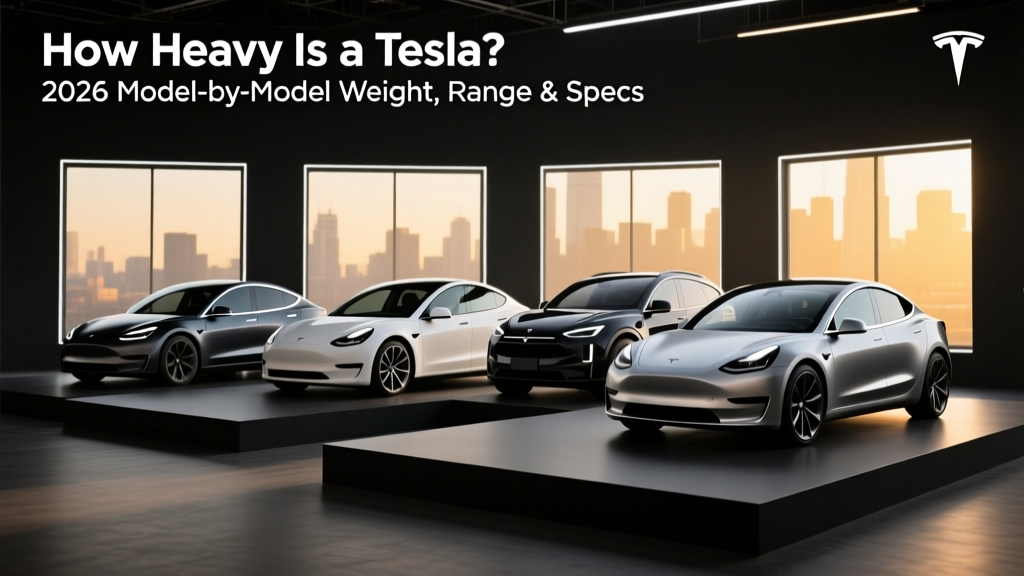
Weight is the silent variable that shapes everything about an electric vehicle: how far it can travel on a charge, how quickly it can stop, how much energy it consumes per mile, and how much wear it puts on tires and suspension components. When buyers ask "how heavy is a Tesla," they are usually trying to understand the relationship between mass, range, and efficiency — or they are calculating payload for a garage lift, a tire spec, or a towing setup.
Tesla's lineup spans a roughly 2,000-pound gap from the lightest Model 3 variant to the heaviest Cybertruck. That spread is driven primarily by battery size, vehicle architecture, and body-on-frame versus unibody construction. Below, we break down every current 2026 Tesla model by weight, battery capacity, EPA range, charging speed, and real-world efficiency — with the numbers that matter for ownership.
Tesla Model Weight Comparison: 2026 Lineup at a Glance
Curb weight reflects the vehicle with all standard equipment and a full battery but no passengers or cargo. Tesla publishes these figures in owner documentation, and the EPA's fueleconomy.gov database corroborates them independently.
| Model / Trim | Curb Weight (lbs) | Battery (kWh usable) | Chemistry | EPA Range (mi) | Drivetrain | 0-60 mph (sec) |
|---|---|---|---|---|---|---|
| Model 3 RWD | 3,862 | 57.5 | LFP | 272 | RWD | 5.8 |
| Model 3 Long Range AWD | 4,034 | 75.0 | NMC | 341 | Dual-Motor AWD | 4.2 |
| Model 3 Performance | 4,065 | 75.0 | NMC | 315 | Dual-Motor AWD | 2.9 |
| Model Y Long Range AWD | 4,363 | 75.0 | NMC | 320 | Dual-Motor AWD | 4.8 |
| Model Y Performance | 4,398 | 75.0 | NMC | 298 | Dual-Motor AWD | 3.5 |
| Model S Long Range | 4,766 | 95.0 | NMC | 402 | Dual-Motor AWD | 3.1 |
| Model S Plaid | 4,766 | 95.0 | NMC | 396 | Tri-Motor AWD | 1.99 |
| Model X Long Range | 5,185 | 95.0 | NMC | 335 | Dual-Motor AWD | 3.8 |
| Model X Plaid | 5,185 | 95.0 | NMC | 326 | Tri-Motor AWD | 2.5 |
| Cybertruck AWD | 6,603 | 123.0 | NMC | 340 | Dual-Motor AWD | 3.9 |
| Cybertruck Cyberbeast | 6,670 | 123.0 | NMC | 320 | Tri-Motor AWD | 2.6 |
Why Tesla Weights Vary So Much Between Models
Three primary factors determine the curb weight of any Tesla: battery pack mass, structural architecture, and body materials.
Battery Pack Mass
The single heaviest component in any EV is the battery pack. Tesla's LFP (lithium iron phosphate) packs used in the Model 3 RWD are denser per cell but smaller in total capacity (57.5 kWh usable), keeping weight down. The NMC (nickel manganese cobalt) packs in Long Range and Performance variants carry more energy but add mass — the jump from 57.5 kWh to 75 kWh adds roughly 170-200 lbs of cells and structural housing. The Model S and X carry 95 kWh packs, and the Cybertruck's massive 123 kWh pack is a primary reason it tips the scales at over 6,600 lbs.
As a general rule of thumb in EV engineering, each additional kWh of NMC battery capacity adds approximately 8-10 lbs of pack weight. LFP chemistry is heavier per kWh (roughly 10-13 lbs/kWh) due to iron's density, but Tesla uses LFP only in smaller packs where total mass stays manageable.
Structural Architecture and Body Materials
The Model 3 and Model Y share a unibody platform, but the Y rides on a longer wheelbase and carries a taller body, adding roughly 330 lbs over an equivalently equipped Model 3. The Model S and X use aluminum-intensive body panels and a larger structural pack enclosure, but their greater length, air suspension hardware, and larger glass surfaces push them past 4,700 and 5,100 lbs respectively.
The Cybertruck stands apart. Its stainless steel exoskeleton is significantly heavier than conventional stamped aluminum or steel panels, and its body-on-frame-style architecture with a 48-volt electrical system and steer-by-wire hardware adds mass that no other Tesla carries. At 6,603 lbs for the dual-motor AWD, it is the heaviest vehicle Tesla currently sells.
Drivetrain Configuration
Adding a front motor for dual-motor AWD typically adds 80-120 lbs compared to a single-motor RWD layout. The tri-motor Plaid powertrains in the Model S, X, and Cybertruck add yet another rear motor, contributing another 60-80 lbs. These differences are relatively minor compared to battery mass but show up when comparing otherwise identical trims.
Real-World Range: What the EPA Sticker Doesn't Tell You
EPA range estimates are measured on a controlled dynamometer cycle that blends city and highway driving at moderate temperatures. Real-world results diverge based on speed, ambient temperature, elevation, and driving style.
- Model 3 Long Range (EPA 341 mi): Expect 280-300 mi at sustained 75 mph highway speeds in mild weather. In sub-freezing temperatures (below 32°F), plan for 230-260 mi due to cabin heating load and increased battery resistance.
- Model Y Long Range (EPA 320 mi): Highway reality is 260-285 mi. Cold weather drops this to 215-245 mi. The Y's taller, less aerodynamic profile costs it roughly 10-15 mi versus the Model 3 at highway speed.
- Model S Long Range (EPA 402 mi): The longest-range Tesla in practice delivers 330-360 mi on the highway. Cold-weather range: 280-310 mi. Its larger battery and efficient heat pump help it hold an edge.
- Cybertruck AWD (EPA 340 mi): Real-world highway range is 270-300 mi. The truck's slab-sided aerodynamics and 6,600+ lb mass make it especially sensitive to headwinds and high speeds. Towing drops range by 40-50%.
Tesla's onboard navigation accounts for many of these variables when estimating arrival charge, and preconditioning the battery before a Supercharger stop (automatic when a charger is set as your destination) recovers some efficiency by warming the cells to optimal charge-acceptance temperature.
Charging Speed: DC Fast, Level 2, and the Curve That Matters
A vehicle's peak DC fast-charge rate (measured in kilowatts, or kW — the power flowing into the battery at any instant) is only part of the story. What matters for road trips is the charge curve: how quickly the battery accepts energy from 10% to 80% state of charge, after which charging slows dramatically to protect cell longevity.
| Model | Peak DC Rate (kW) | 10-80% DC Time (min) | Level 2 Home Rate (kW) | Miles Added per Hour (L2) |
|---|---|---|---|---|
| Model 3 RWD (LFP) | 170 | ~30 | 11.5 (48A) | ~36 |
| Model 3 Long Range / Performance | 250 | ~25 | 11.5 (48A) | ~44 |
| Model Y Long Range / Performance | 250 | ~27 | 11.5 (48A) | ~42 |
| Model S / X Long Range & Plaid | 250 | ~30 | 11.5 (48A) | ~38 |
| Cybertruck AWD / Cyberbeast | 350+ | ~22 | 17.3 (72A / 80A circuit) | ~37 |
The Cybertruck's 800-volt-class architecture allows it to accept peak rates above 350 kW at V4 Superchargers, though sustained rates taper after 50% SoC. The Model 3 and Y operate on a ~400V architecture; they peak at 250 kW but hold strong charge rates through roughly 55-60% before stepping down.
For home charging, a Tesla Wall Connector on a 60-amp circuit delivers up to 11.5 kW (48 amps continuous) to most models, adding 36-44 miles of range per hour of charging — enough to fully replenish any Model 3 or Y overnight. The Cybertruck supports up to 17.3 kW on Level 2 when connected to an 80-amp circuit, which is worth considering if you plan to install a high-amperage home charger. Always have a licensed electrician evaluate your panel capacity before upgrading beyond a standard 48-amp circuit.
Pricing, Trims, and Federal Tax Credit Eligibility
Tesla's pricing shifts periodically, but as of early 2026 the MSRPs below reflect current configurations. Federal tax credit eligibility under IRS §30D depends on three factors: vehicle MSRP caps, buyer income limits, and battery component/critical mineral sourcing requirements.
| Model / Trim | Base MSRP | MSRP Cap Eligible? | Max §30D Credit | Est. After Credit |
|---|---|---|---|---|
| Model 3 RWD | $38,990 | Yes (sedan cap: $55,000) | $7,500* | ~$31,490 |
| Model 3 Long Range AWD | $45,240 | Yes | $7,500* | ~$37,740 |
| Model 3 Performance | $52,990 | Yes | $7,500* | ~$45,490 |
| Model Y Long Range AWD | $44,990 | Yes (SUV cap: $80,000) | $7,500* | ~$37,490 |
| Model Y Performance | $48,990 | Yes | $7,500* | ~$41,490 |
| Model S Long Range | $79,990 | No (exceeds $55K sedan cap) | $0 | $79,990 |
| Model X Long Range | $79,990 | Yes (SUV cap: $80,000) | $7,500* | ~$72,490 |
| Cybertruck AWD | $79,990 | Yes (pickup cap: $80,000) | $7,500* | ~$72,490 |
*The full $7,500 credit requires the buyer to meet income thresholds ($150,000 single / $300,000 joint MAGI) and the vehicle to satisfy critical mineral and battery component sourcing rules that tighten annually. As of 2026, Tesla's US-built models with North American-sourced LFP and NMC cells generally qualify, but eligibility can change as supply chains shift. The credit can now be transferred to the dealer at point of sale as an instant discount. Consult a tax professional and verify current rules at IRS.gov.
Efficiency and the Weight Penalty: MPGe and kWh/100mi
Heavier vehicles consume more energy per mile, all else being equal. Efficiency — measured in MPGe (miles per gallon equivalent) or kWh per 100 miles — is where mass shows up on your electricity bill.
| Model | Combined MPGe | kWh/100 mi | Curb Weight (lbs) |
|---|---|---|---|
| Model 3 RWD | 132 | 25 | 3,862 |
| Model 3 Long Range AWD | 131 | 26 | 4,034 |
| Model Y Long Range AWD | 122 | 28 | 4,363 |
| Model S Long Range | 120 | 28 | 4,766 |
| Model X Long Range | 102 | 33 | 5,185 |
| Cybertruck AWD | ~85 | ~39 | 6,603 |
The Model 3 RWD is Tesla's efficiency champion at 25 kWh per 100 miles — roughly $0.04-$0.05 per mile at average US residential electricity rates ($0.16-$0.18/kWh). The Cybertruck, at nearly 40 kWh/100mi, costs almost 60% more per mile to fuel. Over 15,000 annual miles, that difference translates to roughly $300-$400 per year in electricity cost, assuming home charging. Public DC fast charging at $0.35-$0.50/kWh widens the gap further.
Weight is not the only variable — aerodynamics (drag coefficient and frontal area) and tire rolling resistance play major roles. The Cybertruck's poor efficiency is as much about its boxy shape and all-terrain tires as its 6,600-lb mass. But across Tesla's lineup, the correlation is clear: lighter Teslas are cheaper to drive per mile.
Cargo, Passenger Space, and Practicality by Model
Weight often correlates with size, and Tesla's heavier models generally offer more interior volume — but not always in the ways buyers expect.
| Model | Front Legroom (in) | Rear Legroom (in) | Cargo (rear seats up, cu ft) | Cargo (rear seats down, cu ft) | Frunk (cu ft) |
|---|---|---|---|---|---|
| Model 3 | 42.7 | 35.2 | 23 | — | 3.1 |
| Model Y | 41.8 | 41.6 | 30 | 72 | 4.1 |
| Model S | 42.4 | 35.4 | 28 | — | 5.3 |
| Model X | 41.2 | 41.9 | 42 (5-seat) | 85 | 6.7 |
| Cybertruck | — | — | — | — | 7.0 (frunk) |
The Model Y is the practical sweet spot: it offers 72 cu ft of total cargo volume with the rear seats folded, more than the Model S sedan and approaching the Model X — at over 800 lbs less weight than the X. The Cybertruck's 6-foot bed provides roughly 74 cu ft of lockable volume under the tonneau cover, plus a 7.0 cu ft front trunk ("frunk") and a lockable "gear locker" behind the rear axle. However, the Cybertruck's 6,600+ lb curb weight limits its payload capacity to approximately 1,100 lbs (GVWR minus curb weight), which is less than many full-size gas pickups.
Warranty Coverage Across the Tesla Lineup
Tesla structures its warranty in three tiers that apply consistently across models:
- Basic Vehicle Limited Warranty: 4 years / 50,000 miles, whichever comes first. Covers most non-powertrain components.
- Battery & Drive Unit Warranty (Model 3/Y RWD with LFP): 8 years / 100,000 miles with a minimum 70% capacity retention threshold.
- Battery & Drive Unit Warranty (Long Range, Performance, S, X, Cybertruck): 8 years / 120,000 miles (150,000 miles for Model S/X) with a minimum 70% capacity retention threshold.
Tesla's battery warranties are competitive with the broader EV market. The 70% retention threshold means Tesla guarantees that after 8 years and 100,000-150,000 miles, your battery will still hold at least 70% of its original capacity. Independent fleet data from sources like Recurrent Auto suggests that most Tesla NMC packs degrade roughly 10-12% over the first 100,000 miles, well within warranty tolerance. LFP packs in the Model 3 RWD show even slower degradation curves in early data, though long-term fleet data is still accumulating.
If a battery replacement is needed out of warranty, current Tesla service estimates range from $12,000-$16,000 for a Model 3/Y pack and $18,000-$22,000 for a Model S/X pack. The Cybertruck's 123 kWh pack replacement cost has not been widely documented in the aftermarket yet, but based on per-kWh pricing trends, expect estimates above $20,000.
Standout Technology and Notable Drawbacks
Tech Highlights
- Supercharger Network: Tesla's proprietary network (now open to other brands via NACS adapters) remains the most reliable and widespread DC fast-charging infrastructure in North America, with over 6,000 US Supercharger stations.
- Over-the-Air Updates: Tesla pushes frequent software updates that can add range, improve charge curves, and introduce new features without a service center visit.
- Autopilot / FSD (Supervised): Tesla's driver-assistance suite is a SAE Level 2 system. Despite the "Full Self-Driving" branding, the driver must remain fully engaged with hands on the wheel and eyes on the road at all times. This is not autonomous driving — only Level 4 services like Waymo operate without a human driver.
- Cybertruck Steer-by-Wire: The Cybertruck eliminates the mechanical steering column in favor of a fully electronic system, enabling variable steering ratios that require less than one full turn lock-to-lock.
Drawbacks Worth Noting
- Minimalist Interior: Tesla's cabin design eliminates most physical controls in favor of the central touchscreen. Climate, mirrors, and even glovebox release are screen-operated — a frustration for some drivers, especially in winter when screen responsiveness can lag.
- No Apple CarPlay / Android Auto: Tesla uses its proprietary infotainment system exclusively. If you depend on phone projection, this is a dealbreaker.
- Insurance Costs: Tesla insurance premiums run 20-40% above comparable non-EV sedans and SUVs, driven by high repair costs for aluminum and stainless steel body panels and expensive sensor recalibration after collisions.
- Cybertruck Weight Challenges: At 6,600+ lbs, the Cybertruck exceeds the weight rating of some residential garage lifts and requires commercial-grade tire specifications. Its mass also increases stopping distances and tire wear rates.
Who Should Buy Which Tesla?
- Commuter / solo driver (lowest cost per mile): Model 3 RWD at 3,862 lbs and 25 kWh/100mi. LFP battery tolerates daily 100% charging without degradation concerns. Best value after the §30D credit.
- Family with kids and cargo: Model Y Long Range at 4,363 lbs. 72 cu ft cargo, strong rear legroom, 320 mi EPA range. The efficiency sweet spot for a crossover.
- Road-trip priority (maximum range): Model S Long Range at 4,766 lbs. 402 mi EPA, 250 kW charging, best real-world highway range in the lineup.
- Towing and utility: Cybertruck AWD at 6,603 lbs. 11,000-lb tow rating, 6-foot bed, but expect 150-180 mi real-world range while towing and significantly higher electricity cost per mile.
- Performance enthusiast: Model 3 Performance (2.9s 0-60) or Model S Plaid (1.99s 0-60). Weight is a secondary concern when straight-line acceleration is the priority.
How Tesla Weights Compare to Key Competitors
For context, here is how Tesla's curb weights stack up against similarly sized EVs from other manufacturers:
| Vehicle | Curb Weight (lbs) | Battery (kWh) | EPA Range (mi) |
|---|---|---|---|
| Tesla Model 3 Long Range AWD | 4,034 | 75.0 | 341 |
| Hyundai Ioniq 6 SEL AWD | 4,541 | 77.4 | 316 |
| BMW i4 xDrive40 | 4,682 | 81.5 | 282 |
| Tesla Model Y Long Range AWD | 4,363 | 75.0 | 320 |
| Ford Mustang Mach-E Premium AWD | 4,647 | 88.0 | 290 |
| Hyundai Ioniq 5 Limited AWD | 4,663 | 77.4 | 290 |
Tesla's models are consistently among the lightest in their segments, largely because Tesla's vertically integrated battery pack design (structural battery in the Model Y and refreshed Model 3) doubles as a chassis member, eliminating redundant structural weight. This weight advantage translates directly into better efficiency (more miles per kWh) and often better real-world range despite sometimes smaller battery packs.
Frequently Asked Questions
What is the heaviest Tesla currently sold?
The Cybertruck Cyberbeast (tri-motor) at 6,670 lbs is the heaviest Tesla in the 2026 lineup, followed closely by the dual-motor Cybertruck AWD at 6,603 lbs. The stainless steel exoskeleton and 123 kWh battery pack are the primary contributors to this mass.
What is the lightest Tesla currently sold?
The Model 3 RWD at 3,862 lbs is Tesla's lightest current vehicle. Its smaller 57.5 kWh LFP battery pack and single-motor drivetrain keep mass to a minimum, which is why it achieves Tesla's best efficiency rating of 132 MPGe combined.
Does Tesla weight affect tire wear?
Yes. Heavier EVs wear tires faster than lighter vehicles due to increased contact patch loading and the instant torque delivery of electric motors. Tesla owners typically replace tires every 25,000-35,000 miles, compared to 40,000-60,000 miles for comparable gas vehicles. The Cybertruck and Model X, being the heaviest, tend to be at the lower end of that range. Tesla specifies EV-rated tires with higher load indexes and reinforced sidewalls for all models.
Does a heavier Tesla have worse range?
Not necessarily. The Model S Long Range weighs 4,766 lbs but achieves 402 mi EPA range because it carries a 95 kWh battery — the extra energy capacity more than compensates for the additional mass. Range is a function of battery size divided by efficiency, and efficiency is where weight matters. The Cybertruck weighs 6,603 lbs with a 123 kWh pack but only achieves 340 mi EPA because its aerodynamic drag and rolling resistance are so high that it consumes ~39 kWh per 100 miles.
Does the Model 3 or Model Y qualify for the federal EV tax credit?
Yes. Both the Model 3 and Model Y are assembled in the US and fall under their respective MSRP caps ($55,000 for sedans, $80,000 for SUVs/crossovers/trucks). Eligible buyers (income under $150,000 single / $300,000 joint MAGI) can receive up to $7,500 as a point-of-sale discount, subject to current battery sourcing requirements under IRS §30D. Always verify current eligibility at IRS.gov before purchasing, as sourcing rules tighten each year.
How does Tesla weight affect home charging installation?
Vehicle weight does not directly affect home charging requirements — battery capacity and onboard charger limits do. However, heavier Teslas (Model X, Cybertruck) have larger batteries that take longer to charge on a standard 48-amp Level 2 circuit. A Cybertruck with a 123 kWh battery needs roughly 10-11 hours on an 11.5 kW circuit to charge from 10% to 80%, compared to roughly 5 hours for a Model 3 Long Range on the same circuit. If you own a Cybertruck, consider upgrading to an 80-amp circuit to take advantage of its 17.3 kW Level 2 capability.