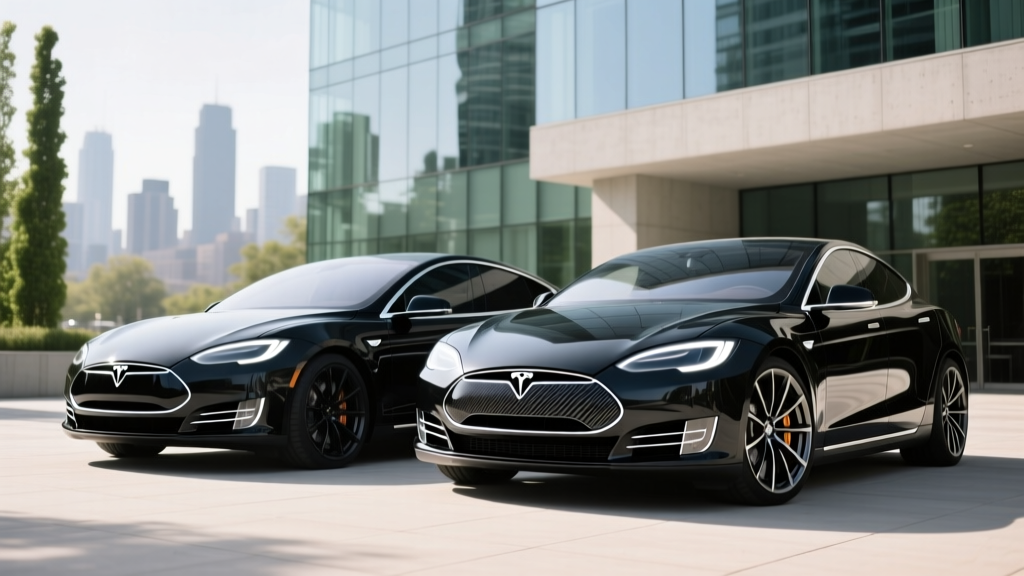
After more than a decade defining the premium electric sedan and SUV segments, Tesla has confirmed what industry watchers have long suspected: the Model S and Model X are nearing the end of their production lifecycle. To mark the occasion, Tesla launched limited Signature Editions for the final Model S/X run, offering exclusive badging, interior treatments, and performance software tweaks that won't appear on any future vehicle. These aren't new platforms — they're farewell packages built on the 2021-refreshed architecture that introduced the yoke steering, horizontal touchscreen, and rear-seat entertainment display.
For buyers who've held off on Tesla's flagship sedan and SUV, the Signature Editions represent either a collector-grade opportunity or a last call on aging technology. Below, we break down every spec that matters — range, charging, performance, pricing, and tax credit eligibility — so you can decide whether these final-run vehicles earn a spot in your garage.
Signature Edition Specs: Model S and Model X at a Glance
| Spec | Model S Signature (Dual Motor) | Model S Plaid Signature | Model X Signature (Dual Motor) | Model X Plaid Signature |
|---|---|---|---|---|
| EPA Range | 402 mi | 359 mi | 348 mi | 320 mi |
| Battery (usable) | ~95 kWh (NMC) | ~95 kWh (NMC) | ~95 kWh (NMC) | ~95 kWh (NMC) |
| Drivetrain | Dual Motor AWD | Tri-Motor AWD | Dual Motor AWD | Tri-Motor AWD |
| Horsepower | 670 hp | 1,020 hp | 670 hp | 1,020 hp |
| 0–60 mph | 3.1 sec | 1.99 sec | 3.8 sec | 2.5 sec |
| Max DC Fast Charge | 250 kW | 250 kW | 250 kW | 250 kW |
| 10–80% DCFC Time | ~30 min | ~30 min | ~30 min | ~30 min |
| Level 2 Rate (11.5 kW) | ~34 mi/hr | ~34 mi/hr | ~30 mi/hr | ~30 mi/hr |
| EPA Efficiency | 124 MPGe (28 kWh/100mi) | 116 MPGe (30 kWh/100mi) | 109 MPGe (32 kWh/100mi) | 101 MPGe (34 kWh/100mi) |
| Cargo (rear seats up) | 28 cu ft | 28 cu ft | 37.1 cu ft | 37.1 cu ft |
| Cargo (seats folded) | ~79 cu ft | ~79 cu ft | ~88 cu ft | ~88 cu ft |
| Base MSRP | $94,990 | $114,990 | $104,990 | $124,990 |
These figures are drawn from fueleconomy.gov and Tesla's official order configurator. The Signature Editions carry a premium over the outgoing standard trims — roughly $5,000–$7,000 depending on configuration — in exchange for unique "Signature" badging on the B-pillars, an Alcantara-and-leather interior with contrast stitching, a serialized dashboard plaque, and a software-unlocked "Track Mode Plus" on Plaid variants that expands thermal management headroom during repeated hard launches.
Real-World Range: What the EPA Sticker Doesn't Tell You
Model S Signature (Dual Motor): EPA 402 mi — expect ~330–350 mi on sustained highway driving at 70–75 mph; ~260–290 mi in sub-freezing winter conditions with cabin heat active.
Model S Plaid Signature: EPA 359 mi — expect ~280–310 mi highway; ~230–260 mi in cold weather.
Model X Signature (Dual Motor): EPA 348 mi — expect ~275–300 mi highway; ~220–250 mi in cold weather.
Model X Plaid Signature: EPA 320 mi — expect ~250–275 mi highway; ~200–230 mi in cold weather.
The Model S Dual Motor's 402-mile EPA rating remains one of the highest of any production EV sold in the US. But EPA testing uses a mixed city/highway cycle with moderate speeds and frequent regenerative braking opportunities — conditions that favor EVs over real-world interstate travel. On a flat 70 mph highway run in 65°F weather, owners consistently report achieving roughly 82–87% of the EPA sticker. That drops to 65–72% in freezing temperatures, where the battery's internal resistance increases and the heat pump (standard on the refreshed platform) works harder to maintain cabin comfort.
The NMC (nickel manganese cobalt) chemistry used across all Signature Editions offers higher energy density than the LFP (lithium iron phosphate) packs Tesla uses in its base Model 3 and Model Y trims. That density is what enables the 402-mile figure in a sedan form factor. The trade-off: NMC cells degrade slightly faster than LFP over hundreds of cycles, and Tesla recommends daily charging to 80–90% rather than 100% for routine use — reserving full charges for road trips. Tesla's battery management system includes a bottom buffer (roughly 3–4 kWh reserved below the displayed 0%) and a top buffer to protect cell longevity.
Charging Speed: Supercharger Network Advantage — and Its Limits
| Charging Level | Power / Rate | Model S (mi added per hour) | Model X (mi added per hour) | Notes |
|---|---|---|---|---|
| Level 1 (120V, 12A) | ~1.4 kW | ~3–4 mi/hr | ~3 mi/hr | Emergency/trickle only |
| Level 2 (240V, 48A) | 11.5 kW | ~34 mi/hr | ~30 mi/hr | Home Wall Connector or equivalent; full charge in ~9–10 hours |
| DC Fast (V3 Supercharger) | Peak 250 kW | ~200 mi in 15 min | ~175 mi in 15 min | 10–80% in ~30 min; tapers sharply above 80% |
| DC Fast (V4 Supercharger) | Peak 250 kW (CCS-native cabinets) | ~200 mi in 15 min | ~175 mi in 15 min | Same peak; newer cabinet architecture |
The Signature Editions use Tesla's native NACS connector, granting full access to the Supercharger network — now exceeding 6,000 V3 and V4 stalls across the US. At a V3 stall with battery preconditioning active (navigating to a Supercharger via the car's nav triggers this automatically), the ~95 kWh pack ramps quickly to its 250 kW peak. However, that peak is sustained only between roughly 10–30% State of Charge. By 50% SoC, power drops to approximately 150–170 kW; by 80%, it falls below 60 kW. This charge-curve taper is why the 10–80% time is ~30 minutes — but a 10–100% session would take closer to 55–60 minutes.
Compared to competitors on 800-volt architectures — the Lucid Air Grand Touring can accept up to 300 kW and the Hyundai Ioniq 6 up to 240 kW with a flatter sustain curve — the Model S/X charging speed is adequate but no longer class-leading. The 400-volt platform in these vehicles dates to the 2021 refresh and was not upgraded for the Signature Editions.
For home charging, the Tesla Wall Connector at 48 amps delivers 11.5 kW, adding roughly 34 miles of range per hour on the Model S. A full charge from 10% to 100% takes about 9 hours — easily accomplished overnight. Installation costs vary widely: expect $500–$1,500 for a straightforward install near the panel, but $2,000–$4,000+ if a 200-amp panel upgrade or long conduit run is required.
Performance, Handling, and What Signature Editions Add
The Plaid variants need little introduction: tri-motor all-wheel drive, 1,020 horsepower, and sub-2-second 0–60 times (Model S Plaid) that remain among the quickest acceleration figures of any production car. The Signature Edition Plaid models add "Track Mode Plus," a software feature that pre-cools the battery and powertrain more aggressively before track sessions and extends the thermal envelope before the car enters power-limiting protection mode. In practice, this means roughly 2–3 additional hard launches before you see power reduction — meaningful for track-day enthusiasts, negligible for street driving.
The Dual Motor variants (670 hp) are the better daily drivers. The Model S Dual Motor hits 60 mph in 3.1 seconds — quicker than any combustion sedan in its price class — while delivering the full 402-mile range that the Plaid sacrifices. The adaptive air suspension, standard across all trims, offers a compliant ride in Comfort mode with adjustable ride height for speed-dependent aero optimization.
Handling remains competent but not sports-sedan sharp. At roughly 4,500–5,100 lbs (Model S vs. Model X), these are heavy vehicles, and the steering — even with the optional yoke — lacks the feedback of a Porsche Taycan or Lucid Air. The Signature Editions don't address this; the chassis hardware is unchanged from the 2021 refresh.
Interior, Tech, and Driver Assistance
The Signature Edition interior distinguishes itself with a two-tone Alcantara headliner, contrast-stitched leather seats (available in cream, black, or a Signature-exclusive deep burgundy), and a serialized plaque on the passenger-side dash indicating the vehicle's production number (e.g., "Signature Edition 347 of 1,000"). Tesla has not publicly confirmed total production numbers for each variant, but industry estimates suggest 500–1,000 units per configuration.
Tech hardware includes the 17-inch horizontal center touchscreen (AMD Ryzen processor), a rear-seat 8-inch entertainment display, a 22-speaker audio system, and wireless phone charging. The infotainment system remains the benchmark for responsiveness in the EV space, though the lack of Apple CarPlay and Android Auto continues to frustrate some buyers.
All Signature Editions ship with Tesla's Enhanced Autopilot hardware (HW4 cameras and sensors). Full Self-Driving (Supervised) remains available as a $8,000 add-on or $99/month subscription. It is critical to understand that FSD is an SAE Level 2 driver-assistance system — it requires continuous driver supervision and does not make the vehicle autonomous. Tesla's branding has drawn scrutiny from NHTSA, and buyers should approach FSD as an advanced lane-keeping and navigation assist, not a self-driving system.
Pricing, Tax Credits, and Ownership Economics
| Model | Base MSRP | As-Tested (typical config) | §30D Federal Credit | Effective Price (after credit) |
|---|---|---|---|---|
| Model S Signature (DM) | $94,990 | $102,490 (FSD + paint) | Not eligible | $102,490 |
| Model S Plaid Signature | $114,990 | $124,490 | Not eligible | $124,490 |
| Model X Signature (DM) | $104,990 | $114,490 | Not eligible | $114,490 |
| Model X Plaid Signature | $124,990 | $134,490 | Not eligible | $134,490 |
None of the Signature Editions qualify for the IRS §30D federal EV tax credit. The reason is straightforward: the §30D credit imposes an MSRP cap of $55,000 for sedans and $80,000 for SUVs/vans/pickups. The Model S (sedan) exceeds the $55,000 cap in every trim. The Model X (SUV classification) starts at $104,990, well above the $80,000 cap. Additionally, buyer income limits ($150,000 single / $300,000 joint MAGI) and battery critical-mineral sourcing requirements apply to vehicles that do fall within the price caps.
Some state-level incentives may still apply — California's CVRP rebate, for example, has its own income and price thresholds that change annually, so check current state program rules before purchasing. But at the federal level, these are full-price vehicles with no tax credit offset.
Insurance costs are another ownership reality worth budgeting for. Model S and Model X premiums consistently rank among the highest in the EV segment — expect $2,500–$4,500 annually depending on your driving record, state, and coverage level, per industry data. Tesla's own insurance product, available in select states, uses real-time driving behavior to calculate premiums and can be competitive for clean-record drivers.
Who Should Buy the Signature Editions — and Who Shouldn't
Buy the Model S Signature if: You want a 400-mile-range electric sedan with Supercharger network access, you value collector-grade exclusivity, and you don't need the latest 800V charging architecture. The Dual Motor variant is the sweet spot — maximum range, strong performance, and a ~$20,000 savings over the Plaid.
Buy the Model X Signature if: You need three-row seating (up to 7 passengers), falcon-wing rear doors for tight parking-space access, and you accept the range penalty of a heavier, less aerodynamic vehicle. The Dual Motor variant offers the best range-to-utility balance.
Look elsewhere if: You prioritize cutting-edge charging speed (Lucid Air, Hyundai Ioniq 6), the latest interior design (Mercedes EQS, BMW i7), or federal tax credit eligibility (any EV under $55K sedan / $80K SUV MSRP). The Model S/X platform is 2021-vintage hardware in a 2026 market.
Signature Editions vs. Key Competitors
The competitive landscape has shifted dramatically since the Model S launched in 2012. Here's how the Signature Editions stack up against the most relevant alternatives:
Lucid Air Grand Touring ($125,650 MSRP): EPA 516 miles, 819 hp, peak 300 kW DC charging (10–80% in ~20 min on compatible chargers), superior rear-seat legroom (41.3 in vs. ~35.4 in for Model S). The Air wins on range, charging speed, and interior space — but lacks Supercharger network access (CCS with a NACS adapter available) and Tesla's software ecosystem.
Mercedes-Benz EQS 580 (~$105,550 MSRP): EPA 371 miles, 536 hp, 200 kW peak DC charging. Offers a more luxurious, traditionally appointed cabin with Hyperscreen dash, but delivers less range and significantly less performance. Better suited for buyers who prioritize ride comfort and brand prestige over acceleration and efficiency.
BMW i7 xDrive60 (~$120,295 MSRP): EPA 318 miles, 536 hp, 195 kW peak DC charging. The most conventionally luxurious option with excellent build quality and rear-seat amenities, but trails the Model S on range, performance, and efficiency.
Porsche Taycan Turbo S (~$190,500 MSRP): EPA 283 miles (Performance Battery Plus), 750 hp (launch control), 270 kW peak DC charging with an excellent sustain curve on its 800V architecture. The driver's choice for handling and charge speed, but significantly more expensive and shorter-ranged.
Warranty, Longevity, and Battery Degradation
Tesla covers the Model S and Model X battery and drive unit for 8 years or 150,000 miles (whichever comes first) with a minimum 70% capacity retention guarantee. The limited vehicle warranty is 4 years / 50,000 miles. This battery warranty is competitive with the industry standard — BMW offers 8yr/100k mi on the i7, Lucid offers 8yr/100k mi on the Air.
Real-world NMC degradation data from Tesla's fleet suggests approximately 10–12% capacity loss over the first 100,000 miles, with the curve flattening significantly thereafter. Owners who follow the recommended 80–90% daily charge limit and avoid frequent DC fast charging in extreme heat tend to see the lower end of that range. A full battery replacement out of warranty is estimated at $15,000–$22,000 depending on pack configuration and labor — a figure worth considering if you plan to keep the vehicle past the warranty period.
Pros, Cons, and Final Assessment
- Class-leading EPA range (402 mi, Model S Dual Motor)
- Full Supercharger network access (NACS native)
- Exhaustive tech suite: 17" screen, rear display, 22-speaker audio
- Signature Edition exclusivity and serialized provenance
- Over-the-air updates continue to add features
- Strong performance across all trims (3.1s to 1.99s 0–60)
- 8yr/150k mi battery warranty
- 400V architecture limits DC fast-charge speed vs. 800V rivals
- No federal tax credit eligibility (MSRP exceeds caps)
- Platform hardware unchanged since 2021 refresh
- Yoke steering polarizing; no conventional wheel option on refresh
- High insurance premiums relative to segment
- FSD (Supervised) remains Level 2 — not autonomous
- Panel gaps and build consistency still trail German competitors
The Signature Editions are, above all, a statement. They don't fix the Model S/X's aging 400V charging architecture, they don't bring the platform in line with newer competitors on interior fit-and-finish, and they don't unlock federal tax credits. What they offer is finality — a numbered, exclusive version of the vehicles that catalyzed the modern EV market, backed by the most mature charging network in North America and a 402-mile range that still holds up against anything on sale in 2026.
If you're a collector or a long-time Tesla enthusiast who wants a piece of the company's flagship history, the Signature Editions deliver that story. If you're a pragmatic buyer optimizing for charging speed, tax incentives, or the latest platform technology, the Lucid Air, BMW i7, or even Tesla's own refreshed Model 3 and Model Y may serve you better.
Frequently Asked Questions
What is the real-world range of the Signature Editions?
The Model S Dual Motor Signature achieves an EPA-rated 402 miles. In real-world highway driving at 70–75 mph, expect 330–350 miles. In freezing weather with cabin heat, expect 260–290 miles. The Model X Dual Motor Signature (EPA 348 mi) delivers roughly 275–300 miles highway and 220–250 miles in cold conditions.
How fast do the Signature Editions charge?
On a Tesla V3 or V4 Supercharger, peak rate is 250 kW, achieving 10–80% in approximately 30 minutes. Power tapers significantly above 50% SoC. On a Level 2 home charger (11.5 kW / 48A), the Model S adds about 34 miles of range per hour, with a full charge taking roughly 9 hours.
Do the Signature Editions qualify for the federal EV tax credit?
No. The IRS §30D credit caps eligible sedans at $55,000 MSRP and SUVs at $80,000 MSRP. The Model S Signature starts at $94,990 and the Model X Signature at $104,990 — both well above the thresholds. Buyer income limits and battery sourcing rules would further restrict eligibility even at lower price points.
Is the Signature Edition worth buying over a Lucid Air or BMW i7?
It depends on your priorities. The Model S Signature wins on Supercharger network access and proven software. The Lucid Air Grand Touring offers more range (516 mi EPA), faster charging (800V architecture), and more rear-seat space. The BMW i7 delivers superior build quality and traditional luxury. For a collector or Tesla loyalist, the Signature Edition's exclusivity has value; for a spec-driven pragmatist, the Air is the stronger EV in 2026.
How many Signature Editions will Tesla produce?
Tesla has not published exact production numbers. Industry estimates based on early order data suggest 500–1,000 units per configuration (Model S DM, Model S Plaid, Model X DM, Model X Plaid), making total production roughly 2,000–4,000 vehicles. Each carries a serialized dashboard plaque.
What battery chemistry do the Signature Editions use?
All Signature Editions use NMC (nickel manganese cobalt) lithium-ion cells in a ~95 kWh usable pack. NMC offers higher energy density than LFP, enabling the 402-mile range figure, but Tesla recommends daily charging to 80–90% rather than 100% to preserve long-term cell health.