For over a decade, the Tesla Model S sedan and Model X SUV represented the pinnacle of electric-vehicle performance and luxury. But in mid-2025, Tesla confirmed what industry watchers had suspected: the Model S and Model X are effectively discontinued in the European market, with orders closed and remaining inventory liquidated. The decision reflects a strategic pivot toward higher-volume platforms like the refreshed Model 3 and Model Y, alongside the Cybertruck and next-generation vehicles.
For US buyers, however, both models remain available — at least for now. If you've been eyeing a Model S or Model X as a 2026 purchase, this is a critical moment to evaluate whether these aging flagships still deliver enough value, range, and technology to justify their premium pricing. Below, we break down every spec that matters, from real-world range to DC fast-charging curves, tax-credit eligibility, and how they stack up against newer rivals.
Why Tesla Pulled the Model S and X from Europe
Europe's EV market has shifted dramatically since the Model S launched there in 2013. The continent now favors smaller, more affordable electric cars, and Tesla's own Model Y — built at Giga Berlin — has become the brand's volume leader. The Model S and X, imported from Giga Texas, faced steep logistics costs, limited demand in a segment increasingly dominated by the Porsche Taycan, BMW iX, Mercedes EQS, and Audi e-tron GT, and the challenge of maintaining CCS2 charging compatibility alongside Tesla's North American NACS standard.
Tesla's European website removed the order configurators for both models in early 2025, with final deliveries completing by mid-year. Existing European owners will continue to receive service and Supercharger access, but new buyers must look to the used market or alternative models. This raises an important question for US shoppers: is Tesla signaling a broader phase-out, or are the Model S and X simply being repositioned as niche, low-volume halo products stateside?
2026 Tesla Model S: Range, Battery, and Efficiency
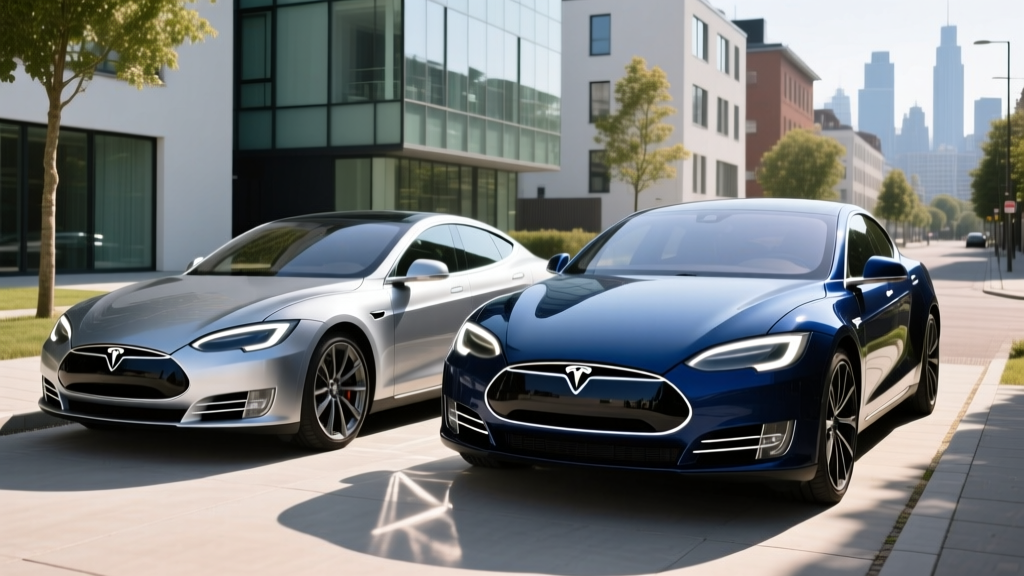
The 2026 Tesla Model S continues with two trims: the dual-motor Long Range and the tri-motor Plaid. Both use a ~100 kWh (usable) battery pack with NMC (nickel manganese cobalt) chemistry — chosen for its higher energy density compared to the LFP (lithium iron phosphate) cells Tesla uses in base Model 3 and Model Y variants.
Model S Long Range: EPA-estimated 402 miles. Expect ~320–350 miles on sustained highway driving at 70+ mph, and as low as ~270–290 miles in freezing temperatures with cabin heating. The heat pump helps, but cold-weather losses of 20–30% are typical for any large NMC pack.
Model S Plaid: EPA-estimated 359 miles (with 19" wheels). Tri-motor powertrain draws more energy under hard acceleration. Real-world highway: ~280–310 miles.
| Spec | Long Range | Plaid |
|---|---|---|
| EPA Range | 402 mi | 359 mi |
| Battery (usable) | ~100 kWh, NMC | ~100 kWh, NMC |
| Efficiency | 124 MPGe / 27 kWh/100mi | 116 MPGe / 29 kWh/100mi |
| Drivetrain | Dual-motor AWD | Tri-motor AWD |
| Horsepower | 670 hp | 1,020 hp |
| 0–60 mph | 3.1 seconds | 1.99 seconds |
| Top Speed | 155 mph | 200 mph |
Efficiency figures, sourced from fueleconomy.gov, place the Model S Long Range among the most efficient large luxury sedans available. The Plaid's additional motor and weight reduce efficiency modestly, but the trade-off is a 0–60 time that remains virtually unmatched in production cars.
2026 Tesla Model X: The Electric Family Hauler
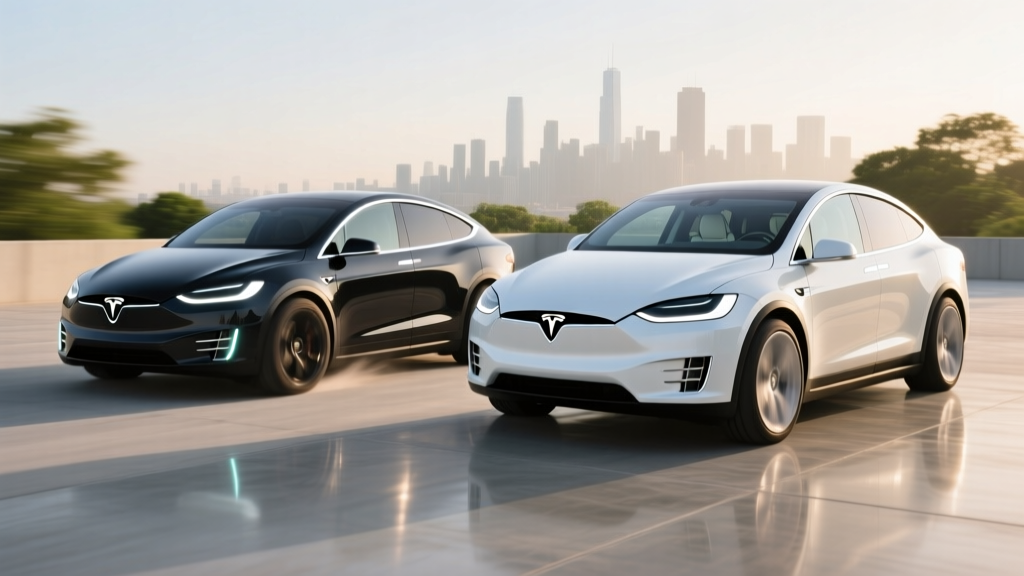
The Model X shares its platform and powertrain architecture with the Model S but trades the sedan's sleek profile for a midsize SUV body with distinctive falcon-wing rear doors. It's available in Long Range (dual-motor) and Plaid (tri-motor) trims.
| Spec | Long Range | Plaid |
|---|---|---|
| EPA Range | 335 mi | 311 mi |
| Battery (usable) | ~100 kWh, NMC | ~100 kWh, NMC |
| Efficiency | 109 MPGe / 31 kWh/100mi | 103 MPGe / 33 kWh/100mi |
| Drivetrain | Dual-motor AWD | Tri-motor AWD |
| Horsepower | 670 hp | 1,020 hp |
| 0–60 mph | 3.8 seconds | 2.5 seconds |
| Seating | 5, 6, or 7 passengers | 5 or 6 passengers |
| Cargo (behind 2nd row) | ~37 cu ft (5-seat) | ~37 cu ft (5-seat) |
| Cargo (max, folded) | ~72 cu ft | ~72 cu ft |
| Towing Capacity | 5,000 lbs | 5,000 lbs |
Long Range: EPA 335 miles; expect ~260–290 miles highway, ~220–250 miles in cold weather. The larger frontal area and heavier curb weight (~5,100 lbs) take a toll on efficiency compared to the sedan.
Plaid: EPA 311 miles; real-world highway drops to ~240–270 miles. Towing at or near the 5,000-lb limit will cut range roughly in half.
The Model X's falcon-wing doors remain a polarizing feature. They offer excellent access to the second and third rows in tight parking spaces, but the complex hinge mechanism has historically been a maintenance concern. Tesla has revised the seals and actuators multiple times since 2016, and recent model-year reliability has improved, though long-term ownership costs remain higher than a conventional SUV door.
Charging Speed: DC Fast Charge and Home Level 2
Both the Model S and Model X support Tesla's V3 and V4 Supercharger network natively via the NACS connector. Here's what charging looks like across levels:
| Level | Power / Rate | Speed | Notes |
|---|---|---|---|
| Level 1 (120V) | ~1.4 kW | ~3–4 mi/hr | Emergency/trickle only |
| Level 2 (240V, 48A) | 11.5 kW | ~30–34 mi/hr | Home Wall Connector; full charge in ~9–10 hrs |
| DC Fast (V3 Supercharger) | Peak 250 kW | 10–80% in ~27 min | Curve tapers significantly above 60% SoC |
| DC Fast (V4 Supercharger) | Peak 250 kW* | 10–80% in ~27 min | *Current Model S/X limited to ~250 kW; newer architectures support more |
The Model S and X charge architecture tops out at approximately 250 kW on DC fast chargers. While that's competitive, it's worth noting that newer rivals like the Hyundai Ioniq 5 (peak ~240 kW with a faster sustained curve thanks to its 800V architecture) and the Lucid Air (peak ~300+ kW) can match or exceed these speeds. The Model S/X charge curve is strong from 10–50% SoC but tapers noticeably above 60%, meaning the last 20% to 80% takes disproportionately longer.
For home charging, Tesla's Wall Connector at 48 amps (11.5 kW) is the practical standard. A full overnight charge from 20% to 100% takes roughly 8–10 hours. If your home electrical panel supports a 60A circuit (required for 48A continuous draw), installation typically runs $500–$1,500 depending on conduit length and panel proximity — though a panel upgrade to 200A service can add $1,500–$3,500 if needed.
Pricing, Trims, and Federal Tax Credit Eligibility
The Model S and X carry premium price tags that place them well above the federal EV tax credit's MSRP caps — a critical factor many buyers overlook.
| Model / Trim | Base MSRP | As-Tested (typical) | §30D Credit Eligible? |
|---|---|---|---|
| Model S Long Range | $79,990 | $84,000–$90,000 | No — exceeds $55,000 sedan cap |
| Model S Plaid | $94,990 | $99,000–$108,000 | No — exceeds $55,000 sedan cap |
| Model X Long Range | $84,990 | $89,000–$96,000 | No — exceeds $80,000 SUV cap |
| Model X Plaid | $99,990 | $104,000–$115,000 | No — exceeds $80,000 SUV cap |
Under IRS §30D rules, new clean vehicle credits are capped at $55,000 MSRP for sedans and $80,000 MSRP for SUVs, vans, and trucks. Both the Model S (classified as a sedan) and Model X (classified as an SUV) exceed their respective thresholds in every trim. Additionally, buyer income caps apply ($150,000 single / $300,000 joint AGI), and battery-critical-mineral and component-sourcing requirements must be met. None of this matters here — the MSRP alone disqualifies both models from the new-vehicle credit.
However, if you're considering a used Model S or X (model year 2022 or newer, purchased from a dealer for $25,000 or more), the used clean vehicle credit (up to $4,000 or 30% of sale price, whichever is less) may apply, subject to income caps ($75,000 single / $150,000 joint) and dealer reporting requirements.
Tech, Driver Assistance, and Interior
Both models feature Tesla's 17-inch center touchscreen with a yoke-style steering wheel (conventional round wheel available at no cost). The infotainment system remains one of the most responsive in the industry, with native navigation, streaming, gaming, and over-the-air updates. However, the absence of Apple CarPlay and Android Auto continues to frustrate buyers accustomed to phone-mirroring integration.
Tesla's Autopilot (standard) and Full Self-Driving (Supervised) are SAE Level 2 driver-assistance systems. They provide adaptive cruise control, lane centering, and automated lane changes — but the driver must remain fully engaged, hands on the wheel (or torque-monitored), and eyes on the road at all times. This is not autonomous driving. Level 4 driverless operation (no human needed) is currently only available through commercial robotaxi services like Waymo in limited geofenced areas.
The Model S and X interior has been refreshed with a rear-seat entertainment screen, ventilated front seats, and a minimalist dashboard. Build quality has improved significantly over earlier model years, though panel gaps and trim alignment still lag behind German competitors like the Porsche Taycan and BMW iX. Cargo space is generous: the Model S offers ~28 cu ft of combined trunk and frunk space, while the Model X provides up to ~72 cu ft with seats folded.
Notable drawbacks include the yoke steering wheel's learning curve at low speeds and full-lock maneuvers (though the round wheel option mitigates this), the lack of a traditional instrument cluster (all info is on the center screen), and the firm ride quality on the Plaid's adaptive dampers in Sport mode.
Warranty and Long-Term Ownership
| Coverage | Terms |
|---|---|
| Basic Vehicle | 4 years / 50,000 miles |
| Battery & Drive Unit (Long Range) | 8 years / 150,000 miles (≥70% retention) |
| Battery & Drive Unit (Plaid) | 8 years / 150,000 miles (≥70% retention) |
Tesla's battery warranty guarantees that the pack will retain at least 70% of its original capacity over the warranty period. In practice, Tesla's NMC packs in the Model S/X have shown moderate degradation of approximately 8–12% over the first 100,000 miles based on fleet data, meaning most owners will remain well within warranty thresholds. However, out-of-warranty battery replacement costs remain steep — estimated at $13,000–$20,000 depending on the pack and service center.
Insurance costs for the Model S and X are notably high. Average annual premiums range from $2,800–$4,200 depending on state, driver profile, and trim (Plaid models cost significantly more to insure due to repair costs and performance risk). Always obtain quotes before purchasing.
Competitor Comparison: Is the Model S/X Still Worth It?
| Attribute | Tesla Model S LR | Lucid Air Pure | Porsche Taycan 4S | BMW iX xDrive50 |
|---|---|---|---|---|
| EPA Range | 402 mi | 419 mi | 246 mi | 324 mi |
| Peak DC Charge | 250 kW | 220 kW | 270 kW | 200 kW |
| 0–60 mph | 3.1s | 5.2s | 3.8s | 4.4s |
| Base MSRP | $79,990 | $69,900 | $93,900 | $87,250 |
| §30D Eligible | No | No (sedan cap) | No (sedan cap) | No (SUV cap) |
| Supercharger Access | Native | Adapter | Adapter | Adapter |
- Choose the Model S if: You want the longest-range luxury sedan with native Supercharger access, value Tesla's software ecosystem, and prioritize straight-line performance without paying Lucid or Porsche premiums.
- Choose the Model X if: You need three-row electric SUV seating, want falcon-wing door novelty, and plan to tow (5,000-lb capacity). The Rivian R1S and Kia EV9 are strong alternatives at lower prices.
- Look elsewhere if: Tax-credit eligibility matters to your budget, you prefer CarPlay/Android Auto, or you want the latest-generation platform (the S/X architecture dates to 2012, refreshed in 2021).
Pros and Cons
- Class-leading EPA range (402 mi, Model S LR)
- Native Tesla Supercharger network access (20,000+ stalls)
- Exceptional performance (Plaid: sub-2-second 0–60)
- Spacious Model X with 5/6/7 seating and 5,000-lb tow rating
- Over-the-air updates and strong software ecosystem
- Generous 8-yr/150,000-mi battery warranty
- No federal new-vehicle tax credit (MSRP exceeds caps)
- Aging platform (2012 architecture, 2021 refresh)
- No Apple CarPlay or Android Auto
- DC fast charging capped at 250 kW (slower than some rivals)
- High insurance premiums ($2,800–$4,200/yr average)
- European discontinuation raises long-term parts/support questions
Frequently Asked Questions
What is the real-world range of the Tesla Model S?
The Model S Long Range carries an EPA estimate of 402 miles. In real-world highway driving at 70–80 mph, expect approximately 320–350 miles. In cold weather (below 32°F), range can drop to 270–290 miles due to battery resistance and cabin heating demands. The Plaid trim's EPA rating is 359 miles, with real-world highway figures closer to 280–310 miles.
How fast does the Model S and X charge?
On a Tesla V3 or V4 Supercharger, both models peak at approximately 250 kW, achieving a 10–80% charge in roughly 27 minutes. The charge curve is strong to about 50–60% SoC, then tapers significantly. At home on a Level 2 Wall Connector (11.5 kW / 48A), a full charge takes approximately 9–10 hours, adding about 30–34 miles of range per hour.
Does the Tesla Model S or X qualify for the federal EV tax credit?
No. Under IRS §30D rules, new sedans must have an MSRP at or below $55,000, and SUVs at or below $80,000 to qualify for the up-to-$7,500 credit. The Model S starts at $79,990 (sedan cap applies) and the Model X starts at $84,990 (SUV cap applies), making neither eligible. A used Model S or X (2022 or newer, ≤$25,000 purchase price from a dealer) may qualify for the up-to-$4,000 used clean vehicle credit, subject to income limits.
Is the Tesla Model S or X worth buying versus competitors?
It depends on your priorities. The Model S Long Range offers the best combination of range (402 mi EPA), performance (670 hp, 3.1s 0–60), and Supercharger network access in the luxury EV sedan segment. However, the Lucid Air Pure offers more range (419 mi) at a lower price ($69,900), while the Porsche Taycan delivers superior driving dynamics and build quality at a higher cost. For SUVs, the Model X's three-row seating and 5,000-lb tow capacity are unique, but the Rivian R1S and BMW iX offer compelling alternatives.
Will Tesla continue selling the Model S and X in the US?
As of early 2026, Tesla continues to list and sell both models in the United States. However, the European discontinuation and the aging platform suggest these models are in their final product cycle. Tesla has not announced a successor, and production volume has steadily declined. Buyers should consider the long-term implications of owning a potentially discontinued model, including parts availability and resale value.
What are the biggest pros and cons?
The biggest advantages are class-leading range, native Supercharger access, exceptional performance, and strong software. The biggest drawbacks are ineligibility for the federal tax credit, an aging platform, lack of phone-mirroring integration, high insurance costs, and the uncertainty surrounding the models' long-term future following the European withdrawal.