If you've been following EV news, you've likely seen the speculation: model s and x discontinued headlines have circulated repeatedly since late 2024, fueled by Tesla's shifting production priorities and the industry's pivot toward more affordable, high-volume electric vehicles. As of early 2026, both the Model S sedan and Model X SUV remain on sale in the United States, but their futures are far from certain. Tesla has not announced a formal discontinuation date, yet production volumes have dropped significantly, and the vehicles are no longer the company's strategic priority.
This guide cuts through the noise. We'll examine exactly what you get if you buy a 2026 Model S or Model X today — real-world range, charging performance, pricing after incentives, and whether these legacy Tesla flagships still make sense against newer competitors like the Lucid Air, BMW i7, and Rivian R1S.
Current Status: Are the Model S and X Actually Being Discontinued?
As of Q1 2026, Tesla continues to accept orders for both the Model S and Model X in the U.S. market. However, several signals suggest these models are in a wind-down phase rather than a growth phase:
- Production consolidation: Tesla has increasingly focused Fremont factory capacity on the higher-volume Model 3 and Model Y, while shifting newer products (Cybertruck, next-gen platforms) to Gigafactories in Texas and beyond.
- Reduced marketing: Tesla rarely features the Model S or X in promotional materials, prioritizing the Cybertruck and refreshed Model 3/Y.
- Infrequent updates: The last significant refresh for both vehicles was the 2021 "Palladium" update (new interior, yoke steering, rear-screen entertainment). Since then, changes have been minor — software tweaks and color/trim adjustments.
- Global pullback: Tesla has already withdrawn the Model S and X from several international markets, including parts of Europe and Asia, where large, expensive EVs face stiffer competition and regulatory headwinds.
The bottom line: You can still order and take delivery of a new Model S or Model X in 2026. But buyers should be aware that long-term parts support, resale value trajectory, and software-update priority may diminish if Tesla formally ends production — something that could happen as early as late 2026 or 2027 based on industry analysis.
2026 Tesla Model S: Range, Battery & Real-World Efficiency
The 2026 Tesla Model S is offered in two trims: the dual-motor all-wheel-drive Long Range and the tri-motor Plaid. Both use a ~100 kWh (usable) lithium-ion battery pack with NMC (nickel manganese cobalt) chemistry — Tesla has not migrated these vehicles to LFP (lithium iron phosphate), which is reserved for the lower-cost Model 3 RWD.
| Spec | Long Range AWD | Plaid (Tri-Motor) |
|---|---|---|
| EPA Range | 402 miles | 359 miles |
| Battery (usable) | ~100 kWh, NMC | ~100 kWh, NMC |
| Drivetrain | Dual-motor AWD | Tri-motor AWD |
| Horsepower | 670 hp | 1,020 hp |
| 0–60 mph | 3.1 seconds | 1.99 seconds |
| Top Speed | 155 mph | 200 mph |
| EPA Efficiency | 124 MPGe (28 kWh/100mi) | 116 MPGe (30 kWh/100mi) |
| Cargo Volume | 28 cu ft (rear seats up), 79 cu ft (folded) + frunk | Same |
| Base MSRP | $79,990 | $94,990 |
The Model S Long Range's EPA rating of 402 miles is among the highest of any EV sold in the U.S. In mixed driving (city + suburban), expect 350–380 miles on a full charge. Sustained highway driving at 75+ mph drops this to roughly 300–330 miles. In cold weather (below 32°F), anticipate a 20–30% reduction — putting real winter range around 280–320 miles. The Plaid's lower EPA figure (359 mi) reflects its higher energy draw; real-world highway range sits around 270–300 miles in temperate conditions.
According to fueleconomy.gov, the Model S Long Range achieves 124 MPGe combined — exceptional for a full-size luxury sedan producing 670 hp. The tri-motor Plaid sacrifices some efficiency for its staggering acceleration, landing at 116 MPGe combined.
2026 Tesla Model X: Range, Battery & Real-World Efficiency
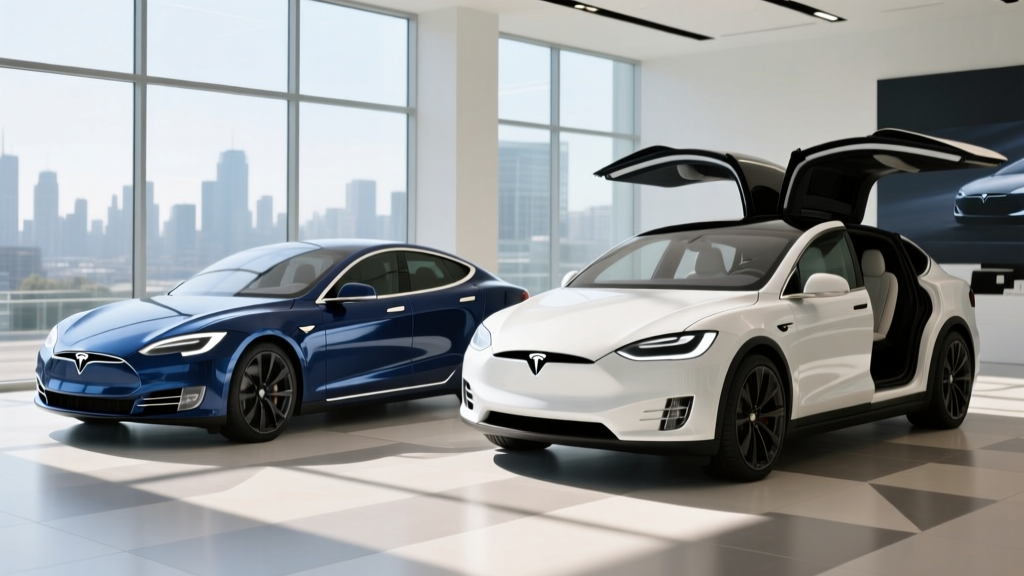
The Model X mirrors the Model S in powertrain options but trades some range for its larger, heavier SUV body, falcon-wing rear doors, and available third-row seating.
| Spec | Long Range AWD | Plaid (Tri-Motor) |
|---|---|---|
| EPA Range | 335 miles | 311 miles |
| Battery (usable) | ~100 kWh, NMC | ~100 kWh, NMC |
| Drivetrain | Dual-motor AWD | Tri-motor AWD |
| Horsepower | 670 hp | 1,020 hp |
| 0–60 mph | 3.8 seconds | 2.5 seconds |
| EPA Efficiency | 109 MPGe (31 kWh/100mi) | 101 MPGe (33 kWh/100mi) |
| Cargo Volume | 88 cu ft (behind 2nd row), up to 92 cu ft w/ seats folded + frunk | Same |
| Seating | 5, 6, or 7 passengers | 5 or 6 passengers |
| Towing Capacity | 5,000 lbs | 5,000 lbs |
| Base MSRP | $84,990 | $99,990 |
The Model X Long Range's 335-mile EPA rating translates to roughly 290–310 miles in real-world mixed driving. Highway-only trips at 70–80 mph yield approximately 260–285 miles. Cold weather hits the Model X harder than the sedan due to its larger frontal area and weight — expect 220–260 miles in sub-freezing conditions. The Plaid version drops to around 240–270 miles in mixed driving.
The Model X's EPA efficiency figures reflect the physics of moving a 5,100+ lb SUV. At 31 kWh/100 miles (Long Range), it's competitive with the BMW iX and Audi e-tron but trails the more aerodynamic Model S sedan significantly.
Charging Speed: DC Fast Charging & Home Level 2
Both the Model S and Model X support Tesla's V3/V4 Supercharger network natively (NACS connector) and can access CCS-equipped public chargers via an adapter (included with newer deliveries).
| Charging Level | Max Power | Speed / Time | Notes |
|---|---|---|---|
| Level 1 (120V household) | ~1.4 kW | ~3–4 miles/hr | Emergency/trickle only |
| Level 2 (240V home, 48A) | 11.5 kW | ~34–40 miles/hr (full charge ~9–10 hrs) | Recommended home setup; Tesla Wall Connector or equivalent |
| DC Fast Charge (Supercharger V3) | Peak 250 kW | 10–80% in ~27 minutes | Sustained rate drops above 50% SoC; precondition battery via nav |
| DC Fast Charge (CCS adapter) | Up to 250 kW (charger dependent) | 10–80% in ~27–35 minutes | Varies by Electrify America / EVgo station output |
Charging curve reality: The Model S and X peak at 250 kW on a V3 Supercharger, but this peak is sustained only between roughly 10–35% state of charge. From 35–60%, expect ~175–200 kW; from 60–80%, the rate tapers to ~100–120 kW. Total 10–80% time is approximately 27 minutes under ideal conditions (warm battery, preconditioned). On a cold battery without preconditioning, add 10–15 minutes.
For home charging, a Tesla Wall Connector on a 60A circuit delivers 48A / 11.5 kW — enough to fully replenish either vehicle overnight. Installation typically costs $500–$1,500 depending on panel proximity and whether a 200A service upgrade is needed.
Pricing, Trims & Federal Tax Credit Eligibility
Both vehicles sit well above the IRS §30D MSRP cap for new clean vehicles, which is a critical factor for buyers expecting the federal tax credit.
| Model / Trim | Base MSRP | As-Tested (typical) | §30D Federal Credit | Effective Price |
|---|---|---|---|---|
| Model S Long Range | $79,990 | $82,000–$86,000 | Not eligible (exceeds $55,000 sedan cap) | $79,990+ |
| Model S Plaid | $94,990 | $97,000–$102,000 | Not eligible | $94,990+ |
| Model X Long Range | $84,990 | $88,000–$95,000 | Not eligible (exceeds $80,000 SUV cap) | $84,990+ |
| Model X Plaid | $99,990 | $103,000–$110,000 | Not eligible | $99,990+ |
Why neither qualifies: Under current IRS §30D rules, new EVs must meet MSRP caps — $55,000 for sedans, $80,000 for SUVs/pickups/vans — along with buyer income limits ($300K joint / $150K single), critical-mineral sourcing requirements, and North American final assembly. While the Model S and X are assembled in Fremont, California (meeting the assembly requirement), both exceed their respective MSRP caps in every trim. The buyer income and battery-sourcing requirements become moot once the price cap is breached.
Used-vehicle credit alternative: If you purchase a qualifying pre-owned Model S or X (model year 2022 or older, priced under $25,000), you may be eligible for the up-to-$4,000 used clean vehicle credit under IRC §25E, subject to income caps ($150K joint / $75K single) and dealer-sale requirements. This makes a 3–4-year-old Model S an interesting value proposition.
Technology, Driver Assistance & Interior
The Model S and X share Tesla's current-generation interior architecture, which was significantly updated in 2021 but has seen minimal hardware changes since.
Infotainment: A 17-inch landscape-oriented touchscreen dominates the dash, running Tesla's proprietary OS. The system supports Netflix, YouTube, and gaming (including Cyberpunk 2077-level titles via the built-in AMD Ryzen processor). An 8-inch rear touchscreen provides climate and entertainment controls for back-seat passengers. Wireless phone charging, Bluetooth 5.0, and a 22-speaker premium audio system are standard.
Driver Assistance:
Tesla's Autopilot (standard) and Full Self-Driving Supervised (optional, ~$8,000 or $99/month subscription) are SAE Level 2 driver-assistance systems. The driver must remain fully engaged, hands on or near the wheel, and eyes on the road at all times. These systems do not make the vehicle self-driving. Only Level 4 services like Waymo operate without a human driver in defined areas.
Standard Autopilot includes Traffic-Aware Cruise Control and Autosteer (lane-centering). FSD Supervised adds automatic lane changes, Navigate on Autopilot (highway on/off-ramp handling), Autopark, Summon, and traffic light/stop sign recognition. In our experience, FSD performs well on divided highways but requires frequent intervention in construction zones, complex urban intersections, and inclement weather.
Unique features: The Model X's falcon-wing rear doors remain a conversation-starter and genuinely aid child-seat installation and rear-row access in tight parking spots. However, they add mechanical complexity and have been a historical reliability concern. The Model S's "yoke" steering wheel (rectangular, no top arc) is now standard — some drivers adapt quickly; others find it impractical for low-speed maneuvering and three-point turns. A conventional round wheel is available upon request at no extra charge.
- No Apple CarPlay or Android Auto — Tesla's walled-garden infotainment means no smartphone mirroring, which remains a dealbreaker for some luxury buyers.
- Build quality inconsistency — While improved since 2021, panel gaps, interior trim alignment, and occasional rattles still surface in delivery inspections. Always inspect thoroughly before accepting delivery.
- Yoke steering learning curve — Not ideal for all drivers; test-drive before committing.
- Aging platform — The underlying architecture dates to 2012 (Model S) and 2015 (Model X). While the powertrain and software have been updated, the chassis and body structure are fundamentally older than competitors like the Lucid Air (2022) and BMW i7 (2023).
- Insurance costs — Tesla vehicles carry higher-than-average insurance premiums due to repair costs and claims data. Expect 15–30% higher premiums vs. comparable non-Tesla luxury EVs.
Pros & Cons at a Glance
Pros
- Class-leading EPA range (402 mi, Model S LR) among luxury EVs
- Access to the Tesla Supercharger network — the most reliable and extensive DC fast-charging network in the U.S.
- Staggering Plaid performance (1.99s 0–60, Model S)
- Over-the-air software updates keep the vehicle current
- Strong cargo capacity, especially Model X (up to 92 cu ft)
- Model X offers 7-seat configuration — rare among electric SUVs
- Excellent real-time navigation with Supercharger route planning and battery preconditioning
Cons
- No federal tax credit eligibility (MSRP exceeds §30D caps)
- Discontinuation risk creates resale-value and long-term-support uncertainty
- No Apple CarPlay / Android Auto
- Yoke steering is polarizing and impractical for some drivers
- Charging speed (250 kW peak) trails newer 800V architectures (Hyundai Ioniq 5 at 350 kW, Lucid Air at 300+ kW)
- Falcon-wing doors add complexity and potential maintenance cost (Model X)
- Interior materials and fit/finish lag behind BMW, Mercedes, and Lucid at this price point
How Do They Compare to Key Competitors?
If discontinuation risk gives you pause, here's how the Model S and X stack up against current alternatives:
| Vehicle | EPA Range | 0–60 | Base MSRP | §30D Credit |
|---|---|---|---|---|
| Tesla Model S LR | 402 mi | 3.1s | $79,990 | No |
| Lucid Air Pure | 419 mi | 3.8s | $69,900 | No (sedan cap $55K) |
| BMW i7 eDrive50 | 318 mi | 5.5s | $105,700 | No |
| Mercedes EQS 450+ | 390 mi | 5.3s | $104,400 | No |
| Tesla Model X LR | 335 mi | 3.8s | $84,990 | No |
| BMW iX xDrive50 | 324 mi | 4.4s | $87,250 | No (SUV cap $80K) |
| Rivian R1S (Dual) | 352 mi | 4.5s | $79,900 | Possible (under $80K cap) |
Key takeaways: The Lucid Air Pure offers more range at a lower price, though its service-center network is far smaller than Tesla's. The Rivian R1S is the only competitor here that may qualify for the federal tax credit (depending on trim and battery sourcing), making its effective price significantly lower. For SUV buyers, the R1S also offers superior off-road capability and a more modern platform, though it lacks the Model X's falcon-wing doors and 7-seat option.
Who Should Buy a Model S or X in 2026 — and Who Shouldn't?
Choose the Model S if:
- You want the longest-range luxury EV sedan available and value Supercharger access for frequent road trips
- Plaid-level performance (sub-2-second 0–60) matters to you
- You're comfortable with the discontinuation risk and potential resale-value implications
- You prefer Tesla's software ecosystem and OTA update model
Choose the Model X if:
- You need a 3-row electric SUV with genuine 7-passenger seating
- Falcon-wing doors provide real utility for your family (child seats, tight garages)
- You need 5,000-lb towing capacity in an EV SUV
Look elsewhere if:
- Federal tax credit eligibility is a priority (consider Rivian R1S or wait for next-gen platforms)
- You want CarPlay/Android Auto or a more traditional luxury interior (BMW i7, Mercedes EQS)
- You're concerned about long-term parts and service support for a potentially discontinued model
- You want the latest 800V charging architecture for faster DC charging (Hyundai/Kia/Genesis, Lucid)
Warranty & Long-Term Ownership
Tesla's warranty coverage for both vehicles:
- Basic Vehicle: 4 years / 50,000 miles (whichever comes first)
- Battery & Drive Unit: 8 years / 150,000 miles (whichever comes first), with a minimum 70% capacity retention threshold over the warranty period
- Restraint System: 5 years / 60,000 miles
The 8-year/150,000-mile battery warranty is competitive and provides meaningful protection against premature degradation. NMC chemistry in the Model S/X typically degrades 8–12% over the first 100,000 miles based on fleet data, after which the degradation curve flattens. If Tesla discontinues these models, the battery warranty remains legally binding — but replacement-pack availability could become a concern 10+ years out if production tooling is retired.
For comparison, Hyundai offers 10 years/100,000 miles on its EV batteries, and Rivian offers 8 years/175,000 miles on the R1S. Tesla's warranty is middle-of-the-pack in duration but covers a generous mileage threshold.
Frequently Asked Questions
What is the real-world range of the 2026 Tesla Model S?
The Model S Long Range carries an EPA rating of 402 miles. In real-world mixed driving, expect 350–380 miles. Highway-only driving at 75+ mph yields approximately 300–330 miles. In cold weather (below 32°F), range drops to roughly 280–320 miles. The Plaid trim's real-world range is approximately 270–300 miles in mixed driving.
How fast does the Model S/X charge at home and on the road?
On a Tesla V3 Supercharger, both vehicles peak at 250 kW and charge from 10–80% in approximately 27 minutes (with a preconditioned battery). At home on a 240V / 48A Level 2 charger (11.5 kW), expect roughly 34–40 miles of range added per hour, or a full charge in 9–10 hours. Level 1 (120V) adds only 3–4 miles per hour and is suitable only for emergency or overnight trickle charging.
Does the 2026 Tesla Model S or X qualify for the federal EV tax credit?
No. Under current IRS §30D rules, the Model S exceeds the $55,000 sedan MSRP cap and the Model X exceeds the $80,000 SUV cap. Neither qualifies for the up-to-$7,500 new clean vehicle credit regardless of buyer income or battery sourcing. A used Model S/X (priced under $25,000) may qualify for the up-to-$4,000 used-vehicle credit under §25E.
Is it worth buying a Model S or X given discontinuation rumors?
It depends on your risk tolerance. Both vehicles offer compelling range, performance, and Supercharger access today. However, discontinuation could affect long-term resale value, parts availability (especially body panels and falcon-wing components for the Model X), and software-update priority. If you plan to keep the vehicle 5+ years, weigh this risk against alternatives like the Lucid Air, BMW iX, or Rivian R1S, which are on newer platforms with longer expected production runs.
What are the biggest pros and cons of the Model S/X in 2026?
Top pros: class-leading range (Model S), Supercharger network access, outstanding Plaid performance, strong OTA software support, spacious interiors. Top cons: no federal tax credit, aging platform, discontinuation uncertainty, no CarPlay/Android Auto, yoke steering learning curve, higher insurance costs, and charging speeds that lag 800V competitors.
How does the Model X compare to the Rivian R1S?
The Model X offers more interior volume, available 7-seat seating, falcon-wing doors, and slightly more range (335 vs. 352 mi EPA for the R1S Dual Motor). The R1S offers a more modern platform, genuine off-road capability, better build quality consistency, potential federal tax credit eligibility, and a more traditional SUV design. For family hauling on pavement, the Model X wins on space. For adventure capability and value after incentives, the R1S has the edge.