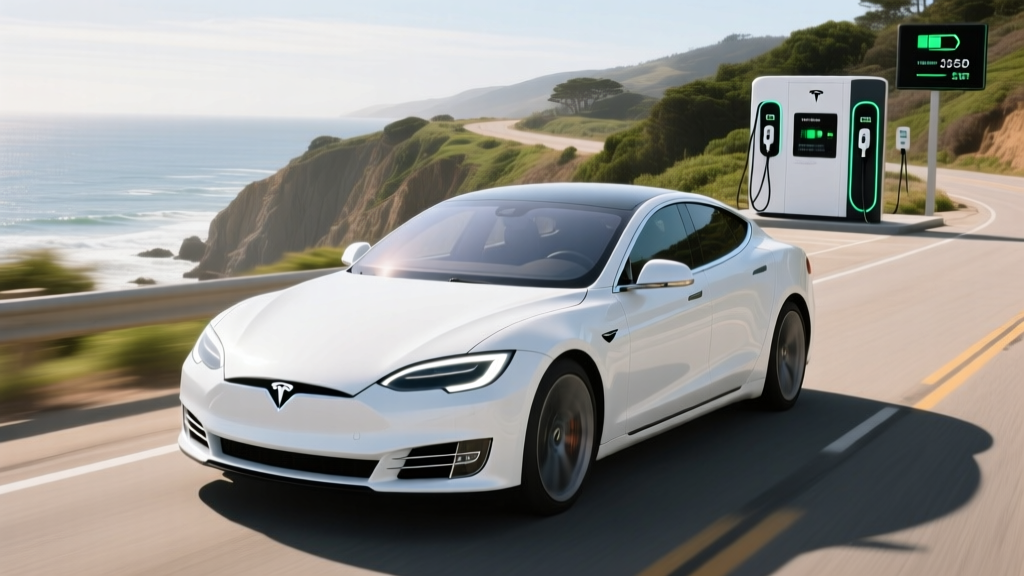
The Tesla Model S remains one of the longest-range, quickest-accelerating sedans on the market more than a decade after its debut. For 2026, Tesla continues to offer the Model S in two trims — Long Range and Plaid — with incremental updates to the interior, thermal management, and Supercharger compatibility. In this review, we focus on the ever-popular Tesla Model S white exterior (officially Pearl White Multi-Coat) and break down everything a prospective buyer needs: real-world range, DC fast-charging curves, Level 2 home charging costs, tax-credit eligibility, and how it stacks up against the Lucid Air and Mercedes-Benz EQS.
If you're cross-shopping luxury electric sedans, the Model S's combination of over 400 miles of EPA range, access to Tesla's Supercharger network, and over-the-air updates keeps it competitive. But it's not without compromises — specifically its aging exterior design, panel-gap inconsistencies, and a price tag that pushes well past $80,000 before options. Let's get into the numbers.
2026 Tesla Model S Specs at a Glance
| Spec | Long Range (Dual Motor AWD) | Plaid (Tri-Motor AWD) |
|---|---|---|
| EPA Range | 402 miles | 396 miles |
| Battery (usable) | ~95 kWh (NMC) | ~95 kWh (NMC) |
| 0-60 mph | 3.1 seconds | 1.99 seconds |
| Horsepower | 670 hp | 1,020 hp |
| Top Speed | 155 mph | 200 mph |
| Drivetrain | Dual Motor AWD | Tri-Motor AWD |
| Peak DC Fast Charge | 250 kW | 250 kW |
| 10-80% DC Charge Time | ~30 minutes | ~30 minutes |
| Level 2 Charge Rate | 11.5 kW (~34 mi/hr) | 11.5 kW (~34 mi/hr) |
| MPGe (combined) | 120 MPGe | 116 MPGe |
| Efficiency | 28 kWh/100 mi | 29 kWh/100 mi |
| Base MSRP | $79,990 | $94,990 |
| Battery Warranty | 8 yr / 150,000 mi | 8 yr / 150,000 mi |
Source: Tesla Model S Design Studio and fueleconomy.gov. Specs reflect 2026 model year as listed at time of publication.
Real-World Range: Beyond the 402-Mile EPA Sticker
EPA sticker: 402 miles (Long Range), 396 miles (Plaid)
Real-world highway (70-80 mph): ~320-350 miles
Real-world cold weather (below 32°F): ~260-300 miles
Mixed city/highway (moderate temps): ~360-390 miles
The Model S Long Range's 402-mile EPA rating is among the highest of any production EV sold in the U.S. However, as with every electric vehicle, your actual range depends heavily on speed, temperature, and terrain. In sustained highway driving at 75-80 mph, expect to use roughly 30-32 kWh/100 miles, which translates to around 320-350 miles before you'll want to stop. The Model S's heat pump — standard on current production — helps mitigate cold-weather losses compared to older resistance-heated EVs, but lithium-ion chemistry still suffers in sub-freezing temperatures. Plan for a 20-30% range reduction in winter conditions.
Efficiency-minded drivers who stick to 65 mph on flat terrain in mild weather can approach or even match the EPA figure. The Model S's excellent aerodynamic drag coefficient (~0.208 Cd) is a major reason its highway efficiency outperforms boxier EVs like the BMW iX or Rivian R1S.
Charging Speed: 250 kW Peak, but Watch the Curve
| Charging Level | Power / Rate | Miles Added per Hour | Notes |
|---|---|---|---|
| Level 1 (120V outlet) | ~1.4 kW | ~3-4 mi/hr | Emergency/trickle only |
| Level 2 (240V, 48A) | 11.5 kW | ~34 mi/hr | Full charge in ~9-10 hours |
| DC Fast Charge (Supercharger V3) | Peak 250 kW | ~200 mi in 15 min | 10-80% in ~30 min |
| DC Fast Charge (CCS adapter) | Up to ~175-200 kW | Varies by station | Requires Tesla CCS adapter ($175) |
The Model S peaks at 250 kW on Tesla V3 Superchargers, but — and this is critical for road-trip planning — it does not sustain that peak for long. The charge curve tapers noticeably after approximately 40-45% state of charge. In practice, you'll see 250 kW only in the 10-30% SoC window, dropping to roughly 150 kW by 50% and further declining to under 50 kW above 80%. This is why Tesla and most EV analysts quote 10-80% times rather than 0-100%.
For home charging, a properly installed 60-amp circuit feeding the Tesla Wall Connector at 48 amps delivers 11.5 kW — enough to replenish a full day's driving (30-40 miles) in about an hour. Most Model S owners who charge at home overnight never visit a public charger except on road trips. Budget $500-$1,500 for a licensed electrician to install a 240V/60A circuit, depending on panel proximity and local permit costs.
One notable advantage: Tesla's NACS connector is now the industry standard, with Ford, GM, Rivian, and others adopting it. The Model S has always used this connector natively, so you'll have seamless access to over 20,000 Supercharger stalls in North America without an adapter.
Performance: 670 hp Standard, 1,020 hp in the Plaid
The Model S Long Range's dual-motor all-wheel-drive powertrain produces 670 horsepower and rockets to 60 mph in 3.1 seconds — quicker than most sports cars and virtually every other luxury sedan at any price. The Plaid's tri-motor setup (one front, two rear) generates 1,020 hp and a claimed 1.99-second 0-60 time, making it one of the fastest production cars ever built.
But straight-line speed is only part of the story. The Model S features adaptive air suspension that adjusts ride height based on speed and GPS-remembered locations (it'll automatically raise for your driveway). Steering is precise if somewhat numb — a common Tesla characteristic — and the low center of gravity from the floor-mounted battery pack gives it composed cornering for a 4,800-pound sedan.
The Plaid's carbon-ceramic brake package (optional, bundled with the track package) is necessary to manage repeated high-speed stops. Without it, the standard brakes can fade during aggressive canyon or track use — something to consider if you plan to exploit that 1,020 hp regularly.
Pricing, Trims, and Federal Tax Credit Eligibility
| Trim | Base MSRP | Destination | Federal §30D Credit | Effective Price |
|---|---|---|---|---|
| Long Range AWD | $79,990 | $1,390 | Not eligible (MSRP cap) | $81,380 |
| Plaid AWD | $94,990 | $1,390 | Not eligible (MSRP cap) | $96,380 |
Here's the hard truth for budget-conscious buyers: the 2026 Tesla Model S does not qualify for the $7,500 federal EV tax credit under IRS §30D. The reason is the MSRP cap — the Inflation Reduction Act limits the new-vehicle clean energy credit to sedars priced at $55,000 or less (and SUVs/trucks at $80,000 or less). Since the Model S is classified as a sedan and starts at $79,990, it far exceeds the threshold.
Additionally, buyer income caps apply to §30D ($150,000 single / $300,000 joint filers), and battery critical-mineral and component sourcing requirements must be met. Even if the Model S were under the MSRP cap, its battery sourcing may not satisfy current-year requirements. Always verify eligibility through the IRS Clean Vehicle Credits page or consult a tax professional before relying on any credit.
State-level incentives may still apply — California's CVRP previously offered rebates for higher-income buyers, and some states like Colorado and Massachusetts have their own credits with different MSRP thresholds. Check your state energy office for current programs.
Pearl White Multi-Coat is currently a no-cost exterior color on the Model S, making it one of the most popular choices. Previously a $1,500-$2,000 upcharge, Tesla has periodically rotated its complimentary color offerings. Midnight Silver Metallic, Deep Blue, Ultra Red, and Solid Black remain premium options at $1,500-$2,500 depending on the current configurator.
Interior, Tech, and Cargo Space
The Model S interior centers on a 17-inch landscape-oriented touchscreen that controls virtually every vehicle function — climate, media, navigation, vehicle settings, and even the glovebox. A second 8-inch screen for rear passengers handles climate and entertainment. Tesla removed the traditional instrument cluster in favor of a slim driver-facing display embedded in the steering column area, which some drivers find intuitive and others find frustrating.
The yoke-style steering wheel (now standard, with a round wheel available upon request) takes acclimation. Tesla's infotainment system is arguably the fastest and most responsive in the industry, with Netflix, YouTube, and a surprisingly capable gaming library for charging-stop entertainment.
Cargo dimensions:
- Trunk (rear): 26.3 cu ft
- Front trunk (frunk): 3.1 cu ft
- Total cargo: 29.4 cu ft
- Rear legroom: 40.9 inches
- Front headroom: 38.8 inches
- Seating: 5 passengers (optional rear-facing third-row jump seats discontinued)
The Model S hatchback design gives it a practical advantage over traditional trunk sedans like the Lucid Air or Mercedes EQS — the entire rear glass lifts, making it easy to load bulky items. That said, build quality remains a point of owner discussion. Panel gaps, while improved from earlier years, still don't match the consistency of German luxury competitors. Interior materials (synthetic leather, Alcantara, open-pore wood) are pleasant but not quite at the level of a $90,000 Mercedes or BMW.
Autopilot, FSD, and Driver-Assist Technology
Tesla Autopilot and Full Self-Driving (Supervised) are Level 2 driver-assist systems, not autonomous driving. The driver must remain fully engaged, hands on the wheel, and eyes on the road at all times. Tesla's system does not replace an attentive driver. Only Level 4 services like Waymo One (operating in select cities) qualify as driverless.
Every Model S ships with Tesla's Basic Autopilot, which includes Traffic-Aware Cruise Control and Autosteer (lane-centering on divided highways). The $8,000 Full Self-Driving (Supervised) upgrade adds Navigate on Autopilot (automatic highway interchanges), Auto Lane Change, Autopark, Summon, and traffic light/stop sign recognition. FSD continues to improve via over-the-air updates but remains a supervised system — it will make errors, miss construction zones, and occasionally behave unpredictably. Treat it as a sophisticated cruise control, not a chauffeur.
Standard safety features include automatic emergency braking, blind-spot monitoring, lane departure warning, and 360-degree cameras. The Model S earned a 5-star overall safety rating from NHTSA and has historically scored well in IIHS crash tests, though ratings are updated annually and buyers should verify current-year results.
Warranty and Long-Term Battery Outlook
Tesla covers the Model S battery and drive unit for 8 years or 150,000 miles, whichever comes first, with a minimum 70% capacity retention guarantee. The basic vehicle limited warranty is 4 years or 50,000 miles. This battery warranty is competitive with the industry standard (most luxury EVs offer 8 years/100,000 miles), and Tesla's 150,000-mile threshold is among the more generous.
The Model S uses an NMC (nickel-manganese-cobalt) lithium-ion battery pack. Real-world degradation data from Tesla's fleet suggests approximately 10-12% capacity loss over 150,000 miles, with the steepest degradation occurring in the first 20,000-30,000 miles before leveling off. To maximize longevity, Tesla recommends daily charging to 80-90% for NMC packs and reserving 100% charges for road trips. A full battery replacement (out of warranty) currently costs between $15,000-$22,000 depending on the pack configuration — a figure worth factoring into long-term ownership projections.
Pros and Cons
- Class-leading 402-mile EPA range (Long Range)
- Access to 20,000+ Tesla Supercharger stalls
- Best-in-class infotainment and OTA updates
- Hatchback cargo versatility (26.3 cu ft trunk)
- Sub-3.2-second 0-60 (Long Range); sub-2.0 (Plaid)
- Air suspension with GPS memory
- Pearl White Multi-Coat at no extra cost
- No federal tax credit (exceeds $55K sedan MSRP cap)
- Panel gap inconsistency still noted by owners
- Yoke steering takes significant acclimation
- DC charging peaks at 250 kW — rivals hit 350 kW
- Build quality not on par with German luxury at this price
- No Apple CarPlay or Android Auto
- FSD ($8,000) remains Level 2, not autonomous
Model S vs. Key Competitors: Is It Still Worth It?
The luxury EV sedan market has grown considerably since the Model S launched. Here's how it compares to its closest rivals:
- Lucid Air Grand Touring ($110,900): 516-mile EPA range, 350 kW peak charging, more luxurious interior. Significantly more expensive, but the range and charging speed advantage is real.
- Mercedes-Benz EQS 450+ (~$104,400): 390-mile range, 200 kW charging, superior ride comfort and build quality. Slower charging and shorter range than the Model S.
- BMW i7 eDrive50 (~$105,700): 318-mile range, 195 kW charging. More of a luxury limousine than a performance sedan; doesn't compete on efficiency or speed.
- Porsche Taycan 4S (~$103,800): 246-mile range, 270 kW charging. Sharper handling and build quality, but substantially less range and cargo space.
Consider a competitor if: Build quality, interior luxury, or 350 kW charging speed (Lucid Air) are higher priorities. If you need the $7,500 federal credit, you'll need to look at vehicles under $55,000 MSRP (sedans) or consider the used-EV credit for a pre-owned Model S.
Frequently Asked Questions
What is the real-world range of the Tesla Model S?
The 2026 Model S Long Range has an EPA-estimated 402 miles. In real-world highway driving at 70-80 mph, expect approximately 320-350 miles. In cold weather (below freezing), range can drop to 260-300 miles. Mixed city/highway driving in moderate temperatures typically yields 360-390 miles.
How fast does the Tesla Model S charge?
On a Tesla V3 Supercharger, the Model S peaks at 250 kW and charges from 10-80% in approximately 30 minutes. At home on a Level 2 Wall Connector (48A/11.5 kW), it adds roughly 34 miles of range per hour, fully recharging overnight in 9-10 hours. The CCS adapter allows charging on non-Tesla networks at up to approximately 175-200 kW.
Does the Tesla Model S qualify for the federal EV tax credit?
No. The 2026 Model S starts at $79,990, which exceeds the $55,000 MSRP cap for sedans under IRS §30D. It does not qualify for the $7,500 new clean vehicle credit. Buyers should consult irs.gov for current rules and check state-level incentives that may have different thresholds.
Is Pearl White Multi-Coat a premium color on the Model S?
As of the current configurator, Pearl White Multi-Coat is included at no additional cost on the Model S. It's one of the most popular choices due to its clean aesthetic, good heat reflectivity (helpful in hot climates), and ease of touch-up. Premium colors like Ultra Red and Solid Black add $1,500-$2,500.
What's the biggest drawback of the Model S in 2026?
The most common criticism is that the exterior design, while aerodynamically excellent, hasn't changed substantially since 2012 — making it look dated next to newer competitors like the Lucid Air. Additionally, 250 kW peak DC charging falls behind the Lucid Air (350 kW) and Hyundai Ioniq 5 (240 kW at a fraction of the price), and build quality still doesn't match German rivals at this price point.
How long will the Model S battery last?
Tesla warranties the battery for 8 years or 150,000 miles with at least 70% capacity retention. Fleet data suggests most Model S packs retain 88-90% capacity at 150,000 miles. With proper charging habits (daily 80-90% limit, avoiding prolonged 100% SoC), the pack should remain functional well beyond 200,000 miles, though gradual range loss is inevitable.
Have questions about the 2026 Tesla Model S or need help comparing it to another EV? Browse our full EV review library or check our home charging installation guides to plan your setup before delivery day.