Why Compare Tesla and Ferrari in 2026?
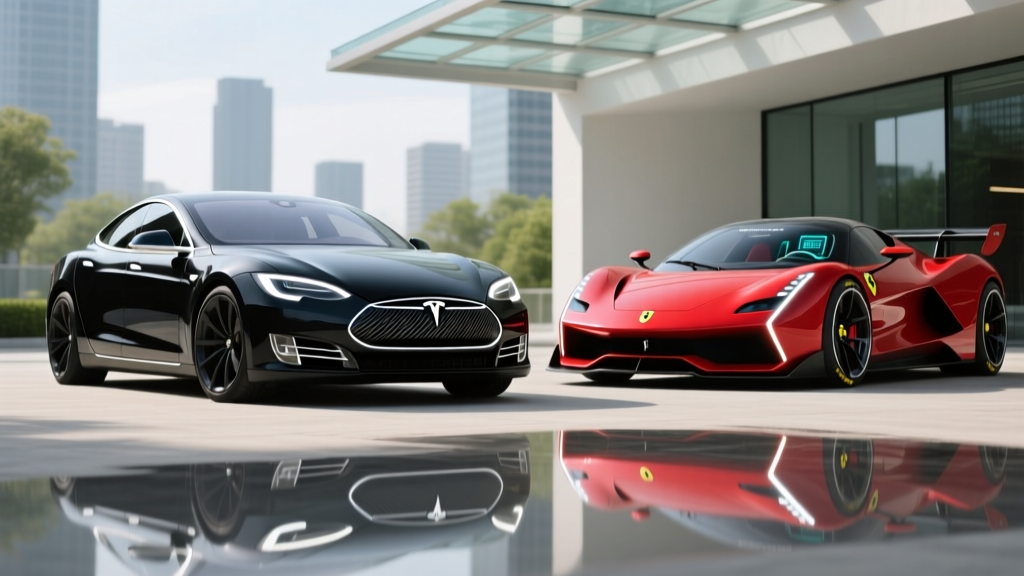
Search "tesla and ferrari" and you'll find endless forum debates about which brand represents the future of performance driving. The comparison isn't as absurd as it once was. Tesla's Model S Plaid hits 60 mph in 1.99 seconds — faster than most Ferrari models — while Ferrari prepares its first fully electric supercar for late 2025/2026 delivery. This review focuses on what you can actually buy today: the 2026 Tesla Model S lineup, with honest context on where Ferrari's electrification stands and what the competitive landscape really looks like.
We'll cover real-world range, charging speeds, total cost, and whether a six-figure Tesla makes sense when traditional supercar money enters the EV space.
2026 Tesla Model S: Full Spec Breakdown
| Spec | Model S Long Range | Model S Plaid |
|---|---|---|
| EPA Range | 402 miles | 359 miles |
| Battery (usable) | ~95 kWh (NMC) | ~95 kWh (NMC) |
| Drivetrain | Dual-Motor AWD | Tri-Motor AWD |
| Horsepower | 670 hp | 1,020 hp |
| 0–60 mph | 3.1 sec | 1.99 sec |
| Top Speed | 155 mph | 200 mph |
| Max DC Fast Charge | 250 kW (peak) | 250 kW (peak) |
| 10–80% DCFC Time | ~27 min | ~27 min |
| Level 2 Charge Rate | 11.5 kW (~41 mi/hr) | 11.5 kW (~41 mi/hr) |
| MPGe (combined) | 120 MPGe | 116 MPGe |
| Efficiency | 28 kWh/100 mi | 29 kWh/100 mi |
| Cargo (rear + frunk) | 28 cu ft + 3.1 cu ft | 28 cu ft + 3.1 cu ft |
| Rear Legroom | 35.4 in | 35.4 in |
| Base MSRP | $84,990 | $94,990 |
| Battery Warranty | 8 yr / 150,000 mi | 8 yr / 150,000 mi |
Sources: EPA fueleconomy.gov, Tesla Model S official specs.
Real-World Range: What the EPA Sticker Doesn't Tell You
EPA Estimate: 402 mi (Long Range) / 359 mi (Plaid)
Real-World Expectation: ~320–360 mi highway at 75 mph; ~280–310 mi in cold weather (below 32°F); ~360–390 mi mixed city/suburban driving.
The Model S's heat pump and thermal management system reduce cold-weather losses compared to older EVs, but expect a 15–25% range reduction in freezing temperatures. Highway driving at sustained speeds above 70 mph consumes significantly more energy than the EPA combined cycle suggests.
Tesla's range figures remain among the best in any production sedan, but the gap between EPA and real-world use matters for road-trip planning. On a 300-mile interstate drive in mild weather, the Long Range model will arrive with roughly 10–15% state of charge remaining — comfortable, but not generous. The Plaid's tri-motor setup and stickier tires add rolling resistance, shaving real-world range to roughly 290–330 miles on a similar trip.
Efficiency-wise, 28–29 kWh/100 mi means you'll spend roughly $8.40–$8.70 per 100 miles charging at home at $0.30/kWh (national average for residential electricity in many markets). That compares favorably to a Ferrari Roma or 812 Superfast at roughly $18–$22 per 100 miles on premium fuel, but the purchase context is entirely different.
Charging Speed: DC Fast Charging and Home Setup
| Charging Level | Power (kW) | Miles Added per Hour | Notes |
|---|---|---|---|
| Level 1 (120V) | ~1.4 kW | ~3–4 mi/hr | Emergency/trickle only |
| Level 2 (240V, 48A) | 11.5 kW | ~41 mi/hr | Full overnight charge in ~9 hrs |
| DC Fast (Supercharger V3) | 250 kW peak | ~200 mi in 15 min | Tapers above 50–60% SoC |
| DC Fast (CCS adapter, non-Tesla) | Up to 250 kW | Varies by station | Requires Tesla CCS adapter (included) |
The Model S still uses Tesla's proprietary connector (NACS) natively, but Tesla now includes a CCS1 adapter in the box, enabling access to Electrify America, EVgo, and other non-Tesla networks. At a V3 Supercharger (250 kW), the charge curve peaks early — you'll see 250 kW roughly between 10–30% SoC, then it tapers to ~150 kW through 50%, and ~75 kW above 80%. The 10–80% time of approximately 27 minutes reflects this taper realistically.
For home charging, a 48-amp Level 2 wall connector on a 60-amp circuit delivers the full 11.5 kW. That's a full charge from 10% to 100% in roughly 8.5–9 hours — adequate for overnight replenishment. Installation typically runs $800–$2,500 depending on panel proximity and whether a service upgrade is needed. If your home has a 100-amp main panel, expect a $1,500–$3,000 upgrade to support dedicated EV charging alongside normal household loads.
Performance and Driving Dynamics
The numbers are staggering and well-documented. The Model S Plaid's 1,020 horsepower and 1.99-second 0–60 time beat every production Ferrari ever made to 60 mph. The Long Range model's 670 hp and 3.1-second sprint would embarrass most sports cars from a decade ago.
But performance comparisons between Tesla and Ferrari break down past the drag strip. Ferrari's chassis tuning, steering feedback, braking feel, and mid-corner balance operate in a different universe. The Model S weighs approximately 4,766 lbs (Long Range) to 4,961 lbs (Plaid) — physics that no amount of torque vectoring fully masks on a canyon road. Ferrari's Purosangue (V12, not electric) weighs roughly 4,900 lbs but was engineered by a company with 75+ years of motorsport chassis development.
The Model S uses adaptive air suspension with automatic ride-height adjustment. Ride quality is genuinely comfortable for a performance sedan, and the cabin noise isolation at highway speeds is excellent. But interior material quality — while improved over 2021–2023 models — still doesn't match the luxury price point. Expect hard plastics on lower door panels and seat bolsters that don't quite match a $95,000 price tag.
Pricing, Trims, and Federal Tax Credit Eligibility
| Trim | Base MSRP | As-Tested (typical options) | §30D Federal Credit |
|---|---|---|---|
| Long Range | $84,990 | $89,000–$93,000 | Not eligible (MSRP exceeds $55,000 sedan cap) |
| Plaid | $94,990 | $99,000–$105,000 | Not eligible (MSRP exceeds $55,000 sedan cap) |
Tax credit reality check: Under IRS §30D rules, new EV sedans must have an MSRP at or below $55,000 to qualify for the federal credit. The Model S, as a luxury sedan, far exceeds this cap. No trim qualifies. Additionally, buyer income caps apply ($150,000 single / $300,000 joint AGI), and critical mineral + battery component sourcing requirements must be met — but the MSRP cap alone disqualifies the Model S regardless.
Some states offer their own incentives (California's CVRP, Colorado's tax credit) that may partially offset cost, but these vary by jurisdiction and often have their own income or price caps. Check your state's energy office for current programs.
Ferrari's EV Status: What Exists vs. What's Coming
To address the search intent directly: as of 2026, Ferrari does not sell a fully electric vehicle. The brand's first EV — reportedly codenamed "Luce" — has been announced for reveal in late 2025 with customer deliveries expected in 2026–2027. Ferrari has confirmed it will be a high-performance GT-style vehicle, but final specs (battery kWh, range, pricing) remain unconfirmed and preliminary.
What Ferrari currently offers in electrified form:
- SF90 Stradale/Spider (PHEV): Plug-in hybrid with ~15 miles of electric-only range, 986 combined hp, MSRP ~$625,000+
- 296 GTB/GTS (PHEV): V6 plug-in hybrid, ~15 miles electric-only, 819 hp, MSRP ~$350,000+
- Purosangue: V12 SUV (no electrification), MSRP ~$398,000+
Ferrari's PHEVs use small battery packs (~7.9 kWh for the 296 GTB) designed for short electric-only bursts and performance enhancement, not daily EV commuting. They do not qualify for the §30D federal EV tax credit due to insufficient electric range and MSRP caps.
Who Should Buy the 2026 Tesla Model S?
- You need 350+ real-world miles of range for frequent road trips
- You want Supercharger network access (still the most reliable DC fast-charging network in the US)
- You need a practical 4-door sedan with genuine cargo space (28 cu ft rear hatch + frunk)
- Performance is a priority but 3.1 seconds to 60 is "fast enough"
- Sub-2-second acceleration is a non-negotiable thrill
- You'll primarily drive in suburban/city environments where range loss is minimal
- Track use is occasional, not frequent (battery thermal management is good but not unlimited)
- You want luxury interior materials matching the $90K+ price — consider the Lucid Air, BMW i7, or Mercedes EQS
- You need third-row seating or SUV cargo flexibility — consider the Model X or Rivian R1S
- Federal tax credit eligibility matters to your purchase math — consider the Model 3 ($38,990, eligible) or competitors under $55K
Pros and Cons
- 402-mile EPA range (Long Range) is among the best of any production EV
- Supercharger network remains the gold standard for reliability
- Plaid's 1.99-sec 0–60 is unmatched by any production car at any price
- Over-the-air updates continuously add features
- Spacious hatchback cargo area + frunk for a sedan
- 8-year / 150,000-mile battery warranty
- No federal tax credit eligibility (MSRP cap)
- Interior quality still lags behind German luxury competitors at this price
- Yoke steering is polarizing and not universally preferred
- 250 kW peak DC charge rate is now outpaced by 800V competitors (Hyundai Ioniq 5 at 350 kW, Lucid Air at 300+ kW)
- Rear-seat entertainment screen is small and limited
- Insurance premiums run 20–40% higher than comparable ICE sedans
Frequently Asked Questions
What is the real-world range of the 2026 Tesla Model S?
Expect roughly 320–360 miles on the highway at 75 mph in mild weather for the Long Range model, and 290–330 for the Plaid. In cold weather (below freezing), plan for 280–310 miles. The EPA's 402-mile figure reflects a mixed cycle with significant city driving, where regenerative braking recovers energy.
How fast does the Model S charge at home and on the road?
At home on a Level 2 (240V, 48A) Tesla Wall Connector, you'll add roughly 41 miles of range per hour, or a full 10–100% charge in about 9 hours. On a V3 Supercharger (250 kW peak), a 10–80% charge takes approximately 27 minutes, though the rate tapers significantly above 60% SoC.
Does the Tesla Model S qualify for the $7,500 federal EV tax credit?
No. Under current IRS §30D rules, the Model S exceeds the $55,000 MSRP cap for sedans. No trim qualifies regardless of buyer income or battery sourcing. State-level incentives may partially apply depending on your jurisdiction.
Is the Model S worth it compared to a Ferrari or other luxury EVs?
For straight-line acceleration and daily usability, the Model S Plaid is extraordinary value at ~$95K vs. a Ferrari SF90 at $625K+. But Ferrari offers chassis dynamics, heritage, exclusivity, and interior craftsmanship that Tesla doesn't attempt. Against luxury EV peers — the Lucid Air Grand Touring (516-mi range, ~$138K), BMW i7 eDrive50 (~$120K), Porsche Taycan (~$99K) — the Model S competes on range and charging network access, but loses on interior luxury and steering feel.
What's the biggest drawback of owning a Model S in 2026?
The 250 kW peak charging rate, while adequate, is now a generation behind 800-volt competitors that sustain 300–350 kW. On long road trips, a Lucid Air or Hyundai Ioniq 5 (on a 350 kW charger) will complete charging stops 5–8 minutes faster. For a $90K+ vehicle, that gap is noticeable when competitors have moved to faster architectures.
How does Tesla's Autopilot/FSD compare to Ferrari's driver assists?
Tesla's Full Self-Driving (Supervised) is an SAE Level 2 driver-assist system — it requires continuous driver supervision and is not autonomous driving. It's capable of highway lane changes, navigation-guided exits, and city street driving, but demands attention. Ferrari's PHEV models offer basic Level 1–2 ADAS (adaptive cruise, lane keeping) but nothing approaching Tesla's feature set. Neither system replaces an attentive driver.
Ownership costs, insurance premiums, and state incentive availability vary by location and personal circumstances. Always verify current IRS rules at irs.gov and consult a tax professional before making purchase decisions based on credit eligibility. Safety ratings available at NHTSA and IIHS.