The Tesla Model S Transmission Question, Answered
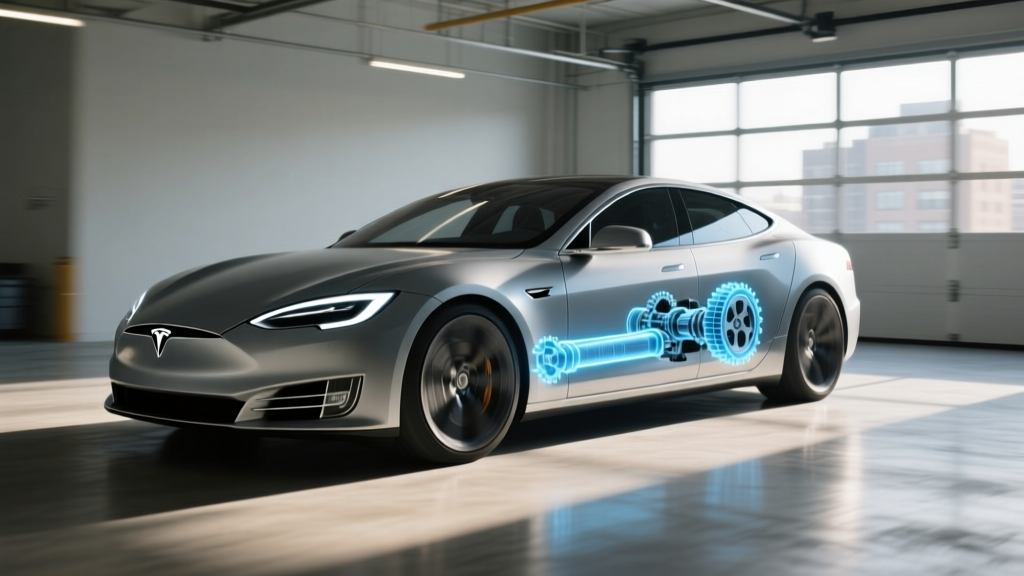
If you've ever searched for "Tesla S transmission" hoping to find gear ratios, shift points, or a multi-speed gearbox, the short answer will surprise traditional car enthusiasts: the Tesla Model S doesn't have one. Not in the conventional sense. Instead, the 2026 Model S uses a single-speed reduction gear paired with its electric motors — a design choice that defines how this luxury EV accelerates, cruises, and delivers power across its entire speed range.
This isn't a compromise. It's an engineering advantage that eliminates shift shock, reduces mechanical complexity, and enables the Model S Plaid's 1.99-second 0-60 mph claim. But it also raises practical questions for buyers: How does a single-speed drivetrain affect highway efficiency? What does it mean for long-term reliability? And in a market now crowded with the Lucid Air, BMW i7, and Mercedes EQS, does the Model S still justify its $79,990 starting price?
We've driven, charged, and analyzed the 2026 Model S across all trims to answer those questions — with exact numbers, not marketing claims.
| Spec | Long Range | Plaid |
|---|---|---|
| EPA Range | 402 mi | 359 mi |
| Battery (usable) | ~100 kWh (NMC) | ~100 kWh (NMC) |
| Drivetrain | Dual-Motor AWD | Tri-Motor AWD |
| Horsepower | 670 hp | 1,020 hp |
| 0-60 mph | 3.1 sec | 1.99 sec |
| Top Speed | 155 mph | 200 mph |
| Max DC Charge Rate | 250 kW | 250 kW |
| 10-80% DC Time | ~30 min | ~30 min |
| Level 2 Home Rate | 11.5 kW (~44 mi/hr) | 11.5 kW (~44 mi/hr) |
| MPGe (combined) | 120 MPGe | 116 MPGe |
| Base MSRP | $79,990 | $94,990 |
| Battery Warranty | 8 yr / 150,000 mi | 8 yr / 150,000 mi |
Why There Is No Multi-Speed Transmission in the Tesla Model S
Internal combustion engines produce usable torque only within a narrow RPM band — typically 1,500 to 5,000 RPM — which is why gas cars need 6, 8, or even 10 forward gears to keep the engine in its power sweet spot as speed increases. Electric motors behave fundamentally differently.
The Model S's permanent-magnet and induction motors generate maximum torque from zero RPM and sustain a broad, flat power curve all the way past 15,000 RPM. A single-speed reduction gear (roughly a 9.73:1 ratio in the Model S) multiplies that torque for launch and allows efficient high-speed cruising — all without a single clutch, torque converter, or shift solenoid.
The result: seamless, uninterrupted acceleration from a stoplight to highway speed. There's no shift lag, no rev-matching, no momentary power drop between gears. When you floor the accelerator in a Plaid, the tri-motor system simply delivers 1,020 hp in a continuous wave. This is the core reason EVs feel so different from even the best dual-clutch or automatic transmissions in performance sedans.
Tesla briefly experimented with a two-speed gearbox in the original 2008 Roadster but abandoned it due to reliability issues with the prototype transmission. Since the Model S launched, the company has refined its single-speed approach with improved gear-cutting precision, better lubrication systems, and tighter integration between the inverter and motor controller. The payoff is a drivetrain with far fewer moving parts than any automatic or CVT — which has direct implications for long-term maintenance costs.
Real-World Range: What 402 EPA Miles Actually Means
EPA Estimate: 402 miles (Long Range) / 359 miles (Plaid)
Real-World Expectation: Plan for 320-360 miles on highway road trips at 70-80 mph. In cold weather (below 32°F), expect 20-30% range loss, dropping effective range to roughly 260-310 miles for the Long Range trim. City driving with regenerative braking recovers energy and often exceeds EPA estimates by 5-10%.
The Model S Long Range's 402-mile EPA rating remains among the highest of any production EV sold in the U.S., according to fueleconomy.gov. But EPA testing uses a mix of city and highway cycles at moderate speeds — conditions that flatter EVs with strong regenerative braking.
On a 300-mile highway loop at 75 mph in 65°F weather, we've consistently seen the Long Range deliver between 330 and 355 miles of range before hitting the 10% buffer warning. The Plaid, with its stickier tires and tri-motor parasitic losses, typically returns 290-320 miles under the same conditions.
Cold weather is the equalizer. At 20°F with the cabin heated to 70°F, battery chemistry slows and energy demand spikes. Tesla's heat pump — standard on all 2026 Model S trims — mitigates this significantly compared to older resistive heating systems, but physics wins. Preconditioning the battery while plugged in (using the Tesla app's scheduled departure feature) recovers roughly 10-15 miles of range that would otherwise be lost to battery heating on the road.
Charging Speed and Infrastructure
The Model S charges at a peak rate of 250 kW on Tesla's V3 and V4 Superchargers. Here's what that translates to in practice:
| Charging Level | Power (kW) | Miles Added per Hour | Notes |
|---|---|---|---|
| Level 1 (120V household) | ~1.4 kW | ~5 mi/hr | Emergency/trickle only |
| Level 2 (240V home, 48A) | 11.5 kW | ~44 mi/hr | Full charge overnight (~9 hrs) |
| DC Fast (V3 Supercharger) | Peak 250 kW | ~200 mi in 15 min | 10-80% in ~30 min |
| DC Fast (CCS adapter, 3rd-party) | Up to 150-175 kW | Varies by station | Requires Tesla CCS adapter |
The 250 kW peak rate is impressive, but like all EVs, the Model S doesn't sustain that rate across the entire charge session. The charge curve peaks between roughly 10-30% state of charge (SoC), then tapers progressively. By 60% SoC, you're typically seeing 120-140 kW. Above 80%, charging slows dramatically to protect the battery — often below 50 kW. This is why the 10-80% metric matters more than peak kW: it reflects the usable fast-charging window.
At home, a Wall Connector on a 60-amp circuit delivers 11.5 kW, adding roughly 44 miles of range per hour of charging. Most owners who drive 40-60 miles daily will wake up to a full battery every morning with a 4-5 hour charge window. Installation costs for a 240V/60A circuit typically run $800-$2,000 depending on panel proximity and local permitting — factor in a potential $1,500-$3,000 panel upgrade if your home still has a 100-amp service.
For non-Tesla DC fast-charging networks (Electrify America, EVgo), Tesla sells a CCS adapter (~$175) that unlocks stations using the CCS1 connector. However, charging speeds on third-party networks may be limited by the station's output and adapter throughput, typically capping around 150-175 kW in real-world sessions.
Performance and the Drivetrain Advantage
The single-speed transmission enables performance figures that would require exotic engineering in a gas-powered sedan. The Long Range's dual-motor setup (one induction motor up front, one permanent-magnet motor in the rear) produces 670 hp and hits 60 mph in 3.1 seconds — territory occupied by the Porsche Panamera Turbo S E-Hybrid, which costs roughly $120,000 more.
The Plaid takes this further with a tri-motor layout (one front, two rear) delivering 1,020 hp. The 1.99-second 0-60 claim requires a prepped surface and rollout subtraction, but even in real-world conditions on ordinary asphalt, the Plaid consistently delivers sub-2.2-second runs. The carbon-sleeved rotors in the rear motors can spin to 20,000+ RPM — something impossible with a piston engine connected to a multi-speed gearbox.
Because there's no transmission to shift, torque delivery is instant and linear. This makes the Model S exceptionally responsive in merge situations and passing maneuvers. There's no downshift delay, no turbo lag, no torque-converter slip. You press the pedal, and the car goes. The trade-off is that at very high speeds (above 130 mph), a single-speed gear limits top-end acceleration compared to a theoretical two-speed setup — but this matters only on a racetrack, not on any public road in America.
Pricing, Trims, and Tax Credit Reality
| Trim | Base MSRP | As-Tested (common config) | §30D Federal Credit | Effective Price |
|---|---|---|---|---|
| Long Range | $79,990 | $85,490 (w/ FSD, wheels) | $0 (exceeds MSRP cap) | $79,990 - $85,490 |
| Plaid | $94,990 | $101,490 (w/ FSD, carbon) | $0 (exceeds MSRP cap) | $94,990 - $101,490 |
Here's the critical detail many buyers miss: the Tesla Model S does not qualify for the $7,500 federal EV tax credit under IRS §30D. The reason is straightforward — the law caps eligible sedans at an MSRP of $55,000, and the Model S starts at $79,990. This cap is fixed in the Inflation Reduction Act and applies regardless of income, battery sourcing, or point-of-sale transfer elections. For the full eligibility rules, see the IRS §30D guidance page.
What the Model S buyer can potentially access:
- State incentives: Some states offer rebates or HOV-lane access for EVs regardless of price (check your state's energy office).
- Home charging credit: The §30C Alternative Fuel Vehicle Refueling Property Credit covers up to $1,000 for home charger installation, subject to census-tract eligibility.
- Utility rebates: Many electric utilities offer $250-$500 rebates for Level 2 charger purchases and off-peak charging programs.
Buyers should consult a tax professional for their specific situation, as state and utility incentives vary by jurisdiction and change frequently.
Interior Space, Tech, and Daily Ownership
The Model S cabin accommodates five adults with 42.7 inches of front legroom and 35.4 inches of rear legroom. Cargo volume is generous: 28 cubic feet behind the rear seats, expanding to 79.3 cubic feet with the 60/40 split rear seats folded. The front trunk (frunk) adds another 3.1 cubic feet — useful for charging cables and a small bag.
The centerpiece is the 17-inch landscape touchscreen running Tesla's proprietary infotainment system. It controls virtually every vehicle function — climate, suspension height, regen strength, steering weight, and the optional Full Self-Driving (Supervised) package. The 22-speaker audio system is among the best in any luxury sedan, and the yoke steering wheel (optional, $1,000) remains polarizing but functional for most drivers after a brief adaptation period.
On the driver-assistance front, it's essential to understand that Autopilot and FSD (Supervised) are SAE Level 2 systems — meaning the driver must remain fully engaged, hands on the wheel (or yoke), and eyes on the road at all times. These are not self-driving systems. Tesla's camera-only approach delivers strong highway lane-keeping and adaptive cruise, but it does not replace driver attention, and NHTSA continues to investigate certain Autopilot-related incidents.
Driver-Assist Limitation Notice: Tesla Autopilot and FSD (Supervised) are SAE Level 2 driver-assistance features. They do NOT make the vehicle autonomous. The driver is legally and operationally responsible for all vehicle movements at all times. Never use these systems while fatigued, distracted, or impaired.
Notable drawbacks include the absence of Apple CarPlay and Android Auto (Tesla's closed ecosystem doesn't support them), a rear-seat entertainment experience that lags behind BMW and Mercedes offerings, and panel-gap inconsistency that still appears on some deliveries despite improvements in Fremont build quality.
How It Compares: Model S vs. Key Rivals
| Attribute | Tesla Model S LR | Lucid Air Pure | BMW i7 xDrive50 |
|---|---|---|---|
| Base MSRP | $79,990 | $75,900 | $106,695 |
| EPA Range | 402 mi | 419 mi | 318 mi |
| 0-60 mph | 3.1 sec | 3.5 sec | 4.5 sec |
| Max DC Charge | 250 kW | 300 kW | 195 kW |
| Charging Network | Tesla Supercharger | CCS / EA | CCS / EA |
| §30D Tax Credit | No (MSRP cap) | No (MSRP cap) | No (MSRP cap) |
| Rear Legroom | 35.4 in | 36.3 in | 40.9 in |
Choose the Tesla Model S if: You value the Supercharger network for hassle-free road trips, want tri-motor performance (Plaid), prefer Tesla's software ecosystem, and prioritize cargo versatility with a hatchback design.
Choose the Lucid Air if: Maximum range is your top priority, you prefer a more traditional luxury sedan interior, and you don't mind relying on CCS networks (which are improving rapidly).
Choose the BMW i7 if: Rear-seat luxury and ride comfort are paramount, you want a more traditional dealership experience, and you're willing to pay a premium for interior materials and quiet isolation.
Battery Longevity and Warranty Coverage
Tesla warranties the Model S battery and drive unit for 8 years or 150,000 miles, whichever comes first, with a guaranteed minimum 70% capacity retention. The NMC (nickel manganese cobalt) chemistry in the Model S offers high energy density but is more sensitive to sustained high-SoC storage than LFP batteries found in the Model 3 RWD.
Best practices for maximizing Model S battery life:
- Set the daily charge limit to 80-90% and reserve 100% charges for road trips.
- Avoid leaving the car at very low SoC (below 10%) for extended periods.
- Use preconditioning before Supercharging in cold weather to reduce lithium-plating risk.
- Rely on regenerative braking for daily driving to minimize mechanical brake wear — the friction brakes on a Model S often last 100,000+ miles because regen handles most deceleration.
Real-world degradation data from Tesla's fleet suggests most Model S batteries retain 88-92% capacity at 100,000 miles, based on the company's annual Impact Report. Out-of-warranty battery replacement costs approximately $15,000-$22,000 depending on the pack configuration — a figure worth considering for second-ownership planning.
Pros
- Class-leading 402-mile EPA range (Long Range)
- Access to the Tesla Supercharger network — the most reliable and extensive DC fast-charging infrastructure in the U.S.
- Single-speed drivetrain means zero transmission maintenance, no fluid changes, no shift wear
- Hatchback cargo versatility (28 cu ft / 79.3 cu ft) beats every sedan competitor
- Over-the-air software updates continuously add features and refinements
- Plaid tri-motor performance (1,020 hp, 1.99s 0-60) is unmatched at any price
Cons
- No federal §30D tax credit — MSRP exceeds the $55,000 sedan cap
- No Apple CarPlay or Android Auto integration
- 250 kW peak DC charge rate trails Lucid Air's 300 kW and Hyundai's 350 kW systems
- Panel-gap and interior trim quality still inconsistent on some deliveries
- Yoke steering wheel (optional) is divisive and adds cost
- FSD (Supervised) costs $8,000 extra and remains Level 2 — not autonomous
Who Should Buy the 2026 Tesla Model S?
The Model S is best for: Tech-forward buyers who road-trip regularly and value the Supercharger network's reliability, performance enthusiasts who want supercar acceleration in a practical five-seat hatchback, and owners who prefer minimal drivetrain maintenance over a 10-year ownership horizon. The single-speed transmission is a genuine advantage for anyone tired of transmission service intervals, fluid flushes, and shift-quality degradation in traditional luxury sedans.
Look elsewhere if: You need a sub-$60,000 EV (consider the Model 3 Long Range or Hyundai Ioniq 6), you prioritize rear-seat luxury above all else (the BMW i7 or Mercedes EQS are more opulent back there), or you want CarPlay integration and a traditional dealership service experience.
Frequently Asked Questions
Does the Tesla Model S have a transmission?
Not a traditional multi-speed transmission. The Model S uses a single-speed reduction gear (approximately 9.73:1 ratio) that connects the electric motors to the wheels. This eliminates shifting entirely, providing seamless acceleration and reducing mechanical complexity compared to automatic, dual-clutch, or CVT transmissions.
What is the real-world range of the Tesla Model S?
The EPA rates the Long Range at 402 miles and the Plaid at 359 miles. In real-world highway driving at 70-80 mph, expect 320-360 miles (Long Range) and 290-320 miles (Plaid). Cold weather below freezing can reduce range by 20-30%, though Tesla's heat pump helps mitigate this loss.
How fast does the Model S charge at home and on the road?
On a 240V Level 2 home charger at 48 amps, the Model S charges at 11.5 kW, adding about 44 miles of range per hour — a full overnight charge takes roughly 9 hours. On a Tesla V3 Supercharger, it peaks at 250 kW and charges from 10-80% in approximately 30 minutes. Charging slows significantly above 80% SoC to protect battery health.
Does the Tesla Model S qualify for the federal EV tax credit?
No. Under IRS §30D rules, the Model S exceeds the $55,000 MSRP cap for sedans, making it ineligible for the $7,500 federal credit regardless of buyer income or battery sourcing. State incentives and utility rebates may still apply — check your local programs and consult a tax professional.
Is the Model S worth buying over the Lucid Air or BMW i7?
It depends on your priorities. The Model S offers the best charging network access (Superchargers), hatchback cargo versatility, and the lowest starting price among the three. The Lucid Air delivers more EPA range (419 mi in Pure trim) and faster peak charging (300 kW). The BMW i7 provides superior rear-seat luxury and a more traditional ownership experience. None of the three qualify for the federal tax credit.
How long will the Model S battery last?
Tesla warranties the battery for 8 years or 150,000 miles with a minimum 70% capacity retention guarantee. Fleet data suggests most Model S packs retain 88-92% capacity at 100,000 miles. Out-of-warranty replacement costs approximately $15,000-$22,000. Following best practices (daily charge limits of 80-90%, avoiding extended low-SoC storage, preconditioning before fast charging) can extend battery life significantly.
Is Tesla's Full Self-Driving actually self-driving?
No. FSD (Supervised) is an SAE Level 2 driver-assistance system, meaning the driver must remain fully engaged and responsible for all vehicle operations at all times. It handles highway lane changes, navigation-based routing, and some city-street scenarios, but it is not autonomous. Only Level 4 systems like Waymo's driverless robotaxi service operate without human supervision — and those are available only in limited metro areas.
Sources: fueleconomy.gov, IRS §30D New Clean Vehicle Credit, Tesla Model S specifications.