Understanding the Tesla Model S Standard Range Battery and Charging Needs
The Tesla Model S Standard Range (sometimes referred to as the base or rear-wheel-drive variant in certain model years) typically ships with a usable battery capacity of approximately 75–80 kWh, depending on the model year and pack chemistry. While Tesla has shifted trim naming conventions over the years—moving between "Standard Range," "Long Range," and "Plaid"—the entry-level Model S with a smaller battery pack has appeared in various configurations, including the 2023–2025 model years where a base RWD option was intermittently available.
For 2026, the Model S lineup centers on the Long Range (dual-motor AWD, ~100 kWh usable, EPA 402 miles) and Plaid (tri-motor, ~100 kWh, EPA 396 miles). If you're researching a "Standard Range" Model S—whether a certified pre-owned example or a market-specific trim—the charging fundamentals below apply to any Model S with a ~75–80 kWh pack. According to fueleconomy.gov, the Model S Long Range achieves 124 MPGe combined, and charging efficiency scales similarly across trims.
Before we map out your charging strategy, let's nail down the single most important distinction in EV literacy: kW (kilowatts) measures power—the rate at which energy flows into your car. kWh (kilowatt-hours) measures energy—the total capacity of your battery. Think of kW as the width of a hose and kWh as the size of the bucket. A 75 kWh battery charged at 11.5 kW (Level 2) takes roughly 6.5 hours from empty; that same battery at 250 kW (DC fast) can go from 10–80% in about 25 minutes.
Charging Levels Explained: Speeds, Power, and Range Added
Every Tesla Model S supports three charging tiers. Here's what each delivers in practice:
| Level | Voltage / Amps | Power (kW) | Miles of Range Added per Hour | Typical Use Case |
|---|---|---|---|---|
| Level 1 (120V) | 120V / 12A | ~1.4 kW | 3–5 mi/hr | Emergency / overnight trickle |
| Level 2 (240V) | 240V / 48A | ~11.5 kW | 30–40 mi/hr | Daily home charging |
| DC Fast (Supercharger) | 400V architecture | Peak 250 kW | ~1,000 mi/hr (peak) | Road trips / rapid top-ups |
Real-world charging curve reality: The Model S peaks at 250 kW only at low states of charge (typically 10–30% SoC). As the battery fills, the charge rate tapers significantly—by 60% SoC, you might see 100–120 kW, and above 80%, it drops below 50 kW. This is why manufacturers quote 10–80% times rather than 0–100%. For a ~75 kWh Model S pack, expect a 10–80% session at a V3 Supercharger (250 kW) in roughly 25–30 minutes under ideal thermal conditions.
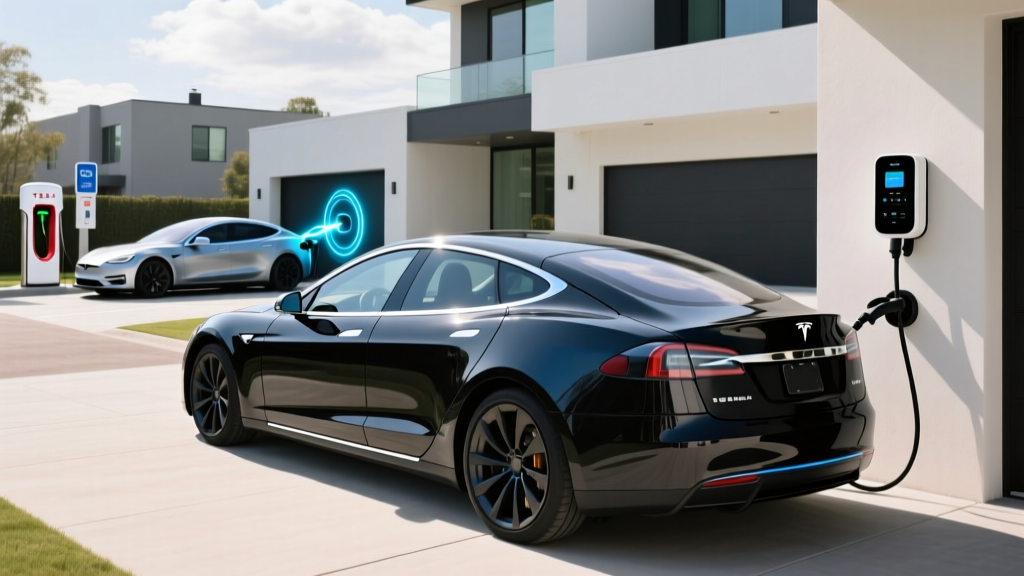
At Level 2 on a 48-amp circuit (Tesla Wall Connector), you'll add approximately 34 miles of range per hour. That means a full overnight session (8–10 hours) easily replenishes 270–340 miles—more than enough for daily driving on any Model S trim.
Home Charger Installation: Electrical Requirements and Costs
Installing a Level 2 home charger for your Model S involves four cost components: the charger unit, electrical labor, permit fees, and potential panel upgrades. Here's the breakdown based on 2025–2026 national averages:
| Component | Low End | Typical | High End (Panel Upgrade) |
|---|---|---|---|
| Charger Equipment | $350 | $450 | $600 |
| Electrician Labor | $400 | $800 | $1,500 |
| Electrical Permit | $50 | $150 | $300 |
| Panel Upgrade (if needed) | $0 | $0 | $2,500 |
| Total | $800 | $1,400 | $4,900 |
Electrical requirements: A Tesla Wall Connector at full 48-amp output requires a dedicated 60-amp, 240-volt circuit (the National Electrical Code requires circuits to be rated at 125% of continuous load, so 48A continuous = 60A breaker). If you opt for a 40-amp charger, a 50-amp breaker suffices.
Panel upgrade reality: Homes with 100-amp service or older panels may not have capacity for an additional 60-amp circuit, especially if you're already running electric dryers, ranges, or HVAC. A panel upgrade to 200-amp service typically costs $1,500–$2,500. Always have a licensed electrician perform a load calculation before committing to a circuit size. The U.S. Department of Energy provides guidance on home charging electrical assessments.
Safety and code considerations:
- Dedicated circuit: Your Level 2 charger must have its own dedicated breaker—never share a circuit with other major appliances.
- GFCI protection: NEC 2020 and later require GFCI protection for EV charging outlets in garages. Hardwired chargers (like the Wall Connector) typically have built-in ground-fault protection.
- Outdoor rating: If installing outside, ensure the unit carries a NEMA 4 (weatherproof) rating. The Tesla Wall Connector is rated for indoor and outdoor use.
- Wire gauge: A 60-amp circuit requires 6 AWG copper wire for runs up to ~50 feet; longer runs may need 4 AWG to minimize voltage drop.
Connector Compatibility: NACS, CCS, and Adapter Needs
The Tesla Model S uses the North American Charging Standard (NACS) connector—Tesla's proprietary design that has now been adopted by Ford, GM, Rivian, Volvo, and most major automakers as the industry standard. Here's how compatibility breaks down:
| Connector | Native Support? | Adapter Needed? | Availability |
|---|---|---|---|
| NACS (Tesla) | Yes — native | No | All Superchargers, Destination Chargers, Tesla Wall Connector |
| CCS1 | No | Tesla CCS Adapter (~$175) | Electrify America, EVgo, third-party DCFC networks |
| CHAdeMO | No | Setec CHAdeMO-NACS (~$300+) | Limited; mostly legacy Nissan Leaf infrastructure |
| J1772 (Level 2 public) | No | Tesla J1772 Adapter (included with car) | Public Level 2 stations, hotels, workplaces |
Practical advice: Your Model S comes with a J1772 adapter for public Level 2 stations and a Mobile Connector for 120V/240V outlet charging at home. For DC fast charging outside the Supercharger network, purchase the official Tesla CCS Adapter. With the broader industry migrating to NACS through 2025–2026, most new public DC fast chargers now include NACS cables natively, reducing the need for adapters over time.
Cost to Charge: Home vs. Public vs. Gas Comparison
Charging economics vary dramatically by location and time of use. Here's what a Model S owner can expect in 2026:
| Scenario | Cost per kWh | Full Charge Cost (0–100%) | Cost per Mile |
|---|---|---|---|
| Home — Off-Peak TOU Rate | $0.08–$0.12 | $6.00–$9.00 | $0.02–$0.03 |
| Home — Standard Rate | $0.14–$0.18 | $10.50–$13.50 | $0.04–$0.05 |
| Public Level 2 | $0.20–$0.35 | $15.00–$26.25 | $0.06–$0.10 |
| DC Fast (Supercharger) | $0.28–$0.40 | $21.00–$30.00 | $0.08–$0.11 |
| Gas Equivalent (25 MPG, $3.40/gal) | — | $36.72 | $0.14 |
Key takeaway: Home charging on an off-peak time-of-use (TOU) plan is the cheapest way to fuel a Model S—roughly 75–85% cheaper per mile than gasoline. Even Supercharger pricing undercuts gas on a per-mile basis, though the gap narrows. If you rely exclusively on public DC fast charging, your per-mile cost approaches $0.10, still below gas but significantly more than home charging.
Many utilities offer EV-specific TOU rates that drop to $0.06–$0.10/kWh during overnight hours (typically 12 AM – 6 AM). Check with your local utility for EV rate plans—some offer $500–$1,000 rebates for Level 2 charger installation as well.
Recommended Home Chargers for the Model S
These Level 2 chargers are optimized for Tesla's NACS connector and the Model S's 11.5 kW onboard charger limit (48 amps maximum):
Tesla Wall Connector (Best Overall for Tesla Owners)
- Power Output: Up to 11.5 kW (48A)
- Connector: NACS (native)
- Cable Length: 24 feet
- Smart Features: Wi-Fi connectivity, OTA firmware updates, power sharing (load balance between two units on one circuit), access control
- Price: ~$475
- Why it wins: Native NACS means no adapter. Power sharing lets you install two Wall Connectors on a single 60A circuit—ideal for two-EV households. Sleek design, indoor/outdoor rated.
ChargePoint Home Flex (Best Third-Party Option)
- Power Output: Up to 12 kW (50A) — configurable down to 16A for panel-limited homes
- Connector: J1772 (use included Tesla adapter) or NACS pigtail version (newer models)
- Cable Length: 23 feet
- Smart Features: App-based scheduling, Alexa integration, energy tracking, flexible amperage settings
- Price: ~$550–$650
- Why it's solid: The adjustable amperage (16A–50A) is ideal if your panel can't support a full 60A circuit. The app's scheduling feature pairs well with TOU rate plans.
Emporia Level 2 EV Charger (Budget Pick)
- Power Output: Up to 11.5 kW (48A)
- Connector: J1772 (Tesla adapter required) or NACS version
- Cable Length: 24 feet
- Smart Features: Energy monitoring, solar integration (pairs with Emporia Vue home energy monitor), scheduling
- Price: ~$350–$400
- Why it works: Lowest price for full 48A output. Solar-aware charging is valuable for homes with rooftop PV systems.
Public Charging and Road Trip Strategy for the Model S
The Model S's greatest charging advantage is native access to the Tesla Supercharger network—over 20,000 stalls across North America as of early 2026, with V3 (250 kW) and V4 (up to 350 kW, though Model S caps at ~250 kW) stations along major corridors. Tesla's route planner automatically integrates Supercharger stops, preconditioning the battery as you approach for optimal charge speed.
Preconditioning matters: The Model S battery charges fastest when warm (ideally 30–40°C / 85–105°F). When you navigate to a Supercharger, the car automatically begins heating or cooling the pack. If you drive to a DC fast charger without using navigation, the battery may not precondition, resulting in significantly slower charge rates—especially in cold weather.
Cold-weather charging reality: At 20°F, expect 10–80% charge times to increase by 20–40% without preconditioning. Always navigate to the charger using the car's built-in routing to trigger thermal prep. Range also drops 15–30% in sustained cold-weather driving due to cabin heating and increased battery resistance.
For non-Tesla DC fast chargers (Electrify America, EVgo, Ionity in Europe), use the CCS adapter. Charge rates on third-party networks may be limited by the station's power output and the adapter's throughput—typically 150–200 kW effective, versus 250 kW on Superchargers.
Federal Tax Credits and Incentives for Home Charging
The IRS §30C Alternative Fuel Vehicle Refueling Property Credit covers 30% of home EV charger installation costs (equipment + labor), up to a maximum of $1,000, through 2032. Eligibility requires:
- The charger must be installed at your primary residence
- The property must be located in an eligible census tract (low-income or non-urban area as defined by the IRS)
- You must have federal tax liability to claim the credit (it is non-refundable)
This is separate from the §30D vehicle purchase credit. Consult a tax professional to confirm eligibility based on your specific address and tax situation, as census tract eligibility maps are updated periodically.
Frequently Asked Questions
How much does it cost to install a home EV charger for a Tesla Model S?
A typical installation with a Tesla Wall Connector on an existing 200-amp panel runs $1,200–$1,800 (equipment + electrician + permit). If your home needs a panel upgrade from 100A to 200A service, add $1,500–$2,500. Total range: $800 on the very low end (short wire run, existing capacity) to $4,900+ with a panel upgrade.
How fast will each charging level add range to the Model S Standard Range?
Level 1 (120V): 3–5 miles per hour. Level 2 (240V, 48A): 30–40 miles per hour. DC Fast (Supercharger V3, 250 kW peak): up to 200 miles in 15 minutes under ideal conditions, though sustained rates taper above 50% SoC.
Which connector is compatible with my Tesla Model S?
The Model S uses NACS natively for all Superchargers and Tesla Destination Chargers. For public J1772 Level 2 stations, use the included J1772 adapter. For non-Tesla DC fast chargers (CCS1), purchase the Tesla CCS Adapter (~$175). CHAdeMO compatibility is available only through expensive third-party adapters and is generally not recommended.
How much does charging a Model S cost per mile compared to gas?
Home charging at off-peak rates: $0.02–$0.03 per mile. Supercharger: $0.08–$0.11 per mile. Gasoline equivalent (25 MPG sedan at $3.40/gal): $0.14 per mile. Home charging saves $0.11–$0.12 per mile, or roughly $1,650–$1,800 annually at 15,000 miles driven.
What electrical upgrades might I need for a Level 2 charger?
If your home has a 200-amp panel with available capacity, you likely need only a new 60-amp breaker and a wire run to the garage—no upgrade required. Homes with 100-amp service, older panels, or high existing electrical loads (electric heat, dryer, range, pool) may require a panel upgrade to 200A. A licensed electrician will perform a NEC Article 220 load calculation to determine your actual capacity.