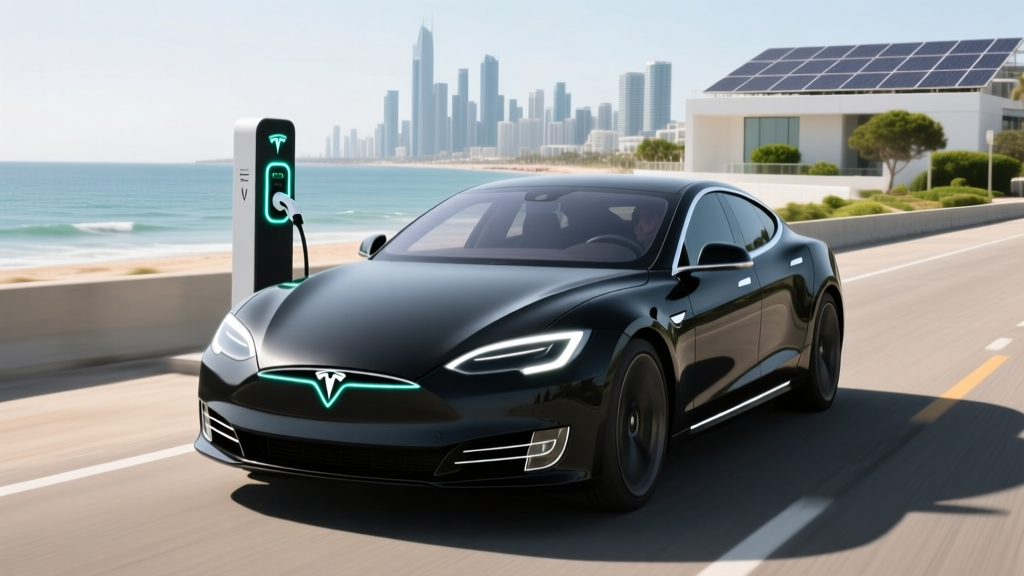
Tesla Model S Specs at a Glance
The Tesla Model S remains one of the longest-range, quickest-accelerating sedans on the market. But spec sheets only tell part of the story. Below, we break down every critical Model S spec — from real-world range and charging curves to tax-credit eligibility — so you can evaluate this EV against its growing luxury competition.
| Spec | Long Range (Dual Motor AWD) | Plaid (Tri-Motor AWD) |
|---|---|---|
| EPA Range | 402 miles | 359 miles |
| Battery (usable) | ~95 kWh (NMC) | ~95 kWh (NMC) |
| Drivetrain | Dual Motor AWD | Tri-Motor AWD |
| Horsepower | 670 hp | 1,020 hp |
| 0-60 mph | 3.1 seconds | 1.99 seconds |
| Top Speed | 155 mph | 200 mph |
| Peak DC Fast Charge | 250 kW | 250 kW |
| 10-80% DC Time | ~30 minutes | ~30 minutes |
| Level 2 Charge Rate | 11.5 kW (48A) | 11.5 kW (48A) |
| MPGe (combined) | 120 MPGe | 116 MPGe |
| kWh/100 mi | 28 kWh/100 mi | 29 kWh/100 mi |
| Base MSRP | $79,990 | $94,990 |
| Battery Warranty | 8 yr / 150,000 mi | 8 yr / 150,000 mi |
Source: fueleconomy.gov and Tesla official specifications. Prices and specs subject to change.
Real-World Range: What the EPA Sticker Doesn't Tell You
Real-World Expectation: ~320-350 miles highway at 70+ mph; ~260-290 miles in sub-freezing weather with cabin heat.
The Model S Long Range's 402-mile EPA rating is among the highest of any production EV sold in the U.S. However, EPA range tests use a blended city/highway cycle with generous assumptions about regenerative braking and moderate temperatures.
In sustained highway driving at 70-80 mph, expect to use roughly 30-32 kWh/100 mi rather than the EPA-rated 28, which translates to approximately 320-350 miles on a full charge. Cold weather compounds the loss: at 20°F, battery chemistry slows and cabin heating (even with the Model S's heat pump) draws additional energy. Owners in northern climates should budget 20-30% range reduction in winter, bringing effective range to roughly 280-320 miles for the Long Range trim.
The Plaid's lower EPA figure (359 miles) reflects its performance-oriented powertrain calibration and stickier tire compound, which increase rolling resistance. Real-world highway range for the Plaid typically lands in the 280-310 mile window under normal conditions.
Battery Chemistry and Longevity
Both Model S trims use a nickel-manganese-cobalt (NMC) lithium-ion battery pack with approximately 95 kWh of usable capacity. Tesla does not publish exact pack specifications, but teardown data and EPA filings consistently point to this figure.
NMC chemistry offers higher energy density than lithium iron phosphate (LFP), which is why Tesla reserves it for the Model S and Model X — vehicles where maximizing range per kilogram matters more than minimizing cost. The trade-off: NMC cells are more sensitive to sustained high state-of-charge (SoC) storage and benefit from daily charging limits set to 80-90% rather than 100%.
Tesla's battery warranty guarantees at least 70% capacity retention over 8 years or 150,000 miles, whichever comes first. Industry data from fleet operators and owner surveys suggests Model S packs typically degrade 8-12% over the first 100,000 miles, with the rate of loss slowing significantly thereafter. A full out-of-warranty pack replacement, should it ever be needed, currently runs between $15,000 and $22,000 depending on labor and pack availability.
Charging Speed: DC Fast, Level 2, and the Supercharger Network
Charging speed is where the Model S's maturity shows — and where it also reveals a competitive gap versus newer 800V-architecture rivals.
| Charging Level | Power / Rate | Speed | Notes |
|---|---|---|---|
| Level 1 (120V) | ~1.4 kW | ~3-4 mi/hr | Emergency/trickle only |
| Level 2 (240V, 48A) | 11.5 kW | ~34 mi/hr | Full charge in ~9-10 hours |
| DC Fast (V3 Supercharger) | Peak 250 kW | ~200 mi in 15 min | 10-80% in ~30 min |
| DC Fast (CCS adapter) | Up to 250 kW | Varies by station | Requires $250 CCS adapter |
The Model S peaks at 250 kW on Tesla's V3 Superchargers. However, that peak rate is only sustained between roughly 10-30% SoC. Above 50%, the charge curve tapers significantly — a characteristic of NMC chemistry and the pack's thermal management strategy. Expect the 10-80% session to take about 30 minutes, with the final 20% (80-100%) adding another 25-30 minutes if you need a full top-up for a long leg.
For comparison, Hyundai's E-GMP platform (Ioniq 5/6) and Porsche's Taycan use 800V architectures that sustain higher charge rates deeper into the curve, enabling 10-80% times closer to 18 minutes at compatible chargers. The Model S compensates with access to Tesla's Supercharger network — still the most reliable and geographically complete DC fast-charging network in the U.S.
At home, the onboard charger accepts up to 11.5 kW (48 amps) on a 240V Level 2 circuit. A Wall Connector or equivalent hardwired station on a 60-amp breaker will replenish the full pack in roughly 9-10 hours, or add about 34 miles of range per hour of charging. For most owners who charge overnight, this is more than adequate.
Preconditioning matters: Always use the car's navigation to route to a Supercharger, even if you know the way. The Model S will automatically precondition the battery — warming it to optimal temperature — so you hit peak charge rates on arrival. Skip this step in cold weather and your initial charge rate may be cut in half for the first 10-15 minutes.
Performance and Driving Dynamics
The Model S Long Range delivers 670 horsepower through its dual-motor all-wheel-drive system, reaching 0-60 mph in 3.1 seconds. That's supercar territory from just a few years ago, packaged in a five-passenger sedan with a usable frunk and over 26 cubic feet of cargo volume behind the rear seats.
The Plaid escalates to 1,020 horsepower via three motors (one front, two rear), achieving a manufacturer-claimed 0-60 mph in 1.99 seconds with rollout subtracted. Independent testing by outlets like Car and Driver and MotorTrend has validated sub-2.1-second times under controlled conditions. Top speed is electronically limited to 200 mph.
Beyond straight-line speed, the Model S features adaptive air suspension that adjusts ride height based on speed and road conditions, torque-vectoring across the rear axle (Plaid), and a low center of gravity from the floor-mounted battery pack that keeps body roll well-controlled for a 4,700+ pound vehicle. The yoke steering wheel remains standard, with a round wheel available as a no-cost option — a choice worth making if you frequently drive in parking structures or tight urban environments where hand-over-hand inputs are necessary.
Interior, Tech, and Cargo
The Model S cabin centers on a 17-inch landscape-oriented touchscreen that handles nearly all vehicle functions — climate, media, navigation, vehicle settings, and even a full web browser. A secondary 8-inch screen serves rear passengers for climate and entertainment. The instrument cluster is a compact 12.3-inch display behind the yoke/wheel.
Tesla's infotainment system is among the most responsive in the industry, with fast rendering and over-the-air updates that regularly add features. However, the near-total absence of physical buttons — no dedicated volume knob, no tactile climate controls — remains a polarizing choice that can require more eyes-off-road time for simple adjustments than traditional luxury competitors.
Cargo and passenger space:
- Rear cargo (behind rear seats): 26.3 cu ft
- Cargo with rear seats folded: 64.9 cu ft
- Front trunk (frunk): 3.1 cu ft
- Rear legroom: 35.4 inches
- Front legroom: 42.7 inches
- Seating: 5 passengers
The hatchback design gives the Model S a practical advantage over traditional sedan competitors like the Porsche Taycan or Lucid Air, whose trunk openings are more restrictive. The 64.9 cu ft maximum cargo figure with seats folded approaches midsize SUV territory.
Autopilot, FSD, and Driver Assistance
Every Model S ships with Tesla's Basic Autopilot, which includes Traffic-Aware Cruise Control and Autosteer (lane centering). This is a capable Level 2 highway driver-assist system, competitive with BMW's Driving Assistant Professional and Mercedes-Benz's Active Distance Assist.
The optional Full Self-Driving (Supervised) package ($8,000 or $99/month as of early 2026) adds Navigate on Autopilot (automatic highway interchanges), Auto Lane Change, Autopark, Smart Summon, and traffic light/stop sign recognition. Despite the name, FSD remains a Level 2 system requiring continuous driver supervision. Tesla's city-street FSD capability has improved substantially in recent software releases, but it still makes errors at complex intersections, construction zones, and unprotected left turns that demand immediate driver takeover.
- Drive without a licensed, attentive driver in the seat
- Navigate all road types without errors or disengagements
- Replace the driver's legal responsibility for the vehicle
- Operate as a Level 3 or Level 4 autonomous system
Safety ratings: The Model S earned a 5-Star Overall rating from NHTSA and has historically performed well in IIHS crash testing, though buyers should verify the latest model-year ratings as IIHS periodically updates test protocols.
Pricing, Trims, and Federal Tax Credit Eligibility
| Trim | Base MSRP | As-Tested (typical options) | §30D Federal Credit |
|---|---|---|---|
| Long Range | $79,990 | $82,000-$88,000 | See eligibility below |
| Plaid | $94,990 | $97,000-$105,000 | See eligibility below |
The Model S qualifies for the IRS §30D New Clean Vehicle Credit of up to $7,500, but only if the buyer meets all current-year requirements. As of 2026, key eligibility criteria include:
- MSRP Cap: Sedans must have an MSRP at or below $55,000. Neither Model S trim meets this cap — the Long Range starts at $79,990.
- Income Cap: Modified adjusted gross income must not exceed $150,000 (single) / $300,000 (joint).
- Battery Sourcing: Critical minerals and battery components must meet escalating domestic/free-trade-partner thresholds.
The critical issue: Under the §30D MSRP cap for sedans ($55,000), the Model S does not qualify for the federal tax credit. This cap has not been adjusted since the Inflation Reduction Act's passage, and it effectively excludes nearly all luxury EV sedans. Buyers should not factor a $7,500 credit into their purchase budget for this vehicle.
Always confirm current eligibility at irs.gov or with a qualified tax professional before purchasing. Rules and vehicle eligibility lists are subject to change.
Pros
- Best-in-class EPA range (402 mi Long Range)
- Supercharger network access — most reliable DC charging in the U.S.
- Blistering acceleration, especially Plaid (1.99s 0-60)
- Hatchback practicality with 26+ cu ft cargo
- Continuous OTA updates add features post-purchase
- 8-yr/150,000-mi battery warranty
Cons
- No federal tax credit (exceeds $55K sedan MSRP cap)
- 250 kW peak charge rate trails 800V competitors
- Yoke steering impractical for low-speed maneuvers
- Minimal physical controls — screen-dependent interface
- High insurance premiums relative to sedan average
- Plaid's range penalty is significant (359 mi EPA)
Who Should Buy the Model S?
Choose the Model S Long Range if: You need maximum range for frequent long-distance travel, value Supercharger network reliability, and want a practical hatchback sedan with legitimate five-passenger usability.
Choose the Model S Plaid if: Performance is your primary purchase driver, you want the fastest-accelerating production sedan available, and you accept the 43-mile range penalty and higher price.
Look elsewhere if: Federal tax credit eligibility is essential to your budget (consider the Model 3, BMW i4 eDrive40, or Hyundai Ioniq 6), you prioritize the latest 800V fast-charging speeds (Porsche Taycan, Hyundai Ioniq 5), or you want a traditional luxury interior with physical controls (Mercedes EQS, BMW i7).
Tesla Model S vs. Key Competitors
| Spec | Tesla Model S LR | Lucid Air Pure | Mercedes EQS 450+ | Porsche Taycan 4S |
|---|---|---|---|---|
| EPA Range | 402 mi | 419 mi | 390 mi | 288 mi |
| Battery (usable) | ~95 kWh | ~88 kWh | ~108 kWh | ~84 kWh |
| Peak DC Charge | 250 kW | 250 kW | 200 kW | 270 kW |
| 0-60 mph | 3.1s | 5.2s | 5.9s | 3.8s |
| Horsepower | 670 hp | 430 hp | 355 hp | 562 hp |
| Base MSRP | $79,990 | $69,900 | $104,400 | $99,400 |
| Federal Credit | No | No | No | No |
The Model S occupies a unique position: it offers more range than the Taycan, more performance than the EQS, and undercuts the Lucid Air on acceleration while trailing it slightly on range. None of these luxury sedans currently qualify for the federal tax credit due to the $55,000 MSRP cap on sedans.
Frequently Asked Questions
What is the real-world range of the Tesla Model S?
The Long Range delivers approximately 320-350 miles in real-world highway driving and 260-290 miles in cold weather (sub-32°F). The Plaid returns roughly 280-310 miles highway and 230-260 miles in cold conditions. These figures assume moderate driving habits and use of the heat pump for cabin conditioning.
How fast does the Model S charge at home and on the road?
On a Level 2 home charger (240V, 48A), the Model S charges at 11.5 kW, adding about 34 miles of range per hour and fully recharging in roughly 9-10 hours. On a V3 Supercharger, it peaks at 250 kW and charges from 10-80% in approximately 30 minutes. The 250 kW peak is not sustained — it tapers above 50% SoC.
Does the Tesla Model S qualify for the $7,500 federal EV tax credit?
No. Under current IRS §30D rules, sedans must have an MSRP at or below $55,000 to qualify. The Model S Long Range starts at $79,990 and the Plaid at $94,990, both well above the cap. State-level incentives may still apply — check your local DMV or energy office for details.
Is the Model S worth buying vs. the Lucid Air or Porsche Taycan?
The Model S is the strongest all-around choice if you prioritize Supercharger network reliability, a blend of range and acceleration, and hatchback practicality. The Lucid Air Pure offers slightly more range at a lower price but lacks Supercharger access. The Porsche Taycan charges faster (800V architecture) and drives more engagingly, but sacrifices significant range. The Mercedes EQS offers a more traditional luxury cabin but less performance.
What is the battery warranty on the Model S?
Tesla covers the Model S battery and drive unit for 8 years or 150,000 miles, whichever comes first, with a guaranteed minimum 70% capacity retention threshold. This is among the more generous battery warranties in the luxury EV segment.
How much does it cost to charge a Model S?
At the U.S. average residential electricity rate of ~$0.16/kWh, fully charging the 95 kWh pack at home costs approximately $15.20 — equivalent to about $0.04-$0.05 per mile. Supercharger pricing varies by location but averages $0.25-$0.35/kWh, bringing road-trip charging costs to roughly $0.07-$0.10 per mile. For comparison, a gasoline sedan getting 30 MPG at $3.50/gallon costs about $0.12 per mile.