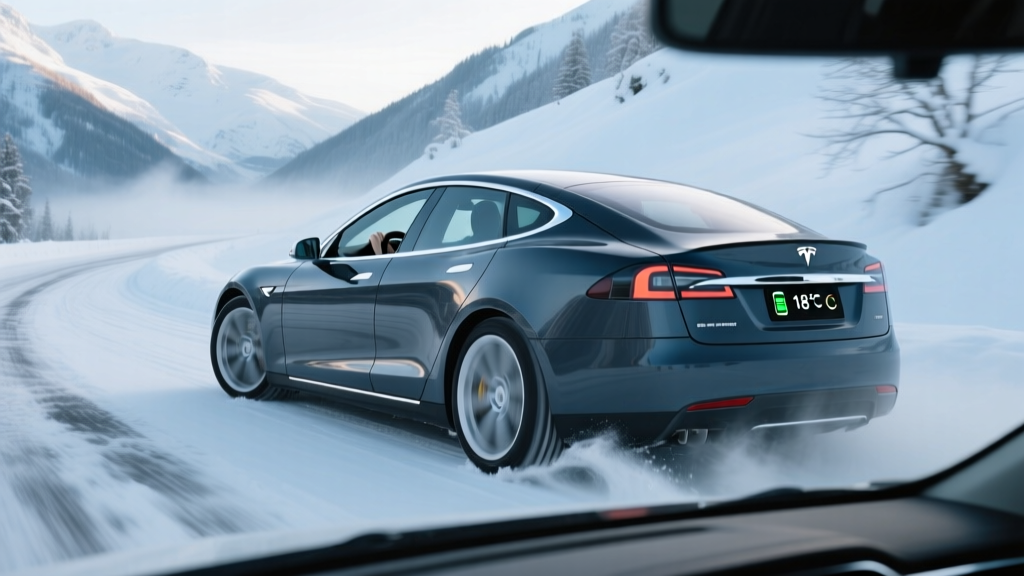
If you live where winter means sub-freezing commutes, icy on-ramps, and snow-packed roads, the question isn't whether the Tesla Model S is a capable luxury sedan — it's whether that capability survives when the thermometer drops below 20°F. The 2026 Tesla Model S pairs dual-motor all-wheel drive with a heat-pump-based thermal management system and a 100 kWh battery pack, giving it one of the longest EPA-rated ranges in the EV market. But cold weather changes the physics of lithium-ion batteries, and snow changes the math on efficiency.
This review examines the Model S through a winter-ownership lens: how much range you actually lose in freezing temperatures, how the AWD system manages traction on snow and ice, how DC fast charging behaves when the battery is cold-soaked, and whether the 2026 Model S still makes financial sense given current IRS §30D tax credit rules. We'll also compare it head-to-head against the key luxury EV sedans competing for the same cold-climate buyer.
2026 Tesla Model S: Core Specs at a Glance
| Specification | Model S Long Range | Model S Plaid |
|---|---|---|
| EPA Range | 402 miles | 359 miles |
| Battery (usable) | ~100 kWh, NMC | ~100 kWh, NMC |
| Drivetrain | Dual-Motor AWD | Tri-Motor AWD |
| Horsepower | 670 hp | 1,020 hp |
| 0–60 mph | 3.1 seconds | 1.99 seconds |
| Top Speed | 155 mph | 200 mph |
| Max DC Fast Charge | 250 kW | 250 kW |
| 10–80% DC Time | ~27 minutes | ~27 minutes |
| Level 2 Home Charge | 11.5 kW (~34 mi/hr) | 11.5 kW (~34 mi/hr) |
| MPGe (combined) | 120 MPGe | 116 MPGe |
| Efficiency | 28 kWh/100 mi | 29 kWh/100 mi |
| Cargo Volume | 28 cu ft (rear) + 5.3 cu ft (frunk) | 28 cu ft (rear) + 5.3 cu ft (frunk) |
| Rear Legroom | 35.4 inches | 35.4 inches |
| Base MSRP | $79,990 | $94,990 |
| Battery Warranty | 8 yr / 150,000 mi | 8 yr / 150,000 mi |
All 2026 Model S variants use Tesla's NMC (nickel manganese cobalt) battery chemistry, which offers higher energy density than LFP but is more sensitive to extreme cold at the cell level. Tesla's thermal management system — which includes a heat pump introduced in the 2021 refresh — actively warms the battery pack, but that energy draw is precisely what cuts into your winter range.
Real-World Winter Range: What Happens Below Freezing
Real-World Expectation: 310–340 miles in mild conditions; 250–300 miles in sustained sub-30°F driving with cabin heat and snow-covered roads. Highway driving at 75+ mph in cold weather compounds the loss.
The EPA range figure assumes moderate temperatures and a mix of city and highway driving. In practice, lithium-ion cells experience increased internal resistance in cold weather, and the energy required to heat both the battery pack and the cabin draws from the same 100 kWh reservoir that propels the car.
Based on aggregated owner data and independent cold-weather testing, expect the following range reductions in the Model S:
- 32–45°F, dry roads: 5–10% range loss (~360–380 miles Long Range)
- 15–32°F, mixed conditions: 15–25% range loss (~300–340 miles Long Range)
- Below 15°F, snow/ice, cabin heat max: 25–35% range loss (~260–300 miles Long Range)
- Highway speeds (75+ mph) in cold: Add another 5–8% loss on top of temperature effects
Tesla's heat pump is a significant advantage over older resistive-heating EVs. A heat pump moves thermal energy rather than generating it, operating at roughly 3–4x the efficiency of a resistive heater. In the Model S, this means cabin heating in 30°F weather might draw 2–3 kW instead of 6–8 kW. But even with that efficiency, a 300-mile road trip in January across the upper Midwest will require at least one charging stop — plan accordingly.
One practical mitigation: preconditioning. If your Model S is plugged in at home, scheduling a departure time warms the battery and cabin using grid power, not battery energy. This preserves your full range when you pull out of the driveway and also enables faster DC charging if your first stop is a Supercharger.
Snow Traction and AWD Performance
The Model S dual-motor AWD system is fully electric — there's no mechanical linkage between the front and rear axles. Instead, independent motors control each axle, and Tesla's traction control software can redistribute torque between front and rear in milliseconds. In practice, this translates to confident acceleration from stops on packed snow and stable handling on icy highway curves.
The tri-motor Plaid adds a second rear motor with torque vectoring across the rear axle, which improves cornering grip on low-traction surfaces. However, the Plaid's additional weight (~4,766 lbs vs. ~4,561 lbs for Long Range) and performance-oriented tire compounds can work against it in deep snow. Most Model S owners in snow-belt states report that switching to dedicated winter tires (e.g., Michelin X-Ice or Bridgestone Blizzak) transforms the car's snow behavior from competent to exceptional.
Ground clearance is a legitimate concern. The Model S sits at 4.6 inches of ground clearance in its standard ride height — adequate for plowed roads and light accumulation, but problematic in unplowed driveways or deep ruts. The adaptive air suspension can raise the vehicle to approximately 6.0 inches at low speeds, which helps navigate snow berms and steep driveway transitions. Engage the "High" ride height setting proactively when you anticipate deep snow.
The Model S's regenerative braking system requires adjustment in snowy conditions. On ice, aggressive regen can cause the rear end to step out during lift-off, similar to engine braking in a rear-biased AWD ICE vehicle. Tesla allows you to reduce regen intensity or switch to "Creep" mode, which mimics a traditional automatic transmission and provides smoother, more predictable deceleration on low-traction surfaces.
Cold-Weather Charging: DC Fast and Home Level 2
| Charging Level | Power | Speed | Winter Notes |
|---|---|---|---|
| Level 1 (120V) | 1.4 kW | ~4 mi/hr | Impractical in winter; energy goes to battery heating |
| Level 2 (240V/48A) | 11.5 kW | ~34 mi/hr | Full overnight recharge; preconditioning enabled |
| DC Fast (250 kW peak) | Up to 250 kW | 10–80% in ~27 min (warm) | Cold-soaked battery: expect 35–50 min without preconditioning |
The Model S peaks at 250 kW on V3 Superchargers, but that peak only sustains between roughly 10–30% state of charge. Above 50%, the charge curve tapers significantly — from ~150 kW down to ~50 kW near 80%. This is normal for NMC chemistry and is managed by the battery management system to protect cell longevity.
In cold weather, the taper is more aggressive. If you arrive at a Supercharger with a cold-soaked battery (parked outside overnight in 10°F weather, for example), the car will initially restrict charge rates to as low as 30–60 kW while it warms the pack. This can extend a 10–80% session from 27 minutes to 45–50 minutes.
The fix is simple: Navigate to a Supercharger using the car's built-in navigation, even if you know the route. This triggers battery preconditioning — the thermal management system begins warming the pack 15–30 minutes before arrival, so you hit the stall at optimal temperature and see peak charge rates immediately. Skipping this step is the single biggest winter charging mistake new Tesla owners make.
At home, an 11.5 kW Level 2 wall connector on a 60-amp circuit adds roughly 34 miles of range per hour. A full 10–100% charge takes approximately 10 hours, making overnight replenishment straightforward. In winter, Level 2 charging also enables preconditioning without depleting the battery — the car draws warmth from the grid while maintaining full charge.
Pricing, Trims, and Federal Tax Credit Eligibility
| Trim | Base MSRP | Federal §30D Credit | Effective Price (if eligible) |
|---|---|---|---|
| Model S Long Range | $79,990 | $0 (exceeds MSRP cap) | $79,990 |
| Model S Plaid | $94,990 | $0 (exceeds MSRP cap) | $94,990 |
The 2026 Tesla Model S does not qualify for the IRS §30D federal EV tax credit. The credit imposes an MSRP cap of $55,000 for sedans, and both Model S trims exceed that threshold significantly. Additionally, buyer income caps ($150,000 single / $300,000 joint filers) and battery critical-mineral sourcing requirements further limit eligibility even for vehicles under the cap.
Some state-level incentives may still apply — states like Colorado, California, and Massachusetts offer their own EV rebates or tax credits that have different MSRP thresholds. Check your state's energy office or department of revenue for current programs, as these change frequently and are outside the scope of federal §30D rules. Consult a tax professional for personalized credit eligibility advice.
As-tested pricing for a well-equipped Model S Long Range with FSD capability ($8,000), premium interior, and 21-inch wheels typically lands between $90,000 and $95,000 before destination fees. The Plaid, similarly equipped, pushes past $105,000. At these prices, buyers are cross-shopping the BMW i7, Mercedes-Benz EQS, and Lucid Air — all of which also fail the §30D MSRP cap.
Tech, Interior, and Winter-Specific Features
The Model S interior centers on a 17-inch landscape touchscreen running Tesla's proprietary infotainment OS. The 2026 model includes a rear-seat 8-inch display, ventilated front seats, a heated steering wheel, and heated rear seats — all standard. For winter driving, the heated surfaces are critical: Tesla's minimalist interior means fewer physical buttons, so you'll rely on the touchscreen for climate adjustments even with gloved hands.
Autopilot, Tesla's SAE Level 2 driver-assistance system, comes standard and includes adaptive cruise control, lane-keeping, and automatic emergency braking. Full Self-Driving (Supervised) is an $8,000 add-on that enables automated lane changes, navigation-based highway exits, and city-street traffic light recognition. In winter conditions, Autopilot's lane-keeping can struggle when lane markings are obscured by snow — the system will alert you to take over, and you should treat it as advisory rather than reliable in heavy snowfall or on unplowed roads.
Winter-specific tech highlights include the Model S's battery preconditioning scheduler, adaptive air suspension with configurable ride heights, and a "Snow Mode" that softens throttle response and adjusts torque distribution for low-traction starts. The Tesla app also allows remote climate activation — warming the cabin and defrosting windows before you reach the car, powered by grid energy if plugged in.
Model S vs. Winter-Climate Competitors
At $80,000–$95,000, the Model S competes with several luxury EV sedans that also offer AWD and cold-weather capability. Here's how the key alternatives compare for snow-belt buyers:
- Lucid Air Pure AWD ($77,400): EPA 419 miles, slightly better range, but less established Supercharger-style network access. No §30D credit (MSRP cap).
- BMW i7 xDrive60 ($105,700): EPA 318 miles, heavier and more luxurious, excellent cabin insulation in cold. No §30D credit.
- Mercedes-Benz EQS 580 4MATIC ($104,400): EPA 371 miles, strong winter comfort features, 200 kW max DC charge. No §30D credit.
- Porsche Taycan 4S ($92,000): EPA 288 miles, superior handling dynamics, but significantly less range. No §30D credit.
The Model S's primary winter advantages are the Supercharger network (over 6,000 V3/V4 stalls in North America with reliable uptime), the longest EPA range in its class (reducing cold-weather charging stops), and over-the-air software updates that continuously refine thermal management. Its main drawbacks relative to competitors are the aging interior design (the current platform dates to the 2021 refresh), firm ride quality on winter-damaged roads, and the lack of Apple CarPlay/Android Auto integration.
Pros
- 402-mile EPA range absorbs 25–30% winter loss and still delivers 280+ miles
- Dual-motor AWD with instant torque redistribution excels on snow and ice
- Heat pump minimizes cabin-heating energy draw vs. resistive systems
- Supercharger network reliability in winter (preconditioning integration)
- Adaptive air suspension raises ride height for deep snow clearance
- Over-the-air updates continuously improve thermal management algorithms
Cons
- 4.6-inch ground clearance (standard) limits deep-snow traversal
- No federal tax credit — MSRP far exceeds §30D $55,000 sedan cap
- 250 kW peak DC charge rate trails newer 350 kW-capable competitors
- Autopilot lane-keeping degrades with snow-covered lane markings
- Firm ride quality on frost-heaved and salt-damaged winter roads
- No Apple CarPlay or Android Auto; touchscreen-only climate controls
Who Should Buy the Model S for Winter Driving?
- You need 280+ real-world winter miles for long cold-weather commutes or road trips without frequent charging stops
- You have home Level 2 charging and can precondition daily
- You value Supercharger network reliability for winter highway travel across rural corridors
- You want a performance AWD sedan that handles snow without sacrificing acceleration
- You regularly drive unplowed roads with 8+ inches of accumulation (consider an EV SUV with more ground clearance like the Rivian R1S or Tesla Model X)
- You need the $7,500 federal tax credit to justify the purchase (look at the Tesla Model 3 Long Range AWD or Hyundai Ioniq 6, both under the MSRP cap)
- You prioritize ride comfort over sportiness on deteriorated winter road surfaces
The 2026 Model S remains the range king among luxury EV sedans, and that range advantage compounds in winter when every competitor loses 20–35% of its EPA sticker. A Model S Long Range with 280 real-world winter miles still outdistances most competitors' best-case warm-weather figures. If you can charge at home, precondition religiously, and equip winter tires, the Model S is one of the most capable snow-belt EVs on the market — provided you accept the premium price without federal credit assistance.
Frequently Asked Questions
What is the real-world range of the Tesla Model S in winter?
Expect 250–300 miles in sustained sub-30°F conditions with cabin heat active, down from the 402-mile EPA rating for the Long Range trim. Preconditioning while plugged in and using seat heaters instead of max cabin air can recover 15–20 miles of that loss.
Does the Tesla Model S qualify for the federal EV tax credit?
No. The IRS §30D credit caps sedan eligibility at $55,000 MSRP, and the 2026 Model S starts at $79,990. State-level incentives may still apply — consult your state's energy office and a tax professional for details. See IRS §30D guidelines for current rules.
How fast does the Model S charge in cold weather?
At a V3 Supercharger (250 kW peak), a warm battery charges 10–80% in about 27 minutes. A cold-soaked battery without preconditioning may take 35–50 minutes. Always navigate to the Supercharger using Tesla's built-in nav to trigger automatic battery preconditioning.
Do I need winter tires on the Model S?
Highly recommended if you drive in sustained snow and ice. The stock all-season tires provide adequate traction in light snow, but dedicated winter tires (Michelin X-Ice, Bridgestone Blizzak) dramatically improve braking distance and cornering grip below 40°F. The AWD system helps you accelerate, but tires determine how you stop and turn.
How does the Model S compare to the Model X for snow?
The Model X offers 6.6–8.1 inches of ground clearance (vs. 4.6–6.0 for the Model S), falcon-wing rear doors that open vertically in tight snow-banked parking spots, and more interior volume for winter gear. However, the Model X sacrifices ~40 miles of range and costs ~$15,000 more. For deep-snow rural roads, the Model X is more practical; for plowed suburban and highway driving, the Model S is more efficient.
Is Autopilot safe to use in snow?
Autopilot is an SAE Level 2 driver-assist system that requires full driver engagement at all times. In snow, lane markings may be obscured, and the system will issue take-over warnings more frequently. Use it as a convenience aid on cleared highways, but be prepared to assume full control instantly. Never treat it as a self-driving system.
What is the battery warranty on the 2026 Model S?
Tesla covers the Model S battery and drive unit for 8 years or 150,000 miles, whichever comes first, with a minimum 70% capacity retention guarantee. If the battery degrades below 70% of its original capacity within the warranty period, Tesla will repair or replace it. NMC chemistry typically degrades 10–15% over the first 100,000 miles under normal use. Source: Tesla Warranty.