The Tesla Model S has offered a rear-facing third-row seat since its early production years, making it one of the few luxury electric sedans that technically seats seven. But for 2026 buyers researching whether a Model S seats 7 passengers in any practical sense, the answer requires more nuance than a simple yes. The third row exists, it's available as a factory option, and it works — but with significant caveats around space, cargo compromise, and value that every prospective buyer needs to understand before checking that box.
This review examines the 2026 Tesla Model S Long Range and Plaid with the optional third-row configuration, covering real-world range, DC fast-charging performance, interior dimensions, and whether the seven-seat layout actually serves families or merely inflates a spec sheet.
Quick Verdict: Who the Seven-Seat Model S Actually Serves
The seven-seat Model S is a niche solution for families who occasionally need to transport more than five passengers but don't want to commit to a full-size SUV like the Model X. The rear-facing third row fits children or smaller adults for short trips, but it is not a substitute for the genuine three-row space in a Model X, Rivian R1S, or Kia EV9. If your use case involves regular carpooling with older children or adults, you'll outgrow this configuration quickly. If you need emergency sixth and seventh seats a few times a month for young kids, it's a clever, if imperfect, solution.
EPA Estimated Range: 402 miles (Long Range, 19" wheels)
Real-World Expectation: Plan for approximately 320–350 miles on highway road trips at 70–75 mph. In cold weather (below 32°F), expect a 20–30% reduction, yielding roughly 280–320 miles. Adding passengers and cargo to the third row increases weight and reduces efficiency by an estimated 3–5%.
2026 Model S Specifications at a Glance
| Specification | Long Range | Plaid |
|---|---|---|
| EPA Range | 402 mi (19" wheels) | 359 mi (19" wheels) |
| Battery (usable) | ~95 kWh, NMC | ~95 kWh, NMC |
| Drivetrain | Dual-Motor AWD | Tri-Motor AWD |
| Horsepower | 670 hp | 1,020 hp |
| 0–60 mph | 3.1 seconds | 1.99 seconds |
| Max DC Fast Charge | 250 kW | 250 kW |
| 10–80% DC Charge | ~30 minutes | ~30 minutes |
| Level 2 Home Charge | 11.5 kW (~44 mi/hr) | 11.5 kW (~44 mi/hr) |
| MPGe (combined) | 120 MPGe | 116 MPGe |
| Efficiency | 28 kWh/100 mi | 29 kWh/100 mi |
| Seating Capacity | 5 standard, 7 optional | 5 standard, 7 optional |
| Cargo (behind 2nd row) | 28.0 cu ft | 28.0 cu ft |
| Cargo (total, seats folded) | 79.3 cu ft (5-seat config) | 79.3 cu ft (5-seat config) |
| Battery Warranty | 8 yr / 150,000 mi | 8 yr / 150,000 mi |
| Base MSRP | $79,990 | $94,990 |
Source: fueleconomy.gov and Tesla's official specifications. EPA figures represent combined driving. Real-world highway and cold-weather results will be lower.
Charging Speed and Infrastructure
The 2026 Model S peaks at 250 kW on V3 Tesla Superchargers, which remain the backbone of Tesla's proprietary network. At this rate, Tesla advertises up to 200 miles of range in approximately 15 minutes under ideal conditions — meaning a preconditioned battery at low state of charge and moderate ambient temperatures.
| Charging Level | Power | Miles of Range Added | Best Use Case |
|---|---|---|---|
| Level 1 (120V household) | ~1.4 kW | ~3–4 mi/hr | Emergency / overnight trickle |
| Level 2 (240V home) | 11.5 kW | ~44 mi/hr | Daily home charging |
| DC Fast (V3 Supercharger) | Up to 250 kW | ~200 mi in 15 min | Road trips |
| DC Fast (V4 Supercharger) | Up to 250 kW* | ~200 mi in 15 min | Road trips (newer stations) |
*V4 Superchargers are capable of higher output for compatible future architectures, but the Model S currently caps at 250 kW.
Charging curve reality: The 250 kW peak is not sustained. Expect the charge rate to taper significantly above 50% state of charge, and sharply above 80%. The 10–80% time of approximately 30 minutes reflects this taper. Charging from 80–100% can add another 25–35 minutes, which is why road-trip strategy should target 10–80% top-ups rather than full charges.
For home charging, the onboard 11.5 kW charger replenishes the ~95 kWh battery from empty in roughly 9–10 hours. A Tesla Wall Connector on a 60-amp circuit delivers the full 11.5 kW; a 48-amp circuit limits you to approximately 11.5 kW as well, while a 40-amp circuit drops to about 9.6 kW (~37 mi/hr). Installation costs for a dedicated 240V circuit typically range from $800 to $2,500 depending on panel proximity and local permit requirements.
The Model S uses the NACS (North American Charging Standard) connector natively — the same Tesla connector now being adopted by Ford, GM, Rivian, and most other manufacturers. This means access to the full Supercharger network without adapters, a significant practical advantage that will narrow as competitors gain Supercharger access through 2026 and 2027.
Third-Row Seating: Dimensions, Comfort, and the Cargo Trade-Off
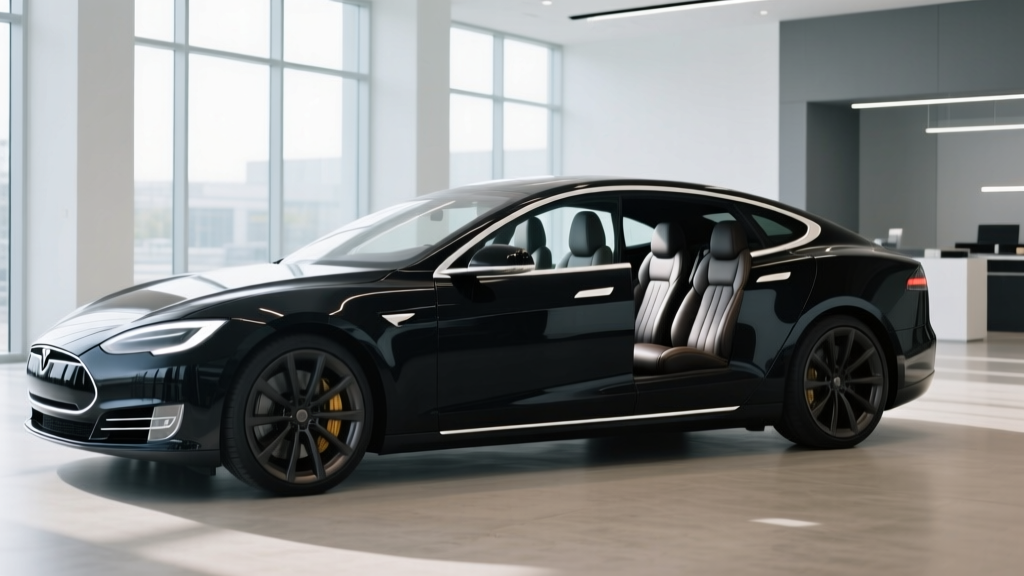
The optional third row in the Model S consists of two rear-facing seats that fold flat into the trunk floor when not in use. Tesla lists these as suitable for passengers up to a specified height and weight — historically, the seats have been rated for children and smaller adults, roughly up to 5'4" and 130 lbs based on previous model-year guidance. Always verify the current owner's manual for exact occupant limits.
Legroom and headroom: The third row offers approximately 28–30 inches of legroom (rear-facing orientation changes how this is measured versus forward-facing seats). Headroom is adequate for children but tight for anyone over about 5 feet tall. The rear-facing orientation means passengers look out through the rear glass — an experience younger children often enjoy but adults find disorienting on longer drives.
Cargo compromise: This is the critical trade-off. With the third-row seats deployed, cargo space behind them drops to approximately 10–12 cubic feet — enough for a couple of grocery bags or small backpacks, but not luggage for a family road trip. Folding the third row back into the floor restores the full 28.0 cu ft behind the second row. The front trunk (frunk) adds approximately 5.3 cu ft of enclosed storage.
For comparison, the Tesla Model X with its genuine three rows provides 41.1 cu ft behind the third row and 88.1 cu ft total — substantially more utility for families who regularly need seven seats plus cargo. The Model S third row is a part-time solution, not a full-time seven-seat configuration.
Performance and Driving Dynamics
Even with the third-row option adding approximately 50–60 pounds, the Model S Long Range delivers a 3.1-second 0–60 mph time and 670 horsepower from its dual-motor all-wheel-drive powertrain. The Plaid variant, with its tri-motor setup producing 1,020 hp, reaches 60 mph in 1.99 seconds — making it one of the quickest production sedans ever built, regardless of seating configuration.
Handling remains composed with the adaptive air suspension, which adjusts ride height based on speed and terrain. The Model S rides on a 116.5-inch wheelbase, providing stable highway manners. The added weight of the third-row hardware is negligible relative to the vehicle's 4,561-pound curb weight (Long Range).
Driver assistance: The Model S comes with Tesla's Basic Autopilot, which includes adaptive cruise control and lane-centering. This is a SAE Level 2 driver-assistance system, meaning the driver must remain fully engaged, keep hands on the wheel, and monitor the road at all times. Full Self-Driving (Supervised) is available as a $8,000 add-on or $99/month subscription, adding automated lane changes, traffic-light recognition, and navigation-on-autopilot — but it remains Level 2 and requires active driver supervision. It is not autonomous driving.
Pricing, Tax Credits, and Total Cost
| Trim | Base MSRP | Third-Row Option | Destination | Est. Before Credit |
|---|---|---|---|---|
| Long Range | $79,990 | ~$2,500 | $1,990 | ~$84,480 |
| Plaid | $94,990 | ~$2,500 | $1,990 | ~$99,480 |
Federal tax credit eligibility (§30D): The Tesla Model S does not qualify for the $7,500 federal EV tax credit under current IRS rules. The §30D credit imposes an MSRP cap of $55,000 for sedans — and the Model S, starting at $79,990, exceeds this threshold significantly. This is a definitive disqualifier regardless of buyer income or battery sourcing.
- MSRP Cap (sedans): $55,000 — Model S exceeds this ❌
- Buyer Income Cap: $150K single / $300K joint — irrelevant due to MSRP cap
- Battery Sourcing: Critical mineral and component requirements — irrelevant due to MSRP cap
- Point-of-Sale Transfer: Not applicable
Source: IRS §30D Clean Vehicle Credit guidelines. Tax rules are subject to legislative change. Consult a tax professional for your specific eligibility.
Buyers seeking a seven-seat Tesla with potential tax-credit eligibility should note that the Model X also exceeds the $80,000 MSRP cap for SUVs. The more affordable path to seven-seat electrification with credit eligibility lies with competitors like the Kia EV9 (starting around $54,900, potentially credit-eligible depending on trim and sourcing).
Tech, Interior, and Standout Features
The 2026 Model S interior centers on a 17-inch touchscreen with a tilting display, a 12.3-inch digital instrument cluster, and a secondary 8-inch rear-seat entertainment screen. The infotainment system supports over-the-air updates, a full web browser, and access to streaming services including Netflix, YouTube, and Spotify (while parked).
Notable features:
- Yoke steering wheel (standard since 2023; traditional round wheel available as a no-cost option)
- Wireless phone charging for two devices
- 22-speaker, 960-watt audio system
- HEPA air filtration with Bioweapon Defense Mode
- Powered frunk and trunk
- Over-the-air software updates that regularly add features
Notable drawbacks:
- No Apple CarPlay or Android Auto — Tesla's proprietary system only
- Rear visibility is compromised when the third row is deployed (passengers block the rear glass)
- Build quality, while improved, still draws occasional panel-gap complaints
- Minimal physical buttons — climate, mirrors, and glovebox all controlled via touchscreen
- Rear-seat USB-C ports but no dedicated rear climate zone controls for third-row passengers
Pros, Cons, and Competitor Comparison
- 402-mile EPA range is among the longest of any production EV
- 250 kW Supercharger access with the most mature charging network in the US
- Sub-3.2-second 0–60 in Long Range; 1.99s in Plaid
- Third row provides occasional 7-seat capability in a sedan footprint
- Air suspension with adjustable ride height
- Strong over-the-air update cadence
- 8-year/150,000-mile battery and drive unit warranty
- Third row fits only children; severely limits cargo when deployed
- No federal tax credit eligibility (MSRP exceeds $55K sedan cap)
- Starting price above $82K with the third-row option
- No Apple CarPlay or Android Auto
- DC fast charge peaks at 250 kW — some competitors now charge at 350 kW
- Insurance premiums run 20–40% higher than comparable gas sedans
- Yoke steering remains polarizing; round wheel availability varies
Key competitors for seven-seat EV buyers:
- Tesla Model X: Genuine three-row SUV, 348-mile EPA range, starts ~$79,990. More cargo and third-row space, but larger footprint and similar price.
- Kia EV9: Three-row SUV, up to 304-mile range, starts ~$54,900. May qualify for federal credit on eligible trims. Far more practical third row.
- Rivian R1S: Three-row adventure SUV, up to 410-mile range (Max Pack), starts ~$79,900. Excellent third row and off-road capability.
Who Should Buy the Seven-Seat Model S?
Choose the Model S with third row if:
- You prioritize maximum range (402 mi EPA) and Supercharger network access
- You need seventh and sixth seats only occasionally, for small children
- You prefer a sedan's driving dynamics over an SUV's ride height
- Performance matters — 670 hp standard, 1,020 hp available
- Federal tax credit ineligibility doesn't affect your budget
Choose a competitor if:
- You regularly carry more than five passengers (Model X, EV9, R1S)
- You need seven seats AND cargo space simultaneously
- Federal tax credit eligibility matters to your purchase decision
- Third-row passengers include teenagers or adults
- You prefer Apple CarPlay / Android Auto integration
Frequently Asked Questions
What is the real-world range of the Tesla Model S with the third-row option?
The third-row option adds minimal weight and does not materially change range. The EPA rates the Long Range at 402 miles. In real-world highway driving at 70–75 mph, expect approximately 320–350 miles. Cold weather (below 32°F) can reduce this to 280–320 miles. Fully loading the vehicle with seven passengers and cargo may reduce range an additional 3–5%.
How fast does the Model S charge at home and on the road?
On a Level 2 home charger at 11.5 kW, the Model S adds approximately 44 miles of range per hour, fully charging the ~95 kWh battery in about 9–10 hours. On a V3 Supercharger at up to 250 kW, a 10–80% charge takes approximately 30 minutes. The charge rate tapers significantly above 50% SoC and sharply above 80%.
Does the Tesla Model S qualify for the federal EV tax credit?
No. The IRS §30D credit caps sedan MSRP at $55,000. The Model S starts at $79,990, which disqualifies it regardless of buyer income or battery sourcing. Consult IRS guidelines or a tax professional for the latest rules.
Is the third row in the Model S safe for children?
The rear-facing third row is designed for smaller occupants and has specific height and weight limits published in the owner's manual. It is located in the rear crumple zone. However, rear-facing passengers in the trunk area raise legitimate concerns about rear-end collision safety that differ from forward-facing, dedicated third rows in SUVs. Review NHTSA ratings and discuss with your family before opting in.
Is the seven-seat Model S worth buying versus a Model X or Kia EV9?
If you need seven seats regularly and want cargo space, the Model X, Rivian R1S, or Kia EV9 are substantially more practical. The Model S third row makes sense only if you rarely need more than five seats but want the occasional option for two small children — and you prioritize sedan dynamics, maximum range, and Supercharger access over interior versatility.
What is the battery warranty on the Model S?
Tesla provides an 8-year or 150,000-mile warranty on the battery and drive unit (whichever comes first), with a guaranteed minimum 70% capacity retention over that period. The NMC chemistry battery is liquid-cooled with active thermal management, which helps mitigate long-term degradation compared to passively cooled packs.