The Quick Verdict: Still the Luxury Sedan to Beat
If you're shopping for a flagship electric sedan and the phrase "Tesla Model S rear" is in your search history, you're likely asking one of two things: Is the rear-seat experience actually comfortable for adults, and does the car's real-world range justify its six-figure price? The 2026 Tesla Model S Long Range answers both questions decisively — with a cavernous rear cabin that outpaces the Porsche Taycan and Lucid Air in pure legroom, and an EPA-rated 402 miles that remains the gold standard for highway cruising. But at a starting MSRP of $79,990, and with federal tax credit eligibility now a complex maze of income caps and battery-sourcing rules, the Model S demands a careful, numbers-driven look before you sign.
This review covers the 2026 Model S Long Range and Plaid trims, with an emphasis on rear-passenger practicality, real-world range honesty, and the exact ownership economics you'll face.
Range, Efficiency, and Real-World Expectations
The 2026 Tesla Model S Long Range carries an EPA-estimated 402 miles of range on its dual-motor all-wheel-drive powertrain. The Plaid trim, with its tri-motor setup, drops slightly to an EPA-estimated 396 miles. Both trims use a ~100 kWh usable battery pack built on Tesla's latest 4680-cell architecture with an NMC (nickel manganese cobalt) chemistry optimized for energy density and sustained highway efficiency.
Real-World Range vs. EPA Sticker
EPA Estimate: 402 mi (Long Range) / 396 mi (Plaid)
Highway (70-75 mph, mild weather): Expect ~340–365 mi. The Model S's sleek 0.208 Cd drag coefficient helps, but sustained high speeds still consume 15–18% more energy than the combined EPA cycle.
Cold Weather (below 32°F): Plan for ~280–310 mi. NMC chemistry loses more capacity in freezing temps than LFP, though Tesla's heat pump and battery preconditioning mitigate this better than most competitors.
City/Stop-and-Go: Regenerative braking pushes real-world city range close to or even above the EPA number — 400+ mi is achievable in mild conditions.
Efficiency-wise, the Long Range achieves an EPA-rated 120 MPGe combined (roughly 28 kWh/100 mi), which is exceptional for a 4,500+ lb sedan. The Plaid drops to about 116 MPGe combined. For context, the Lucid Air Grand Touring edges ahead at 131 MPGe, while the Porsche Taycan Turbo S trails at around 83 MPGe — though Porsche's 800V architecture delivers faster charging speeds.
| Spec | Long Range | Plaid |
|---|---|---|
| EPA Range | 402 mi | 396 mi |
| Battery (Usable) | ~100 kWh (NMC) | ~100 kWh (NMC) |
| Drivetrain | Dual-Motor AWD | Tri-Motor AWD |
| Horsepower | 670 hp | 1,020 hp |
| 0-60 mph | 3.1 sec | 1.99 sec |
| Top Speed | 155 mph | 200 mph |
| Efficiency (Combined) | 120 MPGe / 28 kWh/100mi | 116 MPGe / 29 kWh/100mi |
| Max DC Fast Charge | 250 kW | 250 kW |
| 10-80% DC Charge Time | ~27 min | ~27 min |
| Level 2 Home Charge | 11.5 kW (~44 mi/hr) | 11.5 kW (~44 mi/hr) |
| Cargo (Rear + Frunk) | 26.3 cu ft + 3.1 cu ft | 26.3 cu ft + 3.1 cu ft |
| Rear Legroom | 35.4 in | 35.4 in |
| Base MSRP | $79,990 | $94,990 |
| Battery Warranty | 8 yr / 150,000 mi | 8 yr / 150,000 mi |
Source: fueleconomy.gov, Tesla.com official specifications.
Charging Speed: DC Fast, Level 2, and the Supercharger Advantage
The Model S peaks at 250 kW on a V3 Tesla Supercharger or compatible CCS/NACS DC fast charger. In practice, a 10–80% session takes approximately 27 minutes under ideal conditions (battery preconditioned via navigation routing to a charger). The charging curve is aggressive early — you'll see 200+ kW up to about 40% SoC — but tapers noticeably past 60%, and drops sharply above 80%. This is typical for NMC cells managed for longevity.
| Charging Level | Power / Voltage | Speed | Typical Use Case |
|---|---|---|---|
| Level 1 (120V) | ~1.4 kW | ~5 mi/hr | Emergency / trickle |
| Level 2 (240V, 48A) | 11.5 kW | ~44 mi/hr | Home overnight charging |
| DC Fast (V3 Supercharger) | 250 kW peak | ~200 mi in 15 min (peak) | Road trips, 10-80% in ~27 min |
| DC Fast (CCS adapter / open network) | Up to 250 kW | Varies by station | Electrify America, EVgo, etc. |
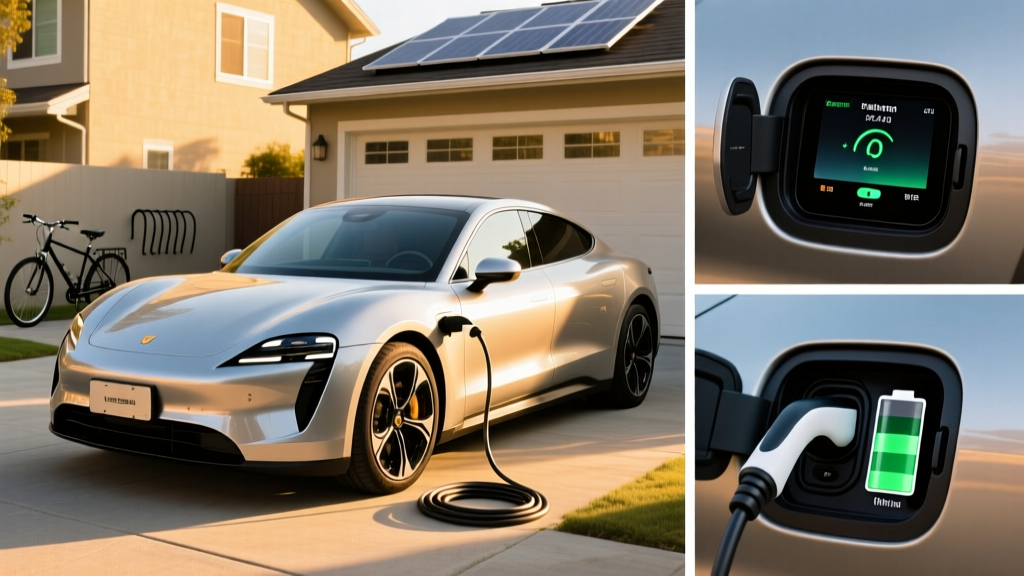
For home charging, the onboard charger accepts up to 11.5 kW on a 60-amp circuit (48A continuous), adding roughly 44 miles of range per hour. A full 0–100% charge at home takes about 9–10 hours. If your electrical panel supports a 100-amp dedicated circuit, Tesla's Wall Connector can deliver this maximum rate — but many homes will need a panel upgrade, which typically costs $1,500–$3,500 on top of the $400–$500 Wall Connector unit and $800–$2,000 in electrician labor.
The Model S now ships with the NACS (North American Charging Standard) connector natively. Tesla has also opened portions of its Supercharger network to non-Tesla EVs, but Model S owners still benefit from the most reliable, widely spaced fast-charging network in the US — with routing and preconditioning handled automatically by the navigation system.
Rear-Seat Comfort, Cargo, and Interior Practicality
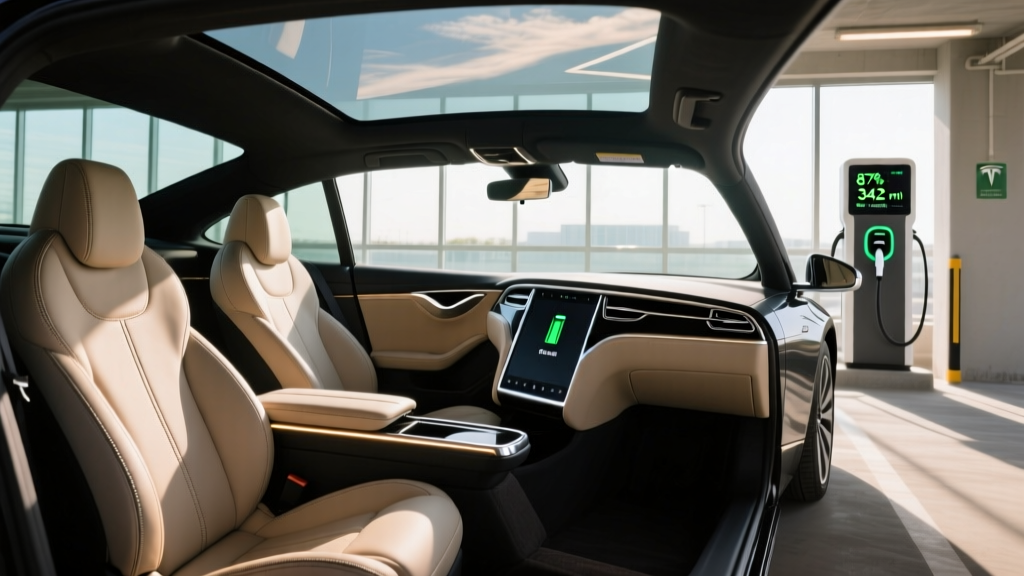
This is where the Tesla Model S rear experience earns its search volume. The rear cabin offers 35.4 inches of legroom, which is generous for the luxury EV sedan class. For comparison, the Porsche Taycan provides 32.7 inches, and the Lucid Air offers 36.3 inches. Two adults over six feet tall can sit behind a similarly sized driver without knee contact — a significant advantage over the Taycan's sportier, more cramped rear quarters.
The rear seat is a 60/40 split-folding bench (not individual captain's chairs), which maximizes flexibility. A fold-down center armrest includes cupholders and a small storage tray. Rear passengers get dedicated USB-C ports and climate vents, but there's no rear-seat entertainment screen as standard — a notable omission at this price point compared to the Lucid Air's available rear amenities.
Cargo space is outstanding: 26.3 cubic feet behind the rear seats (liftback-style hatch access, far more practical than a traditional sedan trunk) plus a 3.1 cu ft frunk. Fold the rear seats and you unlock over 64 cu ft — enough for furniture-hauling duty that no Taycan or BMW i7 can match. The hatchback design is the Model S's secret weapon for practicality.
Performance: Long Range vs. Plaid
The Long Range's dual-motor AWD delivers 670 horsepower and a 0–60 mph time of 3.1 seconds. That's supercar territory from just five years ago, and it's delivered with zero drama — just seamless, instant torque. Highway passing power is effortless, and the adaptive air suspension (standard) adjusts ride height and firmness based on speed and road conditions.
The Plaid's tri-motor setup produces 1,020 horsepower and a claimed 0–60 of 1.99 seconds (with rollout subtracted). It's a party trick you'll use twice and then leave in "Chill" mode forever. More relevantly, the Plaid's torque-vectoring rear motors give it cornering poise that belies its 4,766-lb curb weight. Track mode and carbon-ceramic brakes (optional) make it a legitimate track car — but at a $15,000 premium over the Long Range, most buyers will find the 3.1-second car more than sufficient.
Tech, Driver Assistance, and SAE Automation Level
The Model S runs Tesla's latest infotainment on a 17-inch center touchscreen with a secondary 8-inch rear touchscreen for rear-passenger climate and media control. The yoke steering wheel remains standard (a conventional round wheel is available at no cost). Wireless phone charging, a 22-speaker audio system, and HEPA air filtration with Bioweapon Defense Mode round out the tech roster.
Driver Assistance: SAE Level 2 — Not Self-Driving
Tesla's Autopilot (standard) and Full Self-Driving (Supervised) ($8,000 option or $99/month subscription) are both SAE Level 2 driver-assistance systems. This means the vehicle can manage steering, acceleration, and braking on highways, but the driver must remain fully attentive, hands on or near the wheel, and ready to take over at any moment. FSD Supervised adds automated lane changes, traffic-light recognition, and city-street navigation — but it is not autonomous driving. Only SAE Level 4 services like Waymo operate without a human driver. Tesla's system requires constant supervision and does not absolve the driver of liability.
Standard Autopilot includes Traffic-Aware Cruise Control and Autosteer (lane-centering). FSD Supervised adds Navigate on Autopilot, Auto Lane Change, Autopark, Summon, and Smart Summon. Real-world reliability varies — highway use is generally competent, while city-street FSD can make unexpected routing decisions. Plan to supervise actively at all times.
Pricing, Tax Credit Eligibility, and Total Cost
The 2026 Tesla Model S starts at $79,990 for the Long Range and $94,990 for the Plaid, before options and destination fees. A fully loaded Long Range with FSD, premium paint, and 21-inch wheels can push past $92,000.
| Trim | Base MSRP | Federal §30D Credit | Effective Price (if eligible) |
|---|---|---|---|
| Long Range | $79,990 | See eligibility below* | Varies |
| Plaid | $94,990 | See eligibility below* | Varies |
*Federal Tax Credit (§30D) Eligibility — Critical Caveats:
- MSRP Cap: The Model S is classified as a sedan, and the §30D MSRP cap for sedans is $55,000. At $79,990+, the 2026 Model S does not qualify for the new-vehicle federal EV tax credit. This is a dealbreaker for buyers counting on the $7,500 credit.
- Income Caps: Even for vehicles that qualify, buyer AGI must not exceed $150,000 (single), $225,000 (head of household), or $300,000 (joint).
- Battery Sourcing: Credits require percentage thresholds for critical minerals and battery components sourced from the US or FTA partners — rules that tighten annually through 2026.
- Point-of-Sale Transfer: For qualifying vehicles, the credit can be applied at purchase rather than waiting for a tax return — but again, the Model S's MSRP disqualifies it.
Source: IRS.gov Clean Vehicle Credit. Consult a tax professional for your specific situation. State and local incentives may still apply — check AFDC's state incentive database.
⚠ Tax Credit Reality Check
Do not factor the $7,500 federal credit into your Model S budget. The sedan MSRP cap of $55,000 eliminates the Model S entirely. If a tax credit is essential to your purchase math, consider the Tesla Model 3 ($38,990 base, potentially eligible) or look at state-level rebates that may have different caps.
Pros, Cons, and Who Should Buy
✅ Pros
- Class-leading 402-mile EPA range; best-in-segment highway cruiser
- Hatchback liftback design with 26.3 cu ft cargo — more practical than any rival sedan
- Spacious rear seat (35.4" legroom) comfortable for two adults on long trips
- Supercharger network access with seamless routing and preconditioning
- 670 hp Long Range is absurdly quick (3.1s to 60) without the Plaid premium
- Air suspension, 22-speaker audio, and HEPA filtration standard
- Over-the-air updates continue to add features years after purchase
❌ Cons
- Does NOT qualify for the $7,500 federal §30D tax credit (MSRP exceeds $55K sedan cap)
- 250 kW peak DC charging is slower than Porsche Taycan's 350 kW (800V) architecture
- Yoke steering is polarizing; round wheel available but feels like an afterthought
- FSD Supervised ($8,000) remains SAE Level 2 — not autonomous, inconsistent in cities
- No rear-seat entertainment screen standard at this price point
- Interior material quality (vegan leather, minimal physical controls) divides opinion vs. Lucid/Mercedes EQS luxury
- Insurance premiums run 25–40% higher than comparable gas sedans
Who Should Buy the 2026 Tesla Model S?
Choose the Model S Long Range if: You need a genuine 4-adult, 400-mile highway cruiser with hatchback cargo flexibility, you value Supercharger network reliability on road trips, and you don't need the federal tax credit to make the math work.
Look elsewhere if: Tax-credit eligibility is essential (consider Model 3, Hyundai Ioniq 6, or BMW i4 under the $55K sedan cap), you prioritize 800V-class ultra-fast charging (Porsche Taycan), or you want traditional luxury materials and dealer service (Lucid Air, Mercedes EQS).
Warranty and Long-Term Ownership
Tesla covers the Model S battery and drive unit for 8 years or 150,000 miles (whichever comes first), with a capacity retention threshold of 70%. If your pack degrades below 70% of its original capacity within the warranty period, Tesla will repair or replace it. The basic vehicle limited warranty is 4 years / 50,000 miles.
Real-world battery degradation data from Tesla's fleet shows an average capacity loss of approximately 8–12% over 150,000 miles for NMC packs — meaning most owners will retain 88–92% of their original range at the warranty boundary. The 100 kWh pack's replacement cost out of warranty is estimated at $15,000–$22,000 including labor, though this figure is expected to decline as 4680-cell production scales.
For long-term ownership, NMC chemistry benefits from daily charging to 80–90% (rather than 100%) and regular use. Tesla's built-in charge-limit setting makes this easy to manage. Avoid leaving the car at 100% SoC for extended periods, especially in hot climates.
Frequently Asked Questions
What is the real-world range of the 2026 Tesla Model S?
The EPA rates the Long Range at 402 miles and the Plaid at 396 miles. In real-world highway driving at 70–75 mph in mild weather, expect 340–365 miles. In freezing temperatures, plan for 280–310 miles. City driving with regenerative braking can match or slightly exceed the EPA number.
How fast does the Model S charge at home and on the road?
On a DC fast charger (V3 Supercharger), the Model S peaks at 250 kW, completing a 10–80% charge in approximately 27 minutes. At home on a Level 2 (240V, 48A) charger, it adds about 44 miles of range per hour, with a full charge taking 9–10 hours. A 120V Level 1 outlet adds only ~5 miles per hour.
Does the 2026 Tesla Model S qualify for the federal EV tax credit?
No. Under current IRS §30D rules, new sedans must have an MSRP at or below $55,000 to qualify for the up-to-$7,500 Clean Vehicle Credit. The Model S starts at $79,990, making it ineligible regardless of buyer income or battery sourcing. State and local incentives may still apply.
Is the Tesla Model S rear seat comfortable for adults?
Yes. With 35.4 inches of rear legroom, the Model S accommodates two adults comfortably on long trips. The hatchback/liftback design also provides 26.3 cu ft of cargo space — significantly more practical than a traditional trunk. However, there's no standard rear entertainment screen, and the seat is a bench rather than individual buckets.
Is the Model S worth buying vs. the Lucid Air or Porsche Taycan?
The Model S wins on range (402 vs. Lucid's ~516 mi for Air Grand Touring, but at a higher price), Supercharger access, and cargo versatility. The Lucid Air offers more luxury material quality and slightly more rear legroom. The Porsche Taycan charges faster (350 kW on 800V) but sacrifices range (EPA ~246 mi for Turbo S). If road-trip charging infrastructure and cargo space are your top priorities, the Model S remains the strongest all-around choice in the segment.
What's the biggest drawback of the Model S in 2026?
The inability to qualify for the federal $7,500 tax credit due to the $55,000 sedan MSRP cap is the most significant financial drawback. Combined with higher-than-average insurance premiums and an $8,000 FSD option that remains SAE Level 2, the total cost of ownership requires careful budgeting. The 250 kW charging speed, while adequate, also falls behind the 350 kW capability of Porsche's 800V platform.