The Tesla Model S has long occupied a unique space in the EV market: a luxury sedan that somehow offers optional rear-facing third-row seats, turning it into a seven-passenger vehicle. For 2026, the Model S continues this tradition, but the question remains — are those rear-facing seats genuinely usable, or just a novelty? This review examines the full ownership picture, from real-world range and charging speed to whether this is the right EV for your family.
Tesla Model S Rear-Facing Seats: What You Need to Know
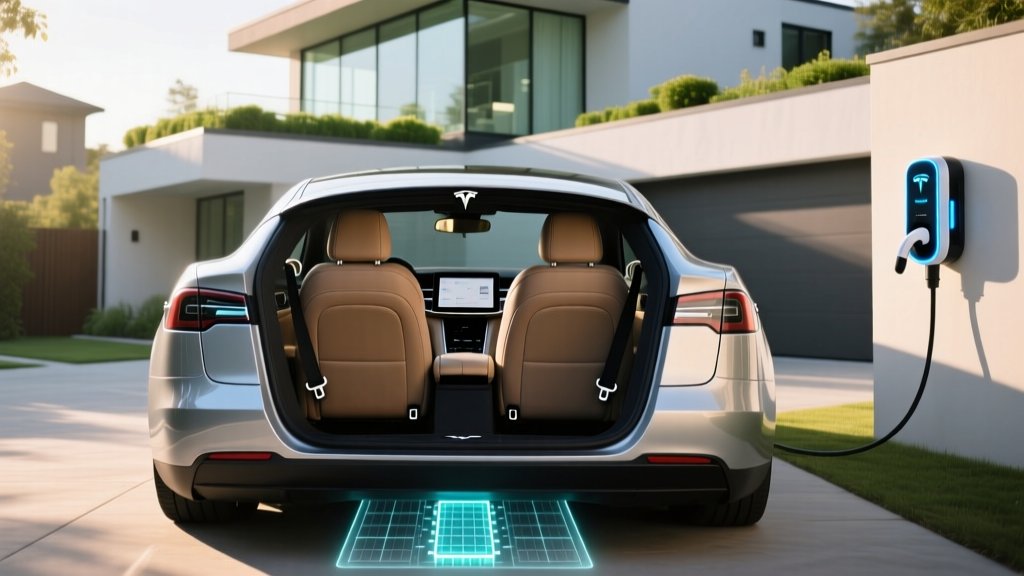
The rear-facing third-row seat option in the Model S is a $1,500 add-on available on the Long Range trim. It replaces the standard five-seat configuration with two small, rearward-facing jump seats in the cargo area, bringing total seating to seven. These seats are designed primarily for children — Tesla recommends them for passengers under approximately 5'3" tall and under 100 lbs.
The rear-facing orientation is a deliberate safety choice. In a frontal collision, the forces push occupants into the seat back rather than against a harness, distributing impact across a larger area. This mirrors the logic behind rear-facing infant car seats. However, the trade-offs are significant: limited headroom, no dedicated HVAC vents for the third row, minimal legroom, and a compromised cargo area when the seats are in use.
2026 Tesla Model S Specs at a Glance
| Spec | Long Range AWD | Plaid |
|---|---|---|
| EPA Range | 402 miles | 396 miles |
| Battery (usable) | ~95 kWh (NMC) | ~95 kWh (NMC) |
| Drivetrain | Dual-Motor AWD | Tri-Motor AWD |
| Horsepower | 670 hp | 1,020 hp |
| 0–60 mph | 3.1 seconds | 1.99 seconds |
| MPGe (combined) | 120 MPGe | 116 MPGe |
| Efficiency | 28 kWh/100 mi | 29 kWh/100 mi |
| Max DC Fast Charge | 250 kW | 250 kW |
| 10–80% DC Charge | ~28 minutes | ~28 minutes |
| Level 2 Home Charge | 11.5 kW (~44 mi/hr) | 11.5 kW (~44 mi/hr) |
| Base MSRP | $79,990 | $94,990 |
| Rear-Facing Seat Option | $1,500 (Long Range only) | Not available |
Sources: EPA fueleconomy.gov, Tesla.com
Real-World Range: What the EPA Number Doesn't Tell You
The ~95 kWh NMC (nickel manganese cobalt) battery pack provides excellent energy density, which is why the Model S achieves over 400 miles despite weighing approximately 4,561 lbs. NMC chemistry offers higher energy density than LFP (lithium iron phosphate) but comes with a recommended daily charge limit of 80–90% to maximize long-term battery health. For road trips, charging to 100% is fine — Tesla's battery management system includes a buffer to protect cells.
At 28 kWh per 100 miles, the Model S Long Range is remarkably efficient for a large luxury sedan. This translates to roughly $0.04–$0.06 per mile when charging at home on average US electricity rates ($0.16/kWh), compared to $0.12–$0.15 per mile for a comparable gas sedan at 25 MPG and $3.50/gallon.
Charging Speed: DC Fast Charging and Home Setup
The Model S charges via the NACS (North American Charging Standard) connector natively — Tesla's proprietary plug that has now been adopted industry-wide. This gives Model S owners access to the Supercharger network, widely regarded as the most reliable DC fast-charging infrastructure in the US.
| Charging Level | Power | Miles Added per Hour | Best Use Case |
|---|---|---|---|
| Level 1 (120V) | ~1.4 kW | ~5 mi/hr | Emergency / overnight trickle |
| Level 2 (240V, 48A) | 11.5 kW | ~44 mi/hr | Daily home charging |
| DC Fast (Supercharger V3) | 250 kW peak | ~200 mi in 15 min | Road trips |
A critical nuance: the 250 kW peak charge rate is not sustained across the full session. The Model S charge curve peaks near 250 kW at low states of charge (10–25%) and progressively tapers. By 60% SoC, the rate drops to roughly 120–150 kW, and above 80% it slows dramatically to protect the battery. This is why the 10–80% time of approximately 28 minutes is the most meaningful metric — not the peak kW number.
For home charging, the Tesla Wall Connector on a 60-amp circuit delivers 11.5 kW (48 amps continuous), adding roughly 44 miles of range per hour. A full charge from 10% to 90% takes approximately 7–8 hours overnight. Installation costs for a dedicated 60-amp circuit typically run $800–$2,000 depending on panel proximity and local electrical codes. Homes with older 100-amp electrical panels may need a $2,000–$4,000 panel upgrade.
Always hire a licensed electrician for Level 2 installation. Final circuit sizing and permit requirements vary by jurisdiction.
Interior, Cargo, and Rear-Facing Seat Practicality
The Model S interior blends minimalist design with impressive technology. The 17-inch center touchscreen runs Tesla's latest software with responsive performance, excellent navigation, and over-the-air updates. A secondary 8-inch screen serves rear passengers. The yoke steering wheel remains polarizing but functional for most drivers.
Dimensions and Space
- Front legroom: 42.7 inches
- Rear legroom (second row): 40.9 inches
- Rear-facing third-row legroom: ~28 inches (limited)
- Cargo volume (behind second row, seats folded): 28.0 cu ft
- Cargo volume (max, second row folded): 64.9 cu ft
- Frunk (front trunk): 3.1 cu ft
With the rear-facing seats deployed, usable cargo space drops significantly. You can fit a few grocery bags or backpacks, but not a stroller or luggage. The seats fold flat into the floor when not in use, restoring the full cargo area — a practical design that makes the option low-cost in daily use.
The second-row bench is comfortable for two adults on long trips, with adequate headroom thanks to the glass roof. However, the sloping roofline means taller passengers (6'2"+) will notice reduced headroom compared to an SUV. The rear-facing third row is strictly a child-oriented space — no adult should expect to ride there comfortably.
Pricing, Tax Credits, and Total Cost
| Trim | Base MSRP | With Rear-Facing Seats | Est. As-Tested |
|---|---|---|---|
| Long Range AWD | $79,990 | $81,490 | $83,000–$87,000 |
| Plaid | $94,990 | N/A | $96,000–$102,000 |
Federal Tax Credit Eligibility (§30D)
For buyers seeking the tax credit, this is a major financial consideration. The Model S is priced as a luxury vehicle, and the full MSRP is what you'll pay (minus any state-level incentives that may apply — check your state's energy office for local rebates).
5-Year Ownership Cost Estimate
Despite the lack of federal credit, the Model S can deliver meaningful operating savings. Over five years and 75,000 miles:
- Electricity (home charging at $0.16/kWh): ~$3,360
- Equivalent gas (25 MPG at $3.50/gal): ~$10,500
- Fuel savings: ~$7,140
- Maintenance savings (no oil, fewer brake replacements due to regen): ~$2,500–$3,500
- Insurance premium increase (luxury EV): ~$1,200–$2,000 additional over 5 years
Net 5-year savings versus a comparable gas sedan: approximately $7,500–$8,500 in operating costs, partially offset by the lack of a federal tax credit and higher insurance.
Performance, Tech, and Driver Assistance
The Model S Long Range delivers 670 horsepower from its dual-motor all-wheel-drive system, achieving a 3.1-second 0–60 mph time. This is supercar territory in a family sedan. The Plaid's tri-motor setup pushes 1,020 hp and a 1.99-second 0–60 — a figure that remains staggering in real-world use.
Ride quality is excellent, with adaptive air suspension that adjusts ride height and damping. The cabin is impressively quiet at highway speeds, aided by acoustic glass and the inherent silence of electric drivetrains.
Autopilot and FSD (Supervised)
FSD (Supervised) costs $8,000 as a one-time purchase or $99/month. It adds automatic lane changes, traffic light/stop sign recognition, and city-street navigation. In practice, FSD performs well on highways but requires frequent driver intervention in complex urban environments, construction zones, and inclement weather. Whether it's worth the cost depends on your commute — highway-heavy drivers get the most value.
Standout Tech Features
- 17-inch cinematic touchscreen with gaming-capable hardware (AMD Ryzen)
- Over-the-air software updates adding features post-purchase
- Sentry Mode (parked camera surveillance with cloud alerts)
- Dog Mode (climate control for pets with external display)
- HEPA air filtration with Bioweapon Defense Mode
- Vaporware note: Tesla has removed ultrasonic sensors in favor of Tesla Vision (camera-only) — parking assist relies entirely on cameras, which can be less precise in heavy rain or dirty conditions
Pros, Cons, and Who Should Buy
Pros
- 402-mile EPA range — among the longest of any EV
- Access to Tesla Supercharger network (most reliable in US)
- Rear-facing seats enable 7-passenger seating in a sedan
- Exceptional performance (3.1s 0–60 Long Range)
- Low operating costs vs. gas equivalents
- Excellent efficiency (28 kWh/100 mi)
- Continuous OTA improvements
Cons
- Rear-facing third row only fits small children, uncomfortable for longer trips
- No federal tax credit (exceeds $55K MSRP cap)
- $79,990+ starting price — steep entry point
- Camera-only parking assist can struggle in bad weather
- Yoke steering not preferred by all drivers
- Rear headroom limited by sloping roofline
- Insurance premiums higher than average
Who This EV Suits Best
Buy the Model S with rear-facing seats if: You want a luxury sedan with the longest range in its class, primarily drive with two children who can use the rear-facing seats for short trips, value Supercharger access for road trips, and don't need the federal tax credit to make the math work.
Look elsewhere if: You regularly need to carry more than two additional passengers (consider Model X, Rivian R1S, or Kia EV9), you need a traditional forward-facing third row with real legroom, or your budget depends on the $7,500 federal credit.
How It Compares to Key Competitors
The Model S rear-facing seat option doesn't have a direct rival — no other sedan offers a third row. The real comparison is against 7-seat electric SUVs:
- Tesla Model X ($84,990+): Proper forward-facing third row, falcon-wing doors, more cargo space. ~335-mile range. Heavier, less efficient, and more expensive — but genuinely usable for 7 adults in a pinch.
- Rivian R1S ($82,700+): Three-row electric SUV with proper seating for 7. ~352-mile range (Dual-Motor). Better off-road capability, more rugged. No Supercharger access natively (requires NACS adapter).
- Kia EV9 ($54,900+): Three-row electric SUV starting under the tax-credit MSRP cap — potentially eligible for $7,500 credit. ~304-mile range. More affordable, but less range and performance.
The Model S wins on range, efficiency, and charging infrastructure. It loses on third-row practicality and overall interior volume. If seven seats are a daily need rather than an occasional convenience, an SUV is the better platform.
Battery Warranty and Long-Term Ownership
Tesla covers the Model S battery and drive unit with an 8-year / 120,000-mile warranty (whichever comes first), guaranteeing a minimum of 70% battery capacity retention over that period. Real-world data from Tesla's fleet suggests NMC packs in the Model S typically retain 85–90% capacity after 100,000 miles, well above the warranty threshold.
Battery replacement, if needed out of warranty, currently costs approximately $12,000–$20,000 depending on the pack configuration and service location. However, full replacements are rare — individual module repairs are often possible at lower cost.
Tesla's build quality has improved in recent years, though panel gaps and minor interior trim issues still appear more frequently than in German luxury competitors. The 4-year/50,000-mile basic vehicle warranty matches industry standards.
Frequently Asked Questions
What is the real-world range of the Tesla Model S?
The EPA rates the Long Range at 402 miles. Real-world mixed driving yields 340–370 miles. Highway-only driving at 75+ mph drops to ~300–320 miles. In freezing weather, expect 280–320 miles depending on cabin heat usage and whether you precondition the battery.
How fast does the Model S charge at home and on the road?
On a home Level 2 charger (11.5 kW), the Model S adds ~44 miles per hour, fully charging overnight in 7–8 hours. At a Supercharger V3 (250 kW peak), it charges 10–80% in approximately 28 minutes, adding up to 200 miles in 15 minutes at peak rate.
Does the Tesla Model S qualify for the federal EV tax credit?
No. The IRS §30D credit has a $55,000 MSRP cap for sedans. The Model S starts at $79,990, disqualifying it regardless of buyer income. State-level incentives may still apply — check your state's energy or DMV website.
How much does the Model S cost after incentives?
Without the federal credit, you'll pay the full MSRP: $81,490 for a Long Range with rear-facing seats, plus destination and options. Some states offer rebates of $1,000–$5,000 (e.g., California, Colorado, Massachusetts), but amounts and eligibility vary. Consult your state's official incentive database.
Are the rear-facing seats safe?
Tesla designed the rear-facing seats with safety as a priority — rear-facing orientation distributes crash forces across the seat back. They include 3-point harnesses. However, they lack side-impact protection comparable to dedicated child car seats. For infants and toddlers, a proper rear-facing car seat installed in the second row remains the safest option.
Is the Model S worth buying over the Model X for families?
If you only occasionally need extra seats for short trips with children, the Model S with rear-facing seats saves money and delivers better range. If you regularly carry 5+ passengers or need a usable third row for older children and adults, the Model X (or a competitor like the Rivian R1S) is the more practical choice despite higher cost and lower range.
Can I install a home charger for the Model S myself?
The Tesla Mobile Connector (included) plugs into a standard 120V outlet for Level 1 charging (~5 mi/hr). For Level 2 speeds, you need a Tesla Wall Connector or equivalent J3472/NACS charger hardwired to a 60-amp circuit. This requires a licensed electrician, permits, and potentially a panel upgrade. Never attempt high-voltage electrical work without a professional.