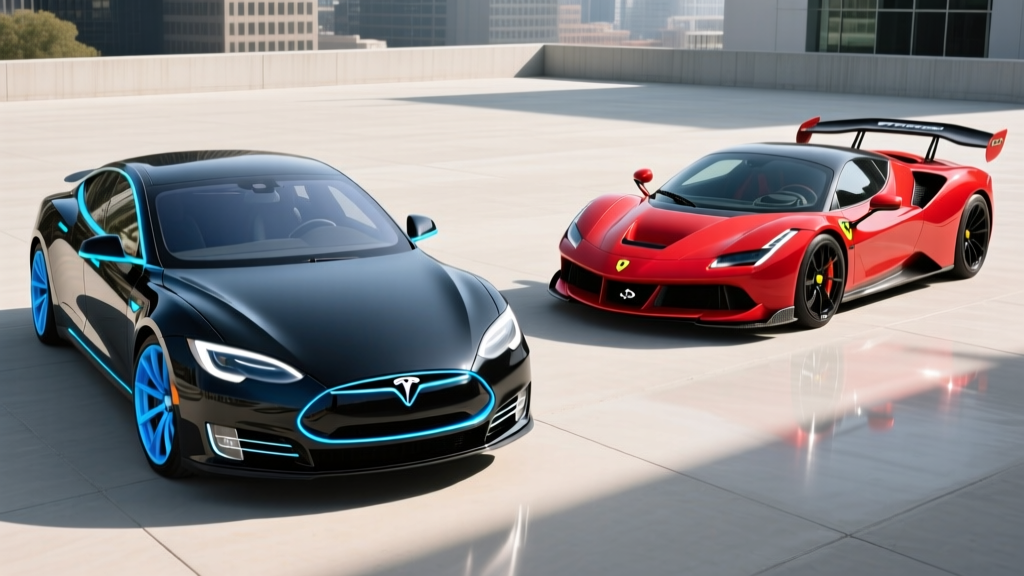
Search "tesla v ferrari" and you'll find drag-strip clips and forum arguments, but rarely a rigorous, numbers-driven breakdown of what these two machines actually deliver as daily-drivable performance cars in 2026. On one side: the Tesla Model S Plaid, a 1,020-horsepower all-electric sedan that rewrote the acceleration rulebook. On the other: the Ferrari SF90 Stradale (and its Spider/open-top sibling), a 986-hp plug-in hybrid supercar from Maranello that pairs a twin-turbo V8 with three electric motors.
This isn't a beauty contest — it's an engineering and ownership comparison. We'll dissect EPA range, real-world efficiency, charging and refueling, performance data, cargo practicality, warranty coverage, and total cost to help you decide which approach to extreme speed actually fits your life.
At a Glance: Side-by-Side Spec Table
| Spec | Tesla Model S Plaid (2026) | Ferrari SF90 Stradale (2026) |
|---|---|---|
| Powertrain | Tri-motor AWD (BEV) | 4.0L Twin-Turbo V8 + 3 electric motors (PHEV) |
| Horsepower | 1,020 hp | 986 hp (769 gas + 217 electric) |
| 0–60 mph | 1.99 sec (manufacturer, rollout subtracted) | 2.5 sec (manufacturer) |
| Top Speed | 200 mph | 211 mph |
| EPA Electric Range | 396 miles (BEV) | ~9 miles electric-only (PHEV) |
| Battery / Fuel | ~100 kWh usable (NMC) | 7.9 kWh battery + 17.7-gal fuel tank |
| Max DC Fast Charge | 250 kW (Supercharger V3) | N/A (AC charge only, ~6 kW) |
| 10–80% Charge Time | ~30 min (DCFC) | ~2 hr (Level 2, full charge) |
| EPA Efficiency | 116 MPGe combined / 31 kWh/100mi | ~13 MPGe combined (gas + electric) |
| Cargo Volume | 28 cu ft (trunk + frunk) | ~4.6 cu ft (front trunk only) |
| Seating | 5 passengers | 2 passengers |
| Base MSRP | $89,990 | $524,995 |
| Federal Tax Credit (§30D) | Up to $7,500 (eligibility varies) | $0 (exceeds MSRP cap) |
| Drivetrain Warranty | 8 yr / 120,000 mi (battery & drive units) | 3 yr / unlimited mi (powertrain); 7 yr maintenance |
Range, Efficiency, and the Real-World Reality Check
The range gap between these two is philosophical as much as numerical. The Model S Plaid is a long-range battery-electric vehicle designed to cross continents; the SF90 is a hypercar with a plug, meant to sip electricity around town and unleash its V8 everywhere else.
Tesla Model S Plaid: EPA-rated at 396 miles. In real-world highway driving at 75 mph, expect roughly 310–340 miles. In freezing temperatures (below 32°F), range drops 20–30%, yielding approximately 260–290 miles. Tesla's heat pump helps mitigate cabin-heating losses, but battery chemistry still suffers in extreme cold.
Ferrari SF90 Stradale: The 7.9 kWh battery delivers roughly 6–9 miles of electric-only driving (EPA-equivalent). Combined gas-electric range on a full tank is approximately 300–340 miles, depending on how aggressively you drive — and with 986 hp on tap, most owners drive aggressively. Efficiency plummets to single-digit MPG on track or canyon runs.
The Model S Plaid's efficiency of 31 kWh/100 miles (116 MPGe combined per fueleconomy.gov) is remarkable for a 4,766-pound sedan producing over 1,000 horsepower. For context, that's roughly $0.10–$0.14 per mile at average US residential electricity rates (~$0.16/kWh), versus the SF90's ~$0.45–$0.60 per mile on premium fuel at $4.50/gallon.
Charging and Refueling: Speeds, Connectors, and Infrastructure
Here's where the ownership experience diverges most dramatically. The Model S Plaid taps into Tesla's Supercharger network — widely considered the most reliable DC fast-charging ecosystem in North America. The SF90 charges its small battery via a standard J1772 AC plug and refuels at any gas station.
| Charging/Refueling Method | Tesla Model S Plaid | Ferrari SF90 Stradale |
|---|---|---|
| Level 1 (120V / 12A) | ~3–4 mi/hr | ~2 mi/hr (electric only) |
| Level 2 (240V / 48A) | ~44 mi/hr (~11.5 kW) | Full charge in ~2 hr (~6 kW) |
| DC Fast Charge | 250 kW peak (NACS connector) | Not supported |
| 10–80% DCFC Time | ~30 minutes | N/A |
| Gas Refuel | N/A | ~3 min at pump (17.7 gal tank) |
The Plaid's charging curve peaks near 250 kW between 10–30% state of charge, then tapers progressively. From 50–80%, expect sustained rates closer to 100–130 kW. This is standard lithium-ion behavior — peak kW figures are never sustained across the full curve. For road trips, Tesla's navigation system automatically preconditions the battery before arrival at a Supercharger, which significantly improves charge speed in cold weather.
The SF90's 7.9 kWh battery is designed for short electric-only sprints — think neighborhood departures and zero-emission urban crawling. You plug in overnight on a Level 2 home charger, wake up to a full battery, and the V8 handles everything else. There's no DC fast charging because there doesn't need to be; the battery is too small to benefit from it.
Performance: Drag Strip, Track, and the Physics of Instant Torque
Both cars are engineering marvels, but they achieve speed through fundamentally different mechanisms. The Model S Plaid's tri-motor setup (one front, two rear) delivers instantaneous torque with zero lag — no turbo spool, no transmission shift, no drivetrain wind-up. The SF90's hybrid system fills torque gaps between the V8's power pulses with electric motor assist, creating a seamless wave of acceleration that feels more organic but slightly slower to a stopwatch.
| Performance Metric | Tesla Model S Plaid | Ferrari SF90 Stradale |
|---|---|---|
| 0–60 mph | 1.99 sec* | 2.5 sec |
| Quarter Mile | 9.25 sec @ 152 mph | ~9.8 sec @ 155 mph |
| Top Speed | 200 mph | 211 mph |
| Curb Weight | 4,766 lbs | 3,461 lbs |
| Drivetrain | AWD (tri-motor) | AWD (V8 rear + 2 electric front) |
| Transmission | Single-speed reduction gear | 8-speed dual-clutch automatic |
*Tesla's 1.99-second claim subtracts a 1-foot rollout, standard in drag racing. Independent tests (MotorTrend, Car and Driver) have recorded 2.07–2.28 seconds without rollout subtraction — still blisteringly fast and the quickest production sedan ever measured.
On a road course, the SF90's 1,300-pound weight advantage, carbon-ceramic brakes, and Ferrari's decades of chassis tuning give it a decisive edge in lap times, cornering G-forces, and brake fade resistance. The Plaid is astonishingly fast in a straight line and surprisingly competent through corners for its mass, but physics is physics — nearly 4,800 pounds of battery and steel can't match a mid-engine carbon-fiber supercar at the limit.
Pricing, Tax Credits, and Total Cost of Ownership
The price gap is staggering and defines who these cars are actually for.
| Cost Factor | Tesla Model S Plaid | Ferrari SF90 Stradale |
|---|---|---|
| Base MSRP | $89,990 | $524,995 |
| Typical As-Tested Price | $95,000–$105,000 (options) | $600,000–$700,000+ (options/customization) |
| Federal §30D Tax Credit | Up to $7,500 (see eligibility below) | $0 — exceeds $55,000 sedan MSRP cap |
| Estimated 5-Year Fuel/Energy | ~$4,500 (electricity) | ~$18,000+ (premium fuel) |
| Estimated 5-Year Insurance | ~$18,000–$24,000 | ~$40,000–$60,000+ |
| 5-Year Depreciation (est.) | ~$35,000–$45,000 | ~$80,000–$150,000 (varies widely) |
The Model S Plaid may qualify for up to $7,500 under the IRS §30D Clean Vehicle Credit, but eligibility depends on multiple factors per irs.gov:
- MSRP Cap: Sedans must have an MSRP ≤ $55,000. The Plaid at $89,990 exceeds this cap, meaning it does NOT qualify for the new-vehicle §30D credit. (Note: Tesla has periodically restructured pricing; always verify with the dealer and your tax professional.)
- Buyer Income Cap: Modified AGI ≤ $150,000 (single) / $300,000 (joint).
- Battery Sourcing: Critical minerals and battery components must meet phased-in domestic-content thresholds.
- Point-of-Sale Transfer: Eligible credits can be transferred to the dealer at purchase for an immediate price reduction.
Interior, Cargo, and Daily Practicality
This is where the comparison becomes almost comically lopsided — and where the Plaid's case as a "supercar you can actually live with" gets strongest.
| Practicality Metric | Tesla Model S Plaid | Ferrari SF90 Stradale |
|---|---|---|
| Seating Capacity | 5 adults | 2 |
| Rear Legroom | 40.9 inches | N/A |
| Cargo (Trunk + Frunk) | 28.0 cu ft combined | ~4.6 cu ft (frunk only) |
| Infotainment Screen | 17-inch center touchscreen + rear screen | 7-inch digital cluster + central touchpad |
| Driver Assistance | Autopilot (SAE Level 2), FSD Supervised available | Basic cruise control, parking sensors |
| Over-the-Air Updates | Yes (frequent, feature-adding) | No |
| Ground Clearance | 5.0 inches (adaptive air suspension) | ~4.3 inches (front-lift system available) |
The Plaid functions as a genuine daily driver: school runs, grocery hauls, airport trips, and 500-mile road trips are all trivial. Its 17-inch infotainment screen, yoke-or-wheel steering option, HEPA air filtration, and available FSD (Supervised) — which remains an SAE Level 2 driver-assist system requiring full driver attention — make it one of the most tech-dense cabins on the road.
The SF90's interior is a masterpiece of carbon fiber and Italian leather, but it's a focused cockpit, not a living space. Cargo is limited to a small front trunk suitable for a weekend bag. Visibility is compromised by the mid-engine layout. There's no rear seat, no meaningful storage, and the infotainment system prioritizes minimalism over functionality. This is a car you drive to destinations, not in for comfort.
Tesla's Autopilot and Full Self-Driving (Supervised) are SAE Level 2 systems — they provide steering and acceleration assistance but require the driver to remain fully engaged, hands on or near the wheel, eyes on the road at all times. Neither system makes the car "self-driving." Only Level 4 services like Waymo operate without a human driver, and only in geofenced areas. The SF90 offers no advanced driver-assistance beyond parking sensors and basic cruise control.
Warranty, Reliability, and Long-Term Ownership
| Warranty Coverage | Tesla Model S Plaid | Ferrari SF90 Stradale |
|---|---|---|
| Basic Vehicle | 4 yr / 50,000 mi | 3 yr / unlimited mi |
| Battery & Drive Units | 8 yr / 120,000 mi (min 70% retention) | 7 yr hybrid system coverage |
| Free Maintenance | None included | 7 yr / unlimited mi (Genuine Maintenance program) |
| Estimated Battery Replacement | $15,000–$22,000 (out of warranty) | Hybrid battery: $10,000–$15,000 est. |
Tesla's 8-year/120,000-mile battery warranty guarantees at least 70% capacity retention — meaning your 396-mile range should stay above ~277 miles through the warranty period. Real-world degradation data from Tesla's fleet suggests most Model S batteries retain 85–90% capacity at 100,000 miles, particularly with the current NMC chemistry and improved thermal management.
Ferrari's 7-year Genuine Maintenance program covers all scheduled service — oil changes, brake fluid, filters — which is significant given that supercar maintenance costs are typically punishing. The hybrid system (battery + electric motors) carries separate coverage. Ferrari's build quality and reliability have improved substantially in recent years, but out-of-warranty repairs on a $525,000 Italian hybrid supercar remain eye-wateringly expensive.
Pros, Cons, and the Verdict
Tesla Model S Plaid — Pros
- Quickest production sedan ever (sub-2.1 sec 0–60)
- 396-mile EPA range with Supercharger network access
- Seats 5 with 28 cu ft cargo — genuine daily driver
- Low running costs (~$0.12/mi electricity vs $0.50+/mi gas)
- Continuous OTA updates add features post-purchase
- Autopilot/FSD for highway commuting assistance
- Under $100K for supercar-beating performance
Tesla Model S Plaid — Cons
- Heavy (4,766 lbs) — limits track-day cornering and brake endurance
- No §30D tax credit (exceeds $55K sedan MSRP cap)
- Build quality inconsistent vs luxury competitors
- Yoke steering controversial; no traditional stalks
- Insurance premiums elevated for performance EV
- Depreciation steeper than Porsche Taycan
Ferrari SF90 Stradale — Pros
- Exquisite mid-engine chassis and steering feel
- 986 hp with soulful twin-turbo V8 soundtrack
- ~1,300 lbs lighter — vastly superior on road courses
- 7-year free maintenance included
- Collector-grade exclusivity and resale potential
- Plug-in hybrid allows silent EV neighborhood driving
- 211 mph top speed
Ferrari SF90 Stradale — Cons
- $525K+ base; options push well past $650K
- 2 seats, 4.6 cu ft cargo — impractical for daily use
- ~9 miles electric-only range; PHEV is supplemental
- No DC fast charging; AC-only for small battery
- Single-digit MPG under hard driving
- Insurance and out-of-warranty repair costs extreme
- No advanced driver-assist or autonomy features
Choose the Tesla Model S Plaid if: You want supercar acceleration in a 5-seat daily driver, value low running costs, road-trip frequently, and want cutting-edge software and driver-assist tech — all under $100K.
Choose the Ferrari SF90 Stradale if: You're a collector or enthusiast who prioritizes driving dynamics, exclusivity, chassis feedback, and brand heritage over practicality — and budget is not a constraint.
Frequently Asked Questions
Is the Tesla Model S Plaid faster than a Ferrari?
In straight-line acceleration, yes. The Plaid's 1.99-second 0–60 time (with rollout) beats the SF90's 2.5 seconds. However, on a road course or race track, the SF90's 1,300-pound weight advantage, carbon-ceramic brakes, and mid-engine balance produce faster lap times. Top speed also favors Ferrari at 211 mph vs Tesla's 200 mph.
Does the Tesla Model S Plaid qualify for the federal EV tax credit?
No, as of 2026, the Model S Plaid does not qualify for the §30D new-vehicle credit. IRS rules cap eligible sedans at an MSRP of $55,000, and the Plaid starts at $89,990. Always verify current rules at irs.gov and consult a tax professional, as regulations evolve.
What is the real-world range of the Model S Plaid?
The EPA rates it at 396 miles. Real-world highway driving at 70–80 mph yields roughly 310–340 miles. In freezing weather, expect 260–290 miles due to battery chemistry limitations and increased cabin heating demand, even with Tesla's heat pump.
Can the Ferrari SF90 drive on electricity alone?
Yes, for approximately 6–9 miles at low speeds using its 7.9 kWh battery and front electric motors. Ferrari designed this for zero-emission urban driving and silent neighborhood departures. The V8 engages automatically under hard acceleration or when the battery depletes.
How much does it cost to charge a Model S Plaid vs fueling an SF90?
At the US average residential electricity rate (~$0.16/kWh), a full 100 kWh charge costs roughly $16 and delivers ~340 real-world miles — about $0.047 per mile. Supercharging is pricier at ~$0.25–$0.35/kWh ($0.07–$0.10/mi). The SF90 on premium fuel at $4.50/gallon and ~14 MPG combined costs approximately $0.32 per mile, rising sharply under hard driving.
Which is the better daily driver?
The Model S Plaid, without question. It seats five, carries 28 cubic feet of cargo, achieves 116 MPGe, has access to 6,000+ Supercharger stations, and offers Autopilot for highway commuting. The SF90 is a weekend and track-day machine that happens to be street-legal — its 2-seat layout, minimal cargo, and punishing ride quality on rough roads make it impractical for daily duties.