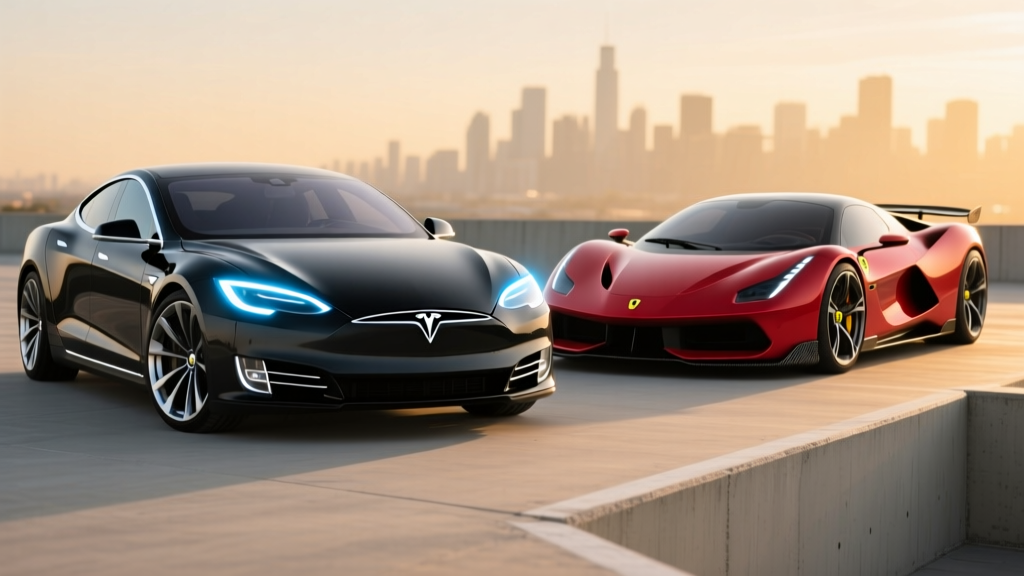
The search for "Tesla Ferrari" usually means one of two things: you're either cross-shopping the quickest sedan Tesla builds against Maranello's fastest offerings, or you're tracking Ferrari's long-promised first fully electric car. Both questions deserve precise, data-backed answers — not hype. This profile anchors on the 2026 Tesla Model S Plaid as the closest thing to a "Tesla Ferrari" you can actually buy today, then stacks it against Ferrari's current electrified lineup (the 296 GTB PHEV and Purosangue V8 PHEV) and what we know about Ferrari's upcoming all-electric model.
2026 Tesla Model S Plaid: The Electric Supercar Sedan
The Model S Plaid remains Tesla's performance flagship — a tri-motor, all-wheel-drive sedan that hits 60 mph in 1.99 seconds and carries an EPA-estimated 396 miles of range. It's the vehicle most often invoked when enthusiasts ask whether Tesla can compete with Ferrari. On straight-line acceleration, it already does. On brand cachet, interior luxury, and exclusivity, the comparison gets more nuanced.
| Spec | Value |
|---|---|
| EPA Range | 396 miles |
| Battery (usable) | ~95 kWh, NMC (2170 cells) |
| Drivetrain | Tri-Motor AWD (1 front, 2 rear carbon-sleeved rotors) |
| Horsepower | 1,020 hp |
| 0–60 mph | 1.99 seconds (with rollout) |
| Top Speed | 200 mph (with hardware update) |
| Max DC Fast Charge | 250 kW peak |
| 10–80% DCFC Time | ~27 minutes |
| Level 2 Home Charge | 11.5 kW (~34 mi/hr) |
| Efficiency | 120 MPGe combined / 28 kWh/100 mi |
| Cargo Volume | 28.0 cu ft (rear) + ~5.0 cu ft (frunk) |
| Base MSRP | $89,990 |
| Battery Warranty | 8 years / 150,000 miles (70% retention) |
Real-World Range: What 396 EPA Miles Actually Means
Tesla's tri-motor Plaid trades some efficiency for the traction and power delivery that enables its 1.99-second sprint. The ~95 kWh NMC pack is thermally managed, but physics still governs: sustained 80 mph highway driving cuts range roughly 15–20% below the EPA sticker, and cold weather compounds that loss. On a 300-mile road trip in mild conditions, you'll arrive with a comfortable buffer. In a Midwestern winter, plan a Supercharger stop.
One ownership insight often missed: the Plaid's carbon-sleeved rear motors are engineering marvels, but they add weight and consume more energy than the dual-motor Long Range variant (EPA 402 mi). If you don't need sub-2-second sprints, the Long Range Model S is the more efficient daily driver.
Charging Speed and the Supercharger Advantage
| Level | Power / Rate | Time / Range Added |
|---|---|---|
| Level 1 (120V) | ~1.4 kW | ~4 mi/hr |
| Level 2 (240V, 48A) | 11.5 kW | ~34 mi/hr (full in ~9 hrs) |
| DC Fast (Supercharger V3) | 250 kW peak | 10–80% in ~27 min; 200 mi in ~15 min |
| DC Fast (V4 / CCS adapter) | Up to 250 kW | Similar curve on compatible networks |
The Model S Plaid peaks at 250 kW on V3 Superchargers, but like all EVs, it doesn't sustain that rate. The charge curve ramps quickly to ~250 kW between 10–30% state of charge, then tapers progressively — dropping to ~100 kW by 60% and ~40 kW above 85%. This is why the 10–80% time (~27 minutes) is the meaningful metric, not the peak number.
Tesla's NACS connector and the now-universal Supercharger network remain the Plaid's strongest road-trip advantage over every Ferrari on the market. With over 6,000 U.S. Supercharger stations, route planning is seamless through the car's native navigation, which preconditions the battery automatically when a Supercharger is set as your destination.
Ferrari's Electrified Lineup: What You Can Actually Buy
Ferrari does not yet sell a fully electric vehicle. As of early 2026, Maranello's electrified options are plug-in hybrids:
- Ferrari 296 GTB (PHEV): Twin-turbo V6 + rear electric motor, 819 hp combined, ~15.5 miles of electric-only range (WLTP; expect ~12 EPA), 7.45 kWh battery. Base MSRP: ~$320,000+.
- Ferrari 296 GTS: Convertible variant of the above. Same powertrain.
- Ferrari SF90 Stradale / Spider (PHEV): Twin-turbo V8 + 3 electric motors, 986 hp, ~15 miles electric-only, 7.9 kWh battery. Base MSRP: ~$525,000+.
- Ferrari Purosangue: Initially launched with a V12, Ferrari has confirmed a V8 PHEV variant is forthcoming. Not a battery-electric vehicle.
The 296 GTB is the closest Ferrari to a "Tesla rival" in spirit — it can drive short distances on electric power alone and delivers savage acceleration. But 12 miles of EV range versus 396 makes these fundamentally different vehicles for daily use. The 296 GTB is a supercar that happens to have a plug; the Model S Plaid is an electric car that happens to outrun supercars.
Ferrari's First EV: What We Know (2026–2027)
Ferrari has confirmed its first fully electric model, internally referenced as the "E-Ferrari," with a reveal expected in late 2026 and customer deliveries beginning in 2027. Key known details remain sparse:
- Expected price: well above $500,000, positioning it above the SF90.
- Ferrari CEO Benedetto Vigna has emphasized the EV will deliver a "unique Ferrari emotion," not simply straight-line speed.
- Reports suggest a multi-motor AWD layout, likely 1,000+ hp.
- Battery chemistry and capacity have not been officially disclosed.
- Ferrari has invested in a dedicated "e-building" at Maranello for EV production.
Until Ferrari publishes specs and opens order books, all figures are preliminary. We'll update this section when official EPA range, kWh, and charging data are released.
Pricing, Tax Credits, and Total Cost
| Item | Amount |
|---|---|
| Base MSRP | $89,990 |
| Typical As-Tested (with options, paint, wheels) | $97,000–$105,000 |
| Federal §30D Tax Credit | NOT eligible (MSRP exceeds $55,000 sedan cap) |
| Estimated 5-Year Fuel Savings vs. Gas Sedan | ~$6,000–$8,000 (varies by electricity/gas rates) |
The Model S Plaid does not qualify for the IRS §30D federal EV tax credit. The sedan MSRP cap is $55,000, and at $89,990 base, the Plaid far exceeds it. Buyer income caps ($150,000 single / $300,000 joint AGI) and battery critical-mineral sourcing rules also apply to the credit generally, but the price cap alone disqualifies the Model S.
No Ferrari PHEV qualifies either — the $55,000 sedan cap (or $80,000 SUV/van/pickup cap) eliminates every model in Ferrari's lineup. For buyers in this price bracket, the federal credit is largely irrelevant to the purchase decision.
Who Should Buy the Model S Plaid (And Who Shouldn't)
Pros
- 1.99-sec 0–60 — fastest production sedan ever measured
- 396-mi EPA range is practical for road trips
- Supercharger network access (NACS) for seamless travel
- Over-the-air updates continuously add features
- Genuine daily usability: 4 doors, 28 cu ft cargo, comfortable ride
- Autopilot standard; FSD (Supervised) available
Cons
- $90K+ base price, no federal tax credit
- Interior materials don't match $90K luxury expectations
- Yoke steering divisive; no round-wheel option on Plaid
- 250 kW peak DCFC is slower than 800V rivals (Hyundai Ioniq 5 N, Porsche Taycan)
- Plaid energy consumption higher than Long Range variant
- Depreciation steeper than comparable Porsche/Lucid sedans
Best for: Performance enthusiasts who want supercar acceleration in a daily-drivable sedan, Tesla ecosystem loyalists who value Supercharger access, and tech-forward buyers who prioritize software and OTA updates over traditional luxury materials.
Look elsewhere if: You want handcrafted Italian interior quality (Ferrari, obviously), 800V charging architecture for faster DC stops (Porsche Taycan, Lucid Air), or a vehicle that qualifies for the $7,500 federal credit.
Model S Plaid vs. Ferrari vs. Key EV Rivals
| Vehicle | 0–60 mph | Range / EV Range | Price (Base MSRP) | §30D Credit |
|---|---|---|---|---|
| Tesla Model S Plaid | 1.99 sec | 396 mi (EPA) | $89,990 | No |
| Tesla Model S Long Range | 3.1 sec | 402 mi (EPA) | $74,990 | No |
| Lucid Air Sapphire | 1.89 sec | 427 mi (EPA) | $249,000 | No |
| Porsche Taycan Turbo GT | 2.1 sec | 279 mi (EPA) | $230,000 | No |
| Ferrari 296 GTB (PHEV) | 2.9 sec | ~12 mi EV / 430 mi total | ~$320,000 | No |
| Ferrari SF90 Stradale (PHEV) | 2.5 sec | ~15 mi EV / 370 mi total | ~$525,000 | No |
The data makes the value proposition clear: the Model S Plaid delivers 90% of the Lucid Sapphire's performance at roughly one-third the price, and it outruns every Ferrari PHEV to 60 mph while offering 25× the electric-only range. Where Ferrari wins is exclusivity, heritage, build quality, and the emotional factor that no spreadsheet captures.
Frequently Asked Questions
Does any Tesla qualify for the $7,500 federal EV tax credit in 2026?
Yes — the Model 3 and Model Y (certain trims and build configurations) may qualify, subject to MSRP caps ($55,000 sedans / $80,000 SUVs), buyer income limits, and battery component/critical mineral sourcing requirements. The Model S, Model X, and Cybertruck (over MSRP cap or sourcing issues depending on the quarter) frequently fall in and out of eligibility. Always verify current status on the IRS clean vehicle credit page before purchasing.
Is the Model S Plaid faster than a Ferrari?
In a straight-line drag race to 60 mph, yes — the Plaid's 1.99-second time beats the Ferrari 296 GTB (2.9 sec) and SF90 Stradale (2.5 sec). On a road course or in terms of top-end speed beyond 150 mph, Ferrari's aerodynamics, weight distribution, and racing heritage give the PHEVs advantages. They're different tools for different jobs.
When will Ferrari release its first fully electric car?
Ferrari has confirmed a reveal is planned for late 2026, with deliveries expected in 2027. Official EPA range, battery capacity, charging specs, and pricing have not been published as of this writing. Expect a price well above $500,000.
How long does the Model S Plaid battery last?
Tesla warranties the battery for 8 years or 150,000 miles, whichever comes first, with a minimum 70% capacity retention threshold. Real-world data from high-mileage Model S owners suggests NMC packs in Tesla's thermal management system typically retain 85–90% capacity at 100,000 miles when charged primarily to 80–90% daily. Full battery replacement, if ever needed, currently runs $15,000–$22,000 out of warranty.
Should I buy a Model S Plaid or wait for Ferrari's EV?
If you need a vehicle now and value daily usability, range, and Supercharger infrastructure, the Plaid is the rational choice. If exclusivity, brand prestige, and a potential collector-grade vehicle matter more — and you're willing to spend $500K+ and wait until 2027 — the Ferrari EV may be worth watching. These are fundamentally different purchase philosophies.