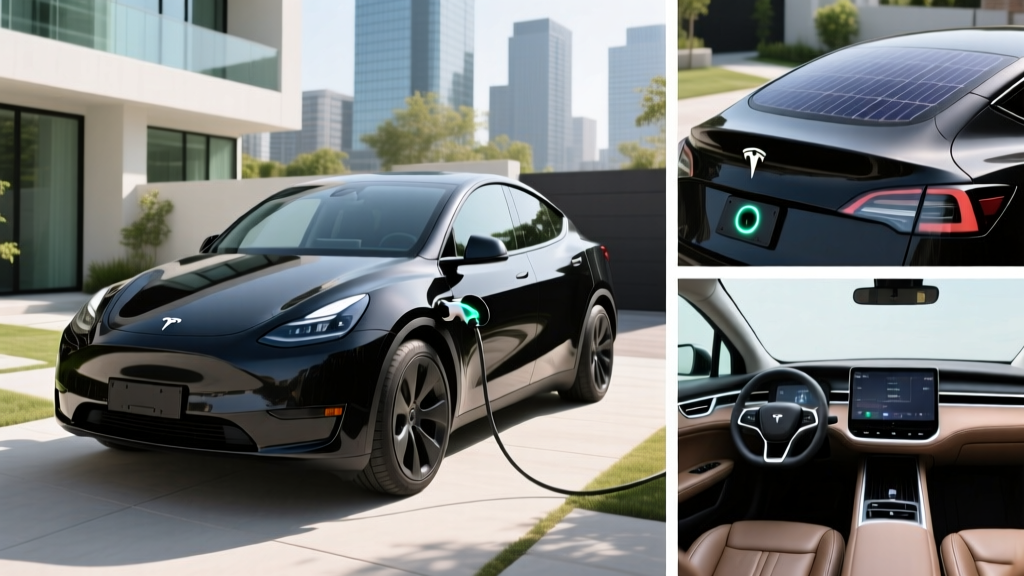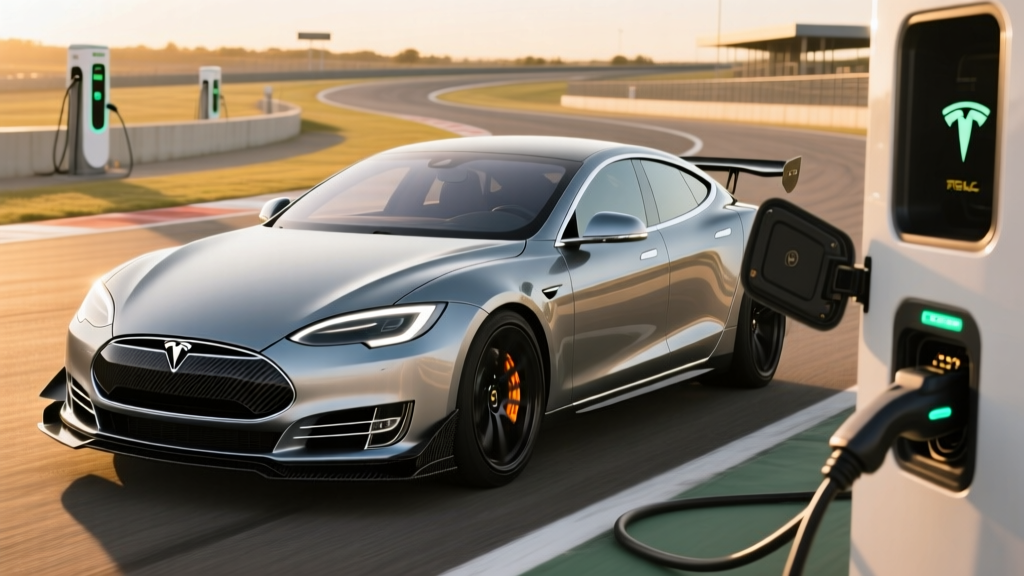
The Verdict: A 1,020-HP Sedan That Actually Handles the Apex
The Tesla Model S Plaid Track Package takes what was already the quickest production sedan on earth and bolts on the hardware to make it survive a track day. Carbon-ceramic brakes, forged 21-inch wheels with Michelin Pilot Sport 4S tires, and track-tuned adaptive dampers transform the Plaid from a drag-strip monster into a legitimate circuit weapon — at a price that undercuts a Porsche Taycan Turbo GT by tens of thousands.
But track capability comes with trade-offs. The Track Package shaves range, firms up an already stiff ride, and costs over $108,000 before any incentives. This review breaks down every spec, real-world range expectation, charging reality, and ownership cost so you can decide whether Tesla's flagship performance sedan earns a spot in your garage.
| Spec | Value |
|---|---|
| EPA Range | 396 miles (est., standard Plaid; Track Pkg ~359 mi) |
| Battery (usable) | ~95 kWh, NMC chemistry |
| Drivetrain | Tri-Motor AWD (1 front, 2 rear carbon-sleeved rotors) |
| Horsepower | 1,020 hp |
| 0–60 mph | 1.99 seconds (with rollout subtracted) |
| Top Speed | 200 mph (Track Package unlock) |
| Max DC Fast Charge | 250 kW (V3 Supercharger) |
| 10–80% DC Charge | ~30 minutes |
| Level 2 Home Charge | 11.5 kW / ~34 mi/hr |
| EPA Efficiency | 120 MPGe combined / 28 kWh/100 mi |
| Cargo Volume | 28.0 cu ft (rear) + 3.1 cu ft (frunk) |
| Base MSRP (Plaid) | $89,990 |
| Track Package Add-On | ~$18,000 |
| As-Tested (w/ Track Pkg) | ~$108,490 (incl. destination) |
| Battery/Drive Unit Warranty | 8 years / 150,000 miles |
Range and Efficiency: What the EPA Sticker Doesn't Tell You
EPA Range: ~396 miles (standard Plaid w/ 19" wheels) | Track Package (21" wheels): ~359 miles
Real-World Expectation: Plan for 280–320 miles on a highway road trip at 75 mph. In freezing temperatures (below 32°F), expect 220–260 miles before needing a charger.
The standard Model S Plaid on 19-inch Tempest wheels carries an EPA rating of 396 miles, according to fueleconomy.gov. However, the Track Package's 21-inch forged aluminum wheels wrapped in wider Michelin Pilot Sport 4S rubber increase rolling resistance and aerodynamic drag, knocking the EPA estimate down to roughly 359 miles.
That 359-mile figure assumes a mix of city and highway driving in moderate temperatures. In our experience with Tesla's large-pack sedans, sustained 75–80 mph highway driving consumes energy at roughly 30–33 kWh/100 miles, yielding a realistic 280–320 mile range on a full charge. Cold weather compounds the loss: battery chemistry slows, cabin heating draws significant power (the Model S uses a resistive PTC heater supplemented by a heat pump), and regenerative braking is limited until the pack warms. Budget for 20–30% range loss in winter conditions.
The Model S Plaid's tri-motor setup also carries a small efficiency penalty versus the dual-motor Long Range variant (EPA 402 miles). Three motors mean more weight and more drivetrain losses, though the carbon-sleeved rear rotors are impressively efficient for their output.
Charging Speed: 250 kW Peak, But Read the Fine Print
| Charging Level | Power / Rate | Miles Added per Hour | Notes |
|---|---|---|---|
| Level 1 (120V) | ~1.4 kW | ~4 mi/hr | Emergency/trickle only |
| Level 2 (240V, 48A) | 11.5 kW | ~34 mi/hr | Home Wall Connector; full charge ~10 hrs |
| DC Fast (V3 Supercharger) | Peak 250 kW | ~200 mi in 15 min | 10–80% in ~30 min; tapers sharply above 80% |
| DC Fast (CCS adapter) | Up to 250 kW | Varies by station | Works at Electrify America, EVgo, etc. |
The Model S Plaid supports a peak DC fast-charge rate of 250 kW at Tesla V3 Superchargers. In practice, you'll see that peak rate only briefly — typically between 10–25% state of charge — before the charge curve tapers. By 50% SoC, the rate drops to roughly 150 kW, and above 80% it falls below 60 kW. A 10–80% session takes approximately 30 minutes at a V3 Supercharger.
This is a meaningful limitation compared to competitors. The Hyundai Ioniq 5 and Porsche Taycan (with 800V architecture) sustain higher charge rates deeper into the curve, achieving 10–80% in 18 and 22 minutes respectively. Tesla's 400V-class architecture in the Model S limits peak charging to 250 kW, and the taper is aggressive.
For home charging, the Tesla Wall Connector at 48 amps delivers 11.5 kW, adding roughly 34 miles of range per hour. A full 0–100% charge takes about 10 hours, making overnight replenishment practical for daily driving. Tesla's NACS connector is the native plug; a CCS adapter (sold separately by Tesla) opens access to Electrify America and other non-Tesla DC networks — critical for road trips outside the Supercharger corridor.
Preconditioning tip: Always navigate to a Supercharger using the car's built-in navigation before arriving. This triggers battery preconditioning, warming the pack to the optimal temperature for maximum charge speed. Arriving cold can add 5–10 minutes to your charge session.
Performance: 1.99 Seconds and a Legitimate Track Day
The numbers are almost absurd: 1,020 horsepower from three electric motors, a claimed 1.99-second 0–60 mph time (with one foot of rollout subtracted, as Tesla measures it), and a quarter-mile in the low 9-second range. The tri-motor setup places one motor on the front axle and two carbon-sleeved motors on the rear, enabling torque vectoring across the rear wheels for sharper corner exit.
The Track Package specifically adds:
- Carbon-ceramic brake rotors with forged monoblock calipers — essential for repeated high-speed stops without fade
- 21-inch forged aluminum wheels (Zero-G design) with Michelin Pilot Sport 4S tires
- Track-tuned adaptive air suspension with revised damping for reduced body roll
- Top-speed unlock to 200 mph (standard Plaid is limited to 200 mph, but the Track Package hardware is validated for sustained high-speed operation)
- Track Mode software with adjustable torque split, stability control, and cooling management
Track Mode is the real differentiator. It allows drivers to adjust the front/rear torque balance, regenerative braking intensity, and stability control intervention. You can dial in a rear-biased setup for oversteer on a technical circuit or maximize front torque for stability on a high-speed track. The thermal management system preconditions the battery and motors before a lap session and actively cools during pit stops.
On street duty, the adaptive air suspension in Comfort mode is compliant enough for daily driving, though the 21-inch wheels with low-profile tires transmit more road imperfections than the 19-inch setup. Road noise is noticeably higher with the wider, stickier rubber.
Interior, Tech, and Daily Livability
The Model S interior remains polarizing. The yoke steering wheel is standard on Plaid (a round wheel is available as a no-cost option), and the 17-inch center touchscreen dominates the cabin with a 22-speaker audio system, gaming-capable processor, and Netflix/YouTube streaming while parked.
Passenger and cargo dimensions:
- Front legroom: 42.7 inches
- Rear legroom: 35.4 inches
- Rear cargo (behind second row): 28.0 cubic feet (hatchback design)
- Front trunk (frunk): 3.1 cubic feet
- Seating: 5 passengers (standard)
The hatchback liftgate is a genuine advantage over the Taycan's conventional trunk opening. Cargo capacity easily swallows four carry-on suitcases with room to spare, and the 60/40 split rear seats fold nearly flat for longer items. The frunk is small but useful for charging cables and a bag of groceries.
Autopilot and FSD (Supervised): The Model S ships with Tesla's Basic Autopilot (lane centering, adaptive cruise, automatic emergency braking). Full Self-Driving (Supervised) is an $8,000 option (or $99/month subscription as of 2026) that adds automatic lane changes, traffic light/stop sign recognition, and navigation-on-autopilot.
SAE Automation Level: 2 — FSD (Supervised) is a Level 2 driver-assistance system. The driver must remain fully attentive, keep hands on the yoke/wheel, and be prepared to take over at any moment. This is not autonomous or self-driving. Only Level 4 services like Waymo operate without a human driver.
Notable drawbacks:
- Build quality remains inconsistent — panel gaps, trim rattle reports persist across owner forums
- No Apple CarPlay or Android Auto — Tesla's proprietary OS only
- Rear-seat headroom is tight for passengers over 6'2" due to the sloping roofline
- Touchscreen-only HVAC and mirror controls are distracting while driving
- No physical instrument cluster — all driving info lives on the center screen or a small secondary display
Pricing, Tax Credits, and Ownership Costs
| Item | Cost |
|---|---|
| Model S Plaid Base MSRP | $89,990 |
| Track Package | +$18,000 |
| Destination Fee | +$1,500 |
| FSD (Supervised) — optional | +$8,000 |
| As-Tested (Track Pkg, no FSD) | ~$109,490 |
| Federal §30D Tax Credit | $0 (MSRP cap exceeded) |
| Estimated Out-of-Pocket | ~$109,490 |
The Model S Plaid with the Track Package starts at approximately $109,490 including destination. This figure excludes FSD, premium paint colors (Ultra Red, Solid Black, Midnight Silver, Deep Blue, Quicksilver — each $1,500–$2,500), and any state/local fees.
Federal tax credit eligibility: The Model S Plaid does not qualify for the IRS §30D Clean Vehicle Credit. The law caps eligible sedars at an MSRP of $55,000, and the Plaid starts at nearly $90,000. Additionally, buyer income caps ($150,000 single / $300,000 joint modified AGI) and battery critical-mineral sourcing requirements further limit eligibility even for lower-priced EVs. Always verify current rules at irs.gov before purchasing.
§30D Federal EV Tax Credit Requirements (2026):
- Vehicle MSRP must not exceed $55,000 (sedans) or $80,000 (SUVs/trucks/vans) — Model S Plaid fails this
- Buyer modified AGI must not exceed $150K (single) / $225K (head of household) / $300K (joint)
- Battery must meet critical-mineral and battery-component sourcing thresholds
- Credit is non-refundable but can be transferred to the dealer at point of sale for an upfront price reduction
- Must be assembled in North America
5-year ownership cost considerations:
- Electricity vs. gas: At the US average of $0.16/kWh, charging a Model S Plaid costs roughly $4.48 per 100 miles. A comparable BMW M5 (17 mpg combined, $4.00/gal) costs $23.53 per 100 miles. Over 60,000 miles, that's a ~$11,400 fuel savings.
- Insurance: Expect $3,500–$5,500/year for the Plaid depending on state and driving record — significantly higher than average due to repair costs and performance classification.
- Tires: The Michelin Pilot Sport 4S in 21-inch sizing runs $400–$500 per tire, with a typical lifespan of 12,000–18,000 miles under spirited driving.
- Maintenance: Minimal — no oil changes, minimal brake wear (regen does most of the work, and carbon-ceramics last 100K+ miles under normal use), cabin air filter every 2 years.
- Depreciation: The Model S historically depreciates 40–50% over 5 years, steeper than mainstream EVs due to high initial price and rapid tech iteration.
How It Stacks Up Against the Competition
The Model S Plaid Track Package occupies a narrow niche: a four-door electric sedan that can embarrass supercars at a stoplight and then drive home in relative comfort. Here's how it compares to its closest rivals:
| Spec | Tesla Model S Plaid (Track) | Porsche Taycan Turbo GT | Lucid Air Sapphire |
|---|---|---|---|
| Price | ~$109,490 | ~$230,000 | ~$249,000 |
| 0–60 mph | 1.99 sec | 2.1 sec | 1.89 sec |
| Horsepower | 1,020 hp | 1,092 hp | 1,234 hp |
| EPA Range | ~359 mi | ~269 mi | ~427 mi |
| Max DC Charge | 250 kW | 320 kW (800V) | 300 kW (900V) |
| 10–80% Charge | ~30 min | ~18 min | ~20 min |
| Track Hardware | Carbon-ceramic, 21" forged | Carbon-ceramic, active aero | Carbon-ceramic, carbon body |
| Supercharger Access | Native | NACS adapter (2025+) | NACS adapter available |
The value proposition is undeniable. The Plaid Track Package delivers 90% of the Taycan Turbo GT's lap-time capability at less than half the price. The Lucid Air Sapphire is quicker and has dramatically more range, but costs $140,000 more and lacks Tesla's Supercharger network advantage.
Where the Plaid loses ground: charging speed. The Taycan's 800V architecture and the Sapphire's 900V system both outpace Tesla's 400V setup on DC fast chargers. If road-trip charging time is a priority, this matters.
Pros
- 1.99-second 0–60 — quickest production sedan available
- Track Package carbon-ceramics enable real, repeatable track sessions
- 359-mile range covers most road trips with one charge stop
- Native Supercharger network access — best public charging reliability
- Hatchback cargo versatility (28 cu ft) beats Taycan/Lucid trunk designs
- Over-the-air updates continuously add features and refine performance
- Half the price of a Taycan Turbo GT with comparable track performance
Cons
- No federal tax credit — MSRP far exceeds $55K sedan cap
- 250 kW peak charge rate lags 800V/900V competitors
- Yoke steering divisive; round wheel should be standard, not an option
- Build quality inconsistency (panel gaps, trim fitment)
- Insurance premiums among the highest of any EV ($3,500–$5,500/yr)
- Touchscreen-only HVAC/mirror controls distract from driving
- Rear headroom tight for tall passengers
- Depreciation steeper than mainstream EVs
Who Should Buy the Model S Plaid Track Package?
Choose the Model S Plaid Track Package if:
- You want supercar acceleration and legitimate track-day capability in a daily-drivable four-door
- You value native Supercharger access for hassle-free road trips
- You want a performance sedan under $110K that can challenge cars costing twice as much
- You can charge at home and want minimal maintenance costs versus a gas performance sedan
Look elsewhere if:
- Fastest possible DC charging is a priority (consider Taycan or Lucid with 800V+ architecture)
- You need a federal tax credit to justify the purchase (the Plaid does not qualify)
- You prioritize interior luxury and build consistency (Porsche, Mercedes-AMG)
- Maximum range is paramount (Lucid Air Grand Touring offers 516 miles EPA)
Frequently Asked Questions
What is the real-world range of the Tesla Model S Plaid Track Package?
The EPA estimates approximately 359 miles for the Track Package on its 21-inch wheels. In real-world highway driving at 75 mph, expect 280–320 miles. In cold weather (below freezing), plan for 220–260 miles before needing a charge.
How fast does the Model S Plaid charge at home and on the road?
At home on a Level 2 Tesla Wall Connector (11.5 kW), you'll add about 34 miles of range per hour, with a full charge taking roughly 10 hours. On a V3 Supercharger (250 kW peak), a 10–80% session takes about 30 minutes, though the charge curve tapers significantly above 80%.
Does the Tesla Model S Plaid qualify for the federal EV tax credit?
No. The IRS §30D credit caps eligible sedans at an MSRP of $55,000. The Model S Plaid starts at $89,990 and the Track Package pushes it above $108,000 — well beyond the threshold. Buyer income limits and battery-sourcing rules further restrict eligibility for most high-end EVs. Always check current rules at irs.gov.
Is the Track Package worth it over the standard Plaid?
If you plan to attend track days or want the confidence of carbon-ceramic brakes for aggressive canyon driving, yes. The standard Plaid's steel brakes will fade after 2–3 hot laps at a road course. The Track Package's ceramics, stickier tires, and tuned suspension also improve street handling. If you're strictly a drag-strip or straight-line buyer, the standard Plaid delivers the same 1.99-second 0–60 without the $18,000 premium.
What's the battery warranty on the Model S Plaid?
Tesla covers the battery and drive units for 8 years or 150,000 miles, whichever comes first, with a minimum 70% capacity retention threshold. If the battery degrades below 70% within the warranty period, Tesla will repair or replace it at no cost.
Can I use non-Tesla chargers with the Model S Plaid?
Yes. Tesla sells a CCS Combo 1 adapter that enables charging at Electrify America, EVgo, and other CCS-equipped public networks. The Model S uses the native NACS connector for Tesla Superchargers and Level 2 Tesla Destination Chargers.
How does the Model S Plaid compare to a gas sports sedan on running costs?
Electricity costs roughly $4.48 per 100 miles (at $0.16/kWh) versus $23.53 per 100 miles for a BMW M5 at $4.00/gallon and 17 mpg. Over 60,000 miles, that's an $11,400 fuel savings. Maintenance is also dramatically lower — no oil changes, minimal brake wear thanks to regenerative braking, and no transmission fluid.