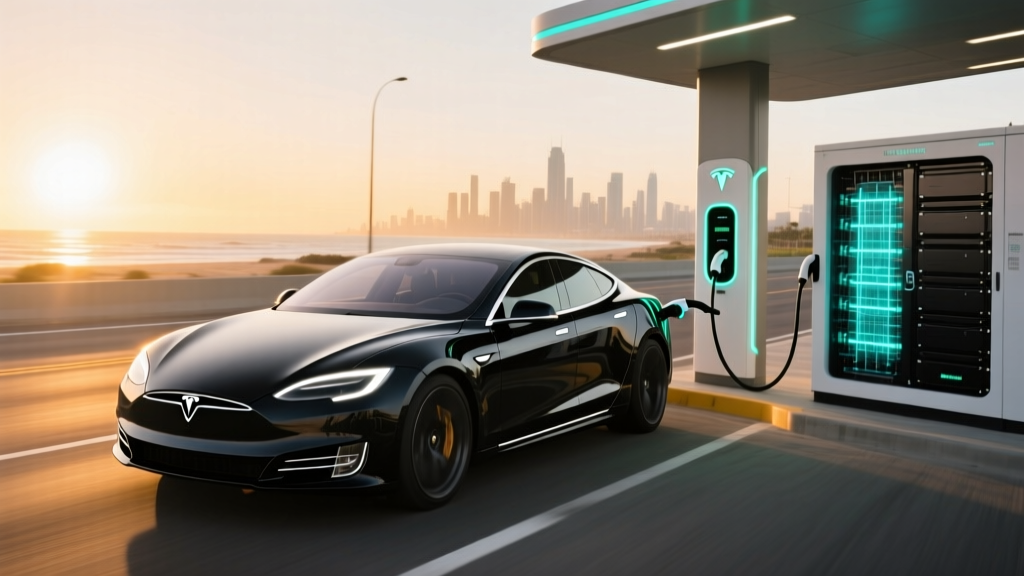
The Tesla Model S Plaid occupies a strange space in the electric-vehicle market: a four-door sedan that hits 60 mph in under two seconds while offering over 350 miles of range and a usable back seat. For buyers researching Tesla Plaid specs, the headline numbers are staggering — 1,020 horsepower, a tri-motor all-wheel-drive layout, and a 9.4-second quarter mile. But supercar performance is only half the story. This review digs into the real-world ownership experience: actual highway range, charging-curve behavior, interior practicality, and whether the Plaid justifies its premium over the already rapid Model S Long Range.
Core Tesla Plaid Specs at a Glance
| Specification | 2026 Model S Plaid |
|---|---|
| EPA Range | 396 mi (19" wheels) / 359 mi (21" wheels) |
| Battery Capacity | ~100 kWh usable (NMC chemistry) |
| Drivetrain | Tri-Motor AWD (1 front, 2 rear carbon-sleeved rotors) |
| Horsepower | 1,020 hp (peak) |
| 0-60 mph | 1.99 seconds (with rollout subtracted) |
| Top Speed | 200 mph |
| Max DC Fast Charge | 250 kW (peak) |
| 10-80% DC Charge Time | ~30 minutes |
| Level 2 Home Charge | 11.5 kW / 48A (~41 mi/hr) |
| EPA Efficiency | 116 MPGe combined / 29 kWh/100 mi |
| Cargo Volume | 28 cu ft (rear trunk + frunk combined) |
| Base MSRP | $89,990 (before incentives) |
| Battery Warranty | 8 years / 150,000 miles (70% retention) |
Real-World Range: What the EPA Number Doesn't Tell You
The 396-mile EPA figure for the Model S Plaid on 19-inch Tempest wheels is among the highest of any performance EV on the market. According to fueleconomy.gov, the Plaid achieves 116 MPGe combined. But EPA testing uses a specific drive-cycle blend that doesn't fully capture sustained highway speeds or extreme temperatures.
In independent real-world highway testing at a steady 70 mph in 65-75°F conditions, the Plaid typically delivers between 310 and 340 miles before reaching a 5% state of charge. The 100 kWh (usable) NMC battery pack provides substantial buffer, but the tri-motor powertrain's energy appetite at high speed is meaningful — you'll see consumption around 29-32 kWh/100 mi on the highway versus the EPA's 29 kWh/100 mi combined rating.
Cold weather compounds this. At 20°F with cabin heating active, highway range drops to roughly 260-290 miles. The Model S Plaid's heat pump is standard and significantly more efficient than resistive heating, but any EV loses 20-30% of range in deep cold. Preconditioning the battery while plugged in mitigates some of this loss and is critical for preserving fast-charge speeds in winter.
Charging Speed and the 250 kW Curve Reality
The Model S Plaid peaks at 250 kW on a V3 Tesla Supercharger (or any CCS-compatible DC fast charger using Tesla's adapter). However, peak kW is not sustained kW — a distinction every EV buyer should understand. The Plaid's charging curve looks roughly like this:
| State of Charge | Approx. Power | Miles Added in 15 Min |
|---|---|---|
| 10-30% | 220-250 kW | ~120-130 mi |
| 30-50% | 175-220 kW | ~95-110 mi |
| 50-80% | 100-175 kW | ~70-90 mi |
| 80-100% | 30-75 kW | Significantly slower |
A 10-80% session takes approximately 30 minutes under ideal conditions (warm battery, V3 Supercharger). Tesla claims up to 200 miles of range in 15 minutes, which is achievable if you arrive at a low state of charge with a preconditioned battery. Above 80%, charging slows dramatically to protect the NMC cells — plan your road-trip stops around 10-80% windows for maximum efficiency.
For home charging, the Model S Plaid accepts up to 11.5 kW (48 amps) on a Level 2 Wall Connector using a 60-amp circuit. This delivers roughly 41 miles of range per hour of charging, meaning a full overnight charge from 20% to 80% takes about 7-8 hours. Installation of a 240V/60A circuit typically costs $800-$2,000 depending on panel proximity and local permit requirements — consult a licensed electrician for your specific setup.
Performance: The Numbers Behind 1,020 Horsepower
The Plaid's tri-motor layout places one permanent-magnet motor on the front axle and two carbon-sleeved induction motors on the rear axle. The carbon-fiber rotor sleeves allow these motors to spin to 20,000+ RPM without expanding and contacting the stator — engineering that enables the 200 mph top speed and the relentless acceleration.
The 1.99-second 0-60 mph time (Tesla's figure, measured with a one-foot rollout subtracted, as is drag-racing convention) makes the Model S Plaid one of the quickest production cars ever built. In independent testing by outlets like Motor Trend and Car and Driver, the Plaid consistently delivers 2.1-2.3 second 0-60 times without rollout — still astonishing for a 4,766-pound sedan.
Beyond straight-line speed, the Plaid's torque-vectoring rear motors provide active yaw control, making the car feel smaller than its dimensions suggest. Track mode allows adjustable front/rear torque distribution, and the standard adaptive air suspension lowers the car at speed for reduced drag. The 10.2-inch ground clearance at standard ride height drops to roughly 6.5 inches in Low mode.
Pricing, Trims, and Federal Tax Credit Eligibility
The 2026 Tesla Model S Plaid carries a base MSRP of $89,990 (including destination). A fully optioned example with 21-inch Arachnid wheels ($4,500), Full Self-Driving (Supervised) capability ($8,000), and premium interior colors can approach $102,000-$105,000.
Here's where the tax credit situation requires careful attention. Under current IRS §30D rules, the Model S Plaid does NOT qualify for the $7,500 federal EV tax credit because its MSRP exceeds the $55,000 sedan cap established by the Inflation Reduction Act. The Model S is classified as a sedan (not an SUV/van/pickup, which have an $80,000 cap), so even the base Long Range variant at $74,990 is above the threshold.
| Item | Amount |
|---|---|
| Base MSRP (Plaid) | $89,990 |
| Federal §30D Tax Credit | $0 (exceeds $55K sedan MSRP cap) |
| Estimated State Incentives | Varies — check local programs |
| Effective Starting Price | $89,990 + tax/registration |
For buyers seeking a Tesla with federal credit eligibility, the Model 3 and Model Y (in qualifying trims and configurations) are the options to explore. Always verify current-year eligibility on IRS.gov and consult a tax professional — rules around battery sourcing, critical minerals, and buyer income caps ($300K joint / $150K single MAGI) change periodically.
Interior, Cargo, and Daily Practicality
The Model S Plaid's interior is minimalist in the way only Tesla can execute — a 17-inch center touchscreen (tilting, 2200x1300 resolution), a 12.3-inch driver display, and a rear 8-inch screen for passengers. The yoke steering wheel is standard, though a round wheel is available at no cost if you prefer traditional inputs. Build quality on the refreshed Model S has improved significantly over pre-2021 models, with better panel gaps and material quality.
Practicality is surprisingly strong for a performance sedan:
- Rear legroom: 35.4 inches — adequate for adults on longer trips
- Trunk (rear liftback): 26.3 cu ft — larger than most midsize sedans thanks to the hatchback design
- Front trunk (frunk): ~2.0 cu ft — enough for charging cables and a small bag
- Combined cargo: ~28 cu ft (seats up), expandable with 60/40 rear fold
- Towing: Not rated for towing (unlike Model X or Cybertruck)
The 17-inch screen runs Tesla's latest software with navigation, streaming (Netflix/YouTube while parked), and a surprisingly capable gaming system. Wireless phone charging, heated and ventilated front seats, heated rear seats, and a 22-speaker audio system are all standard.
Driver Assistance: Autopilot and FSD (Supervised)
Standard Autopilot includes Traffic-Aware Cruise Control and Autosteer (lane centering on marked highways). The optional FSD (Supervised) package ($8,000 or $99/month) adds automatic lane changes, Navigate on Autopilot (highway interchange handling), Autopark, Summon, and traffic light/stop sign recognition. As of 2026, FSD remains a supervised system — impressive for reducing highway fatigue, but not a replacement for an attentive driver.
Safety ratings from NHTSA give the Model S a 5-Star Overall rating, and the vehicle's low center of gravity contributes to exceptional rollover resistance.
Pros and Cons: The Honest Verdict
Pros
- Supercar-rivaling 1.99s 0-60 with four doors and a trunk
- 396-mile EPA range — genuine road-trip capability
- Access to the Supercharger network (250 kW V3 + expanding V4)
- Over-the-air updates continuously improve the vehicle
- Class-leading infotainment and software integration
- Strong resale value relative to luxury EV competitors
Cons
- No federal tax credit (MSRP exceeds $55K sedan cap)
- 250 kW peak charge rate trails 800V competitors (Porsche Taycan at 320 kW, Hyundai Ioniq 5 at 240 kW but with a lighter pack)
- Yoke steering is polarizing and not ideal for low-speed maneuvering
- No Apple CarPlay or Android Auto — Tesla-only ecosystem
- Insurance premiums run 20-40% higher than comparable luxury sedans
- Touchscreen-dependent climate/media controls can distract while driving
Who Should Buy the Tesla Model S Plaid?
The Plaid is best suited for performance-oriented drivers who also need daily usability. If you want a car that can run sub-10-second quarter miles on Saturday and comfortably commute 60 miles round-trip on Monday — all while carrying four adults and their luggage — the Plaid has no direct equal. Road-trippers will appreciate the 396-mile range and Supercharger access, making 500-mile days feasible with a single 25-minute stop.
However, if your priorities lean more toward maximum luxury and ride comfort over raw performance, the Porsche Taycan Turbo S, Mercedes-AMG EQS, or even the Tesla Model S Long Range (which offers similar range and still hits 60 in 3.1 seconds at $15,000 less) may be better fits. If tax credit eligibility is a dealbreaker, the Model S Plaid simply doesn't qualify, and you should look at the Model 3 Performance or Model Y Performance instead.
Frequently Asked Questions
What is the real-world range of the Tesla Model S Plaid?
Expect 310-340 miles on the highway in mild weather, and 260-290 miles in cold conditions (below 32°F). The 396-mile EPA rating reflects a mixed city/highway cycle; sustained 75 mph driving consumes more energy per mile. City driving with regenerative braking can actually approach or exceed the EPA number.
How fast does the Model S Plaid charge at home and on the road?
On a 250 kW DC fast charger, the Plaid adds up to 200 miles in 15 minutes (at low SoC with a preconditioned battery), with a full 10-80% session taking about 30 minutes. At home on a Level 2 Wall Connector (11.5 kW / 48A), you gain approximately 41 miles per hour, easily replenishing daily driving overnight.
Does the Tesla Model S Plaid qualify for the $7,500 federal EV tax credit?
No. Under current IRS §30D rules, the Model S Plaid's $89,990 MSRP exceeds the $55,000 cap for sedans. The vehicle would need to be classified as an SUV, van, or pickup (which have an $80,000 cap) to potentially qualify. Always verify current rules at IRS.gov.
Is the Model S Plaid worth buying over the Porsche Taycan Turbo S?
It depends on priorities. The Plaid wins on range (396 vs ~280 mi EPA), price (~$90K vs ~$190K), and software/tech. The Taycan Turbo S wins on 800V charging architecture (320 kW peak), interior luxury, steering feel, and build quality. If range and value matter most, the Plaid. If driving dynamics and luxury are paramount, the Taycan.
How long will the Model S Plaid battery last?
Tesla warranties the battery for 8 years or 150,000 miles, whichever comes first, with at least 70% capacity retention. Real-world data from high-mileage Model S owners suggests NMC packs in Tesla's thermally managed systems typically retain 85-90% capacity at 100,000 miles. Full battery replacement (out of warranty) currently costs approximately $15,000-$22,000 including labor.
Can I use non-Tesla chargers with the Model S Plaid?
Yes. The Model S Plaid uses Tesla's NACS (North American Charging Standard) connector natively. With Tesla's CCS adapter (included with newer vehicles, available for purchase for older ones), you can also use Electrify America, EVgo, and other CCS-equipped networks. The expanding Supercharger network now also serves non-Tesla EVs, but as a Tesla owner, you retain full native access.