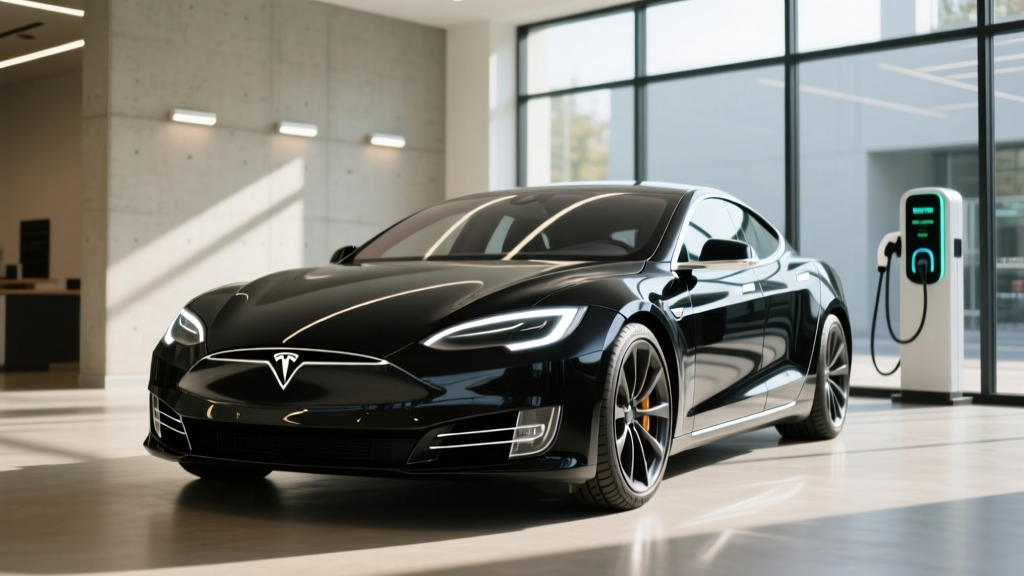
If you've searched "how much is the Tesla Plaid" expecting a simple sticker price, you're about to get the full financial and engineering picture. The 2026 Tesla Model S Plaid remains the benchmark for four-door electric performance, but its six-figure as-tested reality, tax-credit ineligibility, and real-world range quirks demand a thorough breakdown before you put down a deposit.
Below, we cover every number that matters: MSRP by trim, federal tax credit status, EPA versus real-world range, DC fast-charge curves, and how it stacks up against the Lucid Air Sapphire and Porsche Taycan Turbo GT. No marketing fluff — just the data you need to decide.
2026 Tesla Model S Plaid: Core Specifications
| Spec | Value |
|---|---|
| Base MSRP | $89,990 (excl. destination) |
| As-Tested Price (typical) | $97,490–$101,990 |
| EPA Range | 396 miles (19" wheels) / 359 miles (21" wheels) |
| Battery Capacity | ~100 kWh usable (NMC chemistry) |
| Drivetrain | Tri-Motor AWD |
| Horsepower | 1,020 HP |
| 0–60 mph | 1.99 seconds (with rollout) |
| Top Speed | 200 mph (with track package) |
| Max DC Fast Charge | 250 kW (peak) |
| 10–80% DC Charge Time | ~28 minutes |
| Level 2 Home Charge Rate | 11.5 kW (~41 mi/hr) |
| MPGe (combined) | 116 MPGe |
| Efficiency | 29 kWh/100 mi |
| Cargo Volume | 28 cu ft (rear) + ~5 cu ft (frunk) |
| Battery Warranty | 8 years / 150,000 miles (70% retention) |
| Federal Tax Credit (§30D) | Not eligible (MSRP exceeds $55,000 sedan cap) |
Pricing Breakdown: How Much Does the Tesla Plaid Actually Cost?
The headline number is $89,990 for the 2026 Model S Plaid before Tesla's $1,390 destination fee. But almost no Plaid leaves the factory at base price. Here's what typical options do to the bottom line:
| Line Item | Cost |
|---|---|
| Model S Plaid Base MSRP | $89,990 |
| Destination Fee | $1,390 |
| 21" Arachnid Wheels (range drops to 359 mi) | $4,500 |
| Full Self-Driving (Supervised) | $8,000 |
| Yoke Steering Wheel (no-cost option) | $0 |
| Ultra Red or Midnight Cherry Premium Paint | $2,500 |
| Typical As-Tested Total | $97,880–$106,380 |
| Federal §30D Tax Credit | $0 (MSRP exceeds $55K sedan cap) |
| Estimated State Credits (varies) | $0–$2,000 |
Tax credit reality check: Under IRS §30D rules, new electric sedans must have an MSRP at or below $55,000 to qualify for the up-to-$7,500 federal credit. The Model S Plaid, at nearly $90,000, is categorically ineligible. There are also buyer income caps ($150K single / $300K joint filers) and battery critical-mineral sourcing requirements — none of which matter here because the MSRP cap disqualifies it immediately. Always verify current rules at IRS.gov and consult a tax professional before purchasing. Some states offer separate rebates or HOV-lane access that can partially offset the cost; check your state's energy office for specifics.
Range & Efficiency: EPA Sticker vs. Real World
Tesla rates the Model S Plaid at 396 miles EPA on 19-inch Tempest wheels and 359 miles on the optional 21-inch Arachnid wheels. That's among the highest EPA figures of any performance sedan sold today.
Real-World Range Expectations
EPA Rating: 396 mi (19") / 359 mi (21")
Highway (70 mph, 75°F): ~310–340 mi on 19" wheels. The tri-motor Plaid is heavier and less aero-efficient at speed than the dual-motor Long Range, so highway efficiency drops noticeably.
Cold Weather (20°F, highway): Expect 240–280 mi. NMC batteries lose 25–35% of usable capacity in freezing temps without consistent preconditioning. The Plaid's heat pump helps, but physics wins.
Mixed Commute (city + suburban): ~350–380 mi. Regenerative braking in stop-and-go traffic recovers energy the highway run wastes.
Efficiency comes in at 116 MPGe combined (29 kWh per 100 miles) according to fueleconomy.gov. For context, the dual-motor Model S Long Range achieves 122 MPGe — the Plaid's third motor and higher output carry a small efficiency penalty.
Charging Speed: DC Fast Charge and Home Level 2
The Model S Plaid uses Tesla's NACS connector natively and accesses the Supercharger network — still the most reliable DC fast-charging ecosystem in the US. Here's what charging actually looks like:
| Charging Level | Power / Rate | Time / Miles Added |
|---|---|---|
| Level 1 (120V standard outlet) | ~1.4 kW | ~4–5 mi/hr (overnight trickle only) |
| Level 2 (240V home, 48A Wall Connector) | 11.5 kW | ~41 mi/hr; full charge in ~9.5 hrs |
| DC Fast Charge (V3 Supercharger, peak) | 250 kW | 10–80% in ~28 min; ~200 mi in 15 min |
| DC Fast Charge (CCS adapter at Electrify America) | Up to 250 kW | Similar to V3 SC; adapter required (sold separately ~$250) |
Charging curve reality: The Plaid peaks at 250 kW only at low state of charge (below ~30% SoC) and warm battery temps. Above 50% SoC, the curve tapers to ~100 kW, and above 80% it drops to under 40 kW. This is why Tesla (and every other manufacturer) quotes 10–80% times — the final 20% takes almost as long as the first 60%. For road trips, plan stops at 10–80% and skip the temptation to top off to 100% unless it's your final destination.
For home charging, Tesla's Gen 2 Wall Connector on a 60A circuit delivers 11.5 kW (48A continuous). That's roughly 41 miles of range per hour of charging — more than enough to replenish a full day's driving overnight. A typical professional installation runs $800–$2,000 depending on panel proximity and local permitting. If your home has a 200A panel with spare capacity, installation is straightforward; older 100A panels may require an upgrade ($1,500–$3,000+).
Performance: 1,020 HP and the 1.99-Second Claim
The tri-motor powertrain (one front, two rear) produces 1,020 horsepower and launches the Plaid to 60 mph in a claimed 1.99 seconds (with a 1-foot rollout, as is drag-strip convention). Independent testing by outlets like Motor Trend has verified 0–60 times in the 2.1–2.3 second range without rollout — still absurdly quick and firmly supercar territory from a four-door sedan.
The Plaid uses torque vectoring across its three motors for cornering agility that belies its 4,766-pound curb weight. Track Mode allows adjustable front/rear torque distribution, and the carbon-ceramic brake option (included with the Track Package) provides fade-free stopping power during repeated hot laps. Top speed is electronically limited to 175 mph standard or 200 mph with the Track Package ($15,000 option, which also includes the carbon-ceramic brakes and specific suspension tuning).
Drawback: The Plaid's performance envelope is so extreme that public roads can't legally accommodate it. Most owners will experience maybe 5% of this car's capability. If you're buying purely for straight-line thrills, the dual-motor Long Range (3.1s to 60) costs $15,000 less and is more than fast enough for any real-world scenario.
Interior, Tech & Daily Livability
The Model S interior is minimalist by design: a 17-inch center touchscreen handles nearly all vehicle functions (including glovebox release and glovebox, mirrors, and vent direction). A 12.3-inch driver display sits behind the yoke-or-round steering wheel, and an 8-inch rear-seat screen handles rear climate and entertainment.
Space: Front legroom is generous at 42.7 inches. Rear legroom (35.4 inches) is adequate for adults but tighter than a Lucid Air or Mercedes EQS. Cargo volume is 28 cubic feet behind the rear seats (with a 60/40 split fold) plus approximately 5 cubic feet in the front trunk (frunk). Total storage with seats folded is competitive with midsize luxury crossovers.
Driver assistance: Every Plaid ships with Basic Autopilot (lane centering + adaptive cruise). The optional Full Self-Driving (Supervised) package ($8,000) adds automatic lane changes, traffic light/stop sign recognition, and Navigate on Autopilot. This is an SAE Level 2 system — you must keep your hands on the wheel and eyes on the road at all times. Tesla's FSD is not autonomous driving and should not be treated as such.
Notable drawbacks:
- No physical buttons for climate, volume, or drive-mode selection — everything routes through the screen
- Build quality, while improved, still shows occasional panel-gap inconsistency compared to Porsche or Lucid
- Rear-seat comfort is good but not limousine-grade; the Lucid Air and Mercedes EQS offer more rear luxury
- The yoke steering wheel requires an adjustment period and can be awkward during low-speed parking maneuvers
Pros
- Sub-2-second 0–60 capability; tri-motor AWD grip is phenomenal
- 396-mile EPA range (19" wheels) is best-in-class for performance sedans
- Access to Tesla Supercharger network — still the gold standard for road-trip charging
- OTA updates continuously add features and refine performance
- Hatchback/liftback design provides genuinely useful cargo space
- Low center of gravity and torque vectoring deliver real handling precision
Cons
- $89,990+ MSRP means zero federal tax credit eligibility
- Touchscreen-only controls frustrate some drivers (no volume knob, no physical climate buttons)
- Real-world highway range drops to ~310–340 mi; cold weather compounds the loss
- Rear seat comfort and materials trail Lucid Air and German luxury rivals
- 250 kW peak DC charge rate is outpaced by Hyundai/Kia's 800V architecture (350 kW capable)
- Insurance premiums run 20–40% higher than comparable luxury sedans
Model S Plaid vs. Lucid Air Sapphire vs. Porsche Taycan Turbo GT
At this price point, the Plaid faces serious competition. Here's how the key numbers compare:
| Spec | Tesla Model S Plaid | Lucid Air Sapphire | Porsche Taycan Turbo GT |
|---|---|---|---|
| Base MSRP | $89,990 | $249,000 | $233,400 |
| HP | 1,020 | 1,234 | 1,019 (w/ Launch Control) |
| 0–60 mph | 1.99s | 1.89s | 2.1s |
| EPA Range | 396 mi | 427 mi | 269 mi |
| Max DC Charge | 250 kW | 300 kW | 320 kW |
| Federal Tax Credit | No | No | No |
The takeaway: The Lucid Air Sapphire is faster and has more range, but costs $160,000 more — it's a different market tier entirely. The Porsche Taycan Turbo GT offers superior build quality, chassis tuning, and a more engaging analog driving feel, but sacrifices nearly 130 miles of range and costs 2.5x more. The Model S Plaid's real advantage is value: nothing else delivers 1,000+ HP and nearly 400 miles of range under $100,000.
Warranty & Long-Term Ownership
Tesla covers the Model S Plaid's battery and drive units for 8 years or 150,000 miles, whichever comes first, with a guaranteed minimum 70% capacity retention. The basic vehicle limited warranty is 4 years / 50,000 miles.
The Plaid uses an NMC (nickel manganese cobalt) battery pack. NMC offers higher energy density than LFP (lithium iron phosphate) chemistry, which is why Tesla uses it in long-range and performance models. The trade-off is slightly faster degradation and a recommendation to keep daily charge limits at 80–90% rather than 100% (unlike LFP packs, which Tesla recommends charging to 100% regularly).
Battery replacement cost, if needed out of warranty, is estimated at $18,000–$25,000 for the Plaid's pack. However, Tesla's degradation data across the fleet shows an average of ~12% capacity loss at 200,000 miles — meaning most packs will outlast the car's useful life. Monitor your State of Health (SoH) through the Tesla app's battery health section.
Who Should Buy the Tesla Model S Plaid?
The Plaid is right for you if:
- You want supercar performance in a practical four-door sedan with real cargo space
- You road-trip frequently and value the Supercharger network's reliability
- You're comfortable spending $95,000–$105,000 as-tested with no federal tax credit offset
- You want 350+ miles of range without stepping into $200K+ hypercar territory
Look elsewhere if:
- You need maximum rear-seat comfort for chauffeured use (consider Lucid Air Grand Touring or Mercedes EQS)
- You want to qualify for the $7,500 federal tax credit (no sedan over $55K MSRP qualifies)
- You prioritize tactile, analog driving feel over digital performance (Porsche Taycan is your answer)
- You live in a region with limited Supercharger access and need CCS-native fast charging
Frequently Asked Questions
Does the Tesla Model S Plaid qualify for the federal EV tax credit?
No. Under IRS §30D rules, new electric sedans must have an MSRP of $55,000 or less to qualify for the up-to-$7,500 clean vehicle credit. The Model S Plaid starts at $89,990, making it categorically ineligible regardless of buyer income or battery sourcing. Always confirm current rules at IRS.gov.
What is the real-world range of the Tesla Model S Plaid?
EPA-rated at 396 miles (19" wheels), expect approximately 310–340 miles in real-world highway driving at 70 mph in mild weather. In freezing temperatures (below 32°F), highway range can drop to 240–280 miles despite the heat pump. City and mixed driving with regenerative braking yields results closer to the EPA figure, around 350–380 miles.
How fast does the Tesla Plaid charge at home and on the road?
At home on a 240V/48A Tesla Wall Connector, the Plaid charges at 11.5 kW, adding about 41 miles of range per hour (a full charge takes ~9.5 hours). On a V3 Supercharger, it peaks at 250 kW and charges from 10–80% in approximately 28 minutes. Above 80% SoC, charging speed tapers significantly — plan road-trip stops around the 10–80% window for efficiency.
Is the Tesla Model S Plaid worth it versus the Lucid Air or Porsche Taycan?
If your budget is under $100,000 and you want 1,000+ HP with nearly 400 miles of range, the Plaid has no direct rival at its price. The Lucid Air Sapphire is faster and longer-ranged but costs $249,000. The Porsche Taycan Turbo GT offers superior build quality and driving dynamics but costs $233,400 and has only 269 miles of EPA range. The Plaid's unique value proposition is extreme performance per dollar — if you can accept the touchscreen-centric interior and no federal tax credit.
What battery does the Tesla Plaid use, and how long will it last?
The Model S Plaid uses an NMC (nickel manganese cobalt) lithium-ion battery pack of approximately 100 kWh usable capacity. Tesla warranties it for 8 years or 150,000 miles with a minimum 70% capacity retention guarantee. Fleet data suggests average degradation of roughly 12% at 200,000 miles. For longevity, Tesla recommends daily charging to 80–90% for NMC packs, reserving 100% charges for road trips.
Is Full Self-Driving included with the Model S Plaid?
No. Basic Autopilot (adaptive cruise + lane centering) is included. Full Self-Driving (Supervised) is an $8,000 add-on. FSD is an SAE Level 2 driver-assistance system — it requires active driver supervision at all times and is not autonomous or self-driving. The driver remains legally responsible for vehicle operation.
Sources: EPA range and efficiency data via fueleconomy.gov; pricing and specifications from Tesla's official configurator; federal tax credit rules from IRS.gov §30D. State incentives vary by jurisdiction — consult your state energy office for current programs. This review reflects 2026 model-year data and is subject to change as Tesla updates pricing and specifications.