The Tesla Model S Plaid occupies a strange space in the EV world: a four-door luxury sedan that can embarrass supercars at the drag strip while still delivering over 350 miles of real-world range. Its headline achievement remains its Nürburgring Nordschleife lap time — a benchmark that signals serious chassis and thermal engineering, not just straight-line speed. But for buyers spending six figures, the track record is only part of the equation. Range, charging speed, daily usability, and total cost of ownership matter just as much.
This review covers the 2026 Tesla Model S Plaid in full: the Nürburgring record context, EPA and real-world range, DC fast-charging behavior, battery chemistry, interior space, Autopilot capabilities, pricing with federal tax credit implications, and how it stacks up against the Porsche Taycan Turbo GT and Lucid Air Sapphire.
Tesla Plaid Nürburgring Time: What the Record Actually Means
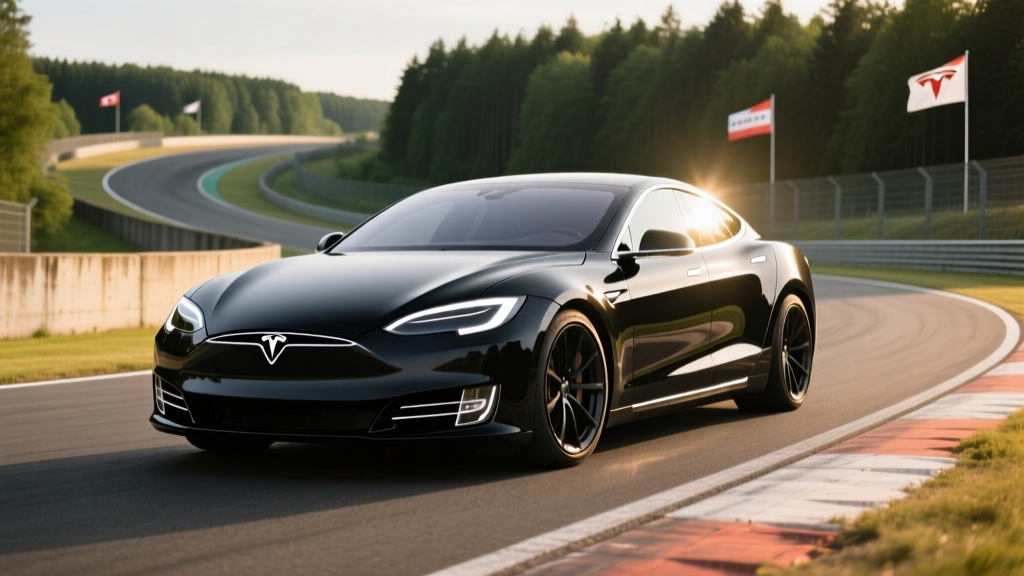
In June 2021, Tesla set a production-sedan lap record at the Nürburgring Nordschleife with the Model S Plaid, clocking 7:35.579 on the full 20.8 km layout. In 2023, Tesla returned with a track-pack-equipped Plaid and posted a 7:25.231, reclaiming the sedan crown from the Porsche Taycan Turbo GT. These times matter because the Nordschleife is a brutal test of sustained thermal management — not just peak power.
Hitting 7:25 on the Ring requires the battery pack, motors, and inverters to handle roughly 1,020 horsepower through 73 corners and 1,000+ feet of elevation change without derating. Many EVs lose power after a single hard lap due to battery overheating. The Plaid's carbon-sleeved tri-motor setup and active thermal management system allow it to sustain near-peak output for the full 12.9-mile circuit — a feat that separates it from most performance EVs.
Range, Efficiency, and Battery Specs
The 2026 Model S Plaid carries a ~100 kWh usable battery pack (approximately 95 kWh usable out of ~100 kWh gross) using NMC (nickel manganese cobalt) chemistry. Tesla has not switched the Plaid to LFP — the energy density of NMC is necessary to hit both the 396-mile EPA target and the 1,020-hp output simultaneously.
| Spec | Value |
|---|---|
| EPA Range | 396 miles |
| Battery (usable / gross) | ~95 kWh / ~100 kWh, NMC |
| EPA Efficiency | 120 MPGe combined (28 kWh/100 mi) |
| Drivetrain | Tri-motor AWD |
| Horsepower | 1,020 hp |
| 0–60 mph | 1.99 seconds (with rollout) |
| Top Speed | 200 mph |
| Max DC Fast Charge | 250 kW (V3 Supercharger) |
| 10–80% DC Time | ~30 minutes |
| Level 2 Home Charging | 11.5 kW (~34 mi/hr at 48A) |
| Cargo Volume | 28 cu ft (rear seats up) + 3.1 cu ft frunk |
| Base MSRP | $89,990 |
| Battery Warranty | 8 years / 150,000 miles |
At 28 kWh per 100 miles, the Plaid is less efficient than the dual-motor Model S Long Range (which achieves 402 miles on a similar pack thanks to lower mass and output). The tri-motor setup adds roughly 200 lbs and requires more energy to cool, but the trade-off is the performance envelope.
Charging Speed: DC Fast and Home Level 2
The Model S Plaid charges at a maximum of 250 kW on Tesla V3 Superchargers using the native NACS connector. On a preconditioned battery (the car automatically heats or cools the pack when you navigate to a Supercharger), the charge curve looks like this:
| Charging Level | Power | Miles Added / Hour | Notes |
|---|---|---|---|
| Level 1 (120V) | ~1.4 kW | ~3–4 mi/hr | Emergency only |
| Level 2 (240V, 48A) | 11.5 kW | ~34 mi/hr | Full overnight charge in ~9 hrs |
| DC Fast (V3 Supercharger) | 250 kW peak | ~200 mi in 15 min | 10–80% in ~30 min |
| DC Fast (CCS adapter) | ~150–200 kW | Varies | Requires Tesla CCS adapter |
The charge curve peaks near 250 kW from roughly 5% to 30% State of Charge, then tapers progressively. From 80% to 100%, charging slows dramatically to protect the NMC cells — expect the final 20% to take as long as the first 60%. For road trips, the practical strategy is charging from 10% to 80% and driving on.
Home charging at 11.5 kW (48 amps on a 60-amp circuit with the Tesla Wall Connector) adds roughly 34 miles of range per hour. A full 0–100% charge takes about 9 hours — perfectly suited for overnight charging on a standard Level 2 installation. Note that the onboard charger limits AC intake to 11.5 kW; installing a higher-amperage circuit won't speed up Level 2 charging beyond this ceiling.
Performance: Tri-Motor Powertrain and Driving Dynamics
The Plaid's tri-motor layout places one motor on the front axle and two on the rear, with torque vectoring across the rear wheels. The result is 1,020 horsepower and a manufacturer-claimed 0–60 mph time of 1.99 seconds (with 1-foot rollout subtracted, as is industry convention for drag-strip times). Independent testing by outlets like Motor Trend and Car and Driver has confirmed 0–60 times in the 2.1–2.3 second range without rollout — still among the quickest production cars ever measured.
Beyond straight-line speed, the Plaid's adaptive air suspension and torque-vectoring rear axle give it genuine cornering composure. The steering is quick but somewhat numb — a common Tesla trait — and the ~4,766-lb curb weight is noticeable during direction changes. On the Nürburgring, the Plaid's grip comes from massive Michelin Pilot Sport 4S tires (265/35R21 front, 295/30R21 rear) and a low center of gravity from the floor-mounted battery pack.
The carbon-sleeved rotors in the Plaid's motors are a key engineering detail: they allow the motors to spin to 20,000+ RPM without the carbon fiber sleeve expanding and separating from the rotor at high centrifugal loads. This enables sustained top-end power that conventional motors can't match.
Interior, Tech, and Daily Usability
The Model S interior centers on a 17-inch landscape-oriented touchscreen that handles virtually all vehicle controls. A second 8-inch screen serves rear passengers, and a 12.3-inch instrument cluster sits ahead of the yoke-style steering wheel (a conventional round wheel is available at no extra charge).
Cargo and passenger space:
- Rear cargo: 28 cu ft (seats up), expanding to ~58 cu ft with the 60/40 split rear seats folded
- Front trunk (frunk): 3.1 cu ft — enough for a charging cable bag and a small backpack
- Front legroom: 42.7 inches
- Rear legroom: 35.4 inches — adequate for adults but tighter than the Lucid Air
- Seating: 5 passengers (bench rear seat standard)
The infotainment system includes Netflix, YouTube, and a full web browser (while parked), plus a 22-speaker audio system with active noise cancellation. Gaming performance on the built-in processor rivals a PlayStation 5 for in-car entertainment during charging stops.
Driver assistance: The Plaid comes with Tesla's Basic Autopilot (adaptive cruise, lane centering, automatic emergency braking). Full Self-Driving (Supervised) is a $8,000 add-on that enables automatic lane changes, traffic-light recognition, and city-street navigation.
Pricing, Tax Credit Eligibility, and Ownership Costs
The 2026 Tesla Model S Plaid starts at $89,990 (MSRP, before destination). Common configurations with FSD, Ultra Red paint, and 21-inch wheels push the as-tested price to $100,000–$105,000.
| Item | Details |
|---|---|
| Base MSRP | $89,990 |
| As-Tested (typical config) | $99,990–$105,000 |
| Federal §30D Tax Credit | Does NOT qualify — MSRP exceeds the $55,000 sedan cap |
| State Incentives | Varies — check your state's EV rebate program |
| Estimated Annual Charging Cost | ~$600–$900 (12,000 mi/yr, $0.15/kWh avg) |
Federal tax credit status: Under IRS §30D rules, new electric sedans must have an MSRP at or below $55,000 to qualify for the up-to-$7,500 federal tax credit. The Model S Plaid at $89,990 far exceeds this cap. Additionally, buyer income caps apply ($150,000 single / $300,000 joint for modified AGI). The Plaid does not qualify for the new-vehicle credit regardless of buyer income. See current rules at IRS.gov.
The battery and drive unit warranty covers 8 years or 150,000 miles (whichever comes first), with a minimum 70% capacity retention guarantee. Tesla's basic vehicle limited warranty covers 4 years / 50,000 miles.
Tesla Model S Plaid vs. Porsche Taycan Turbo GT vs. Lucid Air Sapphire
The Plaid's closest rivals are the Porsche Taycan Turbo GT and the Lucid Air Sapphire. Here's how they compare on the numbers that matter:
| Spec | Tesla Model S Plaid | Porsche Taycan Turbo GT | Lucid Air Sapphire |
|---|---|---|---|
| Price | $89,990 | ~$230,000 | $249,000 |
| Horsepower | 1,020 hp | 1,092 hp (Launch Control) | 1,234 hp |
| 0–60 mph | 1.99s | 2.1s | 1.89s |
| EPA Range | 396 mi | ~269 mi | 427 mi |
| Max DC Charge | 250 kW | 320 kW | 300+ kW |
| Nürburgring Time | 7:25.231 | 7:07.55 | Not published |
| Cargo (rear + frunk) | 28 + 3.1 cu ft | 14.3 + 2.9 cu ft | 22.1 + 10.1 cu ft |
- You want sub-2-second 0–60 for under $100K
- 396 miles of EPA range is a priority for road trips
- You rely on the Tesla Supercharger network
- You want OTA updates and cutting-edge infotainment
- Track-focused chassis feel matters most (Porsche Taycan Turbo GT)
- You need 427+ miles of range and rear-seat luxury (Lucid Air Sapphire)
- Build quality and panel gaps are a top concern
- You prefer a traditional dealer service network
Pros, Cons, and Who Should Buy the Plaid
- 1,020 hp and 1.99s 0–60 at a relative bargain price
- 396-mile EPA range — longest of any performance sedan
- Access to Tesla's 6,000+ Supercharger network (NACS native)
- Class-leading cargo volume for a sedan (28 + 3.1 cu ft)
- Proven Nürburgring thermal management
- Continuous OTA software improvements
- No federal tax credit (exceeds $55K sedan MSRP cap)
- 250 kW max DC charge is slower than Porsche's 320 kW
- Yoke steering is polarizing (round wheel available)
- Panel gaps and interior fit/finish trail Porsche and Lucid
- Insurance premiums run $3,500–$5,500/year depending on region
- Rear legroom (35.4 in) is tight for a car in this price class
Who the Model S Plaid is best for: Performance enthusiasts who also need daily-driver range and practicality. If you want a car that can do a track day, a 350-mile road trip, and the school run — all without switching vehicles — the Plaid has no true equal at its price point. It's not the best luxury sedan interior, and it's not the sharpest track tool, but it's the best combination of speed, range, and charging infrastructure access available today.
Who should look elsewhere: Buyers prioritizing interior luxury and build quality (consider the Lucid Air Grand Touring or Porsche Taycan), those who need maximum rear-seat space for adults, or anyone counting on the federal tax credit to offset the purchase price.
Frequently Asked Questions
What is the Tesla Plaid's Nürburgring lap time?
The Tesla Model S Plaid set a 7:25.231 lap time on the Nürburgring Nordschleife (full 20.8 km layout) in 2023 with the track package. The original 2021 run was 7:35.579 on a stock Plaid. Both times are for production sedans.
What is the real-world range of the Model S Plaid?
The EPA rates it at 396 miles. Real-world highway driving at 70–75 mph in moderate weather yields approximately 320–350 miles. In cold weather (below freezing), expect 260–290 miles. City driving with regen braking can approach or exceed the EPA number.
How fast does the Model S Plaid charge?
On a Tesla V3 Supercharger (250 kW peak), the Plaid charges from 10–80% in approximately 30 minutes with a preconditioned battery. At home on a Level 2 Wall Connector (11.5 kW / 48A), it adds about 34 miles per hour, reaching a full charge overnight in roughly 9 hours.
Does the Model S Plaid qualify for the federal EV tax credit?
No. Under current IRS §30D rules, new electric sedans must have an MSRP at or below $55,000 to qualify. The Plaid starts at $89,990, well above this cap. Buyer income limits ($150K single / $300K joint) also apply to the credit. Check IRS.gov for the latest rules.
How does the Plaid compare to the Porsche Taycan Turbo GT on the Nürburgring?
The Porsche Taycan Turbo GT (with Weissach package) holds a faster time of 7:07.55. However, the Taycan Turbo GT starts at approximately $230,000 — more than 2.5× the Plaid's price — and offers significantly less EPA range (~269 miles vs. 396 miles).
What battery chemistry does the Plaid use, and how long will it last?
The Plaid uses NMC (nickel manganese cobalt) chemistry in a ~100 kWh pack. NMC offers high energy density necessary for the Plaid's range/power combination. Tesla's battery warranty guarantees at least 70% capacity retention for 8 years or 150,000 miles. Real-world data from high-mileage Teslas suggests 10–15% degradation over 100,000 miles is typical.
Is the Model S Plaid worth buying in 2026?
If you want a sub-$100K performance sedan with 396 miles of range, Supercharger access, and proven 1,020-hp thermal management, the Plaid remains the best value in its segment. The Taycan Turbo GT is a sharper track car, and the Lucid Air Sapphire is quicker with more range, but both cost over $230,000. For the money, the Plaid's combination of performance, range, and infrastructure is unmatched.