The Tesla Plaid motor architecture remains one of the most talked-about powertrain configurations in the electric vehicle world. Introduced with the refreshed Model S and later the Model X, Tesla's tri-motor "Plaid" setup pairs two rear axial-flux motors with a single front motor to deliver supercar-rivaling acceleration while maintaining the daily-driver practicality of a full-size luxury sedan. For 2026, the Model S Plaid continues largely unchanged from its 2025 update, retaining the 1,020-horsepower output and the carbon-sleeved rotor technology that allows those rear motors to spin beyond 20,000 RPM without disintegrating under centrifugal force.
This review breaks down everything a prospective buyer needs to know about the Tesla Plaid motor system as it exists in the 2026 Model S Plaid — from real-world range and charging behavior to ownership economics and how it stacks up against the Lucid Air Sapphire and Porsche Taycan Turbo GT.
2026 Tesla Model S Plaid: Core Specifications
| Specification | 2026 Tesla Model S Plaid |
|---|---|
| Drivetrain | Tri-Motor AWD (1 front, 2 rear) |
| Horsepower | 1,020 hp |
| 0–60 mph | 1.99 seconds (with rollout subtraction) |
| Top Speed | 200 mph (with Track Pack) |
| Battery Capacity (usable) | ~95 kWh (NMC chemistry) |
| EPA Range | 396 miles (19" wheels) |
| Efficiency | 124 MPGe combined / 28 kWh/100 mi |
| Max DC Fast Charge | 250 kW (V3 Supercharger) |
| 10–80% DC Charge Time | ~27 minutes |
| Level 2 Home Charge Rate | 11.5 kW (~34 mi/hr) |
| Cargo Volume | 28 cu ft (rear) + 3.1 cu ft (frunk) |
| Base MSRP | $89,990 |
| Federal Tax Credit (§30D) | Not eligible (MSRP & sourcing) |
| Battery Warranty | 8 years / 150,000 miles |
Real-World Range: Beyond the EPA Sticker
Real-World Highway (70–75 mph, mild weather): ~310–340 miles
Cold Weather (below 32°F, mixed driving): ~260–290 miles
Track/Aggressive Driving: Significantly reduced — expect 150–200 miles depending on intensity
The EPA's 396-mile figure for the Model S Plaid on 19-inch wheels is genuinely impressive for a 1,020-hp vehicle, but real-world results tell a more nuanced story. The tri-motor Plaid powertrain carries a weight and efficiency penalty compared to the dual-motor Long Range variant (which achieves up to 402 miles EPA). During steady-state highway cruising at 70–75 mph in moderate temperatures, owners consistently report 310–340 miles of usable range before needing to stop.
The NMC (nickel manganese cobalt) battery pack's ~95 kWh of usable capacity provides a substantial buffer, but the physics of pushing a 4,766-lb sedan at highway speeds with three electric motors drawing current means efficiency drops to roughly 30–32 kWh/100 mi on the interstate. In winter conditions, battery preconditioning helps mitigate some losses when navigating to a Supercharger, but ambient cold still reduces effective range by 20–30%. The Model S Plaid does include a heat pump for cabin and battery thermal management, which improves cold-weather efficiency over older resistive-heater setups.
If you opt for the 21-inch Arachnid wheels, the EPA figure drops to 359 miles, and real-world highway range typically lands in the 270–310 mile window. The larger wheels add unsprung weight and increase rolling resistance — a meaningful trade for the aesthetic and cornering grip they provide.
The Tesla Plaid Motor: Tri-Motor Architecture Explained
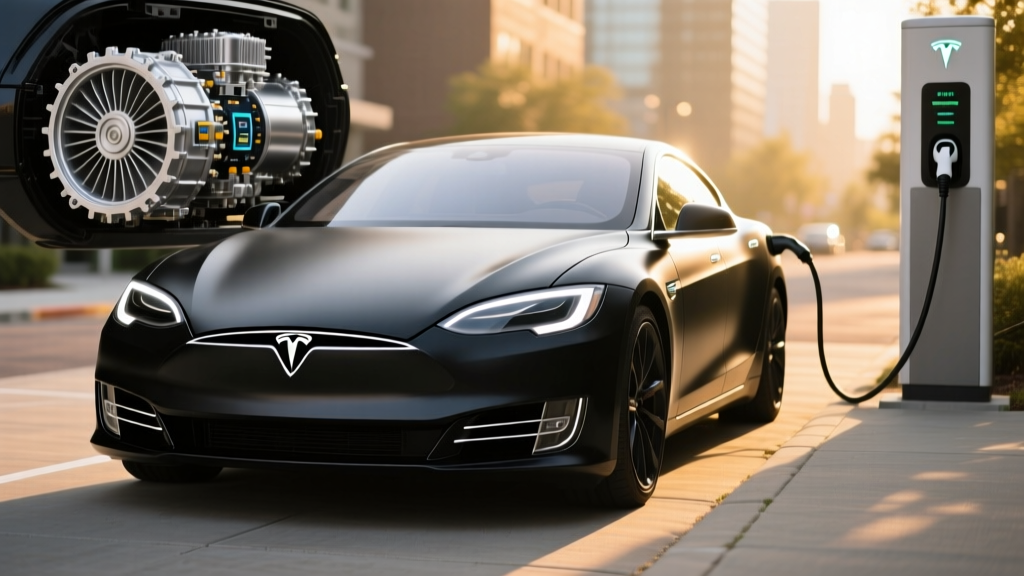
What makes the Tesla Plaid motor system distinct from conventional dual-motor EV setups is the use of carbon-fiber-sleeved rotors in the two rear motors. Traditional electric motor rotors are constrained by centrifugal limits — spin them too fast and the laminations physically separate. Tesla's carbon-sleeve design wraps the rotor in a high-strength carbon fiber shell, enabling sustained RPMs above 20,000 without structural failure.
The result is a powertrain that can deliver peak power well into the vehicle's speed range, not just off the line. Most dual-motor EVs experience a noticeable power taper above 80–90 mph as the motors approach their RPM ceiling. The Plaid's rear motors continue to pull hard past 130 mph, which is why the Model S Plaid can achieve a 1/4-mile time of 9.23 seconds and a verified top speed of 200 mph (when equipped with the optional Track Package that includes carbon-ceramic brakes and specific suspension tuning).
The front motor operates independently, providing torque vectoring and all-wheel-drive traction. During hard launches, Tesla's software coordinates all three motors to optimize grip — sending torque fore and aft in milliseconds based on wheel-slip data. The system also enables "torque sleep" on the front motor during light-load highway cruising, effectively operating as a rear-drive car to improve efficiency when full AWD traction isn't needed.
Charging Speed: DC Fast Charge and Home Level 2
| Charging Level | Power / Rate | Estimated Speed |
|---|---|---|
| Level 1 (120V standard outlet) | ~1.4 kW | ~4 miles per hour |
| Level 2 (240V, 48A Wall Connector) | 11.5 kW | ~34 miles per hour |
| DC Fast Charge (V3 Supercharger) | Peak 250 kW | 10–80% in ~27 minutes |
| DC Fast Charge (400V CCS adapter at third-party stations) | Up to 250 kW (station-dependent) | Varies; typically 150–200 kW sustained |
The Model S Plaid charges at a peak rate of 250 kW on Tesla's V3 Supercharger network. In practice, this peak is sustained only between approximately 10–30% State of Charge (SoC). Beyond 50%, the charge curve tapers noticeably, and above 80%, charging slows to roughly 40–60 kW to protect the NMC cells from excessive heat and lithium plating. A typical 10–80% session takes about 27 minutes under optimal conditions (battery preconditioned via on-route navigation to a Supercharger).
For home charging, Tesla's Gen 3 Wall Connector on a 60-amp circuit delivers up to 11.5 kW (48 amps continuous). This adds roughly 34 miles of range per hour, meaning a full 0–100% charge takes approximately 9–10 hours — easily accomplished overnight. Buyers should budget $800–$2,000 for professional installation of a 240V/60A circuit, depending on panel proximity and local permit requirements. If your home's electrical panel is maxed out at 100 amps, a panel upgrade to 200 amps can add $1,500–$3,000 to the total. Always consult a licensed electrician for a site-specific assessment.
One practical note: the Model S Plaid uses the NACS (North American Charging Standard) connector natively, which in 2026 means seamless access to Tesla's Supercharger network and a growing number of third-party stations that have adopted NACS. For older CCS-equipped public chargers, Tesla provides a CCS adapter (sold separately, ~$250), though availability at those stations may be limited as the industry transitions.
Pricing, Tax Credit Eligibility, and Ownership Costs
| Cost Factor | Amount |
|---|---|
| Base MSRP (Model S Plaid) | $89,990 |
| Destination Fee | $1,390 |
| FSD (Supervised) Add-On | $8,000 (or $99/mo subscription) |
| Track Package | ~$15,000 (carbon-ceramic brakes, 21" wheels) |
| Typical As-Tested Price | $99,000–$114,000 |
| Federal §30D Tax Credit | $0 — MSRP exceeds $55,000 sedan cap; battery sourcing may not meet critical-mineral requirements |
| Estimated 5-Year Insurance | $18,000–$24,000 (varies by state/driver) |
| Estimated 5-Year Electricity Cost (15,000 mi/yr) | $4,500–$6,000 (at $0.14/kWh avg) |
The 2026 Model S Plaid starts at $89,990 before destination, placing it well above the IRS §30D federal tax credit's MSRP cap of $55,000 for sedans. Even setting aside the price cap, the Model S Plaid's battery sourcing and critical-mineral supply chain have not consistently met the IRS §30D requirements for the full $7,500 credit. In short: do not expect a federal tax credit on this vehicle. State-level incentives may apply depending on your jurisdiction — check your state's EV rebate program for specifics.
Insurance is a significant ownership cost for the Plaid. Given its 1,020-hp output and $90,000+ replacement value, annual premiums typically range from $3,600 to $4,800 depending on the driver's profile, location, and coverage levels. Some owners report savings through Tesla's own insurance program, which uses real-time driving data to calculate premiums, though availability varies by state.
On the fuel-cost side, the Model S Plaid's efficiency of roughly 28–32 kWh/100 mi means that at the U.S. average residential electricity rate of ~$0.16/kWh (as of early 2026, per EIA data), you'll spend approximately $4.50–$5.10 per 100 miles on home charging. That compares favorably to a 15-mpg performance sedan on $3.50/gallon gas ($23.33 per 100 miles). Public DC fast charging at $0.35–$0.48/kWh raises the cost to $10–$15 per 100 miles — still a substantial savings over gasoline.
Interior, Tech, and Daily Usability
The Model S Plaid's cabin is defined by its 17-inch landscape-oriented touchscreen running Tesla's proprietary infotainment OS. The interface handles navigation, media, climate controls, vehicle settings, and gaming (the Plaid can run titles like Cyberpunk 2077 at respectable frame rates while parked). A secondary 8-inch screen for rear passengers controls rear climate, seat heaters, and media playback.
The yoke-style steering wheel remains standard on the Plaid (a conventional round wheel is available as a no-cost option). Opinion on the yoke remains split: proponents cite improved forward visibility and a race-car feel; critics note its impracticality during low-speed maneuvers like three-point turns or parking-lot hairpins. Tesla has not added variable-ratio steering that would mitigate this, so the yoke debate continues.
Passenger space is generous for a sport sedan. Front legroom measures 42.4 inches, and rear legroom comes in at 35.4 inches — adequate for adults on moderate-length trips but tighter than the Lucid Air's limousine-like 37.8 inches of rear space. Cargo capacity totals 28 cubic feet behind the rear seats (with a wide hatchback opening) plus 3.1 cubic feet in the front trunk (frunk), giving the Model S Plaid practical versatility that pure sports cars can't match.
On the driver-assistance front, the Model S Plaid comes standard with Tesla's Autopilot suite (Traffic-Aware Cruise Control, Autosteer lane-keeping). Full Self-Driving (Supervised) is available as an $8,000 option or $99/month subscription.
How It Compares: Model S Plaid vs. Key Rivals
The Model S Plaid occupies a rare intersection of extreme performance, long range, and relative value (a 1,020-hp car for under $100K is historically unprecedented). Its closest competitors in 2026 include:
- Lucid Air Sapphire — 1,234 hp, 427-mi EPA range, $249,000. Far more expensive but offers even more power and range with a more luxurious interior.
- Porsche Taycan Turbo GT — 1,019 hp (launch control), 269-mi EPA range, $230,000+. Superior chassis dynamics and build quality, but shorter range and over twice the price.
- BMW i7 M70 — 650 hp, 295-mi EPA range, $168,000. More traditional luxury sedan experience, less performance-focused.
Against this group, the Model S Plaid's advantage is clear: it delivers 90%+ of the performance for 40–60% of the price. The trade-offs are interior material quality (Tesla's cabin still uses more hard plastics than Porsche or Lucid), the yoke controversy, and the absence of a federal tax credit.
- 1.99-sec 0–60 mph is hypercar territory at a sedan price
- 396-mi EPA range (19" wheels) among the longest of any performance EV
- Access to Tesla's Supercharger network — the most reliable DC fast-charging ecosystem
- Over-the-air updates continuously add features
- 28 cu ft cargo + frunk for daily practicality
- Heat pump for improved cold-weather efficiency
- No federal tax credit eligibility (MSRP cap + sourcing)
- Insurance premiums are steep ($3,600–$4,800+/year)
- Yoke steering is polarizing and impractical at low speeds
- Interior materials lag behind Lucid/Porsche at this price point
- 250 kW peak charge rate trails Hyundai/Kia's 800V architectures (350 kW)
- Rear seat space is adequate but not limousine-level
Warranty and Long-Term Battery Durability
Tesla covers the Model S Plaid's battery and drive unit with an 8-year / 150,000-mile warranty (whichever comes first), with a minimum 70% capacity retention guarantee over that period. The limited vehicle warranty runs 4 years / 50,000 miles.
The NMC chemistry in the Plaid's pack offers high energy density but is generally more sensitive to sustained high-SoC storage and repeated DC fast charging than LFP (lithium iron phosphate) cells. Tesla's battery management system actively manages cell temperature and limits charge/discharge extremes, but owners who plan to keep the car 150,000+ miles should follow best practices: charge to 80–90% for daily use, minimize repeated 100% charges, and rely on home Level 2 charging rather than exclusively using DC fast chargers.
Real-world degradation data from high-mileage Model S owners suggests approximately 10–12% capacity loss at 100,000 miles, which would leave a Plaid with roughly 350 miles of range at that milestone — still highly usable. Full battery-pack replacement (out of warranty) currently runs $20,000–$25,000 based on Tesla service center estimates, though prices have been trending downward as battery manufacturing scales.
Who Should Buy the 2026 Tesla Model S Plaid?
- You want hypercar acceleration (sub-2-sec 0–60) without sacrificing daily-driver range and practicality
- You regularly take road trips and value Supercharger network access
- You want a 4-door sedan with legitimate cargo space and a frunk
- You're comfortable with Tesla's minimalist interior philosophy and touchscreen-centric controls
- You prioritize traditional luxury materials and tactile controls (consider Lucid Air Grand Touring or Porsche Taycan)
- You need maximum rear-seat space for tall adult passengers regularly
- Federal tax credit eligibility is important to your purchase math
- You want the absolute fastest DC charging available (Hyundai Ioniq 5 N or Kia EV6 GT at 350 kW)
Frequently Asked Questions
What is the real-world range of the Tesla Model S Plaid?
The EPA rates the Model S Plaid at 396 miles on 19-inch wheels and 359 miles on 21-inch wheels. In real-world highway driving at 70–75 mph in moderate temperatures, expect 310–340 miles. In cold weather (below freezing), plan for 260–290 miles of usable range. Aggressive or track driving reduces range dramatically to 150–200 miles.
How fast does the Tesla Plaid motor charge?
On a V3 Supercharger, the Plaid peaks at 250 kW and charges from 10–80% in approximately 27 minutes. At home on a 240V/48A Wall Connector (Level 2), it charges at 11.5 kW, adding about 34 miles of range per hour — a full charge takes roughly 9–10 hours overnight.
Does the 2026 Tesla Model S Plaid qualify for the federal EV tax credit?
No. The IRS §30D tax credit caps sedan eligibility at $55,000 MSRP, and the Model S Plaid starts at $89,990. Additionally, the vehicle's battery sourcing may not satisfy the critical-mineral and battery-component requirements. Always verify current eligibility on the IRS qualified vehicles list.
Is the Model S Plaid worth buying vs. the Lucid Air Sapphire?
It depends on budget and priorities. The Sapphire offers more power (1,234 hp), more range (427 mi EPA), and a more luxurious cabin — but at $249,000, it costs nearly three times as much. The Model S Plaid delivers the vast majority of the performance for a fraction of the price. If budget is no object, the Sapphire is the more complete package. For most performance-EV buyers, the Plaid is the better value proposition.
What are the biggest pros and cons of the Plaid motor system?
Pros: unmatched acceleration for the price, sustained high-speed power delivery thanks to carbon-sleeved rotors, long EPA range for a 1,000+ hp vehicle, and Supercharger access. Cons: high insurance costs, no federal tax credit, 250 kW peak charge rate trails 800V competitors, and the NMC battery requires more careful long-term charging habits than LFP chemistry.
How reliable is the Tesla Plaid motor long-term?
The carbon-sleeved rotor design is engineered for extreme durability at high RPM, and Tesla's 8-year/150,000-mile powertrain warranty provides substantial coverage. Real-world data from early Plaid owners (2022–2025 models) has not revealed systemic motor failures, though the platform is still relatively young. As with any high-performance vehicle, maintenance of the cooling system and adherence to software update schedules are important for longevity.